Category: Big Thoughts
Sunday, Dec 27, 2020 | Adventure, Art, Big Thoughts, Blogging, Cartoons, Creativity course, Current events, Drawing, Dream, Fire, Fun, Lists, Lynda Barry, Manifest, Play, Space, Work, Writing |

Two years ago, I was preparing to teach the graphic-art-based creativity course at St. Jerome’s, which was really a class about developing an artistic practice, setting goals, and staying open to how a project may change and grow as it unfurls. There’s discipline, the verb, and discipline, the noun, and together they sustain an artistic practice. The hope is that the practice will hold and develop over a lifetime, unique and personal: a pathway into the flow, a mindset, a series of ever-renewing explorations that feed on curiosity and feed curiosity.
If all things flow, I can never step into the same river twice; yet I yearn to find ways to fix experience as it flies. That’s the paradox of being alive, existing inside these breathing time-stuck human bodies: how to occupy the liminal space between immersion and interpretation, how to dance between these ways of being in the world; liminality is what art emerges from, the desire for engagement mixed with the need for something more than preservation — for response, for improvisation, for metaphor, image, song. My practice(s) is a way to step into the river, and also a means of capturing what’s here to be found.
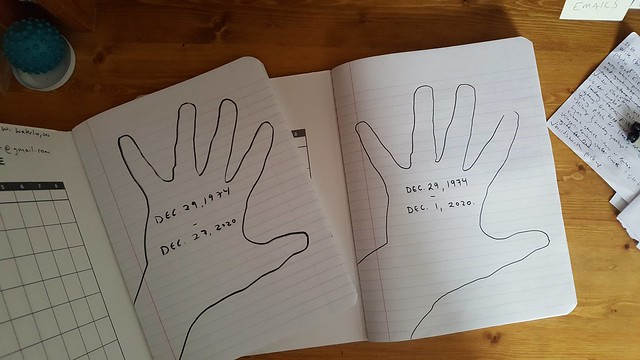
I started a new notebook this morning. To mark the first page of each new notebook, I trace my hand and write my birth date and today’s date, a ritual I learned in a Lynda Barry workshop. As I traced my hand this morning, using a brush rather than a pen, I thought: I love the artistic practices I’ve created. They are cobbled together from different times, teachers, discoveries, experiments, using different mediums, tools and technologies; and they do change as I change and adapt, but they are unique to me and durable.
I love writing by hand, even though I don’t always use it as a method of writing new material. There are easier ways to write, but some stories and reflections call out to be discovered by hand.
I love the playfulness of crayons, which I’m using in my current daily drawing project, begun on December 1st as a month-long trial, and which I’m considering continuing into January, maybe beyond. (I’m also considering scanning these cartoons + captions and posting them weekly on the blog; this will only work if it’s easy. That’s one of the principles of my personal practices, the ones that have stuck: they’re easy to maintain, the materials are easy to acquire, the technology is easy to access.)
I love my studio, this lively yet meditative space that I use daily, which is a retreat, a place I look forward to being in, comforting, cozy, tidy, organized, small, contained yet spacious (the high ceiling, the white walls).
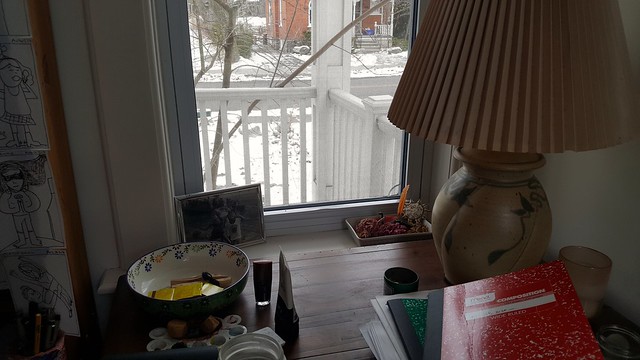
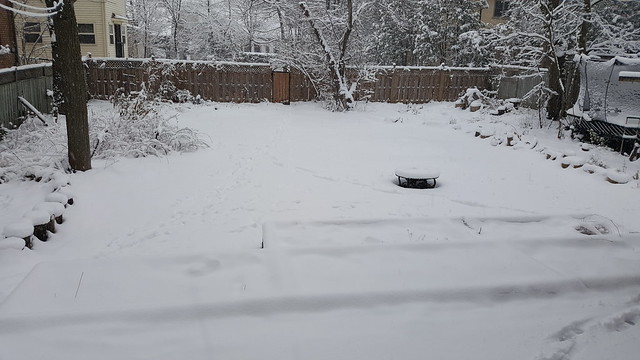
There isn’t much movement out there. We are locked down again in Ontario. There isn’t much movement anywhere, on any front, not in my own personal or professional life. But in this studio space, on the pages of these notebooks, there is movement. There is a river ever-flowing, into which I can step, and be transported.
And that is a gift.
My project ideas for 2020 have changed quite a bit; some came to fruition, others vanished almost as quickly as I’d conceived them. Now, I’m planning my projects for 2021, and looking forward to sketching out new ideas and goals on a fresh index card, and glueing 2020’s into this latest notebook. How will 2021’s projects grow, change, develop? Only time will tell. But they’ll exist, in nascent form, in ripening and in bloom, inside these notebooks, in crayon drawings, in pen, in Scrivener and Word files, and here, online. Sharing what I’m making is an important facet of my practice, too; thank you for being out there.
If you’ve got a moment, drop me a line or leave a comment and tell me about your artistic practices, what you’re doing right now to step into the river, both to enter the flow and to fix experience as it flies.
xo, Carrie
Monday, Dec 21, 2020 | Backyard, Big Thoughts, Blogging, Cartoons, Current events, Family, Fire, Friends, Holidays, Manifest, Meditation, Space, Spirit, Winter, Word of the Year |

Gratitude.
It is the shortest day of the year, the winter solstice, and my hair smells like bonfire smoke. I sat outside on the frozen ground from 4:30 – 7:30AM and watched the sky turn from dark to dim to pale grey dawn. Through my head came visions of friends, and the gratitude and love I’ve felt pouring into me and out of me all through these many months of pandemic otherworldliness, a circle of holding and care that has kept me not just afloat but enriched and comforted and stronger.
There are many ways to stay in touch, even from a distance. This year, I’ve quit Twitter and don’t seem to blog quite so often (perhaps you are surprised when a post drops into your email inbox). I rarely post to Facebook, more often check in on Instagram. Then, there are texts and emails. Occasionally a phone call (usually that’s my mom or dad). Even letters, cards, postcards (such a treat to receive!) And, of course, Zoom calls: sibs night, kundalini yoga, church.
There are walks with a friend, or a kid, or a dog, or the whole family.
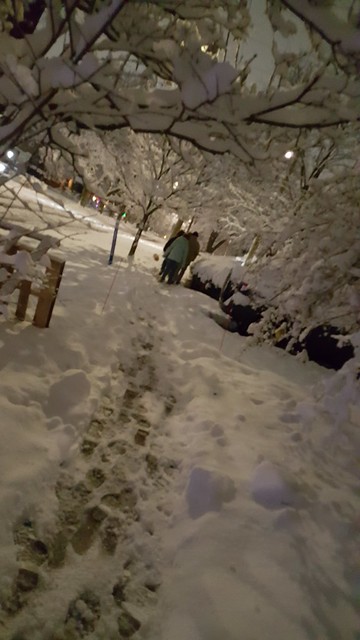
Dec. 16, Family walk with dog, spontaneous snow angels
We meet outside, to meet in person. We learn the weather, we greet the seasons, the changing light, we pay attention.
Dec. 20, Family drinks in the back yard shack
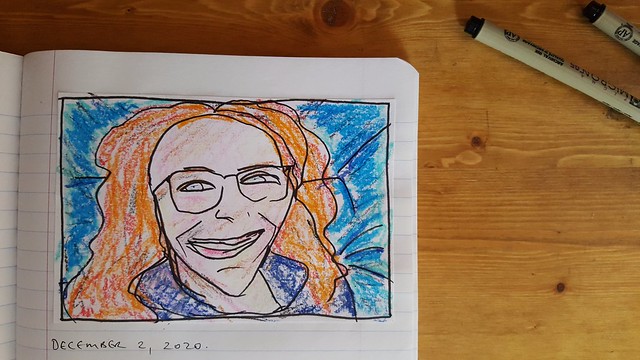
All month, I’ve been drawing a daily portrait and writing a short caption, to capture a scene or moment from each day. I’ve noticed that my portraits most often depict me with others, not alone. Or, if I am alone, I’m thinking of someone else when I write the caption. This year of being apart has actually been a year of coming closer together, in some ways. In others ways, no — I no longer coach a team of lively teenaged girls, and I miss those casual and funny interactions. But I’ve grown closer with my own kids. There are friendships that have deepened.
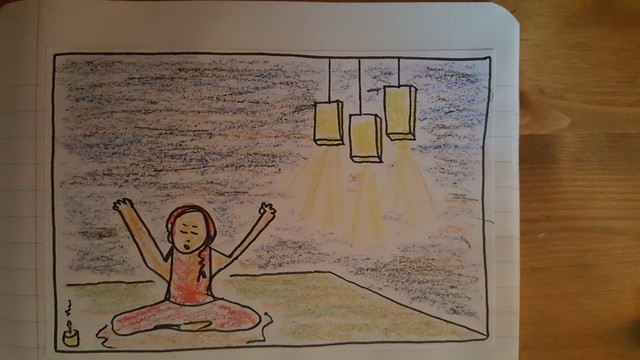
Dec. 12, kundalini class on Zoom, in my studio
I’m closer to the ground. And my spirit is closer to the sky.
Enjoy the darkness, friends. Light a candle, and send out an I love you to someone you’ve been meaning to say that to. The days are short, but won’t always be so.
xo, Carrie
Friday, Dec 4, 2020 | Adventure, Art, Big Thoughts, Blogging, Books, Cartoons, Confessions, Family, Fun, Lynda Barry, Manifest, Reading, Spirit, Success, Work, Writing |
Listening to Joni Mitchell’s River.
I listen to this song even when it’s not the Christmas season. They’re cutting down trees, they’re putting up reindeer, and singing songs of joy and peace. Oh I wish I had a river I could skate away on.
Oh, Joni. I recently read a profile about her early songwriting in the New York Times and then drifted over to read another piece in The New Yorker from 2012 by Zadie Smith about becoming a Joni convert. I’d already read the Zadie Smith essay, maybe when it was originally published, but I read it again. The internet will give you so many windows and doors to open, chasing ideas that you might tell yourself are inspirational or aspirational, when really, you just want to be as original and seemingly free as Joni Mitchell. But it’s okay just being you. Isn’t it?
I’ve started a new project that I’m planning to do every day in December, and possibly beyond. It’s a way of crossing the threshold from the every day into the imagination, a daily portrait and caption, created in about 20 minutes or so, while listening to music. I draw a portrait on an index card in pen, then colour it with crayons (an important part of the playful process!), then write a few lines about whatever’s on my mind, giving myself no more than 3 minutes for the text so I don’t start sweating over it. Like this:

Here are a few other good things and random thoughts, on this Friday afternoon when I’ve run out of steam and am about to turn to fun videos on youtube while doing my stretching routine on the office floor, which isn’t a half-bad way to spend half an hour, truth be told — maybe I’ll count that as one of the random good things going on right now. I’m also attempting to do sets of 10 burpees whenever I think of it throughout the day. While waiting for lunch to heat in the microwave, for example. Before bed. The goal is to raise my heart rate in spurts throughout the day, maybe to compensate for not running right now (though I do ride the spin bike pretty frequently). Whatever. It lifts my spirits every time. I finish my burpee set and throw my hands in the air in victory! Yes! (I should draw that.)
Other daily goals: Go outside! Every day.
And: Flip my current pattern of writing in a frantic panic late in the afternoon, and write in the mornings instead (answer email only after I’m all written-out). The daily portrait and caption kickstarts this goal, and so far it’s worked wonders. Start with something fun and easy, something I look forward to doing, and suddenly I’m pitched into writing new material without even thinking twice.
Also: Work harder. (Weird, I originally wrote “Word harder.” That works too.) Work/word harder is my main life goal. But I mean that only insofar as I mean work harder to dig in, commit, finish projects, even if I don’t know what will happen to them. Hard things are hard. Curiosity is my fuel. Patience is a gift but also can be a weakness if it turns into numb acceptance. Grit is necessary. Add it to your breakfast. Relish and savour what you’re doing because you never know what you’re making. Or what will stick, what will matter, what others will appreciate.
For example: A student sent me a message this week, writing: “I also wanted to tell you that as a graduate, I still appreciate your class. I’ve read books a little differently since, with more compassion, and more interest in the beauty of the work.” How could I guess that a student would come away from a writing class with a new lens on reading? What a gift. I love thinking about the accident of connections, about the things we keep that perhaps someone else has given us, but they don’t know.
Okay, one more goal: Reach out with appreciation for the gifts received from others. I might also add, if there’s a teacher who’s helped you in some way, let her know. Especially now. Any teacher who can engage her students through the screen or the mask is working at a level of commitment and energy and preparation that is almost impossible to understate.
In conclusion, as this seems to be a post that has brought up boundless wells of inner gratitude, I’m grateful for a friend’s idea to create our own collectively brainstormed advent calendar of family activities. As a family of six, each of us contributed four ideas which were randomly sprinkled into the calendar’s pockets. Day 1: decorate Christmas cookies (made by F); Day 2: breakfast for dinner (waffles, made by me); Day 3: ice cream delivery to grandparents; Day 4: games night. (Days 1 and 2 shifted the responsibility to the baker and the cook, and both of us were slightly crusty about this; as a result, we’ve also created a bunch of back-up activities to be accessed should one idea not work out on a particular day).
I’m grateful for a little surprise to look forward to every day of advent.
And I’m grateful to you, my friends who read this blog. It gives me a little boost knowing you’re out there. Connections. They’re harder to come by right now, and I cherish them all the more for that.
xo, Carrie
Tuesday, Nov 24, 2020 | Art, Big Thoughts, Book Review, Books, Confessions, Current events, Reading, Spirit, Writing |
Dear friend, from my life I write to you in your life. That is the title of a book of essays by Yiyun Li, a Chinese-American writer whose stories I’ve admired for years, and I bought this book without knowing much about it, other than the title made me want to know more. (She says it’s taken from an entry in one of Katherine Mansfield’s notebooks. “I cried when I read the line,” Li writes. “What a long way it is from one life to another, yet why write if not for that distance…”)
This turned out to be a book about many things, most significantly about reading other books, and about surviving, continuing to be alive on this earth. The book is written as if to a friend, but in the end, it seems the friend is Yiyun Li herself, trying to write to herself, as she figures out how to stay alive in the years following a long descent into severe depression and hospitalization and release. It was actually exactly what I needed and wanted to read, though I wouldn’t have necessarily chosen it, had I known what I was choosing; a book sometimes chooses us rather than the other way around. I’ve read it slowly, over this fall, marking pages with insights for keeping, and that is what this post will be about: insights from this book, to keep and to wonder about. Li writes in English, a language she learned as an adult, which she calls her private language. She originally studied to be a scientist (immunologist), and in fact came to the United States to further her studies. When she decided to quit science to become a writer, a friend’s husband asked: “Why do you want to make your life difficult?”
I’ve had a thought that I would like to write a story on the theme of each of these quotes; or at least a scene. Each one brings into my mind a picture or feeling, or both, and makes me yearn to respond, through fiction. Why do you want to make your life difficult? The question could be asked in so many contexts and would always create an interesting and troubling problem, without an obvious solution. The seed of a story, I think.
“I have had a troublesome relationship with time. The past I cannot trust because it could be tainted by my memory. The future is hypothetical and should be treated with caution. The present—what is the present but a constant test: in this muddled in-between one struggles to understand what about oneself has to be changed, what accepted, what preserved.”
Yiyun Li thinks about time a lot, and truth be told, I was drawn to this thought because the character in the muddled in-between looks like a version of me, maybe now, maybe from the distant past.
“What I admire and respect in a dreamer: her confidence in her capacities, her insusceptibility to the frivolous, and her faith that the good and the real shall triumph and last. There is nothing selfish, dazzling, or preposterous about dreamers; in everyday life they blend in rather than stand out …
A real dreamer has a mutual trust with time.
Apart from feeling unqualified to be called a dreamer, I may also be worrying about being mistaken for one of those who call themselves dreamers but are merely ambitious. One meets them often in life, their ambitions smaller than dreams, more commonplace, in need of broadcasting and dependent on recognition from this particular time. If they cause pain to others, they have no trouble writing off those damages as the cost of their dreams. Timeliness may be one thing that separates ambitions from real dreams.”
Again, Yiyun Li’s reflection on time, here, made me stop and wonder: am I a dreamer? Or merely ambitious? Or maybe I have the potential to be both, and have been, and will be. What’s my relationship to time? Do I trust it, or fear it will betray me? This scene would have two characters, or multiple characters, perhaps entirely unaware of their own relationship to time; but the reader knows.
“The train, for reasons unknown to us, always stops between a past and a future, both making this now look as though it is nowhere. But it is this nowhereness that one has to make use of. … One has made it this far; perhaps this enough of a reason to journey on.”
Is this a sincere conclusion? Or is the writer writing to convince herself? I love the image of the stopped train; but I don’t want to think of time that way. I don’t want to think of being suspended between destinations. That makes the destinations too central, when it’s where we’ve stopped that I want to land, and be. Of course, the character might get off the train, here, in the middle of nowhere. Or they might find another way to shake themselves awake.
“Perhaps my deficiency as a scientist, a lack of ultimate purpose, is why I love writing. Precision gives me more pleasure than the end result.”
Ah, I thought, as I read this. Me too. (Though I’m not a scientist; but I do love order, precision, walking around a scene and picking up every little item in the room, acknowledging every flickering interior thought, every facial expression, collecting and organizing them into some kind of coherence, accessible for someone else to walk around and observe, too, and draw their own conclusions.)
“For as long as I can remember, my mother has spoken of me as a selfish person. If I were religious, I would kneel nightly for salvation from this sin. There is no measure to quantify selfishness: how much of oneself is devoted to others, or even which part of life is to be lived and which part given up. All my life I have failed to prove myself unselfish.”
A question from my own life, haunting, ever-present; this is so often a mother’s story, isn’t it? How to quantify selfishness? How to know how much is too much to take, or to give; or to want?
“A young person, beginning to read seriously, tends to live—infatuated, even—with one book at a time. The world offered by the book is large enough to contain all other worlds, or exclusive enough to make all other worlds retreat.”
This is how I read, even now, and it can feel overwhelming, almost unsettling, to be so far from home, so far from those who may need me to be present. Yiyun Li calls this “enchantment—or entrapment.” Yes. Both. The vanishing that is uncomfortable to the adult is utterly wonderful to the child; this story may wonder: what’s the difference between those minds and experiences?
“Solitude is noble, but fatal to an artist who has not the strength to break out of it. An artist must live the life of his own time, even if it be clamorous and impure: he must be forever giving and receiving, and giving and giving, and again receiving.” — Romain Rolland, Jean-Christophe
Here, Li pulls a quote from a favourite book, which she read over and over as a teenager (I’d never heard of it). I feel what is being said here most keenly: that we are embedded in our times, of our times, and it’s necessary to bob in their waters; ours are not clamorous right now, so much as masked, awkward with imposed estrangement, lassitude mixed with anxiety. I confess: the pandemic story is a challenge to write; what’s it mean to write about the times we’re in while we’re knee-deep in them? Is it foolish, too close to attempted journalism; maybe fiction comes from the compost, years later. Maybe we’re just gathering now.
“To write is to find a new way to see the world … The truth is, I did not know what I was supposed to see.”
What is my style, my reason for writing, what is it I’ve wanted and want to accomplish? At times, I’ve believed writers (including myself here) are dangerous, untrustworthy beings, both powerful and weak, impotent, seeking reaction, or to provoke; they don’t do much themselves. Ornamental. Admired, but kind of useless; frivolous, but essential, or else how would we remember who we were? And who we wanted to be?
“What does not make sense is what matters.”
This is most often what I write about, I suppose; maybe in hopes of making peace with it, or grasping some insight, or putting together part of the puzzle. Seeing a pattern in random shifting bits of light and shadow.
A friend (the writer William Trevor) writes to Yiyun Li: “You may be less confused than you imagined. Stories are a hope, and often they obligingly answer questions.”
She replies to her friend, but only in her imagination, much later: “We are solitary travellers, having crossed paths in the land of stories.”
Oh.
“One cannot be an adept writer of one’s life; nor can one be a discerning reader of that tale. Not equipped with a novelist’s tools to create plots and maneuver pacing, to speak omnisciently or abandon an inconvenient point of view, to adjust time’s linearity and splice the less connected moments, the most interesting people among us, I often suspect, are flatter than the flattest character in a novel.”
Parse that out (“a novelist’s tools”), and you’ve got the structural ingredients for writing a good story (and she’s right, even the most interesting life, lived at life’s pace, wouldn’t make for a good story; it needs a fictional treatment. And this treatment can be a kindness, or it can be a cruelty; or maybe it is both; but I don’t know any other way in to the questions that come calling; these questions aren’t even asked in language, at least not in my mind, but in imagery, in emotion.)
Dear friend, from my life I write to you in your life. Thank you for reading.
xo, Carrie
Sunday, Nov 1, 2020 | Big Thoughts, Confessions, Current events, Fall, Family, Lists, Local Food, Politics, Spirit, Work |
October Reflections
- What felt good this month? This is a challenging question to start with. It’s been a hard month. What’s felt good? There have been some things! Methodically digging into my novel-rewrite has felt good and necessary. Writing a reflective essay for The Scales Project was absolutely wonderful. Thankfully, my long-established habits and routines have kept me afloat: running and yoga, even if the morning runs now happen in the dark. No matter how bleak I’ve felt, I get out of bed and exercise at an early hour, five mornings a week. Hanging out in Kevin’s “back yard shack” is the best, especially with friends. On Fridays, Kevin and I have been ordering take-out and eating outside by the fake fire, just the two of us. And my studio is a warm, welcoming cocoon to retreat to, for writing, planning, reading, stretching, relaxing, napping.
- What did you struggle with? Depression, in all honesty. I had some lows that felt lower than usual, and I stayed low longer. Thankfully, I was able to reach out and get help. And the help helped. I noticed that what also helped was digging more deeply into my writing work. It was a life raft, keeping me afloat, giving me purpose when the days felt otherwise blank and empty. Cooking and chores actually helped too. I think it’s a privilege to be needed, or to feel certain that one’s work is valuable and valued. I’m not always convinced of that, and that’s when I fall down into the deepest holes. This feels like a pretty dark confession. But I’m compelled to say these things out loud, because shame thrives on silence, and because I think others may be feeling similarly, especially anyone who’s lost their job, or is in a liminal period in their life. Purpose and meaning make life worthwhile. It can be hard to function without being connected to that.
- Where are you now compared to the beginning of the month? I can’t really grasp where I was at the beginning of the month, which makes it difficult to compare. Apparently I was feeling calm at the end of September? Given that I’m on about draft five of trying to answer this question, what I’m feeling right now seems to be distracted, discombobulated, and wondering what the heck is going to happen. The American election is three days away, and I’m feeling wary of false optimism, and wary of “endings,” especially of this belief in some definitive happy ending that appears as if by magic. If the pandemic has taught me anything, it’s that the answers in a crisis, as in ordinary life, change with the circumstances, require monitoring and reassessment, and must shift to take many factors into consideration. In other words: there are no easy answers. Related to this, at least in my confused mind: It seems a particularly American flaw to admire the huckster, the grifter, the entertainer, the fraud — the person who can make a buck out of nothing more than a talent for deception — and even though I’m a fiction writer, I don’t believe in personal deception as a solution to life’s challenges.
- How did you take care of yourself? Meditation, podcasts, reading silly mysteries, stretching, naps on my warm office floor, kundalini yoga, walks with friends, running, yoga, a regular bedtime, beer on the weekends.
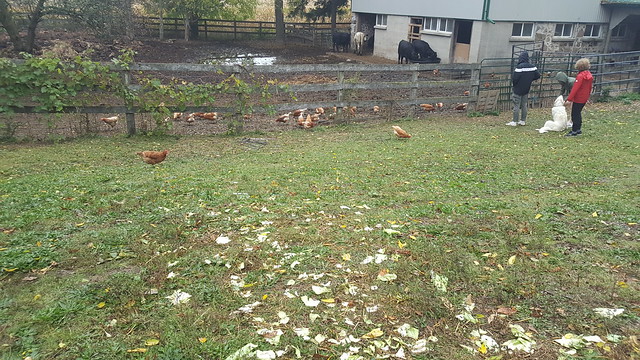
- What would you most like to remember? I’m not going to remember much from this last month. But one really happy memory is the afternoon I drove the kids out to the country to pick up our Thanksgiving turkey. It was raining, the turkey line was long, and absolutely no one complained. The kids went over to the barn area and watched the chickens, pigs, and cows, and petted the dogs. No one was in a rush. The outing was mellow, chilled-out, and completely satisfying, and would only have happened in covid-times, when we’re all kind of starved for entertainment and stimulation, and a drive to the country to watch a chicken drink from a waterspout counts as memorable.
- What do you need to let go of? I’ll let go of my need for things to happen, maybe. Or no. I’ll let go of my need for things to happen in a particular way, according to expectation. I’ll celebrate when I respond according to my values, and forgive myself for not being perfect or better or best.
xo, Carrie
Wednesday, Oct 14, 2020 | Big Thoughts, Confessions, Manifest, Meditation, Sick, Spirit |
What to do when having a bad day? Or a bad couple of days? What does that even mean, to have a bad day?
For me, it means feeling extremely low in spirit. And it happens. I’m trying to track these low days, to figure out whether there is a pattern. On Monday, on my desk calendar, I wrote: “feeling very low.” On Tuesday: “still low.” Today I didn’t write anything, probably because I am feeling a bit better.
I’ve noticed a few things, during these low couple of days.
First, I noticed that I’d quit Twitter and hadn’t replaced that social media scroll with anything in particular … which sounds amazing and very healthy and all the rest of it, but in fact, has contributed to this low feeling, because Twitter and doomscrolling was exactly as soothing as any addiction, it was a distraction from my own inner life, and without it, I’m left facing: my own inner life.
And a whole collection of anxieties, fears, doubts, and nameless sadness lurks inside here. It was easier not to notice when I was busy distracting myself.
This is the push of the pandemic as a whole. It dares us to pause and observe what’s waiting to be noticed underneath our once-busy schedules, our racing around, our frantic quests for acknowledgement and personal satisfaction. Here I am.
What’s come up this week is a recognition that I’m still struggling to come to peace with certain childhood indignities, specifically the feeling of being an outsider always looking in but never fully understanding what’s going on (we moved often, and lived in a few different countries); being an outsider gave me the gift of observation, but what I’ve been more reluctant to acknowledge is that it also dug a hole of insecurities that manifests in unlikeable and unpleasant ways when I’m feeling … well … low …
Oh, how I attempt to protect myself from even the smallest rejection, from loss, from disappointment.
For example. I had a mini-tantrum at the dinner table several nights ago, when I wanted the last piece of pie and didn’t get it. I could have had a tart instead, but I wanted that last piece of pie and, also, I thought my children should have appreciated and loved me enough to give me the last piece of pie. (They may not have seen that piece of pie in quite the same way). I said (and this is an exact quote): “If I don’t get what I want, I don’t want anything at all.” I might as well have stomped my foot before running out of the room. I mean, I didn’t. I spoke in a calm and rational (if petulant) tone, but the words and the feeling were undeniably childish; and I did leave the room. One of my kids said, Mom, I can’t tell if you’re kidding right now. And my inner child said, I’m not kidding!
This got me thinking about two guiding principles I’ve been living by, and would like to stop living by, mostly because I hadn’t realized until recently that I was living by them.
The first is: Save it for later.
The second is: If I don’t get what I want, I don’t want anything at all. Or: I’d rather quit than lose.
Save it for later, as my siblings could tell you, goes back to early childhood, when I would hoard my Easter bunny, uneaten, for MONTHS. The end result, predictably, was that the candy became completely inedible, melting into a sticky disgusting mass hidden away in my sock drawer. This had the effect of not only depriving me of enjoying the original treat, but also of depriving anyone else of enjoying it too. It’s quite possible that I actually didn’t like chocolate Easter bunnies and could have given the candy away to my brothers; but I didn’t. Instead, I hoarded it like I was preparing for the apocalypse. The perfect time to eat it simply never came. Note to self: It never will.
I still do this. I’m trying to change that. I’m trying to eat the chocolate now, or share it, if I don’t want it. I’m trying to treat myself, and others, to little luxuries, today, right now. It takes practice. It’s a pretty sweet practice to practice, though.
I guess the outlook is to change from a scarcity mindset to a mindset of plenty, of abundance; not hedonism, but simply enough.
I’d rather quit than lose, my siblings could also probably weigh in on. Suffice it to say, it’s a shitty way to live a life. And I’ve only just noticed that this tendency is bubbling up in me again; thought I’d cured it over the years by committing to do a bunch of things I was guaranteed never going to win at—like running races, or coaching soccer.
This mindset comes with its own sub-mindset that is a bit more complicated, but summarizes roughly as: If this is as good as I’m going to get, I’m outta here. It’s about sensing when I’m reaching my own limitations and becoming frustrated with my inability to progress. I know this was part of what frustrated me with coaching, and with teaching; I was okay at both, learned lots and absorbed lots pretty quickly, but plateaued: it would have taken so much work to get even incrementally better, and it started not to seem worth it. I don’t like being okay at things. I like to be (dare I say it?) the best.
I’m going to dare to say it, because it’s my only chance of excavating that belief, and leaving it by the side of the road.
To sum up (should I even try to sum up this mess of a post???) …
Remove an addiction and you’re going to notice issues surfacing that were conveniently masked by said addiction.
This is a bit scary. But maybe your childhood self has some messages you’ll be able to hear again. Maybe you’d like a shot at changing some of those things that are, admittedly, painful, even excruciatingly painful, embarrassing, humiliating, frightening, etc., to notice.
One last thing: Make sure to tell someone if you’re feeling low. It’s really really hard, and it really really helps, just to confess out loud: I’m struggling here. Here’s the thing: other people can’t read your mind. I know it’s hard. But reach out and tell someone. The alternative is to keep sinking lower and lower, and that becomes quite a dangerous thing. Just so you know, I did reach out and talk to someone, and it made me feel almost instantly better. Didn’t fix the lowness, exactly, but immediately I felt less alone. My inner child was so relieved.
Find your safe person, or a counsellor. Please. A bad day can feel like the end of the world; it doesn’t have to be. You might feel selfish or foolish or ashamed to be asking for help, especially if you’re seen as (or see yourself as) a high-functioning person who wears a mask of competence. We’ve all got our masks on, and sometimes the person behind the mask just needs to take it off and be seen.
My goal is keep my mask off. Someday. Meanwhile, I’ll be over here, helping my inner child through the important life experience of not getting the last piece of pie.
xo, Carrie