Category: Big Thoughts
Wednesday, Oct 22, 2014 | Adventure, Big Thoughts, Kids, Music, Politics, Travel, Work |

Hi there.
I’m in Vancouver.
The Weather Network tells me it’s 14 degrees, feels like 13, with 20-30 mm of rain expected to begin at 5:50PM, which coincidentally is around the time I’ll be taxiing to tonight’s event, a fundraiser at Vancouver House with Joseph Boyden.
Today may go down in my memory as one of the more surreal; if, that is, I can remember any of it. I’ve been having trouble sleeping on this trip. It was well after 1AM when my body finally shut down, and my alarm went off at 4:15AM. I roused myself, finished stuffing things into my bag (didn’t think it was all going to fit for a moment there), and caught a shuttle from the Banff Centre to the Calgary airport. It was too dark to say a proper goodbye to the mountains.
I slept on the shuttle, like someone who had been drugged rather than like a normal dozing human being. Off the shuttle, I felt delusional from exhaustion, wandering the airport, trying to behave like a responsible adult who understood self-check-in machines and how to attach luggage stickers and where to stand in line. I was randomly selected for the full-body pat-down, which, frankly, bothered me not at all. On the plane I slept that drugged sleep again, surfacing to see on the TV screen in the seat-back next to mine, live footage from Ottawa, where shots had been fired inside the Parliament buildings. A reservist killed at the war memorial for the unknown soldier. A gunman killed too. Baffled Canadians taking cellphone footage. Streets shut down.
There is nothing to be said about this that I feel qualified to say.
I can’t really connect with my emotions on the subject. It sounds trite to express sadness. But I am sad.
When we landed in Vancouver, I realized it was only 9AM here. The hotel generously found me a room. I slept the drugged sleep, roused myself, ate a burger for lunch and watched soccer in a sports bar. I texted with my family while eating, which made me feel less lonely. And then I went for a run on the seawall. Running is hard, it’s always hard, but it works. I feel better.
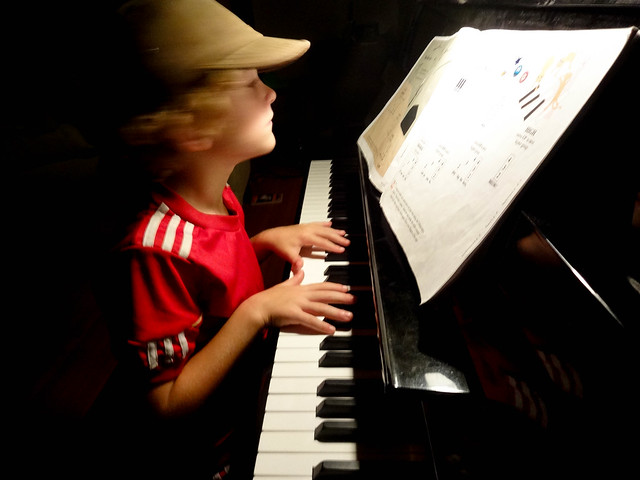
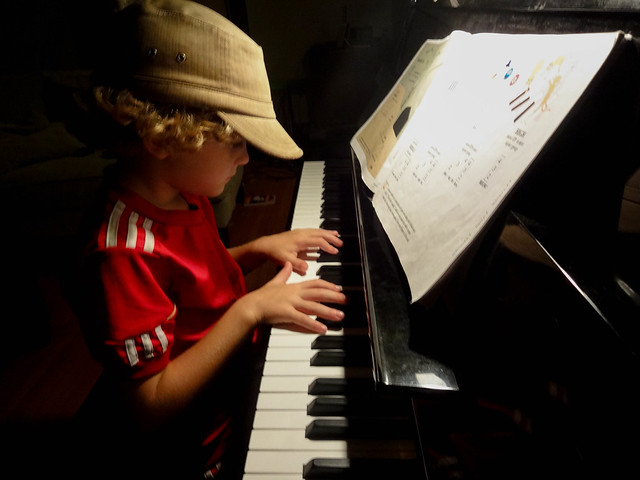
Kevin is sending me texts and photos from home: right now, my kids are playing music together in our living-room. My brother Karl is recording them. CJ is singing into a mic. The girls are playing ukuleles. And Albus is tapping out chords on the piano. It’s like my dream family come to life. Only I wish I were there to see it.
But I have seen Karl Ove Knausgaard–twice. First when checking in, and then when getting off the elevator in my running gear. Neither time did I fangirl him. It took some restraint.
I feel like I’ve been awake for days.
I need a short nap before putting my Little Black Dress and heading out to a party. Nothing about this day feels concrete, feels like I can dig my fingers into it and find the pulse. I’m oddly removed. I was running on the seawall an hour ago. I flew over the mountains this morning. I’m here now. I’m here, now.
xo, Carrie
PS This is the photo Kevin sent me of the kids, playing music together. Sorry. It’s very very tiny. It seems fitting: this is as close as I can get. Home feels far away, right now.

Monday, Oct 20, 2014 | Adventure, Big Thoughts, Travel |
Hi there.
I’m in Banff.
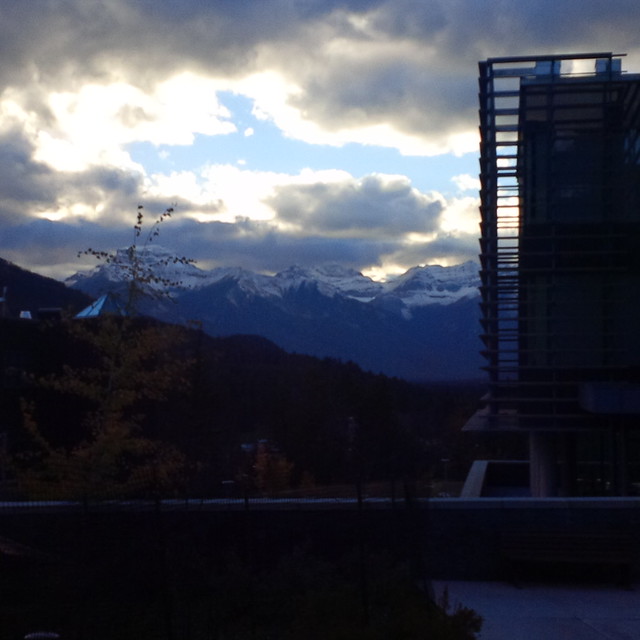
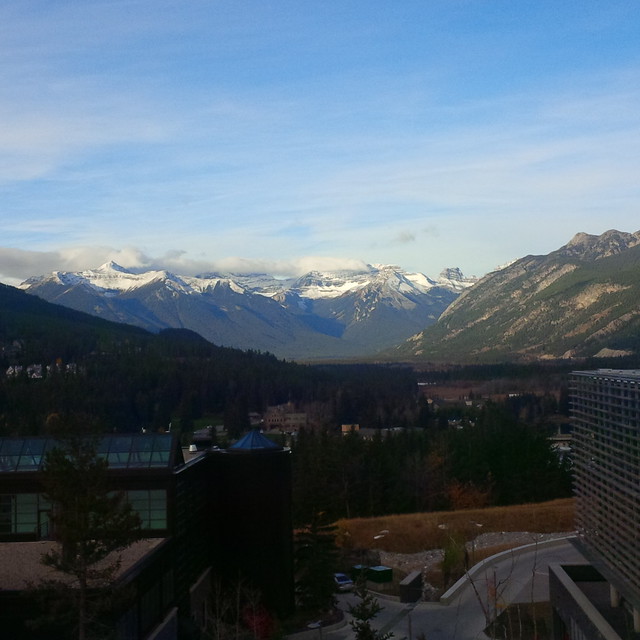
The Weather Networks says it’s 17, feels like 16, which could also be described as “perfect.” I’ve been here since Saturday, late afternoon. I probably should have mentioned it sooner. But I’ve been stunned into silence by the mountains. There are mountains everywhere. It would be no exaggeration to claim that the first evening I was here, I was pulling out my phone to take photos of mountains every few steps.
It was like, hey, wow, holy crap that’s an awesome mountain right there!
Awesome mountain! Right there!
Take photo. Text to husband.
Turn head an inch and begin walking. Stop. Holy crap, another freaking mountain! Like, right there!
I mean, seriously! Look at that mountain!
Take photo. Text to husband.
When it seemed my husband had received enough mountain photos, I widened my range of recipients. If you haven’t gotten one yet, don’t worry, it’s on its way.
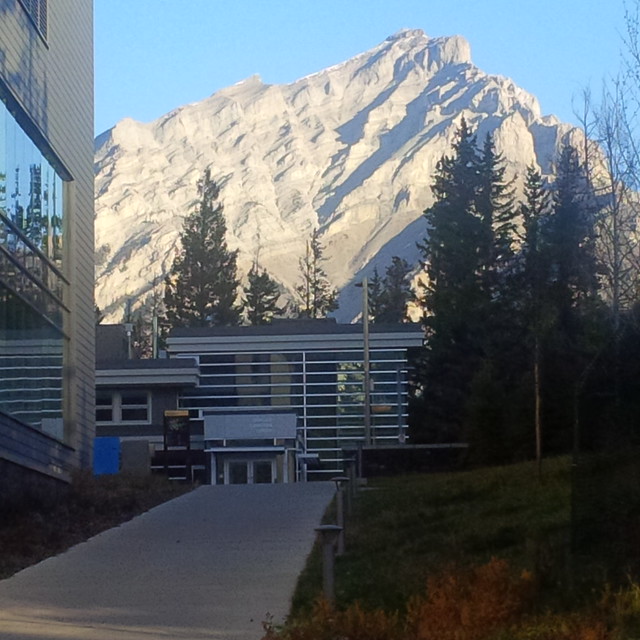
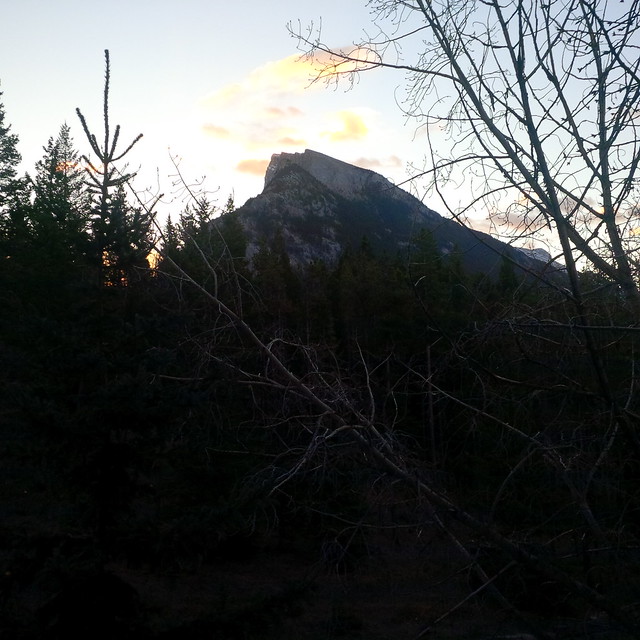
Morning mountain outside bedroom window.
For example, I texted the mountain that’s out my bedroom window to my 13-year-old. Let me rephrase that. I texted a mere photo of said mountain, not mountain itself.
“You should climb that, Mom,” he texts back.
It’s steeper than you think, I reply.
I mean, it’s sheer bloody rock, so far as I can tell. And I have a wobbly kneed fear of heights issue. I also read, with over-much attention and avidity, the section in my Banff Centre guide, provided for me in my room, on local wildlife. It’s a long section with many useful details that set my imagination into overdrive. Walking between buildings after dark, I find myself on the lookout for cougars. I know it’s irrational. But cougars. Mountain lions. What’s not to fear? I’ve noted, too, the signs posted around campus reminding us to keep “three bus lengths” between ourselves and any elk we might see. “Do not approach.” “Was not planning to, thanks.” Apparently there was a grizzly on the other side of Tunnel Mountain, blocking the path today. A grizzly. Tunnel Mountain? The one recommended as a nice stroll with a great view at the top? I might have to pass. Who knew I was such a wimp? Well, now we all do.
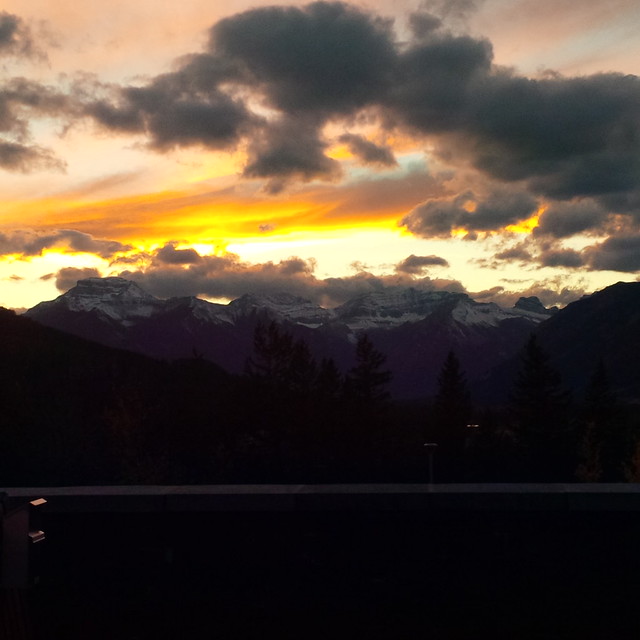
The thing is, I don’t need to trespass on Grizzly land to get a great view. Let me text you a photo of the great view I get just by turning my head.
In fact, it’s a bit unnerving, all the great views. I ate lunch with the writer Kim Thuy today, and she was saying there’s such as thing as suffering from too much beauty, and your head explodes; metaphorically, I presume. I tried looking up the syndrome back in my room. The search led me to a Tumblr site called “Too Much Beauty,” which mainly featured young male actors I didn’t recognize because I’m not a young female teenager. So that seems a dead end.
I wonder, could there be such a thing? Could one suffer from too much beauty, staggered by the immensity, the vast non-human scale of these complex rock creations towering over us, former seabeds embedded with ancient tropical coral reefs? How to write anything of consequence while looking at something so old, so immense, so austerely implacably beautiful?
I am therefore typing this in my room, facing a blank wall. It’s peaceful. I’m working well in here. I’m sipping a healthful beet/carrot/ginger concoction that I pray will dislodge my nasty cough so I can sleep through the night, once again. Truth be told, the free drinks, which seem to abound wherever writers crop up, have not been helping, either with the cough or the sleep.
But the beauty. It’s out there, waiting for me, whenever I’m ready to face it.
xo, Carrie
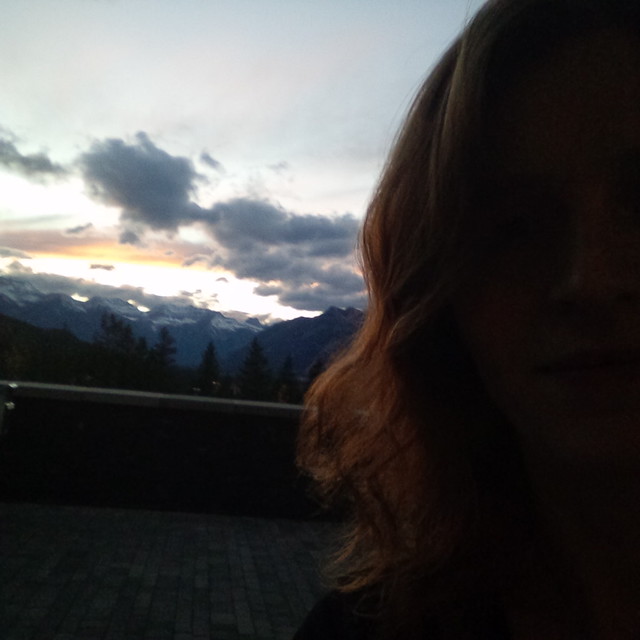
P.S. Never take a selfie with a mountain. There is no point. Mountain wins.
Tuesday, Oct 7, 2014 | Big Thoughts, Fall, Money, Running, Work, Writing |

A friend said to me this morning, as we were running together in the damp, dark pre-dawn, This book is not your whole identity, you know. You are much more than this book.
I needed to hear that. Thanks, friend.
I hadn’t recognized, quite, how Girl Runner has subsumed not just my hours, my focus, my working life right now, but also my identity. I am wearing, almost as a costume, almost full-time, the cloak of person-who-wrote-Girl-Runner. It’s not an invisibility cloak; it might be the opposite, a visibility cloak. But what’s visible is author-of-Girl-Runner, and invisible is everything else. Which is why completing that race felt so very good, perhaps.
My professional life is caught up in this identity: I would not be a teacher or a guest speaker if I were not, first and foremost, the author of Girl Runner. If I shrugged off that visibility cloak, an enormous section of my money-earning life would vanish in a poof of dust.
So it’s scary, I guess, to imagine not pouring my all into inhabiting my writer self. Carrie who writes books earns a living, whether by writing books or by spinning off the writing of books into related enterprises. Earning a living has long been my goal. It’s a worthy goal, I believe.
But maybe that goal feels a little one-dimensional as I pursue it with greater success and therefore greater effort, greater demands on my time. And on my identity.
If the writer cloak were balled up and chucked into a dusty corner, or even just hung up in a closet for awhile, what identity would emerge? Would I be fearful and lost? Free-roaming? Empty? Or would I find friend, mother, baker, caregiver rising up to fill the space? Or something else I can’t guess or imagine? But I can’t imagine it, because in truth being a writer isn’t a cloak, it’s more like tough thread woven right through the skin.
Yet I sense that other parts of me are being shadowed, right now. It’s like I planted a seed that’s grown, quite suddenly, to become a tall leafy tree, shading out all else. It’s like I’ve become that tree. But I’m not. The tree is of me, but separate from me. Can I climb its branches and catch some light? Should I wait patiently for the season to change, the leaves to fall, to crunch around in them, to see them turn to compost, wait for other seeds to grow, a forested tangle of identity, creeping on the ground and digging in roots and reaching for the sky? Can I be many different parts all at once, or can I only do/be one thing at a time fruitfully, fully, well?
xo, Carrie
Sunday, Oct 5, 2014 | Adventure, Big Thoughts, Friends, Fun, Running, Spirit |
 A race is a very special undertaking. For some reason that can’t possibly relate to logic or reason, I’ve chosen to run two in the past three weeks.
It might not be good for my body to run a race every day.
But maybe it would be better for my mind and my spirit to run a race every day.
I did not feel like running this race. I wasn’t even sure my training was sufficient, despite some hard work over the summer. As predicted, my ability to train on the weekends dropped off as soon as September arrived, and with it the book. I ran that half-marathon three weeks ago as a training run. Because otherwise, I’d dropped down to three runs a week, none of them over 12.5 kilometres. Yesterday’s race was double that at 25 kilometres, and on steep winding trails, very hilly, while the half-marathon route had been a gently rolling road with no real hill challenges.
But I went. I set my alarm for early, slept poorly, woke and forced myself to eat and to drink and to prepare, and drove to Pinehurst Conservation area, and picked up my race kit, and stood in line at the bathrooms, and sat in the truck trying to stay warm and eating almonds and reading toward the ending of A Tale for the Time Being and then it was time to lace up my shoes, pin on my number, and go to the start line. And then it was time to run.
So I ran.
I didn’t know whether or not I was up for this particular challenge. In fact, I feared that I was not up for it; certainly knew that I would not be choosing to do it, had I not signed up months ago. But that’s a good enough reason to do something, I believe: sign up, show up, offer what you have in you to offer on the day it is required of you.
It might not be as much as you could offer under ideal circumstances, or at a different time in your life. That is okay.
A race is more about marking the moment with the offering of your effort than it is about finishing or competing or putting up race times. In fact, that last one is just a number and is worth something to you alone, and you get decide, therefore, its value.
I decided yesterday that the numbers didn’t matter.
I ran without a watch. I ran on gut instinct, following my body’s ebbs and flows of energy, without judging or critiquing my body’s efforts, sometimes stronger, sometimes weaker, but then stronger again, always with a mind to the effort needed and the desire and pleasure of speed and forward-motion. On some of the downhills, it felt like I was flying. On some of the uphills, I was bent double and slowed to a walking pace. I tuned a lot out. In fact, the experience had an otherworldly quality, or the quality of a dream I did not control, but only moved through.
For long stretches, I thought of nothing, saw little, only was aware of motion itself, the path immediately ahead, the tree roots, the leaves, the colours, the sticks and stones under my feet. I remember the sun shone for awhile, its brightness on the fallen, wet poplar leaves so strong that it hurt my eyes to focus on the ground and yet I knew that I needed to focus lest I lose my footing or trip. So much of my mind’s work went into the path immediately ahead.
When my energy flagged, I practiced staying in the moment. I thought of old Jiko in A Tale for the Time Being practicing zazen (though this was moving meditation). I used a few mantras, chosen at random from the flotsam and jetsam of information that had passed through my mind either right before race time or during the race itself.
A phrase on the back of a t-shirt that I saw while waiting in line in the women’s bathroom: “The mind leads the body.” For a while, I was saying it backward: “The body follows the mind,” which worked too, but then I ran behind the woman with the t-shirt for a stretch and saw the words as they were, so I switched to that. I tried to thank her when I passed her, but instead said, “I like your shirt.” Which wasn’t quite the right message, but there was very little oxygen available for communication.
Communication was rudimentary. I felt myself pulled deep inside my body, my eyes tools only, unable or unwilling to connect, almost a blank of observable emotion.
The flying mantra came from a comment posted on Facebook by a friend in Ottawa, encouraging my race effort: she said the damp would keep me cool and I would feel like I was flying. And I did, sometimes.
There was one more mantra, from Elizabeth Gilbert, the author, who I follow on Facebook, who said that your fear is the most boring thing about you. So, whenever I felt the trickle of fear approaching, or questioned whether I was running too well, too easily, too strong, and would therefore shortly most definitely crash, I told myself: your fear is the most boring thing about you!
I knew the second lap would be difficult, and was not prepared for it to be as manageable as it became. I’d lost all fear by that point, and the kilometres seemed to melt rather than be counted, as I wasn’t paying much attention, and would miss kilometre markers altogether, so it seemed like before I knew it there were only 5 kilometres left.
I drank coke and water. I sucked on an energy gel pack that my friend Heather, who I run with on Thursday mornings, had given me along with a new pair of socks as a surprise gift for race day. I wore the socks, too. I thought of Heather during that last 10 kilometres because we run that distance together and we run it far faster than I’m used to covering 10 kilometres, so I told myself that if I could keep up with Heather, I could easily complete these last 10 kilometres. In fact, when I realized I had only five kilometres left, it seemed as if the race had happened too quickly.
Not that I wanted it to go on longer.
Just that I was shocked to realize how quickly the time had passed, how deeply inside of it my focus was and would remain, with little ticks and breaks here and there, until I crossed the finish line.
In fact, I sped up significantly when I realized I was completing the last kilometre, and sprinted the last 600 metres, passing many runners, none of them choosing to challenge me, although I kept listening for the sound of footfalls chasing behind me. None came. I knew I could carry myself over the last stretch, and the sprint felt easy at the end, strong.
I don’t know what time I got. I was too totally inside the focus to look at the clock as I crossed the line. I do know it was faster than I’d hoped for, but slower than previous races.
As I drove home, it came to me that a race is an opportunity to prove to yourself that you’re stronger than you think. That’s what it felt like. During the race, I felt so much stronger than I’d thought I was, only hours earlier, so much braver, so much calmer. I’m doing this, I told myself; you’re doing this. It was exhilarating and fun and joyful. I will do it again. I will approach it with the same spirit, with optimism, with training to underpin the approaching effort, and without giving in to fear. It isn’t that the fears won’t rise, but I don’t have to bend to them.
This is life, too.
For example, I can’t not write another book for fear that it won’t match my previous books. I can’t let fear guide my choices or shape my decisions. I need to show up for the challenge, whatever that challenge may be, with the best effort I can offer, right now. I’m stronger than I think; you’re stronger than you think.
xo, Carrie
Wednesday, Sep 17, 2014 | Big Thoughts, Confessions, Friends, Prizes, Publishing, Yoga |
Good things I did yesterday: wrote in journal, wrote blog post, received kind messages from friends, publisher, agent, etc., made detailed class plan for teaching gig tonight, read (and wept) through Katherena Vermette’s GG-winning poetry collection North End Love Songs while curled in front of fire, walked dogs, did not put on brave face, picked up kid from field hockey practice, napped, drove kid to and from gymnastics, ordered Chinese for supper, laughed, shared sadness with family who refused to come to my pity party, played piano duet with 6-year-old, read picture books to kids, folded laundry, went to bed knowing all was well, set alarm for early morning yoga.
Dumb things I did yesterday: did not eat lunch, did not answer phone.
Six-year-old: “So your book didn’t get a medal?”
Eleven-year-old: “Go for a run, Mom, you’ll feel better.”
A list of Canadian authors also with books out this calendar year, also not on this year’s Giller long list, posted in my FB feed yesterday by a friend: Margaret Atwood. David Adams Richards. Ann-Marie MacDonald. Caroline Adderson. Michael Crummey. Johanna Skibsrud. David Bergen. Kate Pullinger. Fred Stenson. Rudy Wiebe. Emma Donaghue. Thomas King. (To which I will add those names I’d hoped or expected to see there too: Richard Wagamese. Tasneem Jamal. Kim Thuy. Dionne Brand. Kathryn Kuitenbrower. Claire Cameron. Angie Abdou. Michelle Berry. And I could go on.) All of which is to say, I’m getting over myself. It usually takes me exactly 24 hours to get over myself. Hi, self.
I want to argue with my own expectations. I do. I want to blame them, get angry at them. But they’re such an integral part of me. Here’s how Kevin put it (this is why I married him): “If you really didn’t care, well, you wouldn’t care. You wouldn’t be who you are.”
Onward.
xo, Carrie
Tuesday, Sep 16, 2014 | Big Thoughts, Confessions, Dream, Prizes, Spirit, Writing |
The worst has happened—in terms of your literary life in Canada, that is, which are terms admittedly insular, and insignificant, perhaps, to all but those who’ve published a book of literary fiction in this calendar year. But there it is. Within this specific framework, at this specific moment in your publishing life, the worst has happened. You’re not on the long-list of the premier Canadian fiction prize.
This has just happened.
You’re surprised (and relieved) not to feel envy for those upon whom the light is shining. But you don’t. They need the light too. You don’t begrudge them a single spark.
What you feel, immediately, perhaps inexplicably, is shame and very little else. You feel like vanishing. You feel as raw as if you’d been sliced open, as vulnerable as a scurrying animal exposed in an alien environment. Shame is the most powerful emotion right now. You can’t imagine going outside of your house ever again.
So what are you going to do?
So you sit here writing. You sit and write because what else could you possibly do, especially if you can’t go outside ever again, even though it is a beautiful sunny day? You sit here writing, laughing at yourself, saying, you’re right here, breathing and alive, and you aren’t going to die from this. Your family is beautiful and funny and active, and they love you no less for this. You haven’t done anything wrong or evil. You haven’t hurt anybody. You haven’t actually failed, because there was nothing you could have done differently to pass. You are the same woman you were this morning, and you will be the same woman tomorrow. You will find your footing.
You are not made for the sprint distance, but for the long hard lonely run.
It isn’t meant to be easy, because if it were, it would count for nothing in your mind.
It’s meant to be hard. You learn most when it’s hard. You learn how to access reserves of strength and humour you did not know you had. You learn how to feel things deeply. You learn compassion for the deep, painful feelings of others. You learn repair. You learn self-governance and self-control. You learn discipline. Maybe, after you’re through writing this post, you’ll learn perspective, too, letting go, you’ll go eat some lunch. So, this is the worst that could happen? So, your reward is not going to be a bright prize and audience applause? You don’t know what your reward is going to be. It doesn’t matter. You aren’t doing this for the reward, you never were, and you never will. You’re doing this for life. You’re doing this to pattern words into story, to carry a reader into another world, to share your ideas in ways that can be taken in deeply and felt.
You want readers to find your book, so this is a disappointment. You know disappointment. It’s a totally non-lethal side effect, a condition of being who you are, someone with high hopes, dreamy and possibly delusional optimism, joyful dogged effort. And joyful dogged effort can’t be stopped by disappointment, only paused briefly, stalled briefly, here in this little rut of a moment that must be walked through to be gotten through.
It’s going to hurt, yes. It hurts, yes. This too is life. This too shall pass. Already it occurs to you that you may, in fact, be able to leave your house and go outside again. Perhaps even later this afternoon. It’s going to be okay.
And tomorrow you’ll write something else because tomorrow this will look different to you again. This is of the moment. This a record of what is happening now.
xo, Carrie