Category: School
Friday, Sep 18, 2026 | Adventure, Fire, Manifest, Organizing, Reading, School, Space, Work, Writing |

Hello again. This summer, I was a writer working toward finishing a new manuscript (essays and poems) and revising my next novel; and now I am a full-time grad student, studying Spiritual Care and Psychotherapy.
It is weird and not-weird, I feel old and not-too-old, at times more socially inclined than I’d expected, at times a little too tired to rise to the occasion of small-talk with desk-mates (I try!). A big goal is to read in a way that allows me to absorb and retain what I’m reading, and that’s very time-consuming; I fear falling behind. But then, I need to practice balance and managing my own expectations; can I learn how to prioritize? For example, I spent about five hours this week on a brief reflection that is worth 5% and was guaranteed to receive an A+; the exercise felt valuable for me personally, but probably not 5 hours worth of value, if you see what I mean.
Proportionality. I have been prioritizing getting to the gym every morning before school. So far, still able to see friends, family. Volunteering. Where will I cut back in order to fit this intensive workload into my hours? I won’t be writing much, creatively, I mean. Journaling, yes, starting a novel, no, probably not. My evenings might be devoted to readings rather than doing a puzzle or watching a show (or going for a walk? but I want to go for walks!). I am still figuring this out.
I feel energized by the material. Open to new experiences. A little bit overwhelmed; mostly calm, prepared, attuned, attentive. I can walk to campus; I pack good food to fuel me through several night classes; I’ve made a few friends (or excellent acquaintances, perhaps more accurately). I sense the importance of building a group of professional peers in this context, as necessary and meaningful for this particular work.
On Monday, I’m going to draw “what God looks like to me”, as a reflective in-class exercise for a course on the “Spiritual Care” side of the roster. On the “Psychotherapy” side, I spent all day reading textbooks about Professional Ethics and the “Ethical Lives of Clients,” with great interest and engagement—I didn’t drift off to sleep even once! Side note: I am aiming for 7+ hours of a sleep a night, and (almost) managing that.
Sitting in the classroom, I feel a strong sense that I’m where I want to be; and wherever it leads, well, that’s a question for a future version of self, the one who’s read all these chapters and written a bunch of papers, and talked to peers, and played with balancing life and study and practice and care. Stay tuned.
xo, Carrie
Monday, Mar 9, 2026 | Big Thoughts, Books, Library, Lists, Reading, School, Space, Teaching, Work, Writing |

What’s a library for?
I wrote this reflection last fall, as I was preparing to “retire” from my school library job to return to writing fiction full-time. I worked in the same library for two years, at a relatively small elementary school (about 275 students), with a relatively small collection (about 8,000 resources, mostly books). The school was small enough that I learned every student’s name, and their borrowing habits, reading levels, likes and dislikes. My thoughts on how the space was used, and what a school library is for, changed and expanded during those years, as I had the privilege of observing and experiencing how students and teachers related to the space.
A library is many things.
It is a room full of books, tangible resources whose information can indeed feel out of date almost instantly in a digitally connected world; but whose resources nevertheless belong to a technology that has persisted across centuries. Of all the technology in this room, almost nothing is older and more lasting than the book.
On the fiction / picture book side of the library, there are classic texts that continue to speak across the years to readers young and old. And new and contemporary writers and illustrators have contributed to diversifying the cast of characters and variety of stories and perspectives that reflect the makeup of our school communities here in Kitchener-Waterloo. The expansion of graphic novel publishing makes rich, complex narratives accessible to older readers whose literacy levels have been impacted by the pandemic. So — the library is its books and stories.
The library is also a compact between the borrower and the institution, which represents the goodwill and goals of the wider, civic community. In my experience, this is its primary value, which underpins all the other benefits of regular library-use in schools. The library is a collective civic resource. Every student in the building may borrow books to bring home, share with family members, and then return so that someone else can read them next. This creates a circle of responsibility and care. Borrowing and caring for a book is a tangible means of expressing belonging to a larger community. Lending a book expresses the community’s trust in an individual’s capacity to learn how to take responsibility for communal goods. It’s an offering on both sides of participation — and it’s a rare example of reciprocity in practice, in our education system. The stakes are relatively low. A book is valuable, but can be replaced, though not easily (budget restraints are real). So, time is spent teaching book care, reminding students of their responsibility to look after the books in their care, and underscoring the importance of sharing resources with others — in a library, we actually get to see how that works, and practice our skills at caring for a communal good.
To be honest, reciprocity was not the element that immediately jumped out at me when I started working in the library. But I’ve come to think of it as being revolutionary and foundational. If the medium is the message, a library book says: this belongs to all of us. And what does that message mean to you as an individual? How do you relate to it?
But also — what does that message mean to the wider community? I think this is where politics have come in, and the wider community may have minority objections to the content being offered inside the books themselves; content isn’t neutral, even if the technology in some way is agnostic.
What I especially appreciated about my role as caretaker of the books was that there were many opportunities for repair, literally and figuratively. I promised the students that they could tell me anything — baby sibling ate a corner, Mom spilled coffee, I ripped a page, I think the book’s at grandma’s, etc. — and I thanked them for their honesty and explained that I would do my best to fix what was broken. I celebrated every “lost” book that was found. Learning how to care for something means making mistakes sometimes. Owning up to a mistake and learning how it can be addressed, even if not fully repaired, changes one’s mindset, at least a little bit. (Maybe this also sums up my parenting philosophy: to become/be trustworthy, you have to know/believe that you are trusted … even if you haven’t quite earned that trust yet.)
Other elements of library life that have stuck with me include
— the opportunity to share stories with students, including mirroring back experiences for students who may not see themselves and their experiences reflected in cultural material often
— the opportunity to invite deeper discussion of real-life issues, concerns and experiences (death, holidays that others celebrate, peace, war, indigenous stories and values)
— the opportunity to create a peaceful environment in which students can rest their minds and bodies
— an opportunity to connect the resources in the library to the larger world on a regular basis with displays and story-time book choices and selections for teachers
— an opportunity to provide a weekly mini-field trip within the school, a special time for students and teachers alike to get a break from the regular routine
— the opportunity to provide space for creative expression, crafts, book clubs, library helpers, etc (though that proved a challenge given the time constraints)
All for now.
xo, Carrie
PS Writing fiction full-time these past number of months has been AMAZING. And I miss the students and the library a great deal. Both/and … I am learning to accept that to do something I love requires surrendering to it fully, and that means not getting to do other things that I also love. Choice is important, necessary, sometimes painful, and I’m grateful to have the luxury to choose.
Saturday, May 3, 2025 | Art, Confessions, Current events, School, Sleep, Spirit, Word of the Year, Work, Writing |

“Time is the substance I am made of. Time is a river that sweeps me along, but I am the river. It is a tiger that destroys me, but I am the tiger.” – Jorge Luis Borges
If time is the substance I am made of, I am depleted and drained and running on empty. If I am a river of time, I am cutting through unknown lands. There is little enough time in one life to defeat the tiger that pursues me, my own personal tiger being ambition and ego, and perhaps, too, the choices I’ve made or not made. I feel much like a stranger to myself, or a distant acquaintance. Is it too late? Too late for what exactly? I am the middle of a sandwich, pressed on either side by demands and responsibilities. Am I strong and calm and solid and grounded—a steady and steadying presence for those around me? Or am I squashed flat and distracted and grandstanding and weary and humourless?
Maybe it’s just a lot all at once, and I need to stand up for myself and turn down opportunities and be wise, for heavens sake, count my blessings, prioritize, ask for help before it’s too late.
Or is my timing off, is that all that’s happening, that youth has run on ahead of me, and I’m holding onto mores and values that strike a clashing tone?
Is it me? Why don’t I recognize myself anymore? Once upon a time, books were a medium that entertained and diverted and enlightened. It takes time to settle into a story, time to deepen understanding. Time to reflect. Who has the time? It’s not that I’m not reading, or you’re not reading; we’re all reading, constantly, we’re all absorbing narrative: texts and posts and blurbs and headlines and opinions and hot takes. Our brains are pinging with the reward of the new(s); our brains are bored silly, restless, over- and under- stimulated at once, chasing a sugary scroll on multiple screens that never fills us up. More, more, more.
I say that what I want is stillness, reflection, ease, breath.
But my choices make a liar of me. At night before bed, I compulsively scroll news headlines till exhaustion drags me under. There are several novels waiting on my nightstand, half-read, and every night I promise myself I’ll pick those up instead.
What brings me back to myself — the self that I long for and occasionally glimpse?
Physical activity, motion, putting things in order. I go to the gym to feel more like myself. I shelf-read at school. I hardly ever stop doing, except to collapse.
The hardness of time, its relentless turning. Gravity pulling me down. I need to be strong, I’d like to wise, but what if, what if, I’m not?
xo, Carrie
Saturday, Dec 7, 2024 | Adventure, Art, Current events, Drawing, School, Spirit, Success, Work |
Day 7 Prompt
Draw & describe yourself through someone else’s eyes.
Notes: Rushed and messy, just like today. Amazed I even got it done, just like today. Grateful for the small acts of kindness I saw reflected and refracting back through this brief but powerful exercise, just like today. Materials: crayons and black pen. Songs: “Delicate Transitions” by Gavin Luke and “World Without Tears” by Lucinda Williams.
xo, Carrie
Friday, May 17, 2024 | Art, Big Thoughts, Family, Feminism, Fire, Library, Organizing, Peace, Reading, School, Space, Spring, Word of the Year, Work |
As much as I long to find just a little more rhythm to my writing life, damn but it’s taken the pressure off to work in a school library. Childhood is bursting with magic. To be with kids is to be in the presence of pure creativity. When I was a child, we would visit the Nashville public library for their puppet shows. I remember being utterly entranced by the puppets. How were they speaking? Who was making them move? They seemed real — in some fundamental way, they were real to my imagination.
Now, on a very small scale, I get to participate in magic-making with the children who come into my library — it’s homemade, it’s improvised, it’s nothing fancy, but even the smallest surprise is sufficient to spark delight, curiosity, questions. Children are not fussy; the youngest of them pay the closest attention to the tiniest details. If you’ve ever read a picture book to a group of kindergarteners, you’ve been blessed by the deepest attention you’ll ever hope to receive. “Oh, those aren’t raindrops, those are tadpoles!” “How did Curious George jump higher?” “Why did he let go of the balloons?”
On my story time bulletin board, I add characters or objects from books we’ve read. The seasons change. Nothing is static — things move around. Somehow, it’s more magical because it’s tactile. It isn’t digital. It isn’t online, or on a screen. It’s present with us, to be experienced and observed by all, as we gather in the same moment and place in time and space. We experience it collectively, from our different positions around the room, our different heights and ages. Like the magic of the puppet theatre, I don’t think this is repeatable, really, online. We don’t live solely in our minds; we live in our bodies, as sensory creatures.
In truth, however, my main job in the library is to maintain the collection — a tactile mode of interacting with this most beloved of mediums (beloved to me!): text and illustration bound up in pages. The sensation of handling books affects me similarly to doing a puzzle; it’s soothing and peaceful to create order.
As for the other hours in my days and weeks, I’m currently on a “spring burst.” I’m going to gym regularly to spin, sweat, lift weights, stretch, and take good care of this deep-into-midlife body (and mind). The X Page is entering its final month of preparation (!!): mark your calendars if you’re local. We’ll be performing this season’s stories on Sunday, June 16th at the Registry theatre in downtown Kitchener (more info coming soon). And my writing life is bursting with beautiful blooms too: seeing a dear friend’s book project come to fruition, editing stories, and dreaming up a new novel.
Come summer, I’ll have a two-month break from the library — writing sabbatical??? And time to repair, restore, relax, too. It’s been very non-stop. I keep thinking I’ll catch up, but there’s no up to be caught. The routine swings round and round.
My instinct is to maximize efficiency on tasks. But more and more, I’m focused on making space to maximize enjoyment, no matter the tasks. What do I love doing? Mostly, really simple things that are easy to call forth, that don’t require a lot of extra planning or resources. I love sweating and the rush of endorphins. I love meeting new people and diving in deep. I love collaborating, learning new skills, appreciating the strengths and techniques and wisdom that others bring. I love grappling with text, creating narrative sequences on both the macro and micro scale that maximize pleasure for an audience. I love eating supper with my family and hearing about their days. I love stopping to smell blossoms on trees. I love blasting songs on the radio when I’m driving alone. I love making magic — out-of-time experiences, opportunities for surprise — through the simplest means possible: a drawing, a story, a group exercise. I love taking care of people. I love cooking (but only when I’m not rushing). I love being outdoors, walking, biking, running. I love creating order out of chaos. I love living in my imagination, in my many imaginary worlds. I love to dream.
Nothing is ideal. I love that too, the reassurance of it. I mutter this phrase to myself a lot — “This is not ideal!” —- and not negatively, but encouragingly. I mean it as a form of freedom. Nothing about this is ideal. (And it does not need to be.) This thing you’re doing, this thing you’re creating, this solution, this story, this hard conversation — whatever it may be — you’re doing it to the best of your abilities; be reassured. There are many possibilities, many directions, many discoveries, of which you will try one and then another and another, testing things out forever and ever, amen.
xo, Carrie
Friday, Mar 1, 2024 | Adventure, Art, Fun, Job, Kids, Peace, Reading, School, Source, Space, Spirit, Work, Writing |

Spending time with children is a fabulous fortune. It’s pure gold.
A friend and I were talking recently about older people whom we love and care about, whose lives have been robbed of dignity by ailments and illnesses, and we wondered what could be done for those we love, when the options for care are so limited? Long-term care: the place where nobody wants to go, nor enters willingly. Could multi-generational living situations be a solution, my friend wondered? But that would require women (most likely) in their prime earning years to become full-time caregivers; our North American culture and norms and the economy itself is not geared toward this, even if it were something women in their prime earning years would wish to do.
What about a dorm-like set-up where university students or young adults lived alongside elderly people, sharing common space and meals? And animals or pets were part of the picture too? Maybe even a nursery school? Personally, I can imagine moving more willingly into a care situation like that. (Yes, even with the germs!)
In the dominant North American culture, we tend to hive ourselves off into age groups. Think of university students who have a tiny window when they can live in dorms communally, then it’s over. We think of independence as living solo or with immediate family. There aren’t many opportunities to experience life as part of a multi-generational whole, and that’s challenging, I think. It’s alienating.
My children are now young adults, and soon they will be quite grown. I don’t want to relive those years again—caring for young children—but I’ve missed the generative energy of children. I’ve missed their naturalness and ease in conversation. I’ve missed their seriousness, too, and the way children pay attention. So it’s been good medicine to be working in an elementary school library. Not only do I get to be in a big quiet (sometimes!) room full of books, but I also get to open those books and read them out loud. Story time is a highly participatory experience (and I need to work on my pacing, to speed this part up a bit, for the teachers’ sake!). But I’m just about nearly as curious as the kids are to explore the effect of words and imagery on the pages. As I read the same book over and over to different mini-audiences, I gain deepening insight into what draws their interest and attention. What matters to them.
The details they notice in the illustrations are fantastic—they’re putting together narrative on a visual level. And they listen carefully to the words, making connections to their own experiences, wondering out loud. Trying to understand.
Working with children, being in their presence again, is like looking into a mirror of how I want to be (on a spirit-level). I hope I’ll always get to be with children, one way or another; or at least I hope I’ll feel free to approach everyone, no matter their age, the way I approach children—with openness and trust, attention, curiosity. It’s in this mind-space (spirit-space) that I am inspired to make things, to write, to draw, to create. It seems to me that the only way to survive being alive, surrounded by inequality, imbalance, suffering and pain—and as a participant in these pain-filled structures and systems too—is to make, to create, to mediate experiences through imagery. To go searching for beauty. And sometimes, to find it.
xo, Carrie
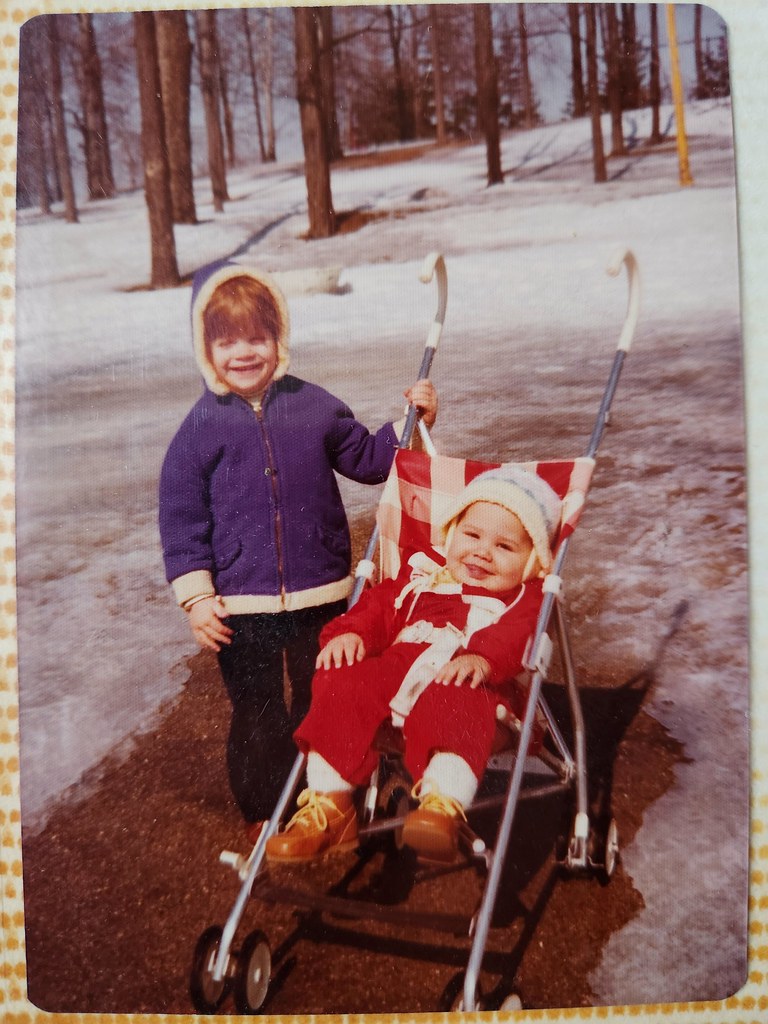
PS That’s me and my brother in Waterloo Park, when we were very young.
Page 1 of 1012345...10...»Last »