Category: Coaching
Monday, Jul 13, 2026 | Adventure, Art, Big Thoughts, Coaching, Exercise, Family, Friends, Fun, Manifest, Peace, Source, Space, Spirit, Writing, Yoga |
 “Flow is an antidote to transactional reality.” – Dave Evans, on Hidden Brain with Shankar Vedantam
(Note: This post qualifies as a “long read,” so take your time.)
I call myself a writer, but in practice, my medium is the simple state of flow.
Flow focuses on task, not outcome. Flow draws me into a sensory experience, a somatic experience that links mind and body and spirit seemingly effortlessly—how? In flow, I am wide open to the world around me, as if “I” were not bound by my edges, but a drop in an ocean.
Last week, I was mainlining episodes of Hidden Brain, the podcast by Shankar Vendantum that focuses on social science, psychology and communication. Recent episodes have been dovetailing with my interest in spiritual care. (I’m returning to school in September to start an MA in Theology, with a focus on Spiritual Care and Psychotherapy.) I’ve been jotting down notes, transcribing, and reflecting on the skills developed during thirty years, or more, of practicing the craft of writing, specifically creative writing, writing in pursuit of beauty, writing to illuminate some meaning that’s just out of reach, writing to sink into mystery.
“Flow is the experience of full and deep engagement, where time stands still.” – Dave Evans, again
From practice, I know—a simple flow state is ever-available, it is always here to step into, just waiting for me to arrive. Like a river, the flow runs alongside the distracted, anxious, needy experiences that riddle my life (aka being human!), and this river is here for me to swim in, drink from, dip my toe into, stare at, always available, so long as I am available, too.
I am not talking about heightened experiences of flow, about the “apex” flow experience. I am talking about simple flow. (Thanks for naming that distinction, Dave Evans.)
“Flow can occur when you’re operating in the flow channel. The flow channel [aka river?] is a place of experience where the task you are currently involved in and your skills to perform that task are in approximate balance. You’re neither over-talented, so you’re bored, nor under-talented, so you’re anxious and nervous you might fail. You’re right at the edge of your capability, which means this task is demanding your full attention.” – Dave Evans (and, here, he cited the work of Mihaly Csikszenmihalyi; see below)
I have been trying to find a name for a skill that seems to come easily, for me. I’ve called it, at times, “creating a welcoming space,” and it’s a skill that I’ve applied in different areas of my life, from running a workshop, to coaching soccer, to reading to kids, to hosting a party. Sometimes this skill gets called “leadership,” but that’s not quite accurate. It’s a directional skill that is also about ceding control. Essentially, I have become skilled, through practice, at ushering not just myself, but others, too, into simple flow moments. In these moments, we are in a flow channel—my river, their rivers, our river—and our collective capacity meets the collective task, so we neither feel anxious that we won’t be able to do the thing and also are engaged and present.
Basically, it’s directing attention toward a particular task that brings us in concert: into the same space, the same moment, so that we are part of a shared experience, which may be delightful, reflective, comforting, challenging, fun, but most importantly, is as spacious and as focused as possible.
“Each person allocates his or her limited attention either by focusing it intentionally like a beam of energy, or by diffusing it in desultory, random movements. The shape and content of life depend on how attention has been used.” – from Flow, by Mihaly Csikszenmihalyi
In practice, “directing attention toward a particular task that brings us in concert” (I need a better phrase for this) requires a certain amount of design, while leaving space for the unknown. Elements that can be considered in advance include: the removal of barriers or friction, an understanding of constraints, and a clear articulation of the goal and the tasks that give structure to the process. That sounds super-vague, and maybe I should be inserting an example here, but the details and context really make a difference in appropriate design; I tend to boil my design down to the simplest and clearest options for communication purposes, with the fewest foreseeable barriers to participation. The limitations and practicality of my design become clarifying only when the experience is rolling. I can see what’s working, and what’s not. I can make changes as needed—though preferably not in a reactionary way; I have to be comfortable with discomfort—my own and others’. Afterward, I may suffer from doubt, need to debrief, and seek to learn from the experience and tweak my design; but in the moment, and this is pretty much no matter how the task is unrolling, I experience a spaciousness and calm that feels freeing.
I am fully inhabiting my self and I am not bound by my self.
I think others feel it too, at least some of the time. And I think that’s all that’s happening—I am in the flow, and others are there with me too.
I’ve begun reading “Flow: The Psychology of Optimal Experience,” by Mihaly Csikszentmihalyi, and I’m reflecting on the concepts of “differentiation” and “integration,” which on first glance appear oppositional. How can I be both unique and connected at once? (It’s a big Life question for me—how to be an artist, which requires ridiculous amounts of time and energy focused on the particularities of a craft, while also being an attentive and connected parent, partner, friend, daughter, sister, etc.).
To be confident within my expression of self while feeling connected across barriers and boundaries—in communion with other people, ideas, art, nature. That’s flow.
Being myself fully and being fully myself with others—this is kind of the ultimate joy in life, isn’t it?
 “This simple truth—that the control of consciousness determines the quality of life—has been known for a long time; in fact, for as long as human records exist.” – from Flow, by Mihaly Csikszenmihalyi
You don’t have to make art to be in a flow state. What’s required is your attention. Attention is always possible, but not always available. Practice helps. Mindfulness is a starting point, meditation is good practice, but so is holding an infant and pairing your breath with theirs, so is sitting with a child who is sounding out letters on the page, so is getting up early to move your body, so is dancing, singing, walking with a friend and listening closely and learning to ask good questions, or watching the birds in your backyard till you feel like you know each one. The more you practice steering your attention toward what matters to you, the easier it becomes to inhabit liminality, to step from here to there, into the flow.
It’s so wonderful, it’s a wonderful state to inhabit, but there are so many distractions, our attention is constantly being pulled, and we only have so much to give.
How much control do we have over where our attention goes?
“With consciousness, we can deliberately weigh what the senses tell us, and respond accordingly. … Power returns to the person when rewards are no longer relegated to outside forces…. The most important step in emancipating oneself from social controls is the ability to find rewards in the events of each moment. ” – from Flow, by Mihaly Csikszenmihalyi
Where are your inner resources? I used to say this to my kids when they were small, and bored, needy, fighting, rolling on the floor. How I wanted them to have inner resources to pull from—imagination, creativity, curiosity, resilience, playfulness of spirit. (And I think they did, and they do!) How I want that for everyone, actually, myself included. And it’s not always possible, and that’s hard sometimes. There are times when external events knock me to my knees, and my attention fades, my “psychic energy” is poured into attempting to solve the insoluble, I become confused by ugly emotions, by grief and loss and self-doubt and pain.
And then … I need reminders, I need well-worn paths that lead down to the river, or even just get me close enough to hear the water rushing past, to trust that it’s still there. I need to give myself over. Maybe it’s a kind word from a wise friend at the right moment. Often I find entry into the simple flow most easily through my body—breathing; walking; stretching; sweating at the gym. Get me out on my bicycle, and suddenly I am more alive, more open to what’s flowing.
My discipline is writing. My practice is flow.
xo, Carrie
Friday, Mar 12, 2021 | Coaching, Confessions, Current events, Manifest, Space, Spirit |

A year, a year, it’s been a year. We’re all thinking about this, aren’t we. Where we were a year ago when we knew. When we knew that something big was happening to us, out of our control — something that was shifting the ground under our feet, cancelling our plans, sending us indoors to scrub all the surfaces, separating us from friends and loved ones, making the world go quiet.
A year ago, I was so busy, so squeezed for time, so exhausted, stretched so thin, that when everything got cancelled — the X Page workshop, soccer, school and kids’ activities, the gym — what I felt in the immediate aftermath was simple relief. I was so tired, it seemed I’d been operating on the verge of collapse. Suddenly, I could sleep, and sleep is what I did, sleeping, then staggering around in a blur, checking twitter a million times a day as if I could discover an accurate prediction of the future, or figure out how to assess risk. I suppose we’ve been trying to figure that out all year. A year on, we know more, collectively, about the risks and about what mitigates risk, including wearing masks, which we didn’t understand in those early months when instead we were bleaching the countertops and sanitizing the doorhandles and washing our hands till the skin cracked.
It wasn’t until just now, as the anniversary has come upon us, that I’ve recognized my own feelings of grief and loss. It’s been a year of pause. We’ve experimented, yes, we’ve tried new ways to interacting, we’ve baked sourdough bread, and gone for hundreds of walks, and helped each other out. Some of this is working quite well: I love doing yoga online in my own little studio; I love chatting with Grandma on Zoom. And I’ve loved having this extra year with all my children still living at home.
But … but … for me, as for many of us, I’ve lost some part of my identity, I’ve lost work and volunteer opportunities, my kids have lost much of their spontaneous social interactions with peers, and I have too.
Many of us have been more alone. Or, we’ve seen people we love struggle, being more alone, and we’ve been unable to help in the ways we ordinarily would and could.
And while I’ve learned a lot that I want to keep from this past year, I’ve learned, too, that it’s important to acknowledge what I’m carrying. And the truth is that this year has felt strangely empty, like lost time. I don’t know how to explain it. But there it is. Looking back across this year is like looking at a scene in which almost nothing moves. It’s quiet. I can hear the wind and the birds. It’s eerie, too. There’s something on the edges of this quiet that is unsettling; uncertainty; a continual unfolding in all directions toward an unknown horizon. That’s what I see when I visualize this past year.
Others will have a very different picture in their minds.
I haven’t been anywhere near the front lines. Those stories of this year would be completely different in tone and energy, learning, loss and grief.
Here’s the thing. I don’t know what I want to do next.
Part of me wants to burst with the coming hope of spring and vaccines and reopenings. Part of me waits, wary and cautious, unwilling to venture any guesses, or name any desires.
And part of me floats above all this, and says, hey, this day, this hour, this moment is what you’ve got, and you are safe, you are loved, you are not alone. Let yourself be here, unfolding out toward unseen horizons.
xo, Carrie
Monday, Feb 22, 2021 | Big Thoughts, Coaching, Confessions, Current events, Dream, Exercise, Feminism, Fire, Manifest, Peace, Politics, Source, Spirit, Teaching, Winter, Word of the Year |
Yesterday afternoon, I set out solo in the sunshine. I love the people in my house and I love my house; yet the need to escape was powerful. To move.
On the busier sections of path, snippets of conversation floated past:
“The single-best way to leave a legacy, guaranteed, is to have a lot of children—” (Spoken by one young man to another, both wearing sunglasses, coming toward me on the trail.)
“Actually, I had a bit of a set-back this week. My tennis friend called and said ‘I have bad news….'” (Two women crossing my path diagonally.)
The sun was so warm, I took off my scarf and hat, unzipped my jacket.
On the quiet stretches of path, I told myself stories about who I wanted to be, who I remembered being. Who knows what a calling is anyway? I miss interacting with people. I miss working with students, I miss coaching. I said this out loud, so I could really hear it.
I listened to an On Being podcast three times yesterday, while mixing and kneading bread dough, doing laundry, searing a small roast, chopping veggies (though not while out walking): Krista Tippett’s conversation with Ariel Burger. I listened and listened and listened, trying to absorb the wisdom.
Do not let anyone be humiliated in your presence.
It sounds very basic: a recipe for being a witness, not a spectator.
I wondered what to do if the person being humiliated was yourself; what then? (The podcast does not discuss power.) I see people who are hurt and wounded by their interactions with systems designed to crush and humiliate them, hurt by people acting within those systems, and I think: what protection is there against this cruelty, injustice? We are asking too much of individuals to fight for themselves, by themselves.
Maybe that’s the power of witness? If you can, if you are able, be a witness, a true witness, and do not let anyone be humiliated in your presence.
Be a blessing.
Be a blessing? How? Alone in my studio, writing stories? With my family? Reaching out to friends?
We are also called to be as strangers to each other, to recognize and acknowledge that others can and will surprise us, if we allow them to. If we approach each other (strangers, family, friends) neither from a place of fear, nor from a place of over-familiarity, what will we learn?
To be a blessing is to push against, as well as to meet. My ideas, experiences, perspective, beliefs will not match up perfectly with yours, no matter how we might wish it. Unity is not conformity.
The divine in me sees the divine in you.
But you are not me. I am not you.
To be blessed is to be given something to carry. A blessing can be heavy. It can ask a lot of the other, the one who is seen. As a coach, as a teacher, as a parent, what I hope to communicate is the deep value in trying; not striving, necessarily, it doesn’t have to be so strenuous; trying. To say: I tried, is to acknowledge your own effort. To say: You tried, is to see someone else’s, to name it.
There’s a lightness to trying. There’s acceptance that trying doesn’t always lead to success. There’s room for surprise. Experiment. Consider. Be blessed. Leap. What if you try and you discover something different, something unexpected, something you weren’t looking for? Isn’t that wonderful too? To try is to leave room for curiosity.
xo, Carrie
Thursday, Oct 8, 2020 | Big Thoughts, Coaching, Confessions, Current events, Exercise, Fall, Manifest, Meditation, Peace, Running, Spirit, Success, Word of the Year |
Be clear with yourself. It’s a practice worth practicing.
Be clear even when it’s uncomfortable. Be clear, even if you’re worried you’re letting someone else down.
This week has not been my best (see previous post …), but I’ve been noticing that it helps, in uncomfortable moments, to ask myself: What do you want to do? Are you doing it?
I almost always know the answer.
And just asking brings me into the present moment.
I can say, yes, this is actually what I want to be doing. Or hell no, it’s not.
If I am doing what I want to do, it becomes so much easier to keep doing it, but with a new perspective, a feeling of agency and freedom. Hey, this is what I’ve chosen to do! Maybe it’s harder than I expected, or maybe it’s not bringing up the feelings I’d anticipated, but I want to do it, I’ve chosen to do it, so I’m going to get on with doing it.
If it’s not, I can dig a bit, and find out whether the situation is changeable; often it is, even if it isn’t. By which I mean, often, the thing I’m doing that I don’t want to do is made less tolerable by what’s going on inside my head. An imaginary conversation. A pointless outrage. An excited or anxious or fraught connection to something that actually has no connection to my immediate well-being.
So, I ask:
Are you okay?
What do you want to do?
(And I remind myself: Don’t worry about what you think everyone else might want you to do — let go of imaginary projections. What do you, Carrie Anne Snyder, want to do?)
Oh. Okay, well, I’m right here, running in the rain, and what I want is to take the long way home, and there’s time, and my body can handle it, and now that I know these things, I’m feeling the rain and the wind on my face, and the breath in my lungs, and I’m okay. I know I’m okay. This is what I want to do, and I’m doing it.
xo, Carrie
Friday, Jul 31, 2020 | Big Thoughts, Books, Coaching, Confessions, Current events, Driving, Exercise, Family, Friends, Fun, Lists, Manifest, Mothering, Peace, Reading, Space, Spirit, Summer, Yoga |
July Reflections
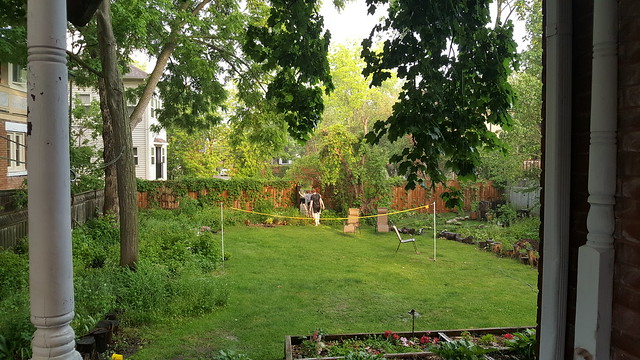
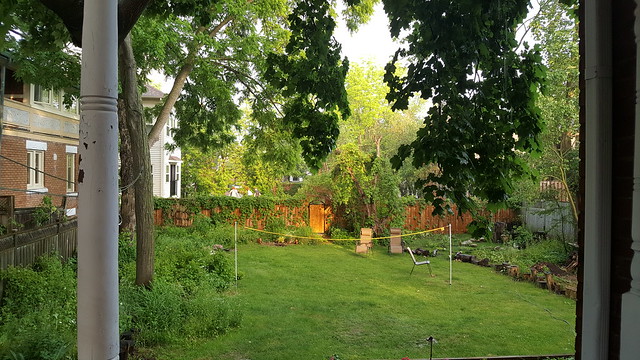
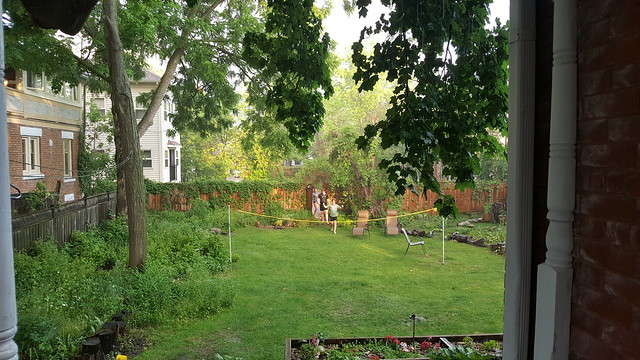
- What felt good this month? Being outside! The weather has been splendid (I live for the heat), and our back yard is inviting, lush, pretty, full of birds and wild critters (including skunks, but that discovery goes into a different category). I’ve been running regularly, never more than 5km, always early in the morning through the park. This past week, CJ and I have been on almost-daily bike adventures, on paths and trails and quiet streets throughout the city (and I’m so glad he’s still happy to go on adventures with me!). Annie and I do yoga outside every morning, and it’s bliss to lie back and look at the sky. Our family has been using the gazebo area to entertain friends, socially distanced, of course; meeting face-to-face is so much sweeter than Zoom, though I’ll continue to appreciate Zoom for making it possible to see each other when it isn’t otherwise feasible. We’ve been camping, we’ve lounged at the beach. Bottom line: I’m drinking up this season, positively gorging on it, while it lasts.
- What did you struggle with? Resigning from coaching soccer. It was a painful decision. But I wasn’t comfortable returning to the field this summer, and I had to make the call one way or the other. I’m a big believer in finishing what you start, and in not bailing on commitments even when it gets hard; but ultimately it didn’t feel like I was being asked to do what I’d signed up for. In truth, my decision came from deep in my guts, and when a decision rises from there, it’s important to listen. So I said goodbye to the players; with gratitude for other coaches willing to step in. For someone who has difficulty saying “No,” this has been a valuable process to work through. My mental health seems more stable this month, too, and I wonder whether the looming return-to-play was weighing more heavily on my mind than I was willing to acknowledge at the time.
- Where are you now compared to the beginning of the month? More chilled-out. I’ve been reading lots of books, and napping on the couch. Less Twitter too! Haven’t written much new material in the past two weeks … but it hasn’t felt imperative. What feels imperative is feeding my mind with new ideas, hanging out with my kids, seeing friends, sticking to an early morning exercise routine. To everything there is a season. I’m submitting to the flow.
- How did you take care of yourself? This month, I continued to tend to my physical and mental health. I’ve been countering negative thoughts with journaling. I try to notice when I’m being unkind to myself, and to assess whether it’s accurate or based on an irrational or subconscious pattern of thought. I’m doing tons of stretching and strengthening (physio homework). Texting/talking with friends is also good self-care, I realize. I’ve been telling my body how much I appreciate it. I’ve been trying to apply the idea of acceptance as a form of love to myself, as well as to my loved ones. Don’t we all just want to be loved and appreciated for who we are, flaws and all? Becoming takes a lifetime. We’re all going it at our own pace, so let’s walk there together, in kindness and generosity.
- What would you most like to remember? Standing in the driveway, listening to my mom tell stories about her past. Biking behind CJ as he learns to lead the way. Laughing around the campfire. Wind blowing through open car windows. The comet shining like a flashlight in the night sky. The sound of many many birds. Being in motion, going somewhere, even if just around the block. The sky.
- What do you need to let go of? Anxiety, especially about everything that’s out of my control. Maggie Nelson writes about “prophylactic anxiety” in her book The Argonauts (her marvellous, genre-defying, mind-stretching book). In fact, I’m noticing that it’s her own mother who cannot escape from this need to anticipate and rehearse for the very worst, at all times. Maggie Nelson quotes Freud’s definition of anxiety: “Anxiety describes a particular state of expecting the danger or preparing for it, even though it may be an unknown one.” My kids have been helping me notice the many ways in which I apply prophylactic anxiety, which I’ve preferred to call “vigilance,” to a multiplicity of situations in our shared lives. But you know—one cannot be ever-vigilant, ever-watchful. I cannot be. It’s a poor state in which to live one’s life. There’s no fun in it; dire warnings aren’t fun to broadcast or receive, and all but the most crucial are probably counter-productive. Is it the responsibility of a mother to prevent disaster? I feel quite certain that this has been the standard you-are-a-mother-and-this-is-your-job messaging. But maybe, just maybe, it’s not.
xo, Carrie
Wednesday, Jun 24, 2020 | Art, Big Thoughts, Coaching, Confessions, Current events, Dream, Fire, Green Dreams, Lists, Manifest, Spirit, Work, Writing |
Lately, I’ve been writing more in my own private journal, circular interior debates questioning my work here on earth (you know, basic existential navel-gazing). I’ve also been recording minor daily interactions that have become normal, but would have seemed strange pre-pandemic. Neither of these genres are blog-friendly, mainly because the posts are lengthy and, as mentioned before, circular. I go round and round, wondering and questioning and hopelessly meandering toward discerning … discerning what, exactly?
There’s the rub.
Lately, I’ve been:
Watching: Never Have I Ever (teen drama/comedy, Nexflix); Slings & Arrows (90s Canadian nostalgia, CBC Gem)
Reading: Untamed, by Glennon Doyle; Such a Fun Age, by Kylie Turner
Eating: greens greens and more greens from two different local CSA farmers
Doing: a 30-day fitness challenge with my soccer girls, which include planks and burpees; ergo, making myself get up by 7 every morning, making myself stretch, do planks and burpees, and ride the spin bike while watching Murdoch Mysteries (almost excessively Canadian, Netflix)
Now is the season of my case-by-case risk-assessment examination of each and every interaction proposed by a family member. It was always going to be easier to shut everything down than to open up again. We knew that. In practice, it feels brutal. What is the emotional cost of weighing the risks versus the reward each time a family member wants to get his hair cut, go to the mall, play outside with a friend? But truly, what it boils down to is: how do I decide, based on guidelines from politicians and public health and my own grasp of available data, whether I’m keeping my family safe or being over-protective? If you think it’s uncomplicated, well, that’s an opinion, one of many gradations of opinions on this subject, because we all have different thresholds, different information, different values, different interior emotional lives, different family dynamics, different pressures, different people we’re protecting, different fears, different experiences, different needs, different imperatives.
So, I revisit my friend Katie’s guidelines: STOMP. Space: more is better; Time: less is better; Outside: better than inside; Masks: important; People: fewer is better. (Maybe it could be SHTOMP, with the H for Hand-washing: often and well.)
Recent thought: What if, as I get older, I’m actually getting worse, not better?
Lately, I have no sense of myself in the wider world, or even in the small world of my own house. Lately, I feel no direction pulling me. I feel no peace, either. I am not content. I am dissatisfied with the state of the world, and with my own response to the needs crying out to be addressed. I am overwhelmed and muddled. I keep thinking that a major plot line will present itself to me, a direction. If I could join the revolution, where is that happening, and how, and can I enlist? What slogan would I write on my scrap of cardboard, to lift over my head, as I march down the street?
Black Lives Matter
No Justice, No Peace
Migrant Labourers Deserve Dignity and Rights (too long; writing slogans clearly takes talent)
Don’t Bring Guns to Wellness Checks!
Defund the Police
Universal Basic Income
Art is for Everyone
Pay All Essential Workers Like They’re Essential, Because They Are
Fuck the Gig Economy
Ban the Stock Market
Indigenous Lives Matter
Canada: We’ve Got Some Serious Work To Do
Cruel systems surround us. Unless we’re cut by them, we can stay blissfully unaware. If we’re the beneficiaries, maybe we’d rather not know, for when we do know, we don’t know how to untangle ourselves either. Systems are entrenched, heavy, crushing. I’m suspicious of any solution that puts the onus on the individual. But I can’t do nothing with all the everything I’m seeing!
For example: What would make it possible for people to work with dignity at jobs that we know are essential? What if, for example, people who love farming could afford to be farmers? What would that look like? Why do we accept profit as the most important goal? Who benefits from the push for corporate-style agriculture with heavy equipment, ruinous pesticides, antibiotics, fertilizers, and a low-paid migrant labour force? Where is the dignity in that? What if human dignity (and, by extension, environmental dignity) were the focus for all systems instead? I imagine this every day, and I haven’t got a clue what work to do to get us any closer.
One precious life, one precious life, one precious life, and what am I going to do with it; what am I doing with it? What I want to make manifest boils down to this: Dignity for All.
xo, Carrie

 “Flow is an antidote to transactional reality.” – Dave Evans, on Hidden Brain with Shankar Vedantam
  “Flow can occur when you’re operating in the flow channel. The flow channel [aka river?] is a place of experience where the task you are currently involved in and your skills to perform that task are in approximate balance. You’re neither over-talented, so you’re bored, nor under-talented, so you’re anxious and nervous you might fail. You’re right at the edge of your capability, which means this task is demanding your full attention.” – Dave Evans (and, here, he cited the work of Mihaly Csikszenmihalyi; see below)
 “This simple truth—that the control of consciousness determines the quality of life—has been known for a long time; in fact, for as long as human records exist.” – from Flow, by Mihaly Csikszenmihalyi