
October reflections
October Reflections
- What felt good this month? This is a challenging question to start with. It’s been a hard month. What’s felt good? There have been some things! Methodically digging into my novel-rewrite has felt good and necessary. Writing a reflective essay for The Scales Project was absolutely wonderful. Thankfully, my long-established habits and routines have kept me afloat: running and yoga, even if the morning runs now happen in the dark. No matter how bleak I’ve felt, I get out of bed and exercise at an early hour, five mornings a week. Hanging out in Kevin’s “back yard shack” is the best, especially with friends. On Fridays, Kevin and I have been ordering take-out and eating outside by the fake fire, just the two of us. And my studio is a warm, welcoming cocoon to retreat to, for writing, planning, reading, stretching, relaxing, napping.
- What did you struggle with? Depression, in all honesty. I had some lows that felt lower than usual, and I stayed low longer. Thankfully, I was able to reach out and get help. And the help helped. I noticed that what also helped was digging more deeply into my writing work. It was a life raft, keeping me afloat, giving me purpose when the days felt otherwise blank and empty. Cooking and chores actually helped too. I think it’s a privilege to be needed, or to feel certain that one’s work is valuable and valued. I’m not always convinced of that, and that’s when I fall down into the deepest holes. This feels like a pretty dark confession. But I’m compelled to say these things out loud, because shame thrives on silence, and because I think others may be feeling similarly, especially anyone who’s lost their job, or is in a liminal period in their life. Purpose and meaning make life worthwhile. It can be hard to function without being connected to that.
- Where are you now compared to the beginning of the month? I can’t really grasp where I was at the beginning of the month, which makes it difficult to compare. Apparently I was feeling calm at the end of September? Given that I’m on about draft five of trying to answer this question, what I’m feeling right now seems to be distracted, discombobulated, and wondering what the heck is going to happen. The American election is three days away, and I’m feeling wary of false optimism, and wary of “endings,” especially of this belief in some definitive happy ending that appears as if by magic. If the pandemic has taught me anything, it’s that the answers in a crisis, as in ordinary life, change with the circumstances, require monitoring and reassessment, and must shift to take many factors into consideration. In other words: there are no easy answers. Related to this, at least in my confused mind: It seems a particularly American flaw to admire the huckster, the grifter, the entertainer, the fraud — the person who can make a buck out of nothing more than a talent for deception — and even though I’m a fiction writer, I don’t believe in personal deception as a solution to life’s challenges.
- How did you take care of yourself? Meditation, podcasts, reading silly mysteries, stretching, naps on my warm office floor, kundalini yoga, walks with friends, running, yoga, a regular bedtime, beer on the weekends.
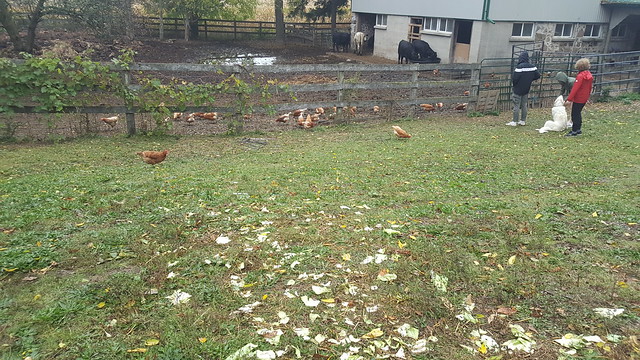
- What would you most like to remember? I’m not going to remember much from this last month. But one really happy memory is the afternoon I drove the kids out to the country to pick up our Thanksgiving turkey. It was raining, the turkey line was long, and absolutely no one complained. The kids went over to the barn area and watched the chickens, pigs, and cows, and petted the dogs. No one was in a rush. The outing was mellow, chilled-out, and completely satisfying, and would only have happened in covid-times, when we’re all kind of starved for entertainment and stimulation, and a drive to the country to watch a chicken drink from a waterspout counts as memorable.
- What do you need to let go of? I’ll let go of my need for things to happen, maybe. Or no. I’ll let go of my need for things to happen in a particular way, according to expectation. I’ll celebrate when I respond according to my values, and forgive myself for not being perfect or better or best.
xo, Carrie
One two step
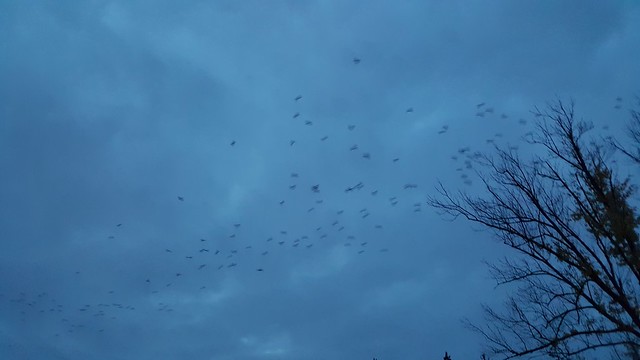
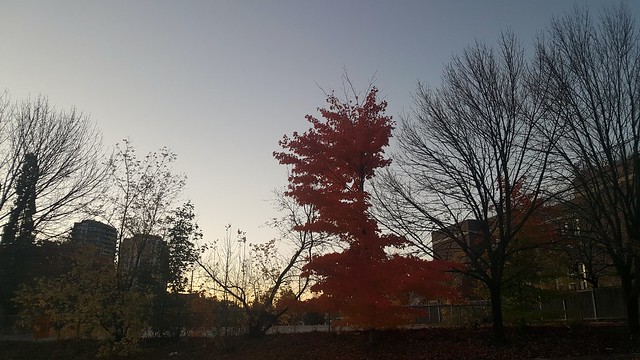
I’ve been pausing to take photos of the morning, the early morning light and sky and trees, as they change. The days are shorter, and now I run in darkness especially when it’s recently rained, as it had last night. This morning I’d already decided that I would stop at the bottom of a hill on the opposite side of the park, to get a different view than I usually do. I’d pulled out my cellphone when the sky filled up with birds. They flew toward me and then on and on, a great stream of them; it looked like they were heading north, not south.
I don’t wear my glasses to run, and the result is photos that are often slightly (or wildly) out of focus.
But my writing life feels more in focus, both this week and last. I’ve been working on revisions, and have been grateful for the energy to be methodical in my planning and execution. Last week, when I was feeling so low, the novel was a complete escape; I needed it, I could see that. I needed something big and whole to tether me to purpose, something outside of myself, that would carry me out of my body and mind into the bodies and minds of other people. Characters. Avatars embodying my questions and testing my theories about how to be (or not to be).
Fiction is escape. Writing fiction is immersive. Like plunging into another bloodstream, or being set free into a new landscape that isn’t mine to tend and repair, only to wander through like a voyeur. Looking through windows. Inside cupboards. What’s on the bathroom floor? I don’t have to pick it up, clean it up, I just get to snoop through imaginary rooms, imaginary weather, climb imaginary trees, hum imaginary tunes in someone else’s dreamy voice. Feel imaginary sadness; that too. And I get to come through it, by piecing together a puzzle so all the edges fit and make sense, the way real life never does, never can.

This morning, I was wearing headphones, listening to my “Run Fast” playlist. Missy Elliot was playing. But I could hear the birds.
(As I ran on, up that hill and turned down a very dark stretch, and the birds kept coming, all I could think was: Please don’t poop on my head!)
Goodbye, goodbye, hello, hello, good morning.
xo, Carrie
What to do when you’re having a bad day
What to do when having a bad day? Or a bad couple of days? What does that even mean, to have a bad day?
For me, it means feeling extremely low in spirit. And it happens. I’m trying to track these low days, to figure out whether there is a pattern. On Monday, on my desk calendar, I wrote: “feeling very low.” On Tuesday: “still low.” Today I didn’t write anything, probably because I am feeling a bit better.
I’ve noticed a few things, during these low couple of days.
First, I noticed that I’d quit Twitter and hadn’t replaced that social media scroll with anything in particular … which sounds amazing and very healthy and all the rest of it, but in fact, has contributed to this low feeling, because Twitter and doomscrolling was exactly as soothing as any addiction, it was a distraction from my own inner life, and without it, I’m left facing: my own inner life.
And a whole collection of anxieties, fears, doubts, and nameless sadness lurks inside here. It was easier not to notice when I was busy distracting myself.
This is the push of the pandemic as a whole. It dares us to pause and observe what’s waiting to be noticed underneath our once-busy schedules, our racing around, our frantic quests for acknowledgement and personal satisfaction. Here I am.

What’s come up this week is a recognition that I’m still struggling to come to peace with certain childhood indignities, specifically the feeling of being an outsider always looking in but never fully understanding what’s going on (we moved often, and lived in a few different countries); being an outsider gave me the gift of observation, but what I’ve been more reluctant to acknowledge is that it also dug a hole of insecurities that manifests in unlikeable and unpleasant ways when I’m feeling … well … low …
Oh, how I attempt to protect myself from even the smallest rejection, from loss, from disappointment.
For example. I had a mini-tantrum at the dinner table several nights ago, when I wanted the last piece of pie and didn’t get it. I could have had a tart instead, but I wanted that last piece of pie and, also, I thought my children should have appreciated and loved me enough to give me the last piece of pie. (They may not have seen that piece of pie in quite the same way). I said (and this is an exact quote): “If I don’t get what I want, I don’t want anything at all.” I might as well have stomped my foot before running out of the room. I mean, I didn’t. I spoke in a calm and rational (if petulant) tone, but the words and the feeling were undeniably childish; and I did leave the room. One of my kids said, Mom, I can’t tell if you’re kidding right now. And my inner child said, I’m not kidding!

This got me thinking about two guiding principles I’ve been living by, and would like to stop living by, mostly because I hadn’t realized until recently that I was living by them.
The first is: Save it for later.
The second is: If I don’t get what I want, I don’t want anything at all. Or: I’d rather quit than lose.
Save it for later, as my siblings could tell you, goes back to early childhood, when I would hoard my Easter bunny, uneaten, for MONTHS. The end result, predictably, was that the candy became completely inedible, melting into a sticky disgusting mass hidden away in my sock drawer. This had the effect of not only depriving me of enjoying the original treat, but also of depriving anyone else of enjoying it too. It’s quite possible that I actually didn’t like chocolate Easter bunnies and could have given the candy away to my brothers; but I didn’t. Instead, I hoarded it like I was preparing for the apocalypse. The perfect time to eat it simply never came. Note to self: It never will.
I still do this. I’m trying to change that. I’m trying to eat the chocolate now, or share it, if I don’t want it. I’m trying to treat myself, and others, to little luxuries, today, right now. It takes practice. It’s a pretty sweet practice to practice, though.
I guess the outlook is to change from a scarcity mindset to a mindset of plenty, of abundance; not hedonism, but simply enough.
I’d rather quit than lose, my siblings could also probably weigh in on. Suffice it to say, it’s a shitty way to live a life. And I’ve only just noticed that this tendency is bubbling up in me again; thought I’d cured it over the years by committing to do a bunch of things I was guaranteed never going to win at—like running races, or coaching soccer.
This mindset comes with its own sub-mindset that is a bit more complicated, but summarizes roughly as: If this is as good as I’m going to get, I’m outta here. It’s about sensing when I’m reaching my own limitations and becoming frustrated with my inability to progress. I know this was part of what frustrated me with coaching, and with teaching; I was okay at both, learned lots and absorbed lots pretty quickly, but plateaued: it would have taken so much work to get even incrementally better, and it started not to seem worth it. I don’t like being okay at things. I like to be (dare I say it?) the best.
I’m going to dare to say it, because it’s my only chance of excavating that belief, and leaving it by the side of the road.

To sum up (should I even try to sum up this mess of a post???) …
Remove an addiction and you’re going to notice issues surfacing that were conveniently masked by said addiction.
This is a bit scary. But maybe your childhood self has some messages you’ll be able to hear again. Maybe you’d like a shot at changing some of those things that are, admittedly, painful, even excruciatingly painful, embarrassing, humiliating, frightening, etc., to notice.
One last thing: Make sure to tell someone if you’re feeling low. It’s really really hard, and it really really helps, just to confess out loud: I’m struggling here. Here’s the thing: other people can’t read your mind. I know it’s hard. But reach out and tell someone. The alternative is to keep sinking lower and lower, and that becomes quite a dangerous thing. Just so you know, I did reach out and talk to someone, and it made me feel almost instantly better. Didn’t fix the lowness, exactly, but immediately I felt less alone. My inner child was so relieved.
Find your safe person, or a counsellor. Please. A bad day can feel like the end of the world; it doesn’t have to be. You might feel selfish or foolish or ashamed to be asking for help, especially if you’re seen as (or see yourself as) a high-functioning person who wears a mask of competence. We’ve all got our masks on, and sometimes the person behind the mask just needs to take it off and be seen.
My goal is keep my mask off. Someday. Meanwhile, I’ll be over here, helping my inner child through the important life experience of not getting the last piece of pie.
xo, Carrie
Questions for an intolerable moment
Be clear with yourself. It’s a practice worth practicing.
Be clear even when it’s uncomfortable. Be clear, even if you’re worried you’re letting someone else down.
This week has not been my best (see previous post …), but I’ve been noticing that it helps, in uncomfortable moments, to ask myself: What do you want to do? Are you doing it?
I almost always know the answer.
And just asking brings me into the present moment.
I can say, yes, this is actually what I want to be doing. Or hell no, it’s not.
If I am doing what I want to do, it becomes so much easier to keep doing it, but with a new perspective, a feeling of agency and freedom. Hey, this is what I’ve chosen to do! Maybe it’s harder than I expected, or maybe it’s not bringing up the feelings I’d anticipated, but I want to do it, I’ve chosen to do it, so I’m going to get on with doing it.
If it’s not, I can dig a bit, and find out whether the situation is changeable; often it is, even if it isn’t. By which I mean, often, the thing I’m doing that I don’t want to do is made less tolerable by what’s going on inside my head. An imaginary conversation. A pointless outrage. An excited or anxious or fraught connection to something that actually has no connection to my immediate well-being.

So, I ask:
Are you okay?
What do you want to do?
(And I remind myself: Don’t worry about what you think everyone else might want you to do — let go of imaginary projections. What do you, Carrie Anne Snyder, want to do?)
Oh. Okay, well, I’m right here, running in the rain, and what I want is to take the long way home, and there’s time, and my body can handle it, and now that I know these things, I’m feeling the rain and the wind on my face, and the breath in my lungs, and I’m okay. I know I’m okay. This is what I want to do, and I’m doing it.
xo, Carrie
This too shall pass, right?

Confession: Today, it feels like I’m totally out of juice. I’m out of steam. I’m bored of myself. I’ve reached an intense sensation of ENOUGH! My impatience with, well, everything that seems to cross my field of vision is competing only with my indifference. It’s unusual that I feel like I don’t care. Today, I don’t care. I just want to be finished with the presidency of Donald Trump, and also the pandemic, and, autocracy and incompetence and gaslighting and gilded mediocrity and the racism infecting all of our systems. I’m done with people going hungry in countries like ours where there should be enough. I’m finished with people getting rich off people being poor. My own life is pretty sweet and easy. Objectively, I’ve had a pretty sweet and easy day, writing, biking, running, laundry, helping a kid make supper. So I shouldn’t feel done or tired or like switching off. But I do. I hope this too shall pass. This too shall pass, right? But what comes next and will it get worse, and sadder and harder? There are some people I want to hug.
xo, Carrie