Category: Stand
Wednesday, Oct 23, 2019 | Art, Big Thoughts, Dream, Feminism, Fire, Friends, Good News, Lynda Barry, Organizing, Space, Spirit, Stand, The X Page, Work |

After a summer to reflect on The X Page workshop and its reverberations, our ad hoc collective is preparing for a second season, with new workshop sessions starting in January, 2020.
In connected news, I’ve been freshening up my website, and have built a new page devoted to The X Page — please visit, look around, share. We are currently in the process of seeking candidates for the next season, so if you’re in the Waterloo Region, and you’re interested or know someone who might be, send them here.
The original project was a lot of work, there was no way around that conclusion, and many of us felt burnt-out following the final performance. Our discussions this summer circled around how to make the project sustainable for all involved, and we began to define the different leadership roles with more specificity, create a long-term plan for funding, and identify elements from the original production that could be revised or reframed. We also wanted to make space within the workshop for former participants to return in leadership roles.
For the 2020 season, The New Quarterly literary magazine has taken over a number of administrative tasks and responsibilities, which frees me and Lamees (who co-coordinated the first workshop with me) from much of the grinding effort necessary to get the project off the ground. I’m excited to be the production’s “stage manager,” a role which I rather accidentally filled last time around (and loved!), while Lamees will be working more directly with candidates during the recruitment process. I’m thankful for our ongoing conversations with Pamela Mulloy, the editor of The New Quarterly — and with others — as we continue to learn from and develop this project. This is not a static process.

Personally, it’s been a gift from the universe to be able to work on a project that combines so many of my interests, including Lynda Barry’s life-changing exercises (the “X page” of the workshop’s title), multi-disciplinary creative team-work, and the power of personal storytelling. I’ve got a running theory that the antidote to (and inoculation from) xenophobia, misogyny, and fear of others’ cultures, religions, and beliefs, is immersion in stories. You can’t sit with someone and listen to their stories without being changed in some way. Especially the particular stories that emerge from Lynda Barry’s X Page — stories that may on their surface appear ordinary, every day, but therein lies their power: X Page stories are rich with sensory detail, evoking images that transfer from speaker to listener, images that pull us directly into another human being’s experience. Being part of this process, through the workshop, is powerful.
Please spread the word.
xo, Carrie
Tuesday, Oct 15, 2019 | Big Thoughts, Coaching, Confessions, Fall, Meditation, Play, Sleep, Soccer, Stand, Yoga |
I have a lot on my mind. And somehow that has translated into silence. How to sift through the jumble and identify items worthy of sharing? I seem to exist in a fog of confusion, at least right now.
Last week was absorbed by creating a roster for this season’s soccer team. A painful, heart-rending process, in all honesty. Humbling and bruising, too. A large part of me rebels against the levels imposed by competitive sport that claim to filter children into good, better, best. It isn’t an objective process, yet it’s treated as such; worse, there’s an implicit assumption that the teams themselves are good, better, best, based on level alone, and that a child’s experience would therefore be improved by moving up, and would deteriorate by moving down. I know what I can offer, as a coach, but within the competitive framework, it often feels like what I can offer doesn’t actually matter.
I’ve been waking in the middle of the night, unable to fall back to sleep. Mind racing. Body restless.
Not thinking about these things, exactly, but about the everything, the jumble, the chaos of a world that claims to be about one set of rules and values, while operating on a completely different set of tacit rules and values. Winning. Winning by any means. Power. Shows of dominance, especially rage. Shaming. Placidly public corruption. Lies. Assume everyone is lying to you, or you’re naive. Well, dammit, then I’m naive! The values we encourage our children to adopt could almost appear cruelly out of step in the context of this greedy, ego-ascendant world: be kind, share, be trustworthy. But that’s what I want to be and to do.
That’s the space I want to hold open.
I keep picturing the frame we teach players to make with their arms, to protect the ball and box out the pressure. It’s a strong stance, but not aggressive or violent or dirty — you don’t lift your elbow to hurt the attacking player, you simply use the steadiness of your body and of this frame you’re creating to hold your ground.
The conclusion I keep coming around to, amidst all the confusion and noise, is: I want to be kind. It’s actually almost the only thing I want to be. I don’t think much else matters to me, in the end, and in the right now. I accept that kindness can go awry, that the road to hell is paved with good intentions, that kindness, offered in ignorance, can cause suffering. And maybe I’m talking about something bigger, deeper, wider than kindness. Maybe I’m talking about love. Love; and attention. But it’s easier to start with kindness. Kindness is easier to grasp in the moment.
There is a mantra that’s been keeping me grounded, as much as it’s possible to be grounded, whenever it feels like I’m whirling away or spiralling down: I am loving awareness. It helps when I’m worrying about being judged, or am judging others, when I’m second-guessing my choices, or letting external pressures and feedback (real and perceived) affect my state of mind.
Here’s a ten-minute meditation to sit with.
(If the visuals in the video turn you off, just listen to the sound. Or don’t listen to anything at all, just repeat the phrase I am loving awareness, till you know it’s true.)
xo, Carrie
Monday, Sep 23, 2019 | Big Thoughts, Books, Confessions, Peace, Space, Spirit, Stand, Work |
Here I sit, Monday morning, trying to distill my thoughts into a package tidy enough to make sense. I’ve been reading “How to Do Nothing: Resisting the Attention Economy,” by Jenny Odell, which is not the type of book I usually manage to wade all the through; non-fiction seems to take me a long time to process, especially when it’s offering new ideas or new ways of looking at the world. Odell uses stories from her own life and experience to analyze different forms of attention, and different ways of being in community with others: with humans, with animals and birds, with ecosystems, with any animate or inanimate being that exists within our particular intersection of time and space.
Here’s a quote that jumped out at me, as I read this morning (Oh, yes, I’m trying to start every weekday/work morning by reading a book): “A community in the thrall of the attention economy feels like an industrial farm, where our jobs are to grow straight and tall, side by side, producing faithfully without ever touching. Here, there is no time to reach out and form horizontal networks of attention and support—nor to notice that all the non-“productive” life-forms have fled.”
Immediately, I thought of my life as a contract lecturer: how lonely it was. How, when I asked an administrator how many other contract lecturers there were at the university and whether there would be some way to reach out to others, to attempt to form a community, share stories (and possibly even to organize for better working conditions), I was told that no one knew how many lecturers there were, and that there was no easy way to identify and contact others who shared my situation.
How many people work jobs like this, now? Part-time, contract, isolated, without benefits or protection, jobs with no guarantee of future contracts, temporary, often with baffling administrative or online systems to learn and negotiate, no set hours, and workloads that creep outside the boundaries of what we’d thought we’d signed on for, our value measured by anonymous evaluations. “Producing faithfully without ever touching.”
It’s a recipe for burn-out. In my experience, it’s not a sustainable way to live a life. But this isn’t a post about disappointment. Because the next thought that came into my mind was how different life can be, if you have the ability (and privilege) to step away from “producing faithfully” and turn instead toward the networks of attention, support, and all the non-“producing” life forms that continue to exist. What am I willing to sacrifice in order to afford a different pace, a different way of being in the world?
Most obviously, I’m willing (and temporarily able) to sacrifice a regular paycheque. I’m willing to live with more risk, to invest time into projects that are underway or unfolding, but not yet profitable (and which may never be profitable). I’m willing to live with uncertainty. I’m willing to live in a nebulous zone of invisible productivity where others may not understand what I’m doing, or why. I’m willing to give up status and authority. I’m willing to *not* be too busy. I’m willing to say no. I’m willing to protect my time to go for walks, to read books, to draw, to write, as fiercely as I would any task deemed important or productive. I’m willing to work inefficiently.
Do I squander my time when I cook a meal from scratch? Is it a waste to go for a walk with the dog and notice trees, birds, other dogs, to stop and talk to neighbours out walking with small children and dogs? Is napping wasteful? I think most would agree that, no, these things are not wasteful; and yet, I feel a shame and guilt as I write this, because there are so many people expending their time and energy to do and achieve big things, or just to survive. Cooking, walking, resting, stopping seem like luxuries only a few can afford. I wonder: is that true?
One final thought, arising from this quotation: how necessary, how critical, how important to our survival as a species is the collective—the opposite of being alone, or being isolated from others who would both support and challenge us. Odell writes about how the self is not, in fact, a fixed property, even if algorithms may insist on its fixedness, and how boring life becomes when our likes and dislikes are made to seem predictable. In fact, we need to know and care about others who aren’t like us: to expand our understanding and empathy, to help us see in new ways, to live interesting lives.
Maybe that’s all I’m after: a life that interests me, not because it’s full of drama, excitement, glamour, but because its fundamentals are present to me in the smallest ways, the most mundane places, the simplest interactions. Fundamentals: birth, death, relationships, conflict, love, beauty, pain, the air, the ground, the sounds, my material self, the spirit. And so here I sit, recommitting to the responsibilities that I’ve decided matter to me; alone, but not feeling alone. Thinking of groups of people with whom I’ve formed bonds; thinking about what it means to be on a team; thinking about everything else, animate and inanimate, that is present with me in this time and this space.
Here. Now.
xo, Carrie
PS

Unrelated to this post, but worthy of an update via caption: our team won the cup final to cap off our season.
Monday, Aug 5, 2019 | Confessions, Death, Driving, Family, Peace, Spirit, Stand, Summer |
Erase, and try again. Erase, and try again.
I sit down at my desk to try to write, wanting to scream. Maybe that’s the problem. I want to scream, not write. I want to rant, not write. I want to tweet my rage, not write.
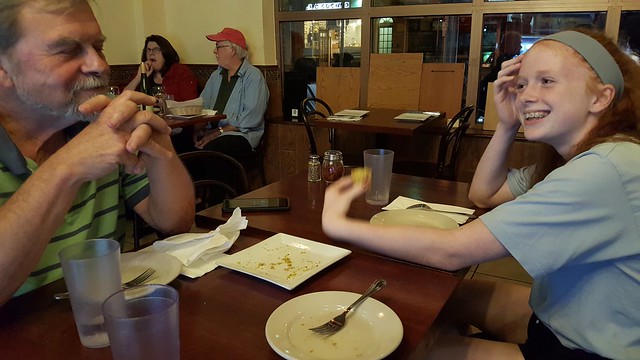
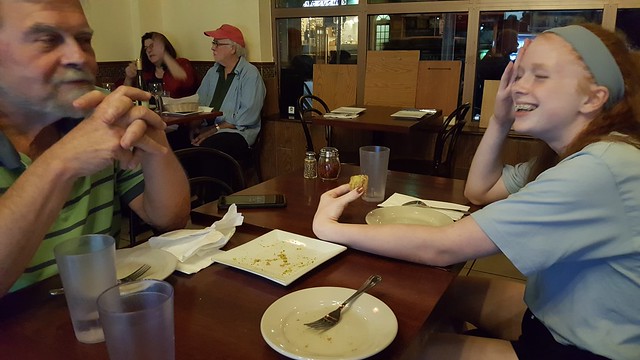
On Friday, my dad and daughter and I drove to Princeton, New Jersey for the funeral of my dad’s uncle, my grandma’s younger brother, who passed away in June at the age of 93. He and his wife had been married for 68 years (makes our 20 sound like a drop in the bucket!). The drive was long, but Dad brought lots of snacks, and we enjoyed the conversation and the scenery. Friday night, rather late, we had dinner in downtown Princeton at a Turkish restaurant, a feast that included a surprise delivery to our table of fresh-baked pitas, which we dipped in house-made hot sauce. We were tired, but we were happy. Flora and I stayed up late watching Friends. On Saturday morning, we breakfasted at the hotel with Grandma and her younger sister and her sister’s husband (who live in Argentina), and my aunt and uncle, who’d all travelled together from Indiana. It was fun. Grandma took one look at me, and sent me back to my room for a sweater (she was sure I’d be chilled due to the A/C), and then led the way, and organized the seating, which should tell you something about her character. She’s 97! I wanted to shout to the room in general, because, honestly, no one would ever guess it.
We dressed up, went to the memorial service and interment, sang, prayed, heard beautiful music. Met relatives. Visited.
Went back to the hotel to change before more family time that afternoon. Turned on the TV. News of a shooting underway in El Paso, Texas. Turned off TV. Pushed news out of mind. Changed, drove to a quiet tree-lined street near downtown Princeton, the home of one of my dad’s cousins. Feasted on a magnificent spread of appetizers. Went for a walk with Flora. Met more relatives. Visited. Listened to grandma and her sister and sister-in-law tell stories. Laughed. Feasted on a magnificent Argentine meal prepared by my dad’s cousins. Argentine music on the stereo. Red wine. Grandma having to be forcibly stopped from helping with the dishes.
Back at the hotel, Flora and Dad and I visited with Grandma in her hotel room. I returned the earrings I’d borrowed from Grandma. It was Grandma who asked whether we’d heard about the shooting. “He’s evil,” she said. She meant Trump. If you knew my Grandma, you’d know that word was not one she would use lightly. The ferocity of her emotion surprised me, even if I was feeling the same.
Flora and I spent the rest of the evening goofing off, wandering the hotel, making ourselves tea, tried to stay up late again to watch Friends, but fell asleep instead.
When my alarm sounded at 7AM, I turned on the news, using my CBC radio app — news from Canada. “Almost thirty people killed in less than 24 hours in mass shootings in the United States …” I thought more people had died of their wounds in El Paso, but no — there had been a second shooting overnight, this time in Dayton, Ohio, a city not an hour from where I grew up. The shooter was killed by police within the first minute that he opened fire, but he still killed at least 9 people; this is the scale of damage that can be done with an assault weapon, and in a world where anything made any sense, it would be evidence to silence the “good guy with a gun” theory forever.
In the breakfast area of the hotel, the news of both shootings played on the large-screen TV. The hotel’s guests were visibly disturbed. The feeling in the room was something unlike anything I’d felt before. It wasn’t shock. It was bewilderment, horror, shame. This keeps happening. This is not an anomaly. This is the new normal. How can this be?
Nevertheless, we had a fun, sociable breakfast with Grandma and everyone else. Briefly, though I don’t think we wanted to go there, the conversation tilted to the causes of this violence. White supremacy. Gun culture. Trump. Racism. White evangelicals — how could they support Trump? But even within our group there was no unity on the solutions. Maybe there are too many solutions, rather then too few?
After our goodbyes, we packed up for the long drive. About half an hour north of Princeton, we drove past Bedminster. It was only later that evening, at home, when I was scouring news sites for opinions and information, that I saw Trump had given his statement (paltry, weak, vague) at his estate in Bedminster, New Jersey. I said, “We drove right by that monster this morning!” And then I thought, good grief, that word rolled out of my mouth unprompted. Do I actually believe he’s a monster? If I call him a monster, what does that make me? And I felt as if rage and hatred was a hole down which I did not want to spiral. Yet I couldn’t turn off the news. I kept scrolling and scrolling, looking for some kind of answer to questions I couldn’t even form. I stayed up till my phone battery was almost dead, at which point, I left my phone downstairs because I knew if I brought it up to bed, I’d never sleep. Would the shootings have affected me in the same way if I hadn’t been in the States when they’d happened? If I hadn’t felt that collective bewilderment in the breakfast area of a Hampton Inn on Highway 1 near Princeton, New Jersey?
This can’t be healthy — and by this, I mean this obsession with the news, in particular this news (though I’ve also been obsessed, this summer, with news of climate change and melting ice, and the murderers, teenagers, crossing Canada, who haven’t been seen for two weeks, whose motives seem linked with the nihilist beliefs of these American shooters). Should I turn it off? Hide my phone? Do I struggle to turn it off because I’m addicted to the feelings of rage and horror this news incites in me?
I feel a need to respond, and not with tweets or rants. To protest. To be an activist. To try to change the way things are. To work to make a better world. To identify possible change and bulldoze toward it. But I also feel very very tired. Overwhelmed. Bewildered. It’s too much. Enough. Do something!
But what? What narratives am I creating? Isn’t it my job to respond with narrative? A narrative is purposeful and directed, but the news confuses me. A confused mind cannot create narrative. Somehow, I have to un-confuse my mind, and also my spirit.
xo, Carrie
Sunday, Jul 14, 2019 | Blogging, Politics, Spirit, Stand, Writing |
I’ve been sitting down to write this blog post for a few days, but it keeps changing on me. Circumstances keep changing. Time keeps moving and things keep happening, and I can’t decide what, exactly, I want to say. I even wondered, last night, whether maybe it was time to stop publishing random inner thoughts on a whim, sending them into the universe without taking time to reflect on why I’ve wanted to share what little I know (or think I know). But here I sit again, typing words into a blank rectangular space.
I write in other places too. I write in my notebook, in pen, words few people could decipher even if they tried. I like not knowing what will come of that material; I like knowing it’s likely nothing will come of it, and it will just exist as a muddy river of unfiltered thought.
I also write stories, using Scrivener or Word, and that always feels like I’m doing something different, too, than what I do here, on this blog. There, I have time, I take time, sometimes years, going over and over the lines of neatly spaced words. I polish. I revisit. I consider. I restructure. It’s satisfying, and while I do write these stories knowing they could be published, someday, the outcome is difficult to guess and in some ways doesn’t matter. I have to work them over till I feel done with them, or they’re done with me.
This blog is a different space. Immediate. Gratifying. Immediately gratifying. When I skim through the years’ worth of postings (nearly 11 years, now), it’s like looking through a scrapbook. Quite pleasant, though I don’t do it often. It can feel like I’m looking at a stranger’s life, in some ways. I’ve been and done many things in the past 11 years, I’ve had my enthusiasms, responsibilities, interests, routines. I’ve been knocked off the path by fortune and misfortune. As ever, I don’t know what happens next, exactly, but I trust that more change will come, and I’ll be pulled onward, to new (or seemingly new) revelations, interests, insights, and errors. There will always be something to write about, in one medium or another.
I had an experience on Friday night that disturbed me; I can’t think what to do about it, so I’m writing about it here. On Friday afternoon, I went to Stratford with my sixteen-year-old daughter, who is off to camp this weekend for a month; we saw Billy Eliot, a musical that confronts ideas about masculinity, among other subjects. That same evening, Kevin and I went and saw Booksmart, a movie about best friends graduating from high school, that was also endearingly, hearteningly queer-positive without making a big deal of it. I could think and imagine that the world was becoming (had become) a better place, a safer place. And then, almost as soon as we’d left the movie theatre, Kevin and I found ourselves in between two groups of young people who were shouting at each other. Actually, it was really only one young man who was doing most of the shouting, and what he was shouting was disturbing, bigoted, violent. He was with a group of other young men, and while I don’t think they participated, they also didn’t intervene. They all looked the same to me: white, early twenties, athletic, clean-cut. The angry guy was shouting past us, at a teenager in a red sweater who was standing some distance away with two friends, a young woman and a young man. It ws the boy in the sweater who was the target of the other man’s rage.
I don’t want to repeat the language used. It was derogatory and homophobic. And finally, the kid in the sweater, whose body language said that he was tired of this, weary, not quite resigned, shouted something back. And then the other guy really cut loose. One of the things he shouted at that point was “you little bitch.” I turned around when he said that, because I wanted to shame him, because I wanted him to know that people were paying attention, and the angry guy said, “Ha ha, not you, you’re fine, I was talking to that other bitch, the one in the red sweater.” And then he started shouting again, possibly because I lifted my middle finger to him (not my finest moment), although it’s equally possible he didn’t even notice the gesture, and was still shouting at the kid. Kevin and I kept walking, and the group of young men kept walking too, in the opposite direction, and I thought it would be okay now, probably, the shouting was over. We passed the boy in the red sweater with his friends, and I wanted to stop and say something, but I couldn’t think what. They seemed to be trying to put the scene behind them and decide where to go to get a drink.
I said to Kevin, “This is the world our kids will have to live in.”
And he said, “They’re already living in it.I’ve spent the weekend reading John Boyne’s The Heart’s Invisible Furies, which follows the life of an Irish man from birth till death; it’s also the history of gay rights in Ireland, from the time of the protagonist’s birth when men could be arrested for being in a homosexual relationship (or beaten up, murdered, blackmailed or banished), to the referendum that legalized gay marriage in 2015. The trajectory is optimistic (which isn’t giving too much away — you should read it), but having witnessed what could only be called a disturbing scene of homophobic rage on the sidewalk on Friday night, when I got to the novel’s happy ending this morning, I felt my heart sink rather than rise.
Things are better. And things are still frighteningly not better.
And I don’t know what to do about it. Life asks us to be the best we can be under the circumstances. To use what talents we’ve got. To be true to ourselves. I believe that, just as I believe that every human being deserves dignity. That dignity is always worth fighting for. But the obstacles are enormous, and when you get right down to it, the horror of it is that the obstacles are almost all human-made. I can’t possibly list all the indignities humans are forced to endure, all the ways humans prevent other humans from being free, but it’s everywhere I turn, especially when I turn on the news.
Tap, tap, tap. I’ve typed for too long, and come up with too little. But I guess I haven’t yet given up on pressing publish, even when I don’t quite know what I’m trying to say.
xo, Carrie
Monday, Apr 29, 2019 | Art, Big Thoughts, Cartoons, Death, Spirit, Stand, Writing |
“We are changing all the time. You become what you love.
You’re always asked to sort of stretch a little bit more. But actually, we’re made for that.
There’s a song that wants to sing itself through us. And we’ve just got to be available. Maybe the song that is to be sung through us is a most beautiful requiem for an irreplaceable planet, or maybe it’s a song of joyous rebirth as we create a new culture that doesn’t destroy its world. But in any case there’s absolutely no excuse for our making our passionate love for our world dependent on what we think of its degree of health. Whether we think it’s going to go on forever. Those are just thoughts anyway.
But this moment we’re alive. So you can just dial up the magic anytime.”
– Joanna Macy in an interview with Krista Tippett (On Being)
I heard today on the radio that Teva Harrison died this past weekend. If you don’t know her work, you can read this piece by Teva in The Walrus, which includes her artwork, on finding four-leaf clovers. Teva was 42 years old when she died. She was diagnosed with metastatic breast cancer at the age of 37. In the years in between, she became known for her work documenting her life with cancer, in text and illustrations / cartoons. Here’s another example from The Walrus. She also published a book called In-Between Days, which combines text and illustration into a unique form of non-fiction (reviewed here in The New York Times).
I don’t want Teva to be gone from the world.
I’m thinking of my stepmother, Marg, too, whose photograph sits just above the upper lefthand side of my computer screen. I can look at there anytime and she smiles back. And although she’s been gone almost exactly one year, each time I look at her photo, I experience a fresh, breathtaking disbelief that lasts for no more than a nanosecond — when I don’t believe she’s gone at all. How could she be, when she seems so alive and smiling at me, as if about to speak?
“Rilke invites us to experience what mortality makes possible. Mortality links us with life and all time. Ours is the suffering and ours is the harvest.
– from In Praise of Mortality: Selections from Rainer Maria Rilke, translated by Joanna Macy and Anita Barrows
Sometimes I think that art is a tiny sacred task that involves carrying fragments of material toward the light. We can’t carry too much at one time. Eternity is too vast for us to understand, but our mortality gives us a window, an entrance. So we pick up a grain of sand and swim with it toward the surface we imagine far above us. This is art. We don’t need to be great to do this work. We don’t need to be visionary. We don’t need to be anything but ourselves.
“This great secret of death, and perhaps its deepest connection with us, is this: in taking from us a being we have love and venerated, death does not wound us, without, at the same time, lifting us toward a more perfect understanding of this being and of ourselves.” – Joanna Macy reading from her translation of Rilke
This moment, we are alive. You are alive and reading these words, as I am alive, writing these words. What song wants to sing itself through us? The task sounds so easy, so joyous — doesn’t it? We just have to make ourselves available. Offhand, here are a few ways I personally dial up the magic: go for a run; talk with a friend; share an experience and share some experience; pet a puppy; meditate; read that book; cry; draw; stretch; be outside; write a story; sit for awhile and think, and breathe.
Hold, love, release. Repeat.
xo, Carrie
Page 6 of 11« First«...45678...»Last »