Category: Reading
Wednesday, May 7, 2014 | Driving, Fun, Girl Runner, Interviews, Publicity, Publishing, Reading, Readings, Running, Work, Writing |

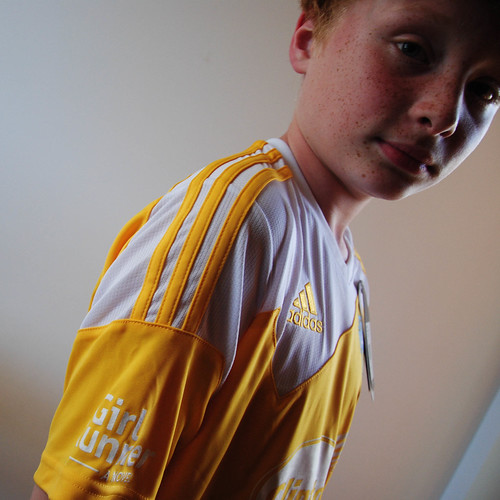
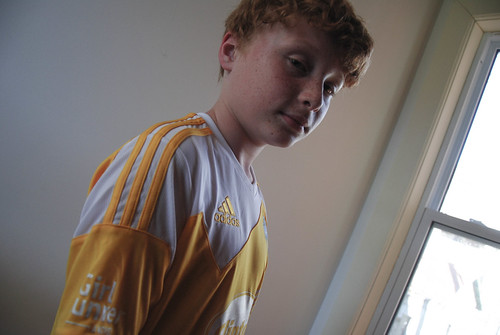
I sponsored the two older kids’ rep soccer teams this season by “buying a sleeve.” We decided to add “A NOVEL” to the title GIRL RUNNER, thinking that a team of 13-year-old boys might not appreciate having to wear that label during games.

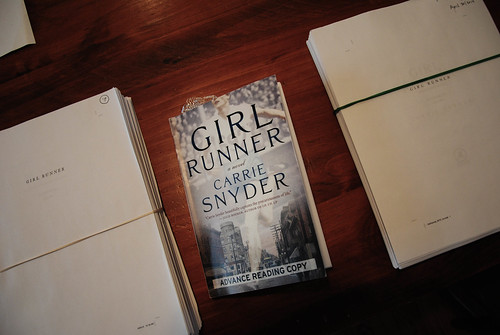
This was our dining-room table, Monday afternoon. Two sets of page proofs, one galley, one sharp red pencil, and one mother announcing to all who entered after school, “There will be no eating or drinking on or near this table until I AM DONE!”
I am done.
All may eat and drink here again.
Last night’s reading at DVLB was really fun. I even indulged in a scotch, thanks to the kindness of a friend who treated. Imbibe ye scotches while ye may. Life’s too short not to enjoy the pleasures that arrive. Even if that happens to be on a Tuesday night and you’re running the next morning. And so I did. (And I ran this morning too: Run ye many kilometres while ye may.)
No scotches tonight, however. I’ll be driving to and from Hamilton, where I’m reading at Bryan Price Bookseller, 7pm, with other M Word contributors. (Note to self: look up directions!)
Tomorrow I’ll be at the Anansi offices working on publicity plans for Girl Runner. (Note to self: more directions! Look up!)
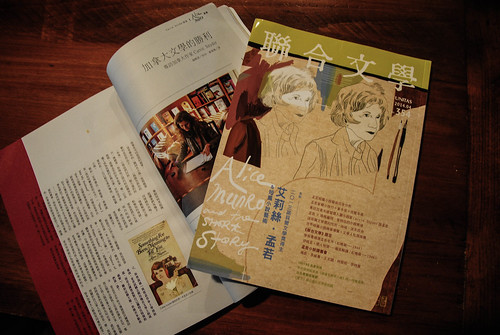
Can you read the above? I can’t. File this under Strange Opportunities that Arrive via the Internet. Last month I was contacted by an editor at Unitas, a Chinese-language literary magazine in Taiwan, who wanted to interview me for a special issue they were planning on Alice Munro. (They’d found and loved my review of Alice Munro’s Dear Love in the National Post.) I agreed. And this month, two copies of the beautifully produced magazine arrived in my mailbox, in an envelope covered in fancy stamps. Sometimes the world seems very very small.
I’ve never met Alice Munro, and can’t imagine what I would say to her if we were to meet. It’s an entirely one-sided relationship based purely on my reading of her stories over many years. I’m immersed in MY LIFE IN MIDDLEMARCH right now, a truly wonderful book that combines biography with memoir, and in some way I feel like my relationship with Alice Munro is similar to Rebecca Mead’s with George Eliot; but Mead has the benefit of distance and I’m not sure I’d feel comfortable exploring Alice Munro’s life and work in quite the same way, given that she’s still living, and that our worlds literally overlap in time and space. It wouldn’t be historical exploration. There’s a freedom to digging back into the past, way back. I’m aiming to do it now, in my next novel. Nothing can be perfectly recovered from the deep past, and so one may imagine quite freely.
Yet I’m so admiring and relishing this memoir/biography mash-up on George Eliot — I would do it, if I could figure out my relationship with non-fiction, a form I’m still learning. I’m thinking out loud here, brainstorming as I type. Perhaps not the best way to compose a blog post on which one is about to press “publish.” But if I could figure out how, yes, I would write about Alice Munro.
I think the NMA nomination was especially thrilling (and perhaps seductive) because it was earned for “personal journalism,” aka non-fiction. It’s a form that interests me more and more, that I find myself devouring more and more, and that I want to learn how to master.
Wednesday, Feb 26, 2014 | Kids, Reading, School |
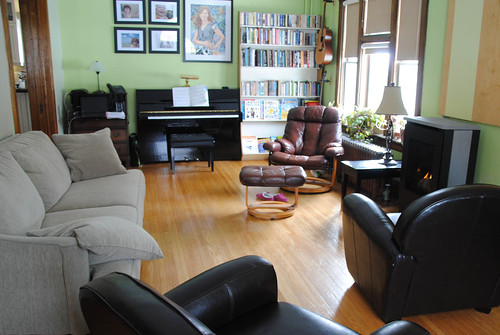
We’ve added an element to the house: FIRE. It’s a gas stove, not wood-burning, placed in the centre of the wall in our main room. I’m sitting in front of it as I type, with my feet up (sorry, treadmill desk; I’m cheating on you with my new flame). As you can see from the photo below, this room remains a long-term work in progress. Kevin and I have two plans, one a total dream and the other something we could hack together ourselves with some help from Ikea. The latter is likely the route we’ll take… when we get a spare moment. Meanwhile, the room looks like this:

I read to the kids in front of the fire last night, snuggling up for the first chapter of Farmer Boy, which CJ had strongly objected to reading (but I can’t read any more Calvin & Hobbes comics, which he loves but totally doesn’t get, requiring a lot of difficult explication). After some stomping around, and “I’m not listening to that,” he came around to “Fine!” when he realized what he’d be missing out on — namely the snuggling in front of the fire.
Farmer Boy begins with children walking through deep wintry snow to a schoolhouse that seems remarkably lawless and dangerous, the scene of potential violence and humiliation where big boys want to “thrash” the teacher and the teacher is considered especially kind because, unlike previous teachers, he does not beat a little boy for not knowing how to spell. The Wilder children are close in age to our family: Royal is 13, Eliza Jane is 12, Alice is 10, and Almanzo is 8. Almanzo, the littlest, has to carry the dinner pail (CJ, the littlest: “That’s not fair!”). By chapter’s end, CJ was hooked. Here’s what the Wilder children found in their dinner pail: bread and butter and sausage, donuts and apples, and one big flaky apple turnover each. (CJ: “Do they only have one nutrition break?” Me: “Yes, but they call it dinner, not nutrition break.”)
We only read one chapter, but it took ages; the conversation around the story could have gone on and on. The little kids were tucked into bed quite late, and Kevin left for hockey. When I came downstairs, the big kids were so perky and happy and chatty that I couldn’t send them to bed. It was the fire. We just couldn’t help but gather and linger and talk … about everything and anything. I learned more about Albus’s school day than I’ve heard all year. They wanted to know what school subjects I was bad at (domestic science and art), and what I looked like in grade 7 (plain and unfashionable: I mostly wore my hair in braids), and I could see them wondering, would I have liked Mom? I’m pretty sure I wouldn’t have been cool enough for Albus. But I grew up so differently from them: never staying in the same place for more than a few years, often the new kid at school, shifting between countries and cultures. By age 12, I’d lived in four different countries, and moved approximately 10 times. The life I’m offering to my children is a settled one, rooted, with privileges that they take for granted, and that I remember not even bothering to envy as a child, because they weren’t things I wanted or needed. Swim lessons, sports teams, fancy gadgets and the “right” shoes and clothes. I was a clueless 12-year-old: dreaming about getting a pony. At the end of grade seven, we moved to a farm and I got a pony! I never felt deprived.
It’s funny how we want to give our kids the things we didn’t get (i.e. swim lessons); but also give them the things we valued from our childhood. I valued my freedom to explore, and I valued being an outsider. It gave me a special status, a special vantage point from which to observe. My kids aren’t getting those things; they’re getting rides to soccer fields instead, and new jeans. What terrifies me is raising entitled kids. I struggle constantly not to do too much for them, to ask them to pitch in for the benefit of the family (and not to earn an allowance, another perk they have, which I did not grow up with). I want them to do the right thing; but more importantly, I want them to choose to do the right thing, not be forced or punished into doing it. You know? I want their inner fires stoked.
So here’s my slow-burning hope. Gathering, talking, sharing, instilling values (one hopes), connecting, laughing: these years go by so fast. Last night, I let the kids stay up late. It seemed like a rare occasion, but I hope it happens often, now that we have something to gather around, something warm and ever-changing and comforting.
Friday, Feb 21, 2014 | Books, Kids, Photos, Reading, Writing |
dress-fitting
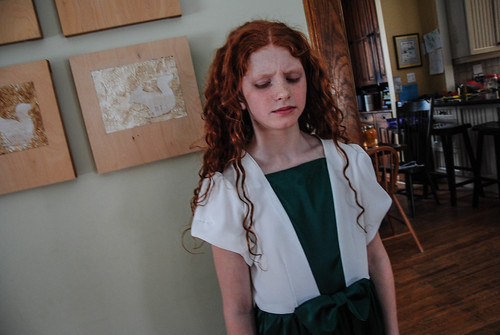
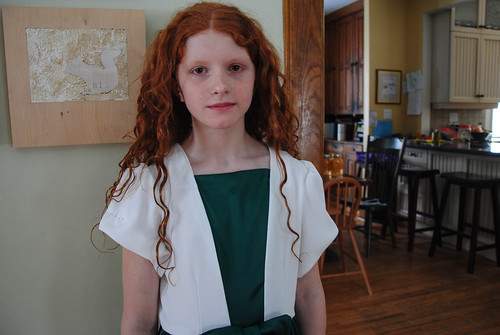
I just accidentally erased the most darling photos of CJ, taken by AppleApple, after Fooey had styled his hair into a swoop across his forehead. I’ve lost other things over the years, too, to digital carelessness or breakdown. It’s always hard to believe something’s gone, when it’s gone. But those comical photos are gone. Loss is a painful emotion, complicated by regret. I’ll get over it in a moment. This post will suffer from their absence, however. Photos affect tone, and those were really funny photos. But these photos are lovely too, taken during a recent fitting; my mom is making AppleApple a dress with puffed sleeves and a puffed skirt (that she might wear to my sister’s wedding this summer).
There’s a commercial running during the Olympics right now with the tagline: Your someday is here. It shows athletes ready to compete, while in the background run faded film scenes of their child-selves, practicing their sport. I find myself curiously affected by these ads; I’m not moved to tears, I’m moved to a faint frisson of panic. Your someday is here. Yikes. Talk about pressure. It also whispers to me: your time will be here and gone before you know it. (I’m obviously in a cheery headspace.) Because doesn’t it also shout: Everything you’ve worked for has brought you here! Celebrate! Enjoy the fruits of your labours!
This week, the Globe and Mail ran a comprehensive obituary on Mavis Gallant. It was heart-breaking to read that she spent her last decade “plagued by ill health and poverty.” Poverty. That word guts me. I reflect on the number of times I read and re-read Gallant’s stories during the past decade, for inspiration, for pleasure, and to admire and try to parse her technical skill as a writer, and how that pleasure received should have been repaid, somehow. Yes, I’ve bought her books over the years. But considering how many times I’ve read them, those purchases were bargains. How to repay a writer for her gift? How to offer appreciation that affords a great writer simple comforts as she ages? Gallant said in an interview in 2006 that “luckily” she had the temperament to be a fiction writer: “I never wanted to own anything — like a bird on a branch.” So maybe I’m projecting my own worries about future financial stability onto a writer who perched above all that, like a bird on a branch. She always noted that her name, Mavis, meant song-bird.
Mavis Gallant was 91 years old when she died.
It’s hard to believe she’s gone. Loss is a painful emotion, complicated by regret.
Tuesday, Feb 18, 2014 | Books, Exercise, Fun, Play, Reading, Soccer |

Yesterday, I played soccer.
Though it may sound odd to say so, it feels like the most significant thing I’ve done so far this year. I played soccer! I feel like a different person, while playing soccer. I feel stronger, smarter, freer, unencumbered. It’s the play I’ve been missing. Play, as in doing something purely for the fun of it.
I haven’t played soccer since August; since the concussion. I was terrified to try again, and wouldn’t have without a lot of encouragement from Kevin and AppleApple, both of whom claimed to want me on their team (flattery always wins; actually, so did our team, but that was mostly due to AppleApple hammering in a pile of goals). My touch was lacking, after six months away, but everything else came back in an instant: strategy, positioning, speed, and the ability to run pretty much forever. We played for two hours, and all I could think was: I have to do this again. Soon.
The players were mostly girls from AppleApple’s team, with some siblings and dads, and me, the lone mom. I was a bit surprised to be the only adult woman on the field. It was so fun playing with these highly skilled, extremely polite and friendly girls (ages 11/12); I’ll bet they’ll still be tearing up the soccer field when they’re my age. When I was their age, there wasn’t anything near the same level of skill-development available for soccer-loving girls, (or probably for soccer-loving boys, either, at least in Canada); I played one season of house league, the summer I was 11. Opportunities have improved for the athletic girl.
I’d love to see more adult women participating in sports: being a participant, a teammate, a competitor gives you a different way of seeing yourself. I think these girls will grow up to be participants, carrying the confidence of their skills. I wish for the skills, but when I get on the field, I find the confidence. And that’s what I’ve missed all these months of not playing: that different way of seeing myself, of being myself.
Mavis Gallant has died. I’ve been reading and re-reading her stories since discovering her in university. How to describe her style? Her stories are like complex riddles that I’ll never entirely puzzle out, and that is their appeal. They offer a clear view into worlds I’ll never know, perspectives as precise as they are unfamiliar. Her stories evoke mysterious emotions, and I think that’s why I’ll never tire of them. She writes of bafflement, of striving and failing and not understanding why one is failing, of being the outsider–always that. My favourite Mavis Gallant story is “The Iceman Going Down the Street.” I’d like to tell you to read it, but only if you’ll promise to read it at least ten times, perhaps over the course of several years, so that you’ll know it and know again, differently, each time.
Goodbye, Mavis. I’ll read you forever.
Monday, Jan 27, 2014 | Big Thoughts, Reading, Sick |

reading in bed
I’m sick and in bed. It’s where I’ve been all weekend. I missed our annual Robbie Burns party, in fact. (Not to sound too over-pitying but the photos above and below were taken during the party. I spent the night at my mom’s instead, with the younger kids, enjoying live-text updates from the party by Albus, Kevin, and my friend Zoe, who had baked Kevin a birthday cake, as we still have no oven. It felt ever so slightly like being there, as I tried to help her locate one lousy birthday candle somewhere in our entire house; she did.)
The one upside to being sick and in bed is all the reading I’ve been able to do. Honestly, I can’t remember the last time I lay around devouring books at this pace. I love books, but I’d forgotten how much I need them. When I think back on my life, I realize that I remember in specific detail sitting and reading, or lying in bed and reading, in many different rooms and seasons, and at many different ages. The winter after I’d turned twenty, I lived in a basement apartment with my brother, and we had no television, and the internet, as we now know it, had not been invented (or at least wasn’t available in our basement apartment). I used my computer much like a typewriter: to write papers and poems. And I read for entertainment. I remember reading Pride and Prejudice, maybe for the first time, and all of J.D. Salinger, for the millionth time, and Anne of Windy Poplars, which I still read every once in awhile, just because.
This weekend I fell in love with a book: Born with a Tooth, by Joseph Boyden. Well, it’s short stories, and I do fall for short stories. If you haven’t read it, seek it out and do. I’m certain some of the themes that seed his novels are planted here, and perhaps not as fully developed, this being his first book, but I don’t mind, not at all. These are stories that will gut you, and make your heart ache, and maybe take your spirit somewhere deeper too.
I also read an entertaining cowboy-noir tough-guy book called All Hat, by Brad Smith, which got me through a really crummy Saturday.
And now I’m reading Nathan Englander’s What We Talk About When We Talk About Anne Frank. More stories. If I find out a writer I like has written short stories, that’s what I go and seek out. I love them. I find it odd that I haven’t felt like writing them, myself, for awhile. It’s almost like poetry. The urge to write a poem comes and goes — goes for years, lately. And then suddenly comes again. I seem to be thinking in novels instead, since Juliet.
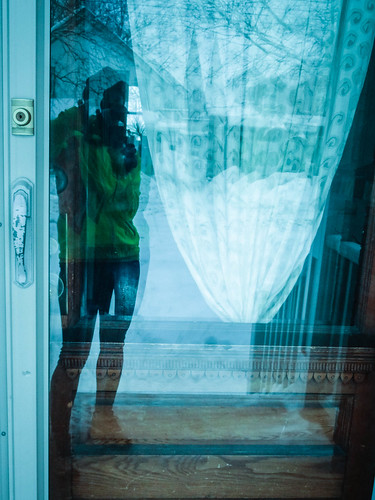
shadow of our house
My profound thought of the day is that everything in this world comes down to land and stories. But now I’ve forgotten why I formed the thought. My brain feels muddy and my eyelids are heavy. Land and stories. I was thinking that war is almost always about land, but not just war — conflict of all kinds. What does it mean to possess land? To claim it? To take its riches? What claim do we have on the land we call ours, both personally and nationally? And then stories. I’ve been thinking how much stories matter. They matter in ways we don’t fully appreciate or maybe can’t take in. Stories are alive and changing, flexible, they can answer the questions we hardly dare to ask, and they can corner us, too, and pin us down. The person in control of the stories is the person with the power. Maybe even more powerful than the person with the land, when you get right down to it.
This could be the fever talking.
Outside, winter winters on, temperatures burning cold, snow whirling, wind whipping. Maybe I will remember this time of reading, years from now, and the stories that filled me up.
Saturday, Jan 25, 2014 | Big Thoughts, Blogging, Books, Reading |
A little more on Christian Wiman, I think, having finished the book this morning. (I mentioned this at supper and Albus said, “Doesn’t it usually take you a really long time to finish a book?” and I went, huh? And then oh! Finished reading a book, not writing one. Yeah, that I can do in a morning, though this book took me every morning of this week, and I could likely sit down and read it all over again and find all new material that chimes true, and differently, a second time around.
Then I went and looked up Christian Wiman online, to see, rather morbidly, whether he was still alive (he spent seven years writing the book, and during that time was undergoing treatment for incurable cancer, so my compulsion to know wasn’t completely out there). He is. I found an interview he’d done with a very kindly looking man named Bill Moyers, whom I’ll admit I’d never heard of. (On a side note, I suspect I would enjoy watching more of Moyers’ interviews.) (On another side note, this must have been a “watch random videos” day, because I’d started my morning with a lecture by Brene Brown, whom everybody but me probably already knows for her work on vulnerability; and I liked it, too, and her message about how to be with people in need, but it didn’t speak to me in the same way that Christian Wiman’s book did, maybe because I didn’t have to work as hard to claim to understand what Brown was saying. Maybe I like working hard to figure something out, like the insights are more earned and therefore more personal to me, more personally valuable for being more challenging.)
Where was I?
Oh, the interview with Christian Wiman. Two things. One, the interview is worth watching if you like to hear poets read their own poetry. He reads several. Two, the part where he says that he doesn’t feel like a poet. He says it’s only when he writes a poem that he feels like a poet. He added that it’s different to write prose, and maybe that’s partially true, but I know that I feel the same way about writing fiction. I don’t feel like a fiction writer during the in-between times. I don’t even believe that I can do it — except when I am.
Tonight I am sitting beside an indoor soccer field. I can write this, it’s true. It doesn’t feel like a struggle, more like a pleasure. But it’s simply a record of where I’m at. It lacks structure and larger purpose. It isn’t meant to last. But even as I write that, I wonder, what the heck is? Isn’t it presumption to think it, that one might ever work on something meant to last?
And yet.