Category: Reading
Friday, Feb 13, 2015 | Big Thoughts, Meditation, Poetry, Reading |

〉 A Poetry Handbook: A Prose Guide to Understanding and Writing Poetry, by Mary Oliver
bought on impulse from Amazon when shopping for photo albums for Christmas gifts
* Mostly, I just want to give you quotes from this book, which is wonderful. It’s slim, precise, measured, and deeply practical: a book about the poetic craft, with useful examples to illustrate the vocabulary necessary to discuss a poem. If I teach again, I will have my students buy and read this book. I am only sorry I’m so late in finding it. Here is a taste.
I was drawn to this section because she speaks of meditation. It is a different way of looking at the practice:
“We experience the physical world around us through our five senses. Through our imagination and our intelligence, we recall, organize, conceptualize, and meditate. What we meditate upon is never shapeless or filled with alien emotion—it is filled with all the precise earthly things we have ever encountered and all of our responses to them. The task of meditation is to put disorder into order.”
Oliver is a believer in patience and will, time spent in honest labour. She quotes Flaubert: “Talent is a long patience, and originality an effort of will and of intense observation.” She says:
“What a hopeful statement! For who needs to be shy of any of these? No one! How patient are you, and what is the steel of your will, and how well do you look and see the things of this world? If your honest answers are shabby, you can change them. … You can attend to them, you can do better … When people ask me if I do not take pleasure in the poems I have written, I am astonished. What I think of all the time is how to have more patience, and a wilder will—how to see better, and write better.”
How to have more patience, and a wilder will….
xo, Carrie
Thursday, Jan 1, 2015 | Books, Reading, Spirit |
I’ve spent the afternoon by the fire reading Meet the Austins, by Madeleine L’Engle, likely for the tenth-or-so time. I hadn’t meant to spend the afternoon reading, but my nine-year-old asked for a book recommendation, and I came back to her with this one and Harriet the Spy, and she chose Harriet the Spy, so I picked up Meet the Austins. I knew I wouldn’t be able to read just a page or two. Sometimes it’s hard to pick up a book because I know how consuming it will be.
But there is nothing to do today, on January 1st. It is one of the quietest days in our whole year. We had a fun celebration last night, a houseful of friends and their kids, music-playing and games and good food and drink, up past the midnight hour, and today is for doing absolutely nothing other than what we want to do.
For me, that’s been lying in pyjamas reading a book and sipping cups of tea.
What I love about reading, and what is so unique about the experience, is that it opens the mind in a particularly vivid way. It elevates my thinking, even while I’m doing it. I can feel my mind opening on a number of different levels as I read a story. I’m empathizing with characters, experiencing an emotional response to their situations, I’m analyzing the structure and style of the text itself, I’m aware of what’s going on around me in the real world, and I’m thinking bigger braver thoughts about my own life and intentions and work. I’m considering why I write, and what I want to write, and why I tell stories, and what stories I want to tell. I’m thinking about the writer herself, Madeleine L’Engle, whose stories I’ve been reading for probably thirty years, and about what I know of her life and career. I’m doing this almost all at once, it seems. And all of this activity enlivens me, even while I’m lying in pyjamas by the fire, at ease, comfortable, relaxed.
And then I come here to this screen, and I write about it. What a fortunate life this is.
Madeleine L’Engle wrote mainly for children and young adults. Her books are full of philosophical questions, moral conundrums, acts of anger, compassion, and forgiveness, quotations from other work (Einstein and Thomas Browne, in this book), engagement with other forms of art. They feel to me like spiritual works. Oh, to write like Madeleine L’Engle. And maybe to live like her — or like her characters, in their rambling houses full of purpose and energy and music and good food and friendship and chores and order amidst the noisy chaos. (Maybe this is what I’ve based my ideal family on, all these years, without even realizing it…)
xo, Carrie
Friday, Sep 5, 2014 | Big Thoughts, Reading, Teaching |

Eleanor Catton, the 28-year-old writer who won the Booker last fall for her novel The Luminaries, continues to win further prizes too, and recently declared her intent to set up a grant with her earnings that would give writers time to read. Yes, you read that right. Time to read. Click here to read the entire article in The Guardian.
“My idea is that if a writer is awarded a grant, they will be given the money with no strings attached except that after three months they will be expected to write a short piece of non-fiction about their reading …
“We’re very lucky in New Zealand to have a lot of public funding available for writers, but they generally require the writer to have a good idea about what they want to write, and how, before they apply. I think that this often doesn’t understand or serve the creative process, which is organic and dialectic; I also think it tends to reward people who are good at writing applications rather than, necessarily, people who are curious about and ambitious for the form in which they are writing. I’m also uncomfortable with the focus that it places on writing as production, with publication as the end goal, rather than on writing as enlightenment, with the reading as the first step.”
I’m making several connections as I read this.
I’m thinking about generosity, creativity, and the many reasons a person may feel compelled both to read and to write. I’m thinking about teaching creative writing again this fall, and agonizing over how best to encourage in my students a love of reading and words and ideas and stylistic play and leaps of connection and openness and generosity, yes, creativity, yes. It’s the necessity of marking that troubles me, not because it takes time and effort, but because aiming for a particular grade is not necessarily conducive to developing a love of writing and reading.
Which leads me back to Eleanor Catton’s idea for a grant that does not require of the writer a full-fledged project at the end or the beginning, but rather openness, curiosity, patience.
(And she’s coming to the Eden Mills Writers Festival on Sunday, Sept. 14, where I do hope we’ll get the chance to meet.)
xo, Carrie
Friday, Aug 1, 2014 | Books, Reading |

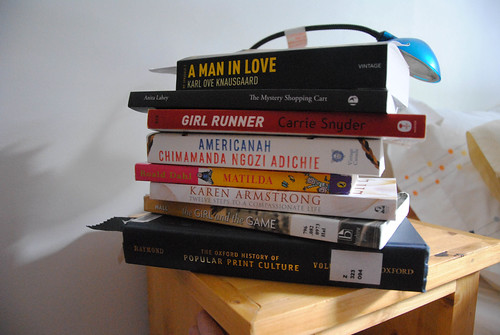
I’m waiting on my new web site to be completed before posting photos from my sister’s wedding this past weekend. I hope that won’t be too long; as with any renovation project, it all comes down to those last technical, finicky details. The new blog is going to look so much prettier than this one that I can’t bring myself to post those gorgeous wedding pics here. Meanwhile, above, here’s what I’ve been reading this summer. Yep, that’s Girl Runner in the pile. With the fall booking up quickly, and the launch party set for Sept. 6th, I need to start selecting and rehearsing scenes for readings. (I did theatre; I’m a big believer in rehearsal before performance, and that’s exactly what a reading is.)
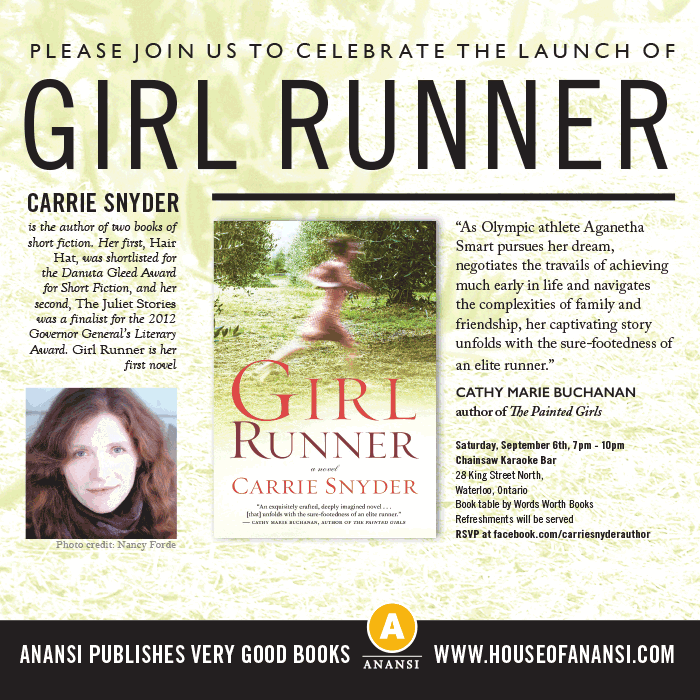
Oh, and about that launch party: invites are on their way, but meantime, consider yourself invited! It’s free, we’ll have food, books, entertainment, maybe even karaoke. I hashed up the Facebook invitation, by confusingly creating TWO pages for the same damn event, which is the sort of problem that comes from being a non-procrastinator born before the existence of the internet. I’ll send you to the event listed on my author page (click here), because it has far fewer confirmed guests, which doesn’t look good, somehow. Is it all about the optics? It’s social media. Of course it is.

I’m in a rambling mood, a confessional end-of-week mood. It’s been a week of big emotions and travel and hard work and waiting and celebrating and a lot of running, literally, including a personal best 10 kilometres this morning, which is nowhere near the personal bests of the best, but nevertheless had me shouting “Yes!” as I crossed my imaginary finish line. Such is the pleasure of achievement for its own sake. I even cleaned half of the house yesterday evening. A whole half of the house! And I played the piano and sang hymns. To sum up: that’s the kind of week it’s been.
Thursday, May 22, 2014 | Book Review, Books, Mothering, Reading, Spirit |

I keep a record of the books I’m reading here (which is to say, there), but occasionally I feel the urge to write about a book I’ve read here (which is to say, here).
Last night, up far too late, I finished Miriam Toews’ ALL MY PUNY SORROWS. This is the kind of book for which book clubs were invented — a lot of book clubs are about friends getting together and drinking wine and the book is the excuse, I get that, but nevertheless there’s a genuine need underlying the concept of the book club. After finishing a heartbreaking resonant emotionally complex narrative don’t you just want to gather some friends immediately and talk about it?
ALL MY PUNY SORROWS is a semi-autobiographical novel about the relationship between sisters, one exquisitely talented and suicidal, and the other a bit of a mess and desperate to save her sister’s life. As in all of Miriam Toews’ novels, the bit characters are as vividly drawn and unique as everyone else, and humour hums silvery through the anguish and grief. But this novel feels different to me, too. It is more raw and immediate, less polished, a straight throughway from beginning to end of almost (seemingly) unmediated experience. People don’t behave like you want them to. They behave like people.
The mother of these two sisters, who has also lost her husband to suicide, is the most brilliantly drawn loved and loving independent fearless woman I can remember reading in a book, ever. Her depth of soul and lightness of spirit anchors the narrative. But even her love cannot anchor her daughters. And that seems to be part of the book’s message (though it’s not a “message” book): that we are responsible for our own lives, that we can only carry the weight of responsibility for the things that are ours to change. And the lives of others do not belong to us, even when we’re mothers. We raise our kids up with love and care, and we offer love and care pretty much forever, as long as we’re living, but that’s all we can do. The mother tells her daughter near the end of the book that letting go of a grief is more painful than holding onto it, but it’s what she hopes her daughter will be able to do.
Maybe if you’ve lost a husband and a daughter to suicide, you understand profoundly how little your love can cure or save someone who doesn’t want to be saved. That doesn’t mean you don’t try to save someone. That means that life is not about problem-solving, even though we may wish it to be so. We may wish to pour our minds into solutions and fix what’s broken, especially on a personal level, especially in families, and that’s a good impulse, I’m not saying it’s not. But to survive trauma and grief without becoming bitter, we have to recognize that we’re not that important. We’re not in charge of other people’s choices. We’re in charge of our own puny sorrows.
What we can offer are small, ordinary gifts. But a gift is a gift, isn’t it. It doesn’t ask for anything in return.
There’s some strangeness to reading this book, knowing Miriam Toews’ personal history, which cleaves closely to the book’s story. It’s difficult to read it as fiction, I guess.
One final observation: it’s been awhile since I’ve read a book that references so many other books. Entire poems are recited by characters, for example. I loved that. Reading as comfort and connection, as a way to speak the unspeakable. Words might not save us, but they may just console us. We read and we are less alone.
Tuesday, May 13, 2014 | Books, Chores, Kids, Laundry, Parenting, Reading |
completely unrelated photos of SPRING!
8:40 PM. Home from AppleApple’s first outdoor soccer game of the season. Kevin off to his soccer game.
Me, at dining-room table, eating a late supper, Business section of the Globe open before me (nothing else available, clearly).
Him, two bowls of bedtime-snack-cereal consumed and teeth brushed, arrives at my side.
Me, hugging him, while trying to finish eating: “It’s bedtime. Would you like me to read to you, or I could play the ukulele for you, or would you like AppleApple to read you some more Harry Potter?”
Him, no hesitation: “Harry Potter!”
:::
8:55PM
Her: “I can read you a bedtime story, Mom.”
Me: “Okay. You can start while I’m loading the dishwasher.”
Her: “It’s about this dog and a boy, and the boy can read the dog’s mind.”
Me: “Okay.”
Her: Reading out loud, stumbling over words like “array” and “campaign.”
Me: “This book uses a big vocabulary.”
Her: “Can we read in my bed now? I’ve set it up for you.”
Me, awhile later, dishwasher running, pots washed: “Sure.”
Her: “Are you coming, Mom?”
Me: “I just have to … kiss your brother goodnight … tuck in your brother … get a sheet for your brother because his blanket is too hot … tell your sister to brush her teeth ….”
Her: Waiting in a little nest she’s made for us in her bunk.
Me, climbing up: “Do you want me to read to you for a little bit?”
Her: “You can finish the chapter!”
Me: Finishing chapter.
Her: “Now I’ll read.” Stumbling over words. Patiently continuing. Laughing with genuine delight when the dog eats the boy’s pillow.
Me: “Look at the clock, honey.” [9:30 on the dot.] “We have to stop here.”
Her: Bookmarking spot.
Me: “This book really has a lot of big words. But I don’t think it’s actually very well written.”
Her: “I finished all the Magic Treehouse books …”
Me: “And we’ve already read a lot of the really good ones, like Pippi Longstocking, Charlotte’s Web.”
Her: “I’m not going to read Because of Winn Dixie. We’re reading it at school.”
Me: “I’ll bet your sister could recommend some really good books for you to read. She’s read just about everything. Let’s ask her in the morning.”
Us: Goodnight kisses.
:::
9:35 PM
Me, back downstairs: “You are not allowed to start reading another Agatha Christie book right now!!!!”
Her, blank-eyed, glancing up at me: “Whaaa?”
Me: “Mark your page and put down the book, or I will take it away from you.”
Her: “What?”
Me: “You need to go to bed. You’re swimming in the morning!”
Her: Eyes gazing downward on page.
Me: Turning book over.
Her: Sad face (fake).
Us: Hugging goodnight.
::
Me: Folding laundry, nearly 10 PM.
Him, coming downstairs, plopping into nearby chair: “Mom, what if video games had been invented before books? Do you think that parents would be making their kids play video games instead of reading books?”
Me: Pondering.
Him: “I mean, what makes books better than video games? At least in video games I get to choose what I want to do next. In books, the story stays exactly the same, no matter what.”
Me: Wondering if fundamentally I don’t get how the mind of a nearly-13-year-old boy operates.
Him: “Why is reading for entertainment better than playing a video game?”
Me, launching into it: “I think it’s because reading is creative. You have to see the characters in your mind. You have to make them up using symbols on a page. In a video game, it’s all there in front of you. You’re just viewing it.”
Him: “I mean, I like reading some books. But it seems like they’re less creative than video games because you can’t make any choices.”
Me: “Well, a book is a linear creation. But even a video game is limited by its own parameters. And in really good books, everything isn’t neat and tidy, and you have to figure out for yourself why characters do certain things, and you wonder afterwards what might happen next.”
Him: “I don’t do that.”
Me: “You don’t wonder why a character did something? Or wonder what might happen next?”
Him: “No.”
Me, climbing onto soapbox: “Also so many video games are extremely violent. You’re in a fantasy world where you can’t empathize with the people you’re killing. And you basically have eternal life.”
Him: “Exactly. It’s a fantasy. That’s what people who play video games want.”
Me: “Sure. I agree with you. Lots of people want the fantasy. Lots of people watch reality television too. It’s easy entertainment. I guess I just don’t really get it.”
Him, sadly: “I’m going to bed now.”
Me, feeling crummy, missing his company, hearing my ponderous long-winded lecture through his ears (have not transcribed entire ponderous long-winded lecture for the sake of brevity and face-saving)
Me, to self: “I’m the worst mother in the world.”
Self, to me: “No you’re not. Don’t get down on yourself. It’s not going to help.”
Me, awhile later, laundry folded, knocking on closed bedroom door, sitting on the end of his bed in the dark: “Maybe we can agree that we don’t quite understand each other’s preferred forms of entertainment. Maybe you can figure out how much time you think is reasonable to spend playing video games, and I’ll figure out how much time I think is reasonable to spend reading books. And then we can talk about other ways to be entertained too.”
Him, quite agreeably: “Ok.”
Me: “Ok!”
Ok. Okay? Ok.
Goodnight.
Page 7 of 17« First«...56789...»Last »