Category: Big Thoughts
Wednesday, Apr 22, 2015 | Backyard, Big Thoughts, Girl Runner, Good News, Spring, Work, Writing |

First, to the news: I’m pleased to announce that Girl Runner is going to Greece! The book has been picked up for translation by Thines Editions. This brings the foreign sales of Girl Runner to eleven languages, plus the US and the UK & Australia. I know. Astonishing, huh.
Every once in awhile it comes to me: thousands of people have read Girl Runner. Thousands of people have taken into their minds this story shaped by my mind. That is a staggering thought, and comes close to fulfilling what I’d hoped to achieve, in thinking back on my early years of hoping to become a writer. It was to be read. Those people who’ve read Girl Runner aren’t thinking about me, Carrie Snyder, they’re thinking about her, Aganetha Smart.
I think that gives me a certain amount of flexibility too, in terms of the choices I intend to make in my career, the projects I intend to pursue, their variety. I see myself as someone who can shape-shift to some degree, with a malleable voice, rather than someone who has a very distinctive style and voice and subject. I can use that in positive ways rather than seeing it as a weakness, but it’s a talent more readily used by someone who doesn’t have a big personal public profile. These stories come from me, but they aren’t me. Or more precisely, I am not them. I am just the mediator, in a sense, or perhaps the medium, the interpreter between worlds.
Ultimately, I’d like to be read because I send out into the world interesting, creative, curious, insightful, moving, maybe even life-giving stories.
It’s a lot to ask. Because it means I want my writing to be excellent. It puts the weight on the writing, and is my writing good enough? Is my thinking deep enough? I don’t honestly know.
For the purposes of achieving this goal, I’m challenging myself to direct attention and energy onto the books that I write, and to otherwise be at peace with my authentic, ordinary self when asked to appear in public. It’s my problem, not anyone else’s, is what I’m getting around to—I’m the one who has been dissatisfied, in the past, with my public performance or persona, always thinking that I should be more charismatic, more out there, more … well, more not myself. Recently, I’ve been trying to let go. And I’ve found myself surprisingly content with being adequate, average, competent at the jobs that are not within my main area of expertise. I’m not splendid or charismatic on stage, but what I can do is make people feel comfortable in the slightly awkward formal environment. My sense is that that’s something I’m able to offer, and that’s good enough. Forget trying to shine or, much worse, to outshine. It’s not who I am. I’m more of a cozy fire in the fireplace, a friendly candle on the table, a light in the window to show you the way home, here to make you feel comfortable in your environment.
So. Let go. Let go of chasing fame in any way, shape, or form. And keep writing for the writing in any way, shape, or form.
xo, Carrie
Monday, Apr 20, 2015 | Big Thoughts, Driving, Mothering, Soccer, Travel |

Hello there! Just checking in. How are you? You may have observed (as my dad recently did) that I’ve been checking in somewhat less frequently here, as my writing time is quite cramped. I also take way less photos than I used to, relying mainly on the camera on my phone. Your understanding is appreciated. I think this is a good example of how I make things work, generally speaking; it isn’t always perfect, or even approaching perfect, but I try to do as much as I can, in as many of the areas of my life that I can, using the resources available. And with plenty of compromise.
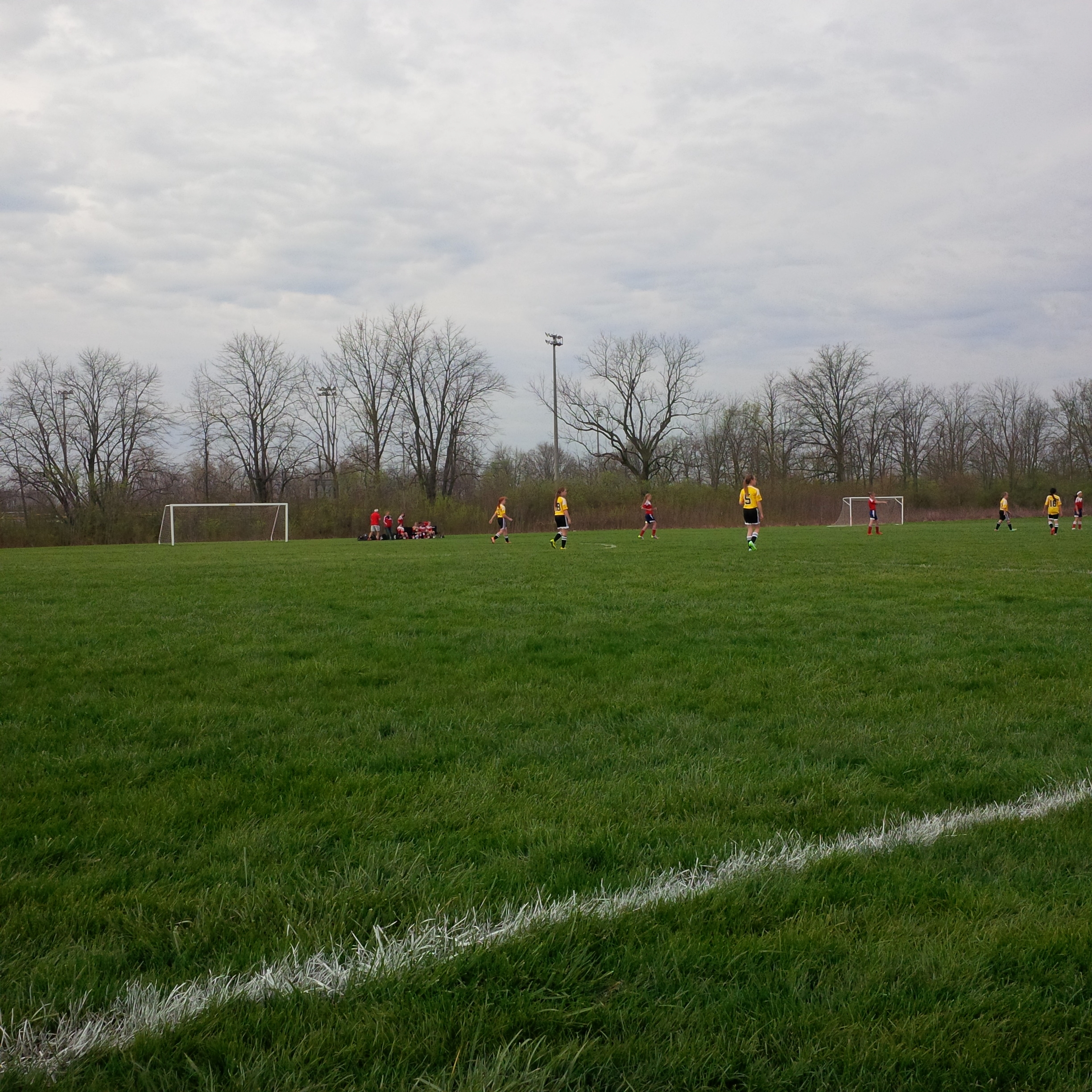
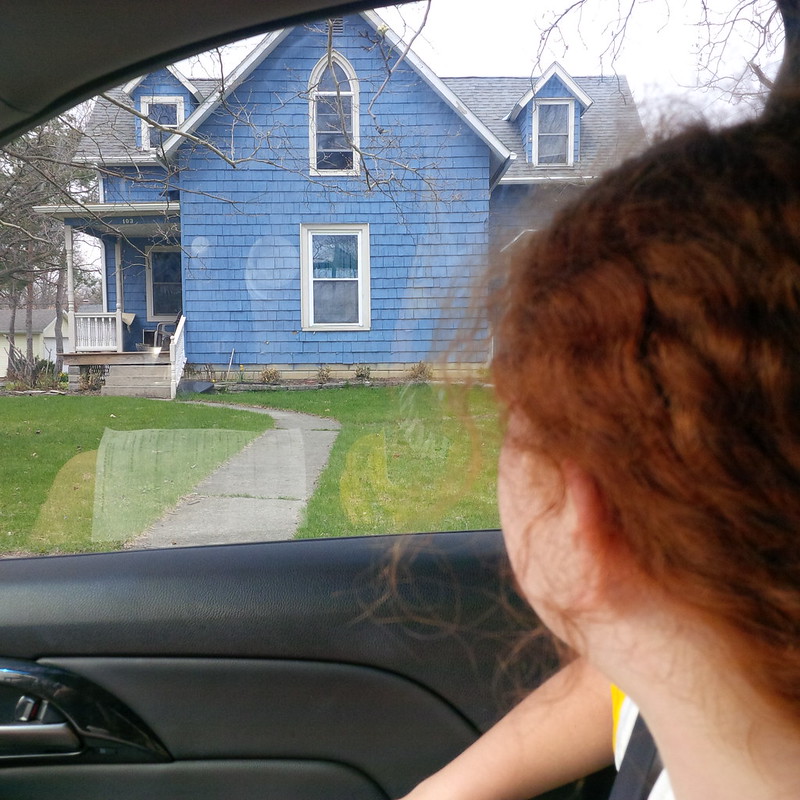
This weekend, AppleApple and I made a trek to Ohio for a soccer tournament. I’d been dreading the long drive and leaving behind my writing work, but it turned out to be really fun. Note to self: stop dreading things! Good grief! Somehow, in my anxiety about crossing the border and having to navigate solo, I neglected to appreciate that I would be alone with one kid, with very few responsibilities other than getting her to and from games, for several days. I left behind the calendar, the scheduling, the laundry, the cooking, the cleanup — well, everything, really. We had beautiful weather, spring had sprung in Ohio, they sell beer in grocery stores there, and everyone was super-friendly.
Highlights included
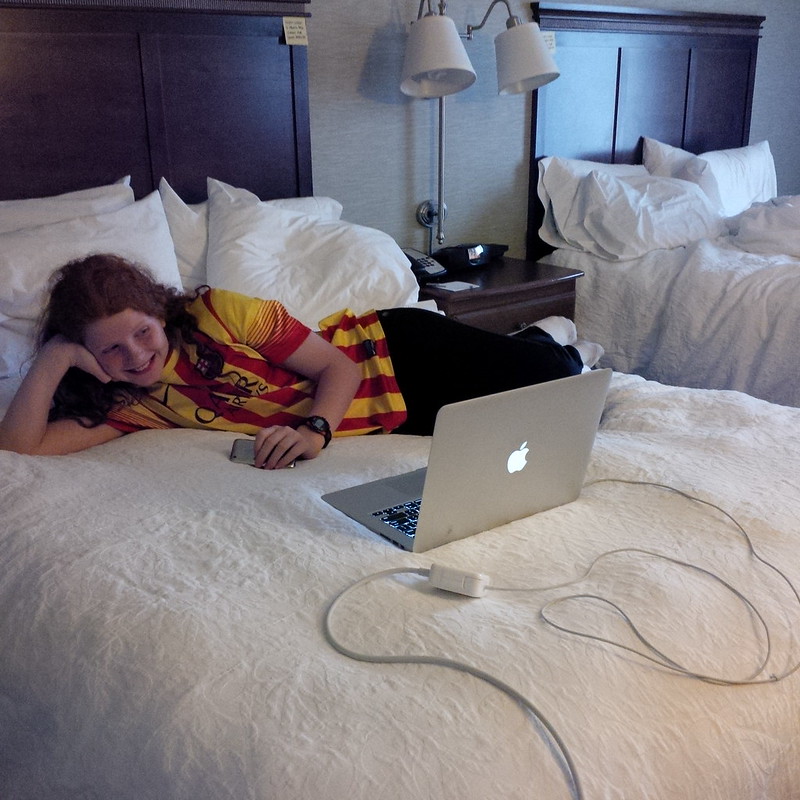
* lounging and watching Friends on my laptop via Netflix with AppleApple in the evenings
* a social meal out with the team on Saturday night
* buds on trees, flowers blooming, needing to wear sunscreen again
* an impromptu picnic in a Kroger’s parking lot (we know how to class it up)
* taking a detour home through Bluffton, Ohio to visit friends and see the house I grew up in from kindergarten through grade 3
So my kid complained about me singing along to the radio on the drive. So her team didn’t win every game. I can’t think of anything else to complain about, actually. How lucky we were to get that time together. How fortunate we are to travel at our leisure, for fun, for recreation.
Back in Canada, driving driving driving, we tuned into the CBC news at 6 o’clock and heard about the failed efforts to rescue hundreds of migrants, drowned when the boat they were travelling on capsized in the Mediterranean sea; I can’t get that out of my head. I keep mentally juxtaposing the ease and safety and fun of our journey with the desperation of the journeys undertaken by so many.
I can’t make sense of it. So it’s just sitting here with me today.
xo, Carrie
PS I’ve got some good news on the book front. I look forward to sharing it with you later this week.
Wednesday, Apr 8, 2015 | Big Thoughts, Blogging, Confessions, Girl Runner, Publicity, Publishing, Word of the Year, Work |

Twenty minutes can feel like no time at all, when I’ve fallen down the rabbit-hole of the internet, reading truly fascinating but perhaps not necessarily useful stories on … well, see, there’s the problem. I must have read at least five truly fascinating but not necessarily useful stories in the past twenty-four hours, following links from Twitter and Facebook—to genuine news stories or long-form articles, not top-ten lists—but I can’t recall the contents of a single one. Poof. The minutes vanish.
But twenty minutes can feel like a very long time when I’m sitting in silence listening to the sound of my thoughts skittering, seemingly randomly. Oh, there’s my mind trying to make a plan for later on today, and a list of things I can’t forget to remember to do. There’s my mind slipping sideways into what seems to be a dream. Bring it back, follow the breath. Breathe, breathe, meditate. Oh, there’s my mind dashing off to wonder how much longer. And under it all, there’s my body, trying to hold fast, remain still and calm but strong. What this exercise seems to be, at its core, is a daily weather report: here’s what you’re feeling today. Here’s how your body and mind is coping with challenge. Bring an umbrella.
Today’s weather report of my body and mind: very tired, wandering, a bit directionless, with a chilly breeze of underlying anxiety about upcoming events.
I’ve been struggling to write, here. Not elsewhere, but specifically here, in Blogland. I was at a book club on Monday evening, a friendly thoughtful group, and they asked interesting questions, including one I found difficult to answer: How do you manage the attention? My gut instinct? To reply: uh, what attention? The truth is that I’ve been managing attention by pretending there’s a solid wall between my public life and my private life, and that the two don’t intersect. It’s a mental trick I sustain when blogging, too. I pretend no one’s reading. It’s like I’m writing this in a special private journal that oddly ends every time with me pushing “Publish.” It’s a trick that doesn’t work terribly well, I’m beginning to understand, not just in Blogland where readers respond to posts (which I love), but also in the real world. (I can hear you thinking: you’re just grasping this now?). For example, on Monday afternoon, my 9-year-old had a new friend over, and when the dad came to pick her up, and I was making small-talk in the front hall, he said, “I saw you in the newspaper.” Private Carrie fought with Public Carrie, confused. He’d seen me in the newspaper? Had I been charged with some crime? Oh, right, I’m a writer. I actually had to say it out loud, as if explaining it to myself, “Oh, yes, I’m a writer.” “I know,” he said. Oh, right.
So the separation is illusory at best, and delusional at worst.
Further, the whole pretence breaks down completely when I admit, both to myself and to you and to the lovely women at Monday night’s book club and likely to that dad in the front hall, that I want people to read what I’m writing. Of course I do! The sustainability of a writer’s career depends on readers. If I were operating a retail business, it would be counterproductive, not to mention just plain ridiculous, to open a shop only to pretend the shop doesn’t exist. A customer walks in. Carrie pretends she’s in her living-room, in yoga pants, looking after sick kid. Customer is confused, feels like an intruder, apologizes for wishing to purchase something from shop Carrie continues to pretend does not exist. (Why doesn’t anyone come to my shop, Carrie wonders? Maybe I’m not very good at making _____. Maybe I should quit trying and become a midwife.)
In other words, ambivalence isn’t actually ambivalent. It’s pretty damning. Like my dad would say, shit or get off the pot. (I really like that saying, actually; I use it a lot, when giving myself advice.)
But here’s the thing. What I’m selling in my shop is not me—it’s my writing. And that does feel genuinely separate. I’m in my living-room, in my yoga pants, with my sick kid, holding out a book. Holding out a blog post. This is the thing, I’m trying to say, Forget about me. So it’s confusing. I write in hopes that people will read what I write, not to attract attention to myself. I read Nick Hornby and Bill Bryson and Miriam Toews and Ruth Ozeki and Karl Ove Knausgaard and Kim Thuy because I really like their writing. I wouldn’t need to know anything about them to like their writing. I may feel I know them, because they are all somewhat autobiographical writers, but knowing them is not my motivation for reading their work: I read because I love what they do with story, with language, with structure and form, and because I’m moved and entertained by their writing.
I guess my overarching question is: Is seeking attention critical to finding readers? Is it a job requirement? What if I focus instead on being the best writer I can possibly be and stop sweating everything else? What if I simply support a project at every stage of development, including talking about it after it’s been published–and let go my attachment to the attention, personally. Then the transition between public and private might be much less jarring, much less important.
During today’s meditation, I had a sudden vision of seeking balance between interior and exterior. Between maintaining a quiet private interior focus, which is what I need in order to write, and an accepting reflective public exterior focus, which is what I need in order to be in the world as a writer. How can I be as authentic and free in my public life as I am in my private life? I breathe in, and I breathe out. Breath itself is a balance between interior and exterior.

So, how do I manage the attention? Maybe I’ll figure it out someday, twenty minutes at a time.
xo, Carrie
PS I’ll be at the Kitchener Public Library this evening, presenting the prose awards for the Dorothy Shoemaker prize, which I adjudicated this year. And I’ll be in Fort Erie on Friday evening as part of the Ridgeway Reads reading series.
Friday, Apr 3, 2015 | Baking, Big Thoughts, Books, Family, Fun, Holidays, Lists, The Candy Conspiracy, Word of the Year, Work, Writing |

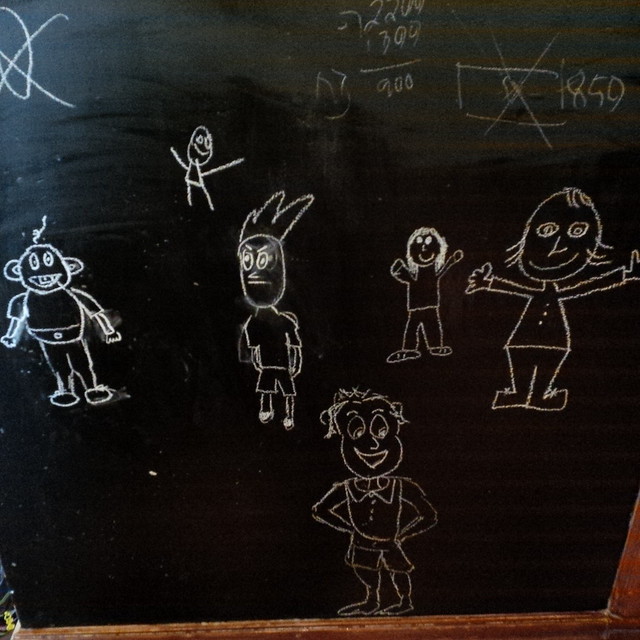
chalkboard family
Oh, the word WRITE. How I love it, on a day like today, after a week like this week, when my mind is rich with ideas and enthusiasm, and the joy that comes from working. Work that sometimes, truly, feels like play.
I think we fall into our themes. We can’t always understand them, or know why they’ve become the themes to which we’ve devoted our creative lives, but they’re there. If I am to identify the themes that have occupied me in projects past, and that are highly likely to continue to occupy me during the years to come—many productive writing years, oh Lord, please, grant me—they include the following: midwifery; abortion; pregnancy and birth; mothering; siblings; running; competition; feminism; activism; rule-breaking or unconventional behaviour; gambling and debt; small-time criminality and the huckster or the shyster; peace and justice; adoption; parentage; memory; forgiveness; gifts or gift-giving; music; fame/performance; horses; spirituality; love; friendship.
I’m absolutely bubbling over with joy at having all of these pieces of life to explore. And more, and more. (Where does The Candy Conspiracy fit into the thematic framework? Hedonism? Entertainment? Fun purely for the sake of fun? Yes, sometimes all I want to do is goof off and have fun–can that be a theme too?)
I’m listening to my eldest daughter play the piano. She’s practicing her songs for the Kiwanis festival later this month. The music is beautiful, though right now she’s going over and over a few rough patches. She’s got a batch of hot-cross buns rising on the counter and she was singing the song this morning, in her pyjamas. The other kids are off with Kevin at his office, helping him reorganize and rearrange, though it’s just as likely that they’re playing video games rather than lugging stuff around.
On Wednesday, we found ourselves with a free evening. Nobody had anything to do or anywhere to go. This is so rare on a weeknight that we all felt celebratory. After supper, the adults drank a beer and the kids each had a pop and we sat around the table talking and drawing. Everyone took a turn suggesting a subject to draw, and we had two minutes to try to draw whatever it was.
Above are our people, drawn on the chalkboard, which is where we started.
It’s Good Friday. I’m going to make paska this afternoon, a Russian Mennonite Easter bread, although I’m not Russian Mennonite. Eggs, spring, colour, sweet bread, new life.
xo, Carrie
Friday, Mar 13, 2015 | Big Thoughts, Book Review, Chores, Confessions, Laundry, Meditation, Parenting, Sick |

First of all, I have to tell you that I’m still sick! (This is because, when I’m sick, I have to tell everyone! It’s a sickness in and of itself.) Here’s where I’m hanging out (see photo above): on the couch by the fire, with crocheted blanket, tea, lozenges, laptop, book, cellphone, and dogs. The dogs look like they’re in heaven. That’s nice, dogs. Happy snoring to you. I, however, am remembering how grumpy being sick makes me. Which is very. I also tend to take a melodramatic outlook, announcing at intervals how awful I feel, how lazy I feel, how pitiful I feel, and generally presenting as a less-than-lovely human specimen. My family puts up with it rather kindly, I must say, even if their reaction is to basically ignore my general pitifulness. Or gently mock me for it. Thanks, family. I mean that sincerely.
So I finally finished reading A Short History of Nearly Everything, by Bill Bryson, which is a book about scientific discoveries (and the scientists who laboured, sometimes futilely, to discover verifiable facts about our planet, our environment, the origins of life on Earth, the chemical makeup of the universe, etc.). Excellent book, easy to read, lots of great stories, plus I felt like I was getting reacquainted with the teenaged self who really wanted to study biology and chemistry in university, if only those subjects could have been coordinated with an arts degree. (I couldn’t figure out how to do it.)
Anyway.
I’ve been using the word “anyway” a lot these past few days, as a handy segue. I think it indicates how little energy I have to spare. My throat is so sore, people!
Anyway …
Bill Bryson’s book ends with a devastatingly sad chapter, titled “Goodbye,” detailing the efficiently destructive ruin that homo sapiens have inflicted on other species who come into contact with us. We seem to be unique in our ruthlessness, and pointless destruction. When we show up, species vanish. So much of what makes us different from all of the other species of life on Earth — our consciousness that allows us to plan and remember and create communities and construct stories and share information and move easily across vast distances — is also what makes us a force deadlier than any other species that has ever existed. It’s like we were made to destroy. Looking at humans from this perspective is deeply sad. To counter my sadness, I think of Jean Vanier, founder of L’Arche communities, on the the front page of Wednesday’s Globe and Mail, saying, “We are in a world that is rather terrifying. People close ranks and hide behind their factions. There is great insecurity. … [And yet] it is possible for humans to live together as long as you let down the walls that separate you.”
Yes. I’m part of this species, of course. We all are. We’ve got this little window of time here on Earth to share with those around us. How to be more open, more vulnerable? How to do no harm?
Anyway.
I’m putting this couch-time time to good use! Reading a lot. Resting. Meditating (although this morning’s session turned into napping — dreaming). Writing a bit too. It’s not like I can’t do my job while lying on this couch. Well, this part of my job. This other part of my job, I can’t do while lying on the couch. See below.
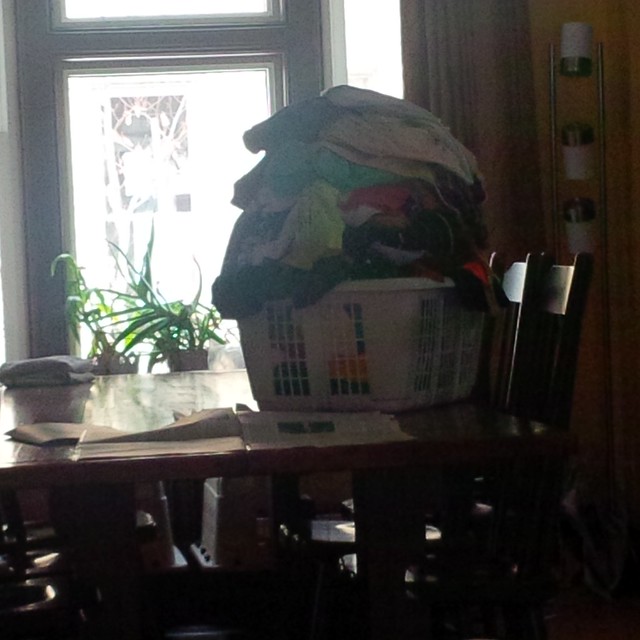
terrible photo taken from current position on couch, using cellphone, which explains terribleness
This is just the first basket of two — clean laundry! — that look like this. I carried this one up to the dining-room table this morning in hopes that a) I would feel inspired to fold it and/or b) kids would arrive home from school and feel inspired to fold it. LOL. No, seriously. Do you think I can guilt them into folding it? It’s probably my parental duty to try. I realize that if I were a better parent, my children would already be trained to fold laundry themselves. Somehow, this hasn’t been the kind of parent I’ve turned out to be. Okay. I’m okay with it, actually. I can’t seem to fight against the tide of what matters to me, and what doesn’t.
Anyway.
Weekend! March break! Wishing all of you, all of us, everyone: Health!
xo, Carrie
PS After posting, I lay down and listened to a program that ran on Ideas this past fall, called “How To Do Ordinary Things.” You can hear Jean Vanier and others who work/live in L’Arche communities talk about freedom from fear, and being vulnerable not just in body (which I’m aware of right now), but also in relationships. Here’s a quote I wrote down while listening:
“Who will love me in my brokenness? …
To love someone is not to do things for people but to reveal to people who they are.” — Jean Vanier.
Wednesday, Mar 11, 2015 | Big Thoughts, Blogging, Reading, Travel, Writing |
Well, this wasn’t what I meant to do this morning, while suffering from a sudden and nasty cold, and lying around the house in yoga pants feeling pitiful. But hey, in my pitiful yoga-panted state, I clicked myself over to Facebook to do one tiny thing — instantly forgetting what that was; still can’t remember! — and saw that a friend had posted the link to Part 2 of Karl Ove Knausgaard’s “My Saga,” which would perhaps be better titled “Travels Through America,” freshly published in the New York Times magazine (I read Part 1 two weeks ago).
Here are two passages that jumped out at me, fitting, as they do, into my land and stories theory about power, conflict, and human connection.
“If there is something to be gained, if it is gainable, no power on earth can restrain the forces that seek to gain it. To leave a profit or a territory or any kind of resource, even a scientific discovery, unexploited is deeply alien to human nature. …
Not only is it alien to human nature to leave a profit unexploited, but discovering, inventing or knowing something without passing that knowledge on is alien to us, too.”
– Karl Ove Knausgaard
Read both parts of “My Saga,” if you like Knausgaard’s work. If you don’t, well, don’t bother; Knausgaard is Knausgaard. Either way, you might be forgiven for reading “My Saga” as close to self-satirizing. I found it at times hilarious, occasionally grotesque, Knausgaard willing to set himself up as a curiosity, as the inscrutable Other passing through an awfully familiar (to me) landscape, which he can’t or won’t even attempt to understand. Except he makes some interesting philosophical and cultural observations, and is himself a fascinating study in contradictions, having constructed his persona on the unlikely combination of personal reticence and abject confession.
Yes, I’m a fan.
I happened to be at the Vancouver Writers’ Festival last fall at the same time as Knausgaard, and he was one of the first people I saw when I arrived at the hotel where all of the visiting writers stay. We stood side by side at the front desk, he with one of his daughters, me with my tiny carry-on bag behind me like a favourite pet, on the very day that a lone gunman attacked Parliament Hill. I didn’t say a word to him. He seemed like a private person who wanted to go on a touristy excursion with his daughter, not someone who wished to acknowledge that the person standing next to him at the front desk of a hotel might have read his own hyper-detailed account of his life (I’d recently read the first and second books in My Struggle). Strange, wouldn’t it be? Or am I doing something similar here — on a much, much smaller scale — writing about my life and offering it up to anyone who happens along, yet also certain that I’m essentially a private person, deserving of privacy.
Anyway. I didn’t disturb him. Later, we took an elevator together. In silence.
I’m convinced “My Saga” is a classic piece of travel writing, even if it doesn’t tell a great deal about the land being travelled through; really, it’s about the human condition. How we’re shaped by where we’re born, and by what were willing to do, but also by what we can’t see or recognize, even within ourselves. Maybe most especially there. Writing is an effort to translate emotion and sensation and experience into shared language. This happens, when it happens best, not by explaining what we want to say, but by inhabiting it. So, in writing, a seeker may have more meaning to offer than a finder. A seeker, who doesn’t know what she’s looking at, exactly, might reveal more than she who is quite certain of what she’s found.
Here are links to Part One and Part Two of Knausgaard’s “My Saga.”
Back to my cold-fighting garlic-ginger tea.
xo, Carrie