Tuesday, Nov 24, 2020 | Art, Big Thoughts, Book Review, Books, Confessions, Current events, Reading, Spirit, Writing |

Dear friend, from my life I write to you in your life. That is the title of a book of essays by Yiyun Li, a Chinese-American writer whose stories I’ve admired for years, and I bought this book without knowing much about it, other than the title made me want to know more. (She says it’s taken from an entry in one of Katherine Mansfield’s notebooks. “I cried when I read the line,” Li writes. “What a long way it is from one life to another, yet why write if not for that distance…”)
This turned out to be a book about many things, most significantly about reading other books, and about surviving, continuing to be alive on this earth. The book is written as if to a friend, but in the end, it seems the friend is Yiyun Li herself, trying to write to herself, as she figures out how to stay alive in the years following a long descent into severe depression and hospitalization and release. It was actually exactly what I needed and wanted to read, though I wouldn’t have necessarily chosen it, had I known what I was choosing; a book sometimes chooses us rather than the other way around. I’ve read it slowly, over this fall, marking pages with insights for keeping, and that is what this post will be about: insights from this book, to keep and to wonder about. Li writes in English, a language she learned as an adult, which she calls her private language. She originally studied to be a scientist (immunologist), and in fact came to the United States to further her studies. When she decided to quit science to become a writer, a friend’s husband asked: “Why do you want to make your life difficult?”
I’ve had a thought that I would like to write a story on the theme of each of these quotes; or at least a scene. Each one brings into my mind a picture or feeling, or both, and makes me yearn to respond, through fiction. Why do you want to make your life difficult? The question could be asked in so many contexts and would always create an interesting and troubling problem, without an obvious solution. The seed of a story, I think.
“I have had a troublesome relationship with time. The past I cannot trust because it could be tainted by my memory. The future is hypothetical and should be treated with caution. The present—what is the present but a constant test: in this muddled in-between one struggles to understand what about oneself has to be changed, what accepted, what preserved.”
Yiyun Li thinks about time a lot, and truth be told, I was drawn to this thought because the character in the muddled in-between looks like a version of me, maybe now, maybe from the distant past.
“What I admire and respect in a dreamer: her confidence in her capacities, her insusceptibility to the frivolous, and her faith that the good and the real shall triumph and last. There is nothing selfish, dazzling, or preposterous about dreamers; in everyday life they blend in rather than stand out …
A real dreamer has a mutual trust with time.
Apart from feeling unqualified to be called a dreamer, I may also be worrying about being mistaken for one of those who call themselves dreamers but are merely ambitious. One meets them often in life, their ambitions smaller than dreams, more commonplace, in need of broadcasting and dependent on recognition from this particular time. If they cause pain to others, they have no trouble writing off those damages as the cost of their dreams. Timeliness may be one thing that separates ambitions from real dreams.”
Again, Yiyun Li’s reflection on time, here, made me stop and wonder: am I a dreamer? Or merely ambitious? Or maybe I have the potential to be both, and have been, and will be. What’s my relationship to time? Do I trust it, or fear it will betray me? This scene would have two characters, or multiple characters, perhaps entirely unaware of their own relationship to time; but the reader knows.
“The train, for reasons unknown to us, always stops between a past and a future, both making this now look as though it is nowhere. But it is this nowhereness that one has to make use of. … One has made it this far; perhaps this enough of a reason to journey on.”
Is this a sincere conclusion? Or is the writer writing to convince herself? I love the image of the stopped train; but I don’t want to think of time that way. I don’t want to think of being suspended between destinations. That makes the destinations too central, when it’s where we’ve stopped that I want to land, and be. Of course, the character might get off the train, here, in the middle of nowhere. Or they might find another way to shake themselves awake.

“Perhaps my deficiency as a scientist, a lack of ultimate purpose, is why I love writing. Precision gives me more pleasure than the end result.”
Ah, I thought, as I read this. Me too. (Though I’m not a scientist; but I do love order, precision, walking around a scene and picking up every little item in the room, acknowledging every flickering interior thought, every facial expression, collecting and organizing them into some kind of coherence, accessible for someone else to walk around and observe, too, and draw their own conclusions.)
“For as long as I can remember, my mother has spoken of me as a selfish person. If I were religious, I would kneel nightly for salvation from this sin. There is no measure to quantify selfishness: how much of oneself is devoted to others, or even which part of life is to be lived and which part given up. All my life I have failed to prove myself unselfish.”
A question from my own life, haunting, ever-present; this is so often a mother’s story, isn’t it? How to quantify selfishness? How to know how much is too much to take, or to give; or to want?
“A young person, beginning to read seriously, tends to live—infatuated, even—with one book at a time. The world offered by the book is large enough to contain all other worlds, or exclusive enough to make all other worlds retreat.”
This is how I read, even now, and it can feel overwhelming, almost unsettling, to be so far from home, so far from those who may need me to be present. Yiyun Li calls this “enchantment—or entrapment.” Yes. Both. The vanishing that is uncomfortable to the adult is utterly wonderful to the child; this story may wonder: what’s the difference between those minds and experiences?
“Solitude is noble, but fatal to an artist who has not the strength to break out of it. An artist must live the life of his own time, even if it be clamorous and impure: he must be forever giving and receiving, and giving and giving, and again receiving.” — Romain Rolland, Jean-Christophe
Here, Li pulls a quote from a favourite book, which she read over and over as a teenager (I’d never heard of it). I feel what is being said here most keenly: that we are embedded in our times, of our times, and it’s necessary to bob in their waters; ours are not clamorous right now, so much as masked, awkward with imposed estrangement, lassitude mixed with anxiety. I confess: the pandemic story is a challenge to write; what’s it mean to write about the times we’re in while we’re knee-deep in them? Is it foolish, too close to attempted journalism; maybe fiction comes from the compost, years later. Maybe we’re just gathering now.
“To write is to find a new way to see the world … The truth is, I did not know what I was supposed to see.”
What is my style, my reason for writing, what is it I’ve wanted and want to accomplish? At times, I’ve believed writers (including myself here) are dangerous, untrustworthy beings, both powerful and weak, impotent, seeking reaction, or to provoke; they don’t do much themselves. Ornamental. Admired, but kind of useless; frivolous, but essential, or else how would we remember who we were? And who we wanted to be?
“What does not make sense is what matters.”
This is most often what I write about, I suppose; maybe in hopes of making peace with it, or grasping some insight, or putting together part of the puzzle. Seeing a pattern in random shifting bits of light and shadow.
A friend (the writer William Trevor) writes to Yiyun Li: “You may be less confused than you imagined. Stories are a hope, and often they obligingly answer questions.”
She replies to her friend, but only in her imagination, much later: “We are solitary travellers, having crossed paths in the land of stories.”
Oh.
“One cannot be an adept writer of one’s life; nor can one be a discerning reader of that tale. Not equipped with a novelist’s tools to create plots and maneuver pacing, to speak omnisciently or abandon an inconvenient point of view, to adjust time’s linearity and splice the less connected moments, the most interesting people among us, I often suspect, are flatter than the flattest character in a novel.”
Parse that out (“a novelist’s tools”), and you’ve got the structural ingredients for writing a good story (and she’s right, even the most interesting life, lived at life’s pace, wouldn’t make for a good story; it needs a fictional treatment. And this treatment can be a kindness, or it can be a cruelty; or maybe it is both; but I don’t know any other way in to the questions that come calling; these questions aren’t even asked in language, at least not in my mind, but in imagery, in emotion.)
Dear friend, from my life I write to you in your life. Thank you for reading.
xo, Carrie
Thursday, Nov 19, 2020 | Art, Birthdays, Books, Interviews, Publicity, Publishing, Readings, Work, Writing |

Wow. I tuned in to an amazing event at the Wild Writer’s Literary Festival yesterday evening. Managed to squeeze it in between the whole family getting their flu shots at a drive-through clinic (amazingly well-run, and gives me hope for the future of public health care in Canada) and birthday cake and gifts for this newly minted adult, pictured above with her sister’s homemade carrot cake. The aforementioned amazing literary event was a panel on the short story, with Souvankham Thammavongsa, Jack Wang, and Vinh Nyugen. Souvankham just won the Giller Prize with her collection of short stories, How to Pronounce Knife, and Jack Wang is the author of a recently published collection that I want to read too, We Two Alone, and Vinh Nyugen is a professor of English who happens to be teaching a short story class to my son, who in his first term of Arts at the University of Waterloo. And How to Pronounce Knife is on the syllabus; my son is now on his second read, and says he has to write his assignment before I can get a chance to read it myself.
But last night, I got a taste of both writer’s styles, and, oh, it was wonderful. Both writers read from each other’s stories, and that flipped the usual way things are done, and made it somehow so much better. It was a treat for the writers, too, to hear their words read with such affection by someone else. I love the short story as a form. And it was so interesting to hear their approaches to writing short stories. Jack Wang said he tries to see how much he can stuff into the short story and still make it work; and Souvankham Thammavongsa talked about making what we take for granted into something strange; and also about how she wants her endings to devastate the reader.
I loved that. I’ve never wanted to admit that as a goal, but damn if it isn’t true. To write toward a feeling rather than an idea seemed to be something both writers agreed on.
And there was more. I think you can access the interview on the Wild Writers website till the end of the November. And you should, if, like me, you’re craving deep intricate exploration of the ways in which stories work, or can work, or might work, and how they get made. Or even if you just want your brain pushed open a bit. I don’t make my stories in quite the same way, but that’s what made their conversation so interesting — maybe I could try different ways of entering into a story, maybe I could try shoving more in, why not? What would happen? I’ll be thinking for a long time about Souvankham’s Point A, Point B, and Point C (the last one being the point that the writer knows about that doesn’t get into the story at all, but exists outside of it, calling to the reader from out past its boundaries).
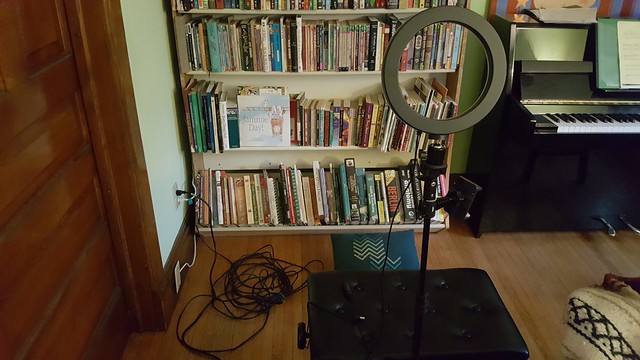
I also spent some time scrutinizing the backgrounds of the rooms in which each writer was speaking, because I’ve got a few events online to attend myself, and I want to know … things I really don’t know. Like, which wall in my house would make the best background, and do I need extra lighting, and should I wear makeup, and if I’m going to half-dress-up (top half only, of course) what colours work best on-screen, and will my knock-off bluetooth ear buds conk out midway through and what then?
Clearly, these are things that must be figured out by doing, and there are a lot of people learning how to do these things well, from whom I’m sure I can learn lots.
Meanwhile, this is the set-up I’m going to try out, mainly because it’s closest to the router. But the bookshelves make a good background, I think. Please wish me luck as I dip my toe into this new online literary existence this evening, in the brief role of “Introducer” for a conversation between Lamees Al Ethari and Antonio Michael Downing (also at the Wild Writers Literary Festival); and tomorrow morning, as I read my picture book Jammie Day to a friend’s online kindergarten class!
xo, Carrie
PS For those of you who read these posts as a newsletter received via email, the timing on the aforementioned events will be off by a day. This post was written on Thursday afternoon but due to automation beyond my control (or expertise, more accurately!), it will be sent on Friday. And I can report, updating this post on Friday morning, that both events were more interactive, more natural-feeling, and most importantly more fun than I’d dared to hope they could be. It felt like I could be myself. At the Wild Writers event, the conversation was thought-provoking, personal, and got my brain pinging with ideas. And after the Jammie Day reading and Q&A, all the kindergarteners stood up to show me their pyjamas, and then turned on their microphones to send me a chorus of goodbyes and thank-yous. It was wonderful.
(Yes, I put on a bit of make-up; yes, I borrowed a ring light from my husband, who does online presentations all the time; and I’m pretty sure no one saw my bright-patterned leggings, or noticed that I was sitting cross-legged on a yoga block on the floor!)
Tuesday, Nov 17, 2020 | Art, Books, Confessions, Current events, Exercise, Family, Readings, Spirit, Work, Writing |
Ever get the feeling that too much is on your mind, so instead of trying to say it all, you say nothing instead? Yeah. That’s where I’m at. That’s where I’ve been at for a few weeks now. I’ve also been reasonably busy, trying to seize all the moments in all the days that have come calling. It was sunny and warm for a full five days, so I was outside as much as possible with friends and family. Then one of my kids had a migraine for three days last week. I haven’t been able to run, as the nagging pain has returned, so I’ve been experimenting with other forms of self-soothing. Early morning dog walk: unsuccessful, did not provide enough endorphins, although the dog was thrilled with all the new scents to sniff. Riding the spin bike: much more successful, with the added bonus of delightfully cheesy Canadian entertainment. (While spinning, I watch Murdoch Mysteries, and I’ve been told that I talk out loud to the characters, muttering things like “Don’t go in there, George! You’re going to regret it!” or “It’s the brother. It has to be the brother!”)
Up till last Friday, I was working full-tilt on novel revisions, and now need to pause and consult with my editor to make sure we’re on the same page. It’s been fun, and a relief, and an escape, immersing myself in an imaginary world, where imaginary characters make imaginary choices and try to figure out how to mend themselves, or inflict mending on others.
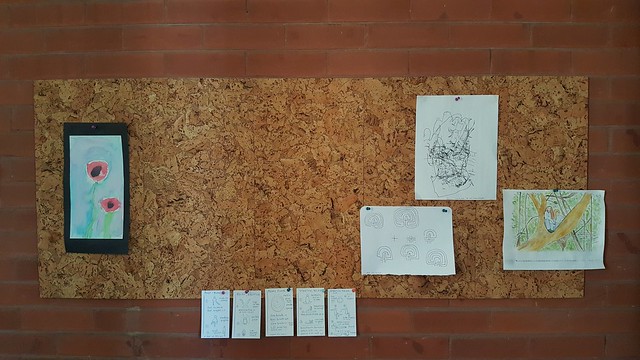
My corkboard is mostly empty, but for a number of physio exercises — I’ve drawn a series of reminders for myself on index cards, including instructions for stretching exercises that are meant to get a person up from her desk at least once an hour. (It has yet to happen, but a person can hope to change her ways!) The other items on the corkboard are a watercolour of two people in a tree, inspiration for my novel; a drawing of hands that look to be in prayer, to remind myself that my work requires patience and grace, and also as a reminder of the novel’s theme of spiritual searching; and some sketches that show the steps for making a labyrinth, though it looks more like I’ve drawn a strange, childlike version of the brain. Not on the corkboard, but critical to the revision process, is a sketched-out structure for the novel, done in a kind of personal visual code that I find very satisfying and comforting to look at.
Tomorrow, my oldest daughter turns 18. I’ve ordered donuts for pick-up. I’m planning to bike to pick them up, no matter how cold. Also this week, I’m introducing a conversation at the Wild Writers Festival on Thursday, 7-9PM, between two wonderful writer, Lamees Al Ethari and Antonio Michael Downing: here’s the registration information. And on Friday morning, I’m going to read my picture book Jammie Day to a friend’s kindergarten classroom. These last two events, needless to say, are happening online. One of my goals for this pandemic time is to become more tech-savvy; or at least, less-tech-anxious.
I’m grateful for plans. No matter how small. Like those donuts.
Almost every day, I lie on my office floor. Sometimes I take a nap. It’s a glorious floor for napping. More often, I do those physio exercises 0n the corkboard. I meditate, or listen to a podcast. Almost every day, my eyes fill with tears. It seems like a way to live now, on the verge of tears, but also attempting to strengthen and bolster oneself, to practice breathing, to pay attention to the pain, not to ignore it. Not to be overwhelmed by it.
Till next time—
xo, Carrie
Tuesday, Oct 20, 2020 | Exercise, Fall, Manifest, Music, Spirit, Writing |
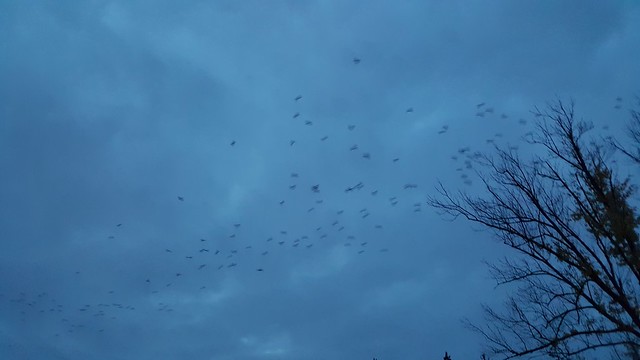
I’ve been pausing to take photos of the morning, the early morning light and sky and trees, as they change. The days are shorter, and now I run in darkness especially when it’s recently rained, as it had last night. This morning I’d already decided that I would stop at the bottom of a hill on the opposite side of the park, to get a different view than I usually do. I’d pulled out my cellphone when the sky filled up with birds. They flew toward me and then on and on, a great stream of them; it looked like they were heading north, not south.
I don’t wear my glasses to run, and the result is photos that are often slightly (or wildly) out of focus.
But my writing life feels more in focus, both this week and last. I’ve been working on revisions, and have been grateful for the energy to be methodical in my planning and execution. Last week, when I was feeling so low, the novel was a complete escape; I needed it, I could see that. I needed something big and whole to tether me to purpose, something outside of myself, that would carry me out of my body and mind into the bodies and minds of other people. Characters. Avatars embodying my questions and testing my theories about how to be (or not to be).
Fiction is escape. Writing fiction is immersive. Like plunging into another bloodstream, or being set free into a new landscape that isn’t mine to tend and repair, only to wander through like a voyeur. Looking through windows. Inside cupboards. What’s on the bathroom floor? I don’t have to pick it up, clean it up, I just get to snoop through imaginary rooms, imaginary weather, climb imaginary trees, hum imaginary tunes in someone else’s dreamy voice. Feel imaginary sadness; that too. And I get to come through it, by piecing together a puzzle so all the edges fit and make sense, the way real life never does, never can.
This morning, I was wearing headphones, listening to my “Run Fast” playlist. Missy Elliot was playing. But I could hear the birds.
(As I ran on, up that hill and turned down a very dark stretch, and the birds kept coming, all I could think was: Please don’t poop on my head!)
Goodbye, goodbye, hello, hello, good morning.
xo, Carrie