Category: Spirit
Wednesday, Sep 30, 2020 | Art, Big Thoughts, Blogging, Books, Current events, Death, Drawing, Exercise, Fall, Feminism, Fire, Friends, Lists, Manifest, Meditation, Organizing, Peace, Politics, Reading, Running, Space, Spirit, Work, Writing, Yoga |

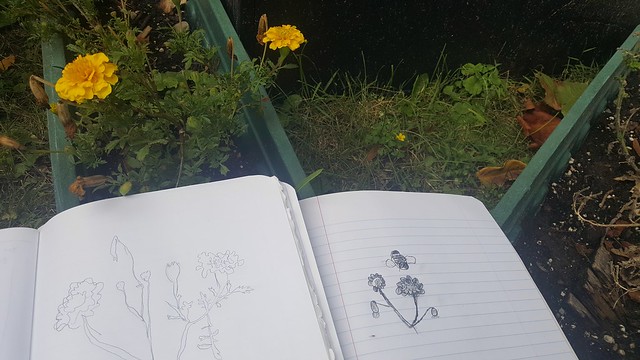
Drawing a flower with CJ.
September Reflections
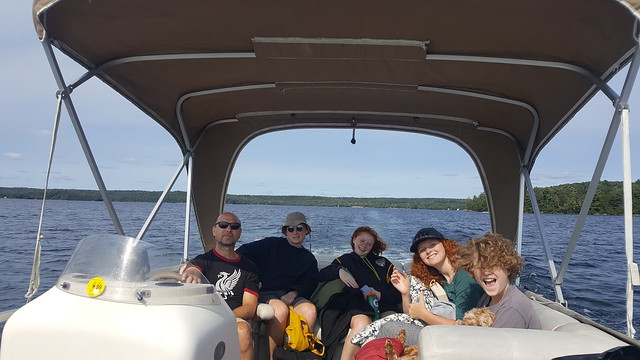
- What felt good this month? At the beginning of the month, it felt wonderful to be on holiday (we spent two weeks away at an isolated cottage). As always, I hoped to bring that holiday-feeling home; but inevitably it has slipped. I can’t drink a caesar while cooking supper every day! It isn’t even possible to keep up the habit of twice-daily yoga. But it is possible to get up early every week day morning for a walk or run, followed by yoga. It’s also been blissful to take charge of my studio space, to clean and organize and purge and paint, and to set new goals. And we have kept the holiday-feeling going in small ways: Kevin bought a fake fire pit (propane-powered) and we’ve been sitting outside some nights, watching the flames, listening to tunes.
- What did you struggle with? After rejigging my studio, I panicked—as if I didn’t deserve the space, full of fear and doubt about my work and worth as a writer. But then I journaled, meditated, and went for a dog walk with Kevin, and I came out the other side. It helped to reframe my work through the window of books. Books are my life’s work. If I feel unmoored, I can ground myself by reading, writing, or connecting with others who read and write. I am so thankful for this blog as a place to come to, to share ideas, and experiment, too. I am so thankful for each one of you who reads. Thank you.
- Where are you now compared to the beginning of the month? Unexpectedly calm. When my mind spirals away, caught in fear or doubt or shame, I notice, and find a safe branch on which to land. I breathe. I think: Is this true? What’s really happening right now? Are you okay? Is there anything you need to do? I’ve noticed, too, that projects are so very satisfying to work on and complete: my mind is soothed, no matter the task. Cleaning out the bathroom cupboards. Cooking a meal from scratch. Painting a door. Writing a grant application. Revising a story to send to my writing group. In this way, small accomplishments accrue, and the days flow peacefully, but don’t feel dull. And in the evenings, I reward myself with some stretching, watching a show, reading, eating popcorn, letting my mind and body relax. (Note: this is so much easier to achieve now that I’m not coaching! I do not take my easy evenings for granted!)
- How did you take care of yourself? All of the above. Plus, remembering to reach out to friends. Working on my posture, and core strength. Sticking with established healthy routines. Putting away the pairs of jeans that don’t fit anymore. Thanking my body for carrying me through this life. I ask a lot of my body! I am in total awe that my chronic running injury has healed through physio, and that I’m able to run fast again, without pain, at least for now. Every morning run through the park is a full-body expression of thanks.
- What would you most like to remember? It’s okay if I don’t remember very much from this time. Sometimes the best days aren’t super memorable—I don’t remember much when inside the flow, but if I’m fortunate, from the flow will emerge some work of substance, or a strengthened relationship, or deepening insight and capacity for approaching conflict, suffering and pain. I will remember where I was when Ruth Bader Ginsberg died; and my own sadness and immediate despair. But I’ll remember just as much that her passing sparked a renewed connection with one of my beloved American cousins. I’ll remember, too, what she worked toward: equality for all, a far-seeing, long road of commitment that developed from her own experiences, that was encouraged to develop through the support of her husband and family, and that extended till her death. Like John Lewis, she is a true role model of character and vision, beyond the self.
- What do you need to let go of? I deactivated my Twitter account a week ago, after watching The Social Dilemma on Netflix. I also turned off most of the app notifications on my phone. It’s been good, and I hope it lasts. What I’ve noticed: I’m freed to work with more focus throughout the day. But I’m also not filling my mind with fury and outrage, the primary emotions sparked by “doom-scrolling.” True, there’s less to distract me from my own restlessness and boredom, but here’s the strangest part: I’ve felt less restless, less bored, since signing off. There are more productive and meaningful ways to connect with others in this world. I commit to choosing those instead.
xo, Carrie
Friday, Sep 25, 2020 | Blogging, Manifest, Peace, Running, Spirit |
For those of you who come here to read a Canadian literary blog (if that’s what this is!), it’s probably a surprise to learn that the bulk of searches that bring people to this site include the word “midwife.” Far and away the most popular post on this entire blog is one I wrote in 2013 called “Why I Want to be a Midwife.” I composed it just before the interview stage of my application to enter a midwifery program, and the post is heartfelt and passionate and idealistic (if memory serves; to be honest, I haven’t read it recently). Maybe it’s helped others at the same stage of their journey to become midwives. Maybe it’s been read by people who have actually become midwives!
I never updated the post with news of what came next: I got into the program; but ultimately turned down my spot. I’m not a midwife. You already know that. (The people who read the post seem not to know that, as a number of the comments ask how it’s going.)
Anyway, this is a long rambling intro that I did not sit down intending to write.
Maybe this is a nudge to reflect on setting aside expectations, the desire for control. You never know what’s going to stick. You don’t know what you’re making while you’re making it. The consequences of our choices, deeds, words are unpredictable, outcomes uncomfortably beyond even our best guesses.
As a friend wrote in a reflection she shared with me this morning: Let life reveal itself through you.
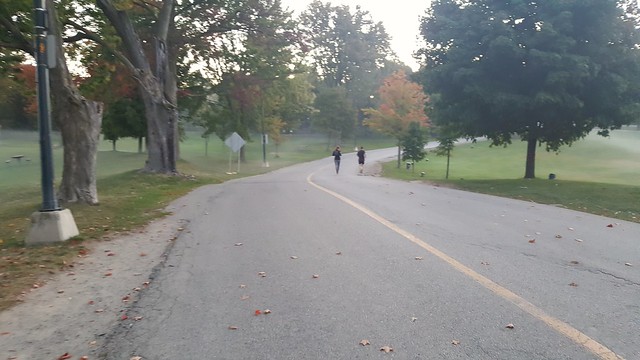
This morning, I felt buoyant, like my feet weren’t touching the ground as I ran through the park, the fog, the flock of white walking gulls on green grass, the song in in my ear buds: “Everything is everything,” sang Lauryn Hill. And everything was everything, as it is. I knew it from the inside out, my whole body expressing joy. I wasn’t focused on what wasn’t—I was loving what was.
Let life reveal itself through you.
xo, Carrie
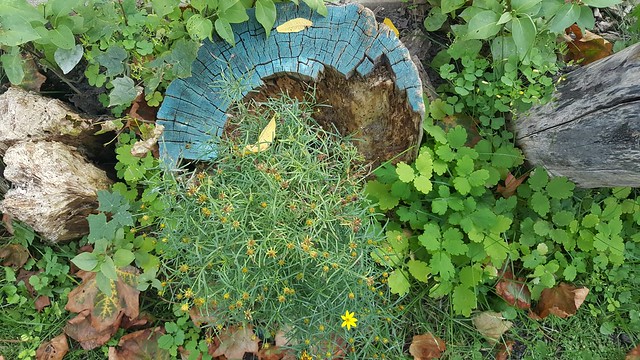
PS The second-most-popular post is one called “Tree Stump Playground,” from 2011. Photo above is from the playground as it looks today.
Wednesday, Sep 23, 2020 | Blogging, Confessions, Current events, Exercise, Family, Green Dreams, Lists, Manifest, Meditation, Peace, Poetry, Politics, Spirit, Stand |
The darkest hour is before the dawn (says who?), but I don’t think we’re there yet. Our planet flares with alarms, and I keep scrolling the news like it’s entertainment. Like it’ll make a difference to know more and more, somehow. Like I’ll reach the end and go: there, done, at last, problem solved! 1
(Anonymous commenter: “The darkest hour is actually midnight.”)
The equality we’ve fought for is tenuous, incomplete, and may erode further. What hope is there that we humans on planet Earth will work together, pull together, row in a direction that honours difference, blesses the frail, lifts up everyone who is in pain? Where does it hurt? What’s your story? 2

Vote? Of course! I’ve got my ballot filled in, ready to mail back to Ohio. I will take deep breaths and hope. One voice, one gesture, one act of faith. But VOTE is not enough to fix what’s broken. Dividing, degrading, self-dealing; cynicism. What does democracy mean? For the people, by the people? Also, a corporation is a person?? Also, send more money? 3
Don’t pretend the end justifies the means. We live in the means! If you lie and cheat to win, you’re not a winner, you’re a liar and a cheat. If the only way to win is at all-costs, I’d rather be the sucker who spoke her heart and lost. 4
My heroes are the ones who saw the long road ahead and walked onward toward a light and promise they knew wouldn’t be found in their own lifetimes. Or maybe ever. But they saw it and articulated it. Our better selves. Where everyone will have enough, and dignity too. 5
Where love not greed rules. What I see: my brothers sisters friends strangers the ground underfoot the air trees stars the living oceans are of me and I of them. All of us humans are flawed, broken, in need. To share is to receive but also to give. 6
Look at this bountiful world. End
xo, Carrie
Tuesday, Sep 15, 2020 | Art, Confessions, Current events, Fire, Friends, Manifest, Meditation, Peace, Poetry, Spirit, Word of the Year |

The Sunflowers, by Mary Oliver
Come with me
into the field of sunflowers.
Their faces are burnished disks,
their dry spines
creak like ship masts,
their green leaves,
so heavy and many,
fill all day with the sticky
sugars of the sun.
Come with me
to visit the sunflowers,
they are shy
but want to be friends;
they have wonderful stories
of when they were young —
the important weather,
the wandering crows.
Don’t be afraid
to ask them questions!
Their bright faces,
which follow the sun,
will listen, and all
those rows of seeds —
each one a new life!
hope for a deeper acquaintance;
each of them, though it stands
in a crowd of many,
like a separate universe,
is lonely, the long work
of turning their lives
into a celebration
is not easy. Come
and let us talk with those modest faces,
the simple garments of leaves,
the coarse roots in the earth
so uprightly burning.
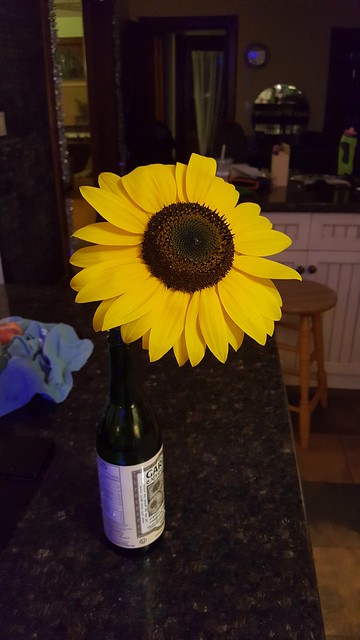
Say you were invited to hold a sunflower, and examine it, while reading and thinking about these words in Mary Oliver’s poem. Say you were invited to respond by asking questions of the sunflower, or listening to the sunflower ask you questions. What would come into your mind, and onto the page? On Friday evening, outside around a fire pit, my friend Jen led a small group of us in this meditation. It was already, newly dark, and we used cellphones to illuminate the page and look at our sunflowers. which another friend had cut down and brought from her yard. Several of us found bees nestled into the flowers.
This is what I wrote.
“… the long work / of turning their lives / into a celebration / is not easy. / Come //”
Some solutions seem so simple
I will paint my office door the bright yellow
of this sunflower’s petals
I will spend the whole day reading a book
I will stretch and breathe
But when restlessness turns inside me
what should I do then, Sunflower, tell me?
When I am afraid
that my service is too meagre
and I can’t think what to do to be a
better person — what should I do, Sunflower?
The restlessness, the sense of longing
of energy unused or squandered
The list of all the harms I’ve caused
shuffling round and round inside me —
Tell me, what should I do
to fix these feelings, Sunflower?
It is true I hear you humming
Too tall, cut down, a living
bee nested in your blossom that has not
bloomed, tucked beneath the brighter face of you
You are humming not an answer
but a blessing with a sting:
Get on with living
You are not between two points
like a traveller on a train stalled between
destinations, you are in the only place
in which you are as you are — alive
and very you
Do you remember when you saw a whole
field of us, sunflowers, calling you
and you drove on, you said, It’s not
my field, I would be a trespasser?
You were right enough
But we’ve found you anyway, again
as you are. Come
Tomorrow, I would like to write a post about the new colour of my office door, and the books I’ve been reading, and the ways I’m seeking to connect, and to learn and listen, and find antidotes to fear and despair, but for today, I invite you to find your own sunflower and ask it some questions. Whimsical, fanciful? Yup. Uncomfortable, weird? Maybe. Silly, frivolous? Try it and see for yourself.
xo, Carrie
Tuesday, Sep 8, 2020 | Big Thoughts, Confessions, Current events, Family, Feminism, Holidays, Manifest, Meditation, Peace, Spirit, Stand, Success, Summer, Yoga |
Two weeks is a long luxurious span of time to be on holiday, especially right now, especially when one’s holiday is basically a two-week quarantine away from other people and the world and news and thoughts of the future; it’s all a beautiful, slow-moving present; now, now, now.
We’re back home, but I’m holding onto my holiday brain for as long as I possibly can.
This is what I learned on holiday: Notice. Notice what I’m doing or about to do. Notice what effect it has on others around me. Notice what I like and don’t like about the things I’m doing and saying, and their effect. Do I want to change those things? Can I? (Don’t know. Maybe!) But it all starts by noticing. And then deciding what to do next.
As one of my kids told me: I think you have to want to change, Mom.
Yes. That is true.
On holiday, as an experiment, I sometimes did the opposite of what my first response would have been. I had the time. I noticed how I wanted to respond before I responded, and then if I didn’t want to respond that way, I paused myself and tried to respond differently, just to see what would happen. This was on a very small scale. For example, Annie and Kevin and I did yoga twice a day on the dock and one fine afternoon, I noticed that I wanted to announce to them—during tree pose—that I was wearing very slippery pants, and the pants were the reason I couldn’t place my foot up high on my opposite leg—I wanted to explain: hey guys, it’s not me, it’s my pants! But instead, I noticed that I wanted to do this before I did it. I noticed, too, that to speak would be to spoil this moment of shared concentration. I noticed that what I wanted to share was a) information not useful to them, and b) information that, if shared, wouldn’t actually solve anything. Any insecurity, any fear of failure, was mine; unrelated to what they were doing, and certainly not theirs to fix.
So I bit my tongue. I just did the pose. Obviously, this was a very tiny moment of noticing and making a very tiny decision, but I remembered it afterward, clearly, because I’m writing about it from memory now. What I noticed was that it didn’t hurt at all to stay quiet. It just shifted the moment, and my experience of the moment. It reminded me why I was doing yoga—as a gift to my body and mind, as a way of loving myself, respecting my body, no matter what it was/is capable of doing. It reminded me to thank my body for holding me up, no matter what the position.
It reminded to say: Thank you, body, for bringing me into this moment!

Notice, notice, notice. It’s why I meditate. I have to want to change if change is going to happen. But I also have to notice what I’m doing in the first place. So much of what we do, think, say is almost automatic. We’ve fit ourselves into systems, we’ve figured out how to survive, how to take the easiest route to self-soothing, how to comfort ourselves, how to minimize conflict (or ramp it up, if that’s what makes us feel alive/better). Our responses are formed by long experience, often dysfunctional, or harmful to our bodies and minds. Changing deep patterns takes patience, trial and error. Takes forgiveness and generosity above all else—to the self, which will extend then so easily to others too. If you can forgive yourself for your flaws and weaknesses it will be easy to forgive the flaws and weaknesses in others.
Insecurity, fear, the desire to be liked, the need to win and prove myself; these are among my deepest flaws. And I do want to change the way I respond when in their thrall. The only hope is to notice.
One more thing I learned on holiday (or learned anew, again): To notice when others are doing and saying things that make me feel good, cherished, calmer, more generous-minded—so I can learn from their deeds and words, and also be appreciative. For example, I’m so thankful that my children are kind and hopeful people, who are rolling with their changed circumstances, accepting what they’ve got and actively making the best of it, adapting, not complaining or mourning any perceived losses, just getting on with what’s being offered to them. I watch them, I notice, and I follow their lead.
xo, Carrie
Tuesday, Sep 1, 2020 | Big Thoughts, Confessions, Current events, Family, Friends, Holidays, Lists, Manifest, Peace, Spirit, Summer, Work, Yoga |
August Reflections
- What felt good this month? Being on holiday and, more importantly, feeling on holiday. Being outside, as much as possible — I’m writing this outside, for example. Daily yoga with Annabella, and in the past couple weeks, we’ve bumped it to twice-daily. Going easy on myself in terms of expectations (especially while on holiday). Seeing friends and family in person, for walks or on porches, or back patios, or back yards.
- What did you struggle with? I’ve noticed a few things. One, it’s harder to remain vigilant about the pandemic, the further we get from its initial shock. Summer has given us a blissful break, but I dread the possibility of an interior, locked-in, limited-contact fall/winter. Two, I’m hyper-critical of my social interactions; specifically, any social error that I make now feels magnified and terrible, and I’ll wake up in the middle of the night replaying these moments. There’s a piece in today’s New York Times about how we’re all becoming more socially awkward, and I, for one, can attest that this is painfully true. Three, I feel a longing and almost a panic about finding things to do that will connect me with other people: I had a dream that I’d gotten a job working at a newspaper as a copy editor two days a week, and in the dream I was thrilled and excited, till I realized that it was likely work I could do from home, and I wouldn’t be with people. I woke up feeling confused, as this hasn’t been a conscious desire — to be with people, to work with people; in fact, I’ve been carefully arranging my life in order to work alone, writing things. Maybe I’ve got this all wrong? Or even somewhat wrong? Maybe I need to find outlets / work that allow me to be with others? (And is this a pandemic-induced feeling of starvation-for-contact, or a more fundamental issue, career-wise?)
- Where are you now compared to the beginning of the month? Flatter. I’m not sure I can explain this better. I feel suspended between seasons. There are too many unknowns looming. I’m riding the moment, trying not to think ahead or get ahead of where I’m actually at. My expectations feel low, and I can’t decide whether that’s a good thing or a bad thing. Mostly good, I think. But sometimes I think I need more … more ambition (?), a defined goal (?), something concrete to bolster my otherwise circular practices (?).
- How did you take care of yourself? Same as last month: I’m practicing radical self-love! (Try saying that out-loud and not undercutting it with a self-deprecating aside.) Reminding myself and my body that to be imperfect is to be human. Speaking up when I feel upset or ignored. Trying to address conflict directly. Trying to notice my own shortcomings and dysfunctional patterns, emotionally, so I can at least take a step back and say, hey, do I like this? Do I want to change this? And if so, try to respond differently than I ordinarily would. I’m talking very very small-scale changes: like, whether I eat a piece of chocolate now or save it for later. (To this point: I’ve noticed I tend to hoard for the future rather than permit myself to enjoy in the present; what does it mean to give myself permission to use my resources freely, without fear? What does a mindset of plenty, of enough, of bountiful, of abundance feel like? How would it change how I live?)
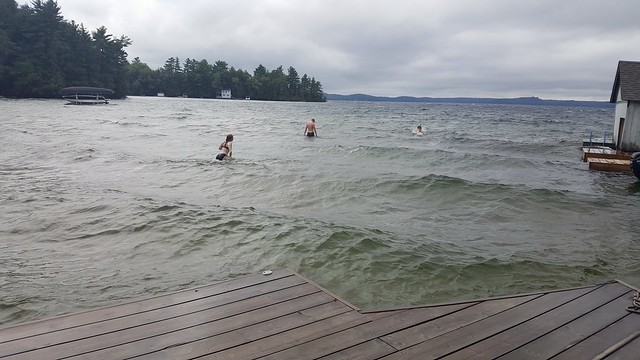
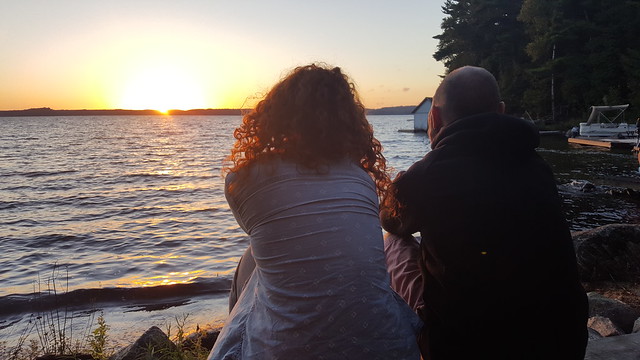
- What would you most like to remember? The lake. The way the water moves differently depending on the wind and the time of day: long ripples; flat; waves; dappled. The sunsets. Card games with the kids. The meals: potato crust quiche, beans and rice, risotto made with homemade broth, roasted beets. Bike adventures with CJ.
- What do you need to let go of? What I should probably let go of is news from the States. But I can’t and I won’t. I’m practically an obsessive about it, even when on holiday. I’m by turns baffled and infuriated, disbelieving, resigned. It’s like everything that’s been simmering under the surface has been turned up to a boil, all the chickens are coming home to roost: the country is armed to the teeth, divided, sick, hungry, the inequality is obscene, the systems corrupt and built on racist and misogynist beliefs, and reality itself seems upended by the lies and false narratives being peddled and eagerly devoured online. What am I witnessing? I can’t make sense of it, and want to. So much doesn’t make sense to my mind, perhaps most basic, the willingness to let so many people get sick and even die, when there are simple solutions that could stop the spread of the virus. If they’re willing, as a country, to accept so much death, what else will they be willing to accept? It frightens me. (And what am I willing to accept, as a Canadian, that I shouldn’t?) So … should I let this go, turn off the news? It doesn’t affect my life directly, does it? Wouldn’t I be more content, more peaceable of mind, if I were to let it go? How important is this form of passive engagement? In what ways do I become actively engaged for knowing more? (For one, as a dual citizen I’ve registered to vote, but that’s not new.) Is it a sick form of entertainment, in a way, or is there value in staying informed?
xo, Carrie