Category: Confessions
Friday, May 17, 2019 | Art, Big Thoughts, Coaching, Confessions, Feminism, Organizing, Peace, Space, Spirit, Word of the Year, Writing |

Sometimes my skin feels too porous, and emotions pour in almost painfully. Yesterday, I started reading a personal essay in the newspaper written by the mother of a child on the autistic spectrum who was being bullied by classmates, people he thought were his friends. I had to stand up and walk away, so strong were my feelings of sickness and pain, gut-deep, a grief and horror that seemed to wash through my bloodstream.
I stood by the sink and wept.
Stories of exclusion, cruelty, judgement of others trouble me so deeply I can hardly tolerate the pain. I guess here in my mind, I live in a world in which people see each other, are kind to each other, have compassion for each other; but in the real world, there is a lot of pain inflicted even by people who are trying to be kind; pain is also inflicted by people who only want to be left alone, people who don’t want to engage, people who don’t care, who are struggling with their own troubles; and there is pain actively inflicted by people who fear and hate others for their differences, people who don’t want to understand or learn or listen, people who actively target others, weaker and more marginalized than themselves.
I can’t make sense of it.
It just doesn’t make sense in my brain.
I don’t have solutions. I can only to attempt to make spaces for that version of the world that exists in my mind to exist in real life. I’ve tried in the classroom, on the soccer field, inside my own family, and in this storytelling workshop. I know I’ve gotten things wrong. I suspect I’m sometimes the person who’s inflicted pain when trying to be kind, and acting in ignorance. But I’d rather try than hide. There is no alternative that makes sense to me.

XPagePerformance2019WEBAD
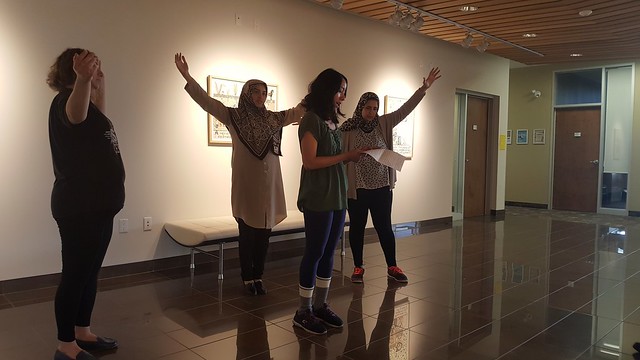
For the past 11 weeks, I’ve been privileged to be part of The X Page Workshop. It was envisioned as a creative and collaborative undertaking that would bring together women from different cultural backgrounds, all of whom are making lives for themselves and their families in Canada. Each week, a group of almost 30 of us have met to work on writing and staging stories. Together, we’ve made something that’s rich and enriching. Just with stories! Just with stories and goodwill, trust, kindness, and effort. When we’re together in the beautiful space at the Centre for Peace Advancement, as we have been every Tuesday evening since March, I feel immersed in the possibility of the world inside my mind becoming a real place. It feels like a real place, then and there.
Just thinking about being there brings me a sense of peace and ease.
It isn’t perfect. Why should it be? This world in my mind has conflict, but it also has ways of talking about conflict, because there is trust, and the trust is constantly being earned. Each small thing offered, in this world in my mind, is actually a really big thing. Our gifts to each other don’t have to be grand gestures, large acts, or come from a place of material wealth.
I think the best gift we can give to someone else is to see and acknowledge them without wanting or trying to change them in any way.
Unconditional love.
To live in this world in my mind, I have to try to live with unconditional love. And that means feeling too porous sometimes to the brokenness in the real world. That means loving what’s broken, too, unconditionally. And that hurts. But it’s the only thing that makes any sense to me at all.
xo, Carrie
Monday, Mar 25, 2019 | Confessions, House, Lists, Space, Spirit, Stand |

(Apologies in advance for an extremely boring, list-heavy post. I will not be offended if you skip this one. I just had to figure out what went wrong today.)
Things I’ve done today:
Teaching-related: Replied to one student email; marked several student projects (so many more looming); prepped classes for this coming week; made three PowerPoint presentations; scanned artwork for PowerPoint presentations; downloaded artwork from students for launch party PowerPoint presentation; emailed event planner at university to organize details for class launch party; printer stopped working so Kevin had to drive to office, bring home crappy old printer, so I could print my class plan for tomorrow; packed bag for tomorrow’s class; transferred PowerPoint onto jump drive.
Soccer-related: Booked an exhibition game; cancelled an exhibition game; arranged ref for new exhibition game; answered emails from parents; posted summer season game schedule on TeamSnap; contacted coaches from two other teams to arrange rescheduling of regular season games (+ looked up coaches’ contact info online); emailed club admin about spring field times; emailed club admin about new player; emailed different club admin about procedure for rescheduling games; multiple emails to and from team manager about related subjects.
Child-related: Oversaw daughter’s online math test; arranged carpooling for youngest to attend birthday party (did not participate in carpool); picked eldest up from work; drove two children to swim lessons; related, found swim goggles and shampoo and loaded into bag with towel; also related, gave $10 to daughter to oversee youngest as swim lessons and walk him home; drove elder daughter to band practice; talked son through reversing into parking spot; pulled stuck ring off daughter’s finger (emergency-level panic situation); washed daughter’s shoes; instructed youngest to make birthday card; instructed eldest to open can of tuna for youngest’s very late lunch; discussed eldest’s English seminar on Death of a Salesman (he talked; I listened); facilitated cheerful conversation around the supper table.
Miscellaneous tasks: Updated calendar on the chalkboard for upcoming three weeks; four loads of laundry while watching YouTube videos and absorbing depressing Trump-crowing-about-being-exonerated news; made pasta with cabbage, walnuts, tofu and sage for supper, had to improvise and use three kinds of pasta because we were apparently out of matching pasta, which required boiling two separate pots of pasta water; put gas in car; put dishes in dishwasher, cleared table, wiped table; washed part of upstairs hallway floor.
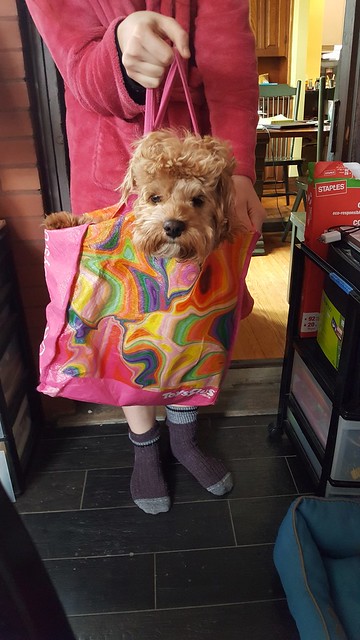
Just for me: This blog post; rode spin bike for 70 minutes, with sprints every 5 minutes (easiest part of my day); texted a friend; multiple texts to and from my mom; took photo of dog (above) and texted it to child; ranted to Kevin about this feeling I have that I’m drowning, succumbing, going under and may not come up, and also how the house is filthy and no one vacuumed this weekend (not blaming him, just ranting generally, as he was just coming home with loads of groceries).
Things I didn’t do today: Go to church; meditate; eat lunch; read a book for pleasure; meet a friend; relax; nap; rest; do something just for the fun of it; take a break; cartoon, draw, write, sing, play piano, listen to music.
Children are now calling me to come watch an episode of Schitt’s Creek with them before bed, and I think this may be the best option at this moment in time.
xo, Carrie
Tuesday, Mar 19, 2019 | Art, Big Thoughts, Cartoons, Confessions, Creativity course, Family, Friends, Meditation, Parenting, Peace, Space, Spirit, Teaching, The X Page, Work, Writing |
Too much. There’s too much on my mind. The kids were home last week on March break, and I looked at the surfaces around our house, covered with debris, and I thought, this could be a metaphor for the surface of my mind. I’m drowning in details, in crumpled to-do lists, in scattered responsibilities, in unmet needs, in forgotten or neglected tasks.
My solution is multi-pronged, and does not, as one might think would be prudent, involve a lot of cleaning. Whenever I clear a surface, more debris appears.
Instead, my solution is in connection. Connection outward and connection inward. I go to a kundalini yoga class, and chant, whirl, and root myself deep inside my body. I go to church and rest within an hour of spiritual reflection. I draw and I write. I go for a walk with a friend. I meditate. I help lead workshops, and I stand at the front of a classroom trying to connect students to the transformative magic of their own creativity.
I’ve been sharing a journal with one of my children, as a way to “talk” back and forth about big subjects. Our household currently has three teenagers, a time of life that is especially full of big questions — what is the purpose of my life, what am I supposed to do next, who am I, where can I find meaning? There aren’t one-size-fits-all answers to these questions, it seems to me, so I can only offer ideas, suggestions, places to search.
One of my teenagers said to me, earlier this week, that people are looking for connection with something bigger than themselves. That’s it, isn’t it. That’s the general answer. I think it’s why religion has played such a critical role in human society: religion is explicitly about connecting with something larger than oneself. Most religions involve community, ritual and practice, and some personal sacrifice; all of which are important ingredients, in my experience, to feeling connected to a larger purpose and meaning. It’s important to be aware that there are healthy connections, but there are also dangerous connections (if you’ve connected with something that demands that you hurt or denigrate other people, or yourself, for example, that is not a healthy connection with a larger cause).
Sitting in church on Sunday, I thought about who I am becoming as I age and grow more rooted within myself. I’m not someone who needs a clear surface to thrive. I don’t need to live in a clean house. But I am someone who needs to pay attention to the things that are causing the clutter, the people whose lives coincide with my own, whose interests interest me, the people who share my space (and I don’t just mean my own family); I carry their cares close, in other words. The debris isn’t all mine; I’m not even sure a quarter of it really belongs to me; certainly I generate far less than I take responsibility for. And that’s where I need to take care, be more mindful — recognize and accept responsibility for the choices I make, and recognize and let go of that which is not mine to tidy, clean up, or carry.
Somehow, it’s my spiritual self that recognizes what matters. Yet the spiritual self is the easiest to neglect, and the hardest to talk about. Here’s what I’ve been telling myself to maintain those connections, inward and outward, that give me meaning and purpose: If you don’t have time to meditate, you’re too busy; if you don’t have time to go to church, you’re too busy; if you don’t have time to talk to a good friend, you’re too busy; if you don’t have time to be alone, you’re too busy. (Here’s the thing: even though I’m busy, I almost always have time.)
xo, Carrie
Wednesday, Feb 20, 2019 | Adventure, Art, Big Thoughts, Cartoons, Confessions, Drawing, Writing |
I’ve been doing an intensive writing week. I have little transferable advice to pass along regarding strategies for how to write a novel, unless you’re interested in the pathological approach. I’ve spent seven days writing almost non-stop, abandoning all else, and I can report back to you that the overwhelming sensation involved is: compulsion; essentially, it felt too psychologically painful to stop until done. So I wrote till I was done, and the whole book was out of me. (Important side note: Much editing awaits ahead.)
I finished this morning. I was working off a previous draft, and an outline, so this wasn’t material conjured from thin air, these are characters I’ve been exploring in one form or another for several years now. I know them. Writing scenes felt like describing events that I’d witnessed. I just had to look around, pay attention, and write what I was seeing.
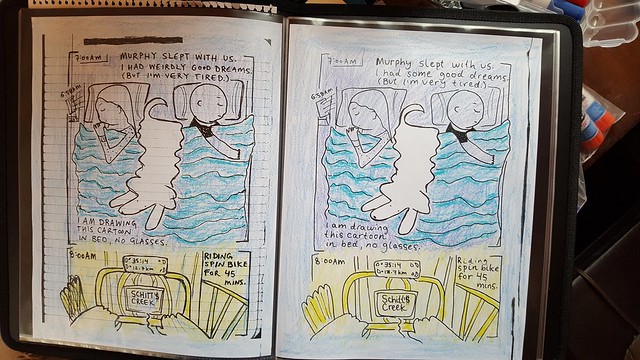
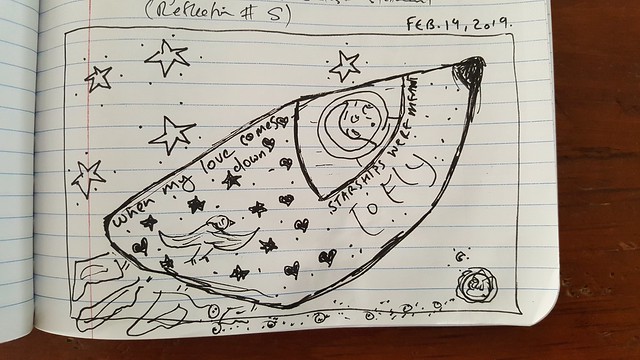
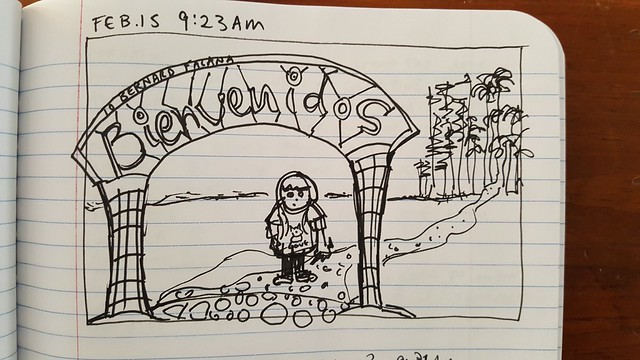
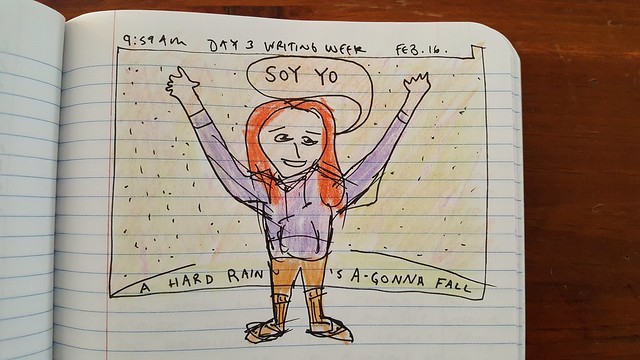
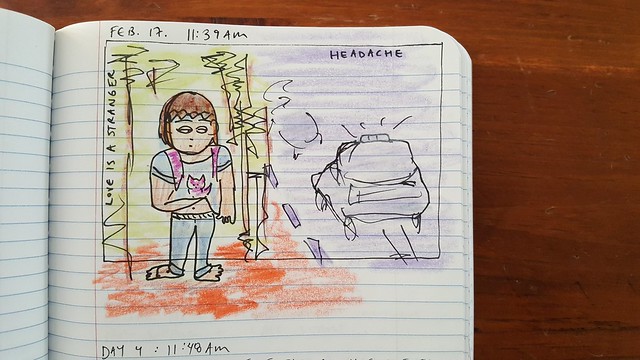
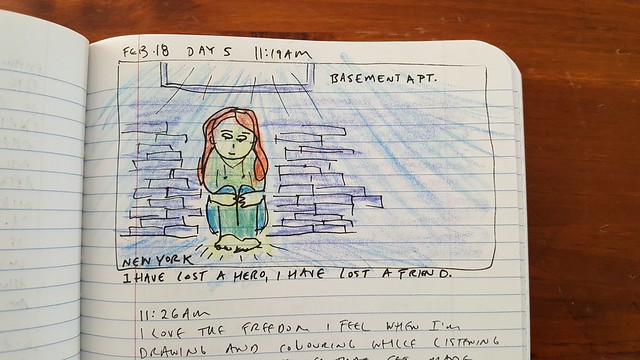
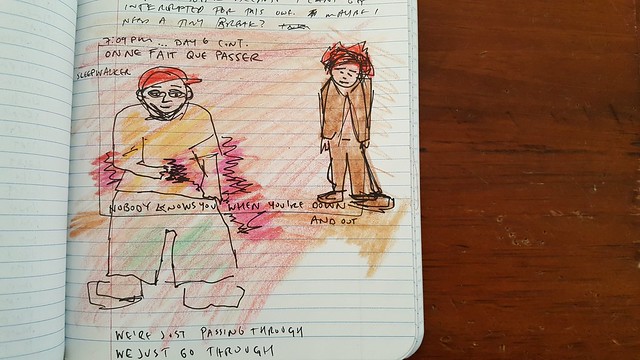
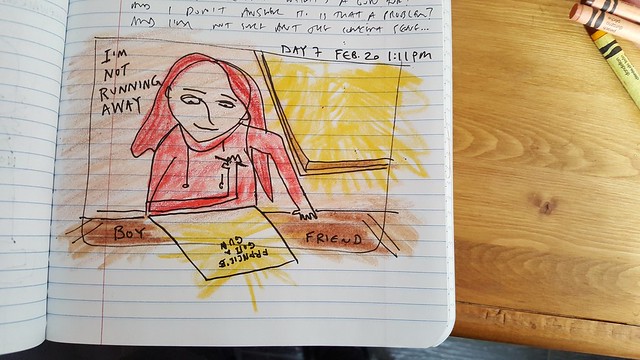
I marked each writing session by drawing — the drawings I’ve used to illustrate this post — while listening to music (the song titles are incorporated into each drawing). After drawing, I wrote for three minutes — “What’s on your mind?” — the same prompt I use when leading creative writing classes, and it’s brilliant. Just dump it out. And then GO.
There must be another way to do this work, of course, and my goal is to give myself enough space during my regular life that I can aspire to write under more regular, ordinary circumstances. Because, I’ll be honest, all I crave is more of this. More and more and more and more. Writing like this feels as natural as breathing. Effortless? In truth, yes. The way that going for a hike in the woods is effortless. Because I was so occupied, it was like I was living in another world. And now, thankfully, that world exists outside of me in a form accessible to others.
The relief I feel is extreme. I can’t describe it accurately. I was so afraid that something would happen to prevent me from pouring the whole thing out — the whole story. And to imagine leaving those characters half-formed, half-finished with their tasks, was excruciating.
I’m writing this now to help myself remember what it feels like to be in this rare place. I want to record what it feels like to be inside this altered state, because I can’t assess it clearly from inside, yet I know I’m not exactly myself, even now. I’m still too attached to that other world, which feels more vital, more marvellous, more enticing than the mundanity of this real world, which is loaded with responsibility, distraction, good intentions (mine) causing problems, irritating details that mustn’t be overlooked. I know it’s good in the real world too, but this other world — it’s like getting to live inside of a novel, which is somehow even more profoundly affecting than simply reading a novel. If you know the pleasure of reading a novel, and falling into that other world (or any invented and stylized world, of any form), I hardly dare tell you that writing a novel is a million times more intoxicating, more absorbing, more wonderful, because that will sound like hyperbole. (Or maybe, too, I fear sounding like a junkie craving another hit.)
But it’s not hyperbole, it’s true. It’s that wonderful, that absorbing. I must make space to do this — just this.
xo, Carrie
Wednesday, Feb 6, 2019 | Art, Big Thoughts, Confessions, Fire, Good News, Publishing, Spirit, Stand, Success, Work, Writing |
I’m sitting in my cozy office, wearing reading glasses, listening to my favourite Spotify playlist (song of the moment: “Ya veras,” by Systema Solar), office door closed because my elder daughter is practicing piano obsessively. Kids are all home from school, which makes Rose-the-pup very happy. Kevin is mid-flight to Fort McMurray for a work trip. All schools, including the universities, are closed today due to freezing rain. I started teaching more than six years ago, and today’s is the class I’ve ever missed. (Not-Humble-Brag # 1)
I’ve decided that this post’s theme is the Not-Humble-Brag.
I’m uncomfortable with bragging. But it makes me even more uncomfortable to pretend that I’m not bragging. (Side note: Why call it bragging? Why not label it differently in my own mind, as good news, and own the sharing of it?) (Side note # 2: My superstitions are kicking in strongly, as all my instincts scream: if you announce that you have good news, you will be deservedly and instantly punished with bad news!)
Okay, superstitious self, what if the Not-Humble-Brags are less earth-shattering, more like gentle observations of loveliness? Hey?
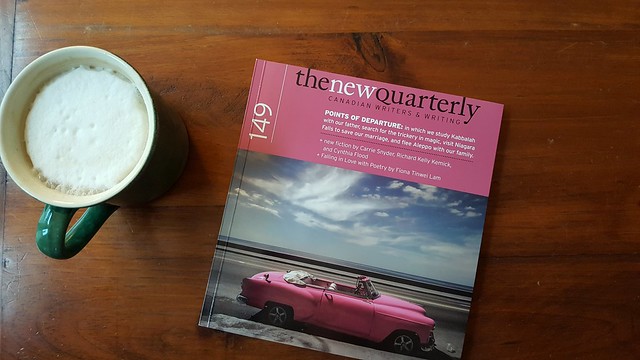
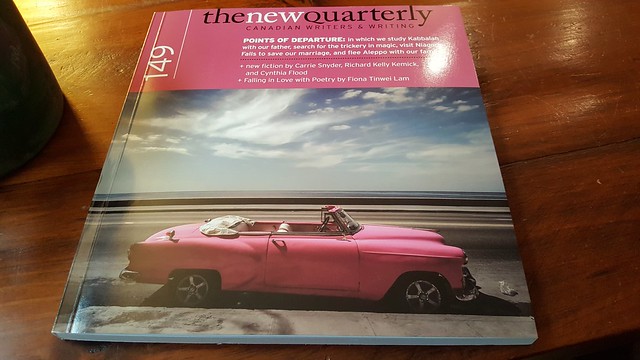
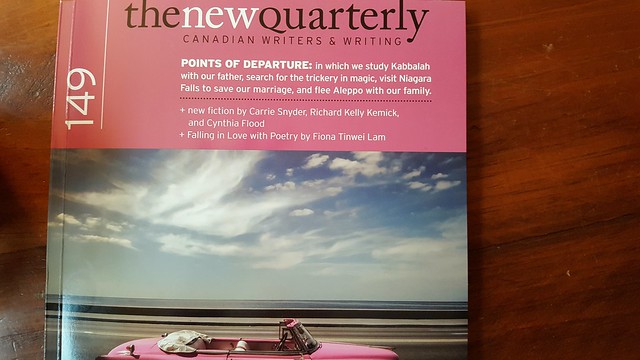
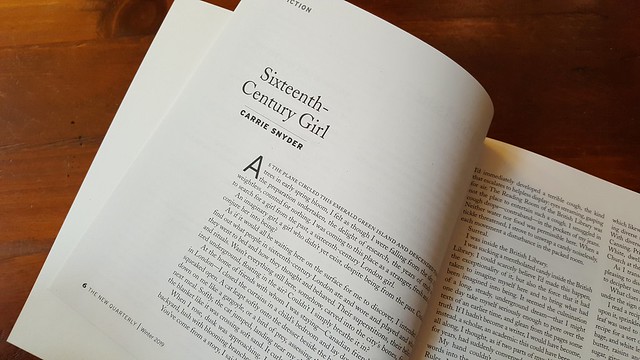
For example, I’ve got a new story in the latest edition of The New Quarterly! (Not-Humble-Brag # 2)
The story is from an auto-fiction collection I’ve been working on steadily for a rather long time, and which makes me happy every time I dip into it, to revise, edit, polish, or write a brand-new story. On Monday evening, when I was in my office marking madly, my eldest daughter came rushing in. She was glowing. She’d just read the story in TNQ — “16th Century Girl” — and she’d loved it. She said, You should just do this, Mom. You should just write. She said she’d been thinking about writers who just wrote regardless of success during their lives, just wrote anyway, no matter what, and that could be me, as she saw it. You’re such a good writer, Mom, she said.
That night, I woke in the middle of the night and wondered whether I could “just write.” Would it satisfy me? What sacrifices would be involved?
Last night, I again woke in the middle of the night. This time, I asked myself: What is your ideal career path? Who is your role model?
I remembered that for a very long time, my ideal was Alice Munro. A mother and grandmother, devoted to the short story, who dabbled in other money-earning ventures, such as a bookstore she owned with her first husband, and teaching creative writing for a year or so early in her career; but mostly, who simply sat at her table, stared out the window, and wrote and wrote and wrote and wrote. Brilliantly. When I appeared at a literary festival named in her honour, I was told that she was known as a quiet, dedicated volunteer, serving pie at community functions to people who had no idea who she was, even if they’d come to the small town hoping to catch a glimpse of her. Even before her retirement a few years ago, she rarely engaged in readings or public appearances. Add the Nobel Prize on top of that, and could there be a more romantic ideal?
Next, I thought of Grace Paley, the American short story writer, teacher and activist. Here’s what Ann Patchett writes about Grace Paley, with whom Patchett studied in university: “Grace wanted us to be better people than we were, and she knew that the chances of our becoming real writers depended on it. Instead of telling us what to do, she showed us. Human rights violations were more important than fiction. Giving your full attention to a person who is suffering was bigger than marking up a story, bigger than writing a story. Grace turned out a slender but vital body of work during her life. She kept her editors waiting longer than her students. She taught me that writing must not be compartmentalized. You don’t step out of the stream of your life to do your work. Work was the life, and who you were as a mother, teacher, friend, citizen, activist, and artist was all the same person.” (from “The Getaway Car,” an essay in Patchett’s This Is The Story of a Happy Marriage.)
In my mind, Alice Munro and Grace Paley don’t represent competing versions of “how to be a writer”; for both women, being a writer was not about performing as a writer, it was about doing what needed to be done. There are different ways to do this.
If I were an academic, I would keep very close track of every publication, conference, appearance, event, workshop, review, panel, and award. I discovered this lack in my own accounting last fall when a colleague and I were applying for an academic grant (a SSHRC). Creating a somewhat comprehensive CV involved picking through old calendars, emails, and boxes of clippings. The exercise was instructive, and weirdly buoying. Look at all these things you’ve done, woman! (Not-Humble-Brag # 3)
But there’s a reason I haven’t kept track of these things very well.
As a writer, what I’ve done is not as important as what I’m going to be doing. What matters is what I’m making, not what I’ve made. (I realize that’s not completely accurate; past publishing history opens doors unavailable to many, which is a privilege and not to be minimized.) But there is no tenure. No security.
To be a mid-career, mid-level literary writer is … well, it’s a form of invisibility, to be perfectly frank. It takes fortitude. It takes devotion to an idea of oneself, an aspirational self, and it takes devotion to a singular cause, which is craft. Like Grace Paley, I don’t (can’t) compartmentalize my writing from my life. And yet my life ranges rather widely and wildly. It sprawls. My attention is divided. My loves are many. If I were to “just write,” as my daughter says, what would that mean? What path am I carving, in this career my CV claims I’m building?
We were awarded the grant, by the way. (Not-Humble-Brag # 4)
Now, to spend the rest of the afternoon, this gift of unexpectedly free mid-week calm, “just writing.”
xo, Carrie
Monday, Dec 31, 2018 | Big Thoughts, Confessions, Creativity course, Fire, Lists, Meditation, Mothering, Spirit, Word of the Year, Writing |
Yesterday was my birthday. But I did not feel contemplative; I have avoided contemplation for this entire holiday. I’ve given myself a solid break from my office, from email, from planning, from organizing. Instead, I’ve read books, watched movies in the theatre (with popcorn), done some yoga and walking, hung out with family, worked on puzzles, listened obsessively to Joni Mitchell’s Blue. As soon as thoughts of duties and responsibilities approach, or anything to do with the future, both near and far, I’ve turned away.
The next four months of this new year resemble quite closely the past four months of this old year, with changes only minimally implemented or inched toward. Is change so important? And if so, why?
Because you can’t leave a fire untended. It will burn out or burn out of control.
Because some fuel burns bright and quick, while other fuel lasts a long time.
How many fires can one person tend? What fuels me, long and slow, sustaining? Are there fires I could let burn out, or would I grow cold?
(Do I just need more sleep, maybe? I’ve slept so much this holiday. It’s been blissful.)
What is it I want from this coming year?
What did I want from this past year? I can’t recall.
But I can tell you what I got. This past year, I recognized and accepted my own grief (and shame) for all the ways in which my writing career has not been what I’d hoped and perhaps even expected it would be. This was the fire untended, burning out. Without even noticing, I’d been setting other fires, here and there, and this was the year I became a pyromaniac, when the flames from all these fires rose so high, so hot, the smoke so thick I couldn’t see myself, or breathe. Now the question hangs: Which fires? Which fires, Carrie, will you continue to tend?
I seem to vacillate between wanting to lead a big bold busy demanding life, and seeking the small peace a spirit can aspire to embrace. The former requires support and agreement from others, attention that must be earned and commanded (and that feels good and affirming); but the latter hangs only on the self allowing the self to live without any notice at all (and that feels hard and awfully quiet).
Both are possible, in theory. But in practice, the balance isn’t so easy to calibrate.
Begin with the honest admission that one person cannot do all the things, all at once, all the time. Acknowledge that some things take up more space than other things. (A career, for example; becoming an expert in anything, for example.) Come January, as before, I’ll still be teaching, coaching, coordinating The Shoe Project KW. I’ll still be mother of four, wife, friend, daughter, sister, puppy trainer, laundry-doer, meal-maker, chauffeur, occasional bathroom cleaner. I’ll still go to the gym, practice yoga, try to run, meditate. And then there’s my writing. And all of the things that support it: grant-writing, story submissions, revising, research, reading, speaking, relationships with peers.
Yet here it is — writing — at the end of the list, because it’s one of those things that takes up a lot of space, if done with devotion and cause for hope. And I’ve not been willing or able (which is it? is it important to know?) to give writing that kind of space. I’ve squeezed it into an ever-smaller corner of the room, in truth, as if this part of myself only deserves attention if there’s proof of validity, permission, signs pointing toward success. And there hasn’t been, not for a long while. This is the year, 2018, I’ve come to recognize: there may not be. And with that the reckoning: what now?
What if it turns out I’m not a very good writer? What if I can’t earn (more) money as a writer? Are these the same things? What if I’m not very good and I can’t earn money, but I still want to make space — lots of space — to keep trying? Is that okay? Especially if it means not doing other more worthy, more admirable, more noticeable, more helpful things?
How can I convince myself that it’s okay?
You step onto a treadmill because it is a guarantee that you will move (paradoxically, it is also a guarantee that you will stay in one place). What is the desire to press ever-forward? To progress? You want new experiences and challenges, but you want, too, to build a big roaring fire around which to gather — the fire itself ever-changing, as the mind is ever-changing, and this body. It is time that keeps turning, or that is the sensation — that time churns forward, with or without you. Maybe you feel obliged to run in order to keep up with time itself. But isn’t time always with you, wherever you are, whether you are running or sitting, paused in thought or too busy to stop and think, or feel? There is no need to run, to catch up. You aren’t behind, no more than you could ever be ahead. You’re exactly where you are.
xo, Carrie
Page 22 of 38« First«...10...2021222324...30...»Last »