Category: Big Thoughts
Monday, Aug 21, 2017 | Adventure, Art, Big Thoughts, Lynda Barry, Peace, Politics, Spirit, Stand, Summer, Teaching, Work, Writing |

A person wonders whether she can carry home the things she learned, whether transformation in a radically different setting from home is sustainable. A person yearns to be the self she was while she was away. But a person knows, coming home is coming back to a crowd of needs waiting to be met. Even the house needs her. A person has so many loves. Loves are obligations but loves are also earned and cherished and what would a person write about were she to have no loves to tend to?
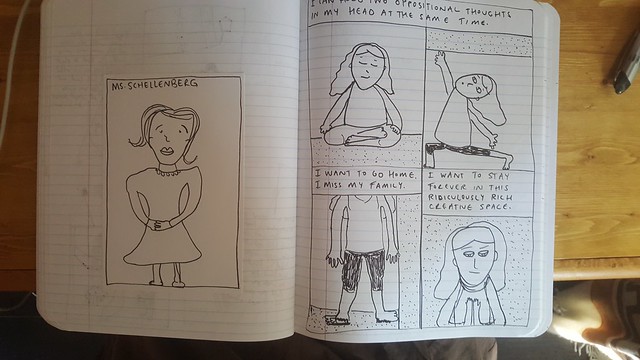
I can hold two oppositional thoughts in my head at the same time. I want to go home. I miss my family. I want to stay forever in this ridiculously rich creative space.
What I’m trying to say is that I’m home from Omega, in upstate New York, home from the Lynda Barry + Dan Chaon workshop, a 5-day intensive experience in a summer-camp-like setting, with an amazing yoga class every morning, ultra-healthy vegetarian/vegan food served three times daily, virtually no responsibilities, no chores, and perhaps most critically, almost no emotional labour except for the work that poured onto the page. My mind was uncluttered and immediately more open to images and connections. Will I be able to be joyful, I wondered on the evening we arrived, will my spirit find lightness? Is it still possible? I had my answer in less than a day: yes. It was so easy, under the circumstances, to be playful, attuned to what’s under the surface, easy to meet any challenge.
Writing isn’t easy, but it’s enjoyable, said Lynda Barry. She likened it to seeing runners go by in the middle of the day, and you can tell they’re enjoying it, but you never once think, hey, that looks easy. Writing — it’s the same. What this week kindled in me is a fire for the writing. For the possibility in writing, which is seductive to someone who entertains as rich a fantasy life as I do.
After Lynda Barry said goodbye, on the last morning, Dan Chaon, with whom she co-taught this workshop, helped us debrief our experience. Someone asked him about writing to an audience, and his answer had me in tears. It must have answered something very deep inside me, something neglected, lost, forgotten. I’m writing to my peers, he said. I’m writing to the writers I love, my kindred spirits.
I’m writing to my peers.
Am I capable of thinking of the writers I admire as peers? How does it change my mind and body to think: I am writing to Helen Oyeyemi. I am writing to Rumi. I am writing to Eden Robinson. I am writing to Ann Patchett, to Rilke, to Mavis Gallant, to Chimamanda Ngozi Adichie, to Mary Oliver. Feelings of love and awe and excitement come over me. I am writing so my work will speak to their work. In Lynda Barry’s classroom, we show our drawings to each other, but we also show our drawing to each other’s drawings. It sounds flaky, but it’s a reminder: this work, once created, lives a life separate from our own.
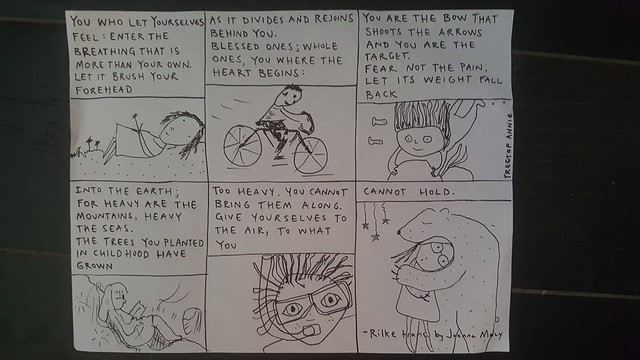
On Wednesday, I walked the labyrinth on campus, and spent a lot of time writing — my own writing, not guided writing. It was late in the evening. I decided to do one last project before snack and bed, something I’d been wanting to do for awhile: make the Rilke poem I’ve memorized and repeat often into a little cartoon. For the pictures, I looked at my peers’ attendance cards, hanging from the walls, and I chose images that seemed to speak to the words in the panel, and I copied them as best I could. All the drawings are drawings I admired, made by hands and minds I did not know. Then I taped the cartoon to the classroom wall and left it there for the rest of the week.
It was the kind of space that makes a person want to leave behind gifts. But on the last day, I untaped the cartoon from the wall and brought it home. It was the kind of space that makes a person want to believe she can bring what she found there home.
I know we were in another world, a bubble of creative vibes and chickpea scramble, but what was happening in the world was with us too, if at a remove. I mean, there we were in the United States of America during the week when the president spoke out in support of Nazis. There was pain and confusion in that classroom too. This feels like a crisis, said Lynda Barry, doesn’t it feel like a crisis? And everyone said yes. We are facing a crisis. What are we going to do about it? What are we going to do?

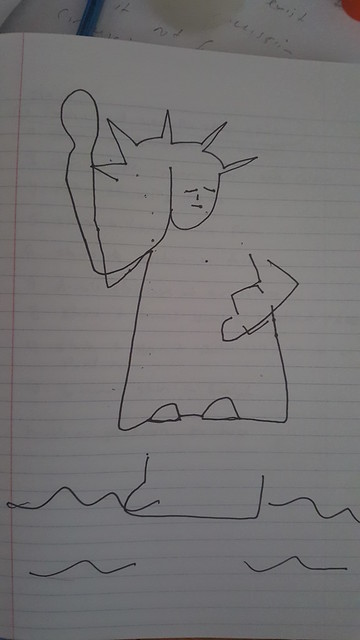
She didn’t have an answer. She just had us knuckle down and draw ourselves as a dejected Batman, draw the statue of Liberty with our eyes closed, make a map of a familiar walking path. And then she made us show our neighbour.
xo, Carrie aka Treetop Annie
Friday, Jul 28, 2017 | Adventure, Big Thoughts, Lists, Teaching |

I’ve been making lists.
Every night before bed, I make a list in the journal I share with my fourteen-year-old daughter, and she replies with her own list. This is a list I made up on the spur of the moment, six simple questions to focus the mind, capture the day, and provide an opportunity to be thankful and reflective. It really works, and the answers can be as short or as long as you want.
For my last class, on Tuesday, I finished by asking the students to answer these six questions, as a way of reflecting on their experience in the class.
These are the questions, and my own answers:
- Something that surprised you? Surprised by how easy it was to teach during the day.
- Something you’re proud of? Proud that I kept thinking of ways to make this time slot work. [I taught twice a week in 90 minute chunks, rather than once a week in a 3-hour chunk.]
- Something silly? Me at the front of this class. Like basically every time.
- Something happy? Listening to my students share their work.
- Something sad? Worried I was boring students. Having to assign marks to their work.
- Something you’re thankful for? Thankful for summer, and bike rides through the park to and from work.
At the end of each term, there is a magical feeling in the classroom. It happens each time, and each time I am nevertheless surprised. Each time, I feel a joyful inner peace, welling up from the depths. I think of what Lynda Barry told us at the end of her workshop last summer, that she is just the person pointing the way, that what she’s doing isn’t magic. What we’re feeling, when we overflow with gratitude, is appreciation for a deep connection to something we thought maybe we’d lost; our gratitude should be directed toward ourselves, not her.
I understand afresh what she meant.
Because the outpouring from students this term has been so genuine, so unforced, like something spontaneous that can’t be stopped up, and I know that while I facilitated their experiences, it was the students themselves who tapped into their own wealth of knowledge, their deeper consciousness, or unconscious minds, and that is what brought them feelings of peace and joy. It wasn’t me. Anyone who went there — that was of their own doing. Anyone who was pulled into the spiral and moved by the recitation of Rumi’s poem, “The Diver’s Clothes Lying Empty” — that was something they found for themselves. I could never make them do this — I could only invite them to try, with the tools I understand to have worked for myself and for others.
A student visited my office on Wednesday, to give me a book by Eckhart Tolle that was meaningful to him. After he’d left, I opened to the first page and read:
“A true spiritual teacher does not have anything to teach in the conventional sense of the word, does not have anything to give or add to you such as new information, beliefs, or rules of conduct. The only function of such a teacher is to help you remove that which separates you from the truth of who you already are and what you already know in the depth of your being. The spiritual teacher is there to uncover and reveal to you that dimension of inner depth that is also peace.”
When I read these words, I thought: that is what I’m trying to do. My medium is the written word, and images, but my goal is to open you to yourself. I can offer you technical information, and I try to, but the point of all those exercises in class is to facilitate opening, diving to the depths of the self, adventuring down and in and emerging with something you can hold and look at and read and share. What you return with isn’t the thing itself, but a record of what you’ve experienced, a record of your imaginative travels. Will this process, repeated over time, make you a better writer? Honestly, I don’t know. But if you go there, you will write things that matter to you, which is a good start.
I accept that my methods won’t work for everyone. It’s been hard to come to acceptance; I want to reach everyone, and I can’t. But for those who connect with what I’m offering, the connection is deep and it is meaningful. It seems to give people the opportunity to feel emotions they’d forgotten they could. It gives people the chance to play, to imagine, to be silly. And to be still, in a world that moves quickly. How often do we get to sit and not be distracted? These exercises can be reminders of the better world that is within reach, that we can access if only we remember how. If only we are given the excuse to go there.
If you can spare a few minutes before bed, consider sitting down and answering six questions about your day. Even better, consider sharing the ritual with someone else.
- Something that surprised you?
- Something you’re proud of?
- Something silly?
- Something happy?
- Something sad?
- Something you’re thankful for?
xo, Carrie
Saturday, Jul 22, 2017 | Big Thoughts, Confessions, Parenting, Spirit, Summer, Work, Writing |
A memorable week that I can scarcely recall lies behind me. Hosting cousins who live far away, playing pickup soccer together, visiting, early morning exercise, teaching, marking, cycling, reading stories, watching feminist movies, coaching practices and games almost every evening. I staggered to my Thursday practice and recognized that I was almost sleepwalking; yet somehow practice went ahead, I was running around the field, instructing, demonstrating, playing. I drove home in a haze, stopped to put gas in the little car, arrived to a houseful of awake children, Kevin racing out the door for … more soccer, I think? I’m not sure. All I know is that I needed to get the children to bed, and myself.
I sat down beside one child and rubbed her back, briefly, and it was enough to set her on the path toward bed. It’s the little things. Yelling, cajoling, ordering — these are mostly useless tactics; or these are tactics useless to me. Patience, empathy, a gentle touch are infinitely more effective. I’m trying to decide whether exhaustion makes me a more effective leader or a less effective leader; logic would suggest the latter, although oddly, the fog of exhaustion can create an aura of peaceful calm through which I gaze, slightly disengaged, but also without the energy for upset.
This is my current definition of balance.
Yesterday, I worked from 8:30am until after midnight, non-stop, to finish all of the things I needed to finish in order to shift my focus to a soccer tournament this weekend.
None of those things were writing.
The questions currently plaguing me are tangled up in my mind … Can we (I) afford for me to be doing so much volunteer work? How could I earn more, more consistently? Is there space in my life to continue pursuing writing as a career, or, when surveying the landscape, should I accept that writing has been relegated to the level of hobby? Do I want my writing to be more than a hobby? If so, what am I willing to change or drop? And finally, should I be prioritizing earning money, or … what’s the or? How does it change my outlook and goals if I were to prioritize earning money? What would I be doing differently, and is that what I should be doing? A person wants to live a purposeful life, a useful life; a person doesn’t want her family to suffer for her choices. We live a life of many luxuries: our needs (and “needs”) accumulate and become normalized. What would we (I) be willing to give up? And for what?
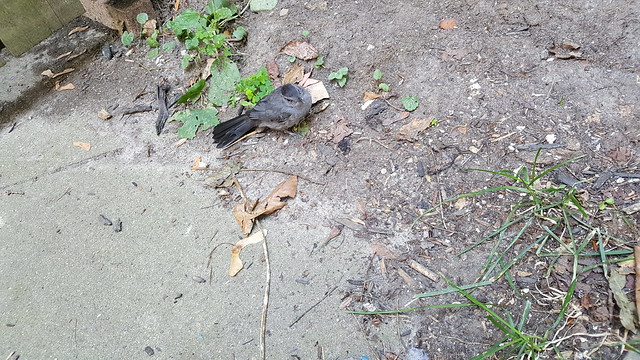
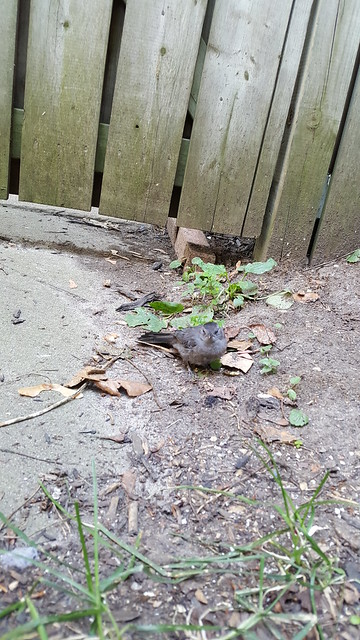
This post was going to be about a bird. Yesterday, I spent an hour working outside, sitting in a lawn chair beside a small grey bird that had flown into our dining-room window. I heard it strike, and saw it fall. After googling “how to help a stunned bird,” I concluded that keeping it safe from predators was the most straight-forward course of action. The bird had righted itself. It did not appear wounded. I sat, reading, taking notes, watching. Gradually, the little bird began looking around. Finally, it startled and ran under my chair, and then it disappeared, and I couldn’t find it. Had the little bird flown away? Or had it kept running, was it hiding in the vines and undergrowth of the house next door?
I could only hope that the bird would survive.
Was this act of witness useful?
Is it for me to judge what is useful? But yes, I think, I must, so that I know how to direct my energies, so that I can be sure and focused and committed, every day. How can I make critical changes in behaviour and priorities if I don’t know? Am I going to keep sleepwalking, sleepwalking, sleepwalking? Here is the poem that comes to mind, and calms my mind. It’s a poem I must commit to memory along with the few that are there now, rattling around my brain — as useful as any tool I’ve found.
The Summer Day
Who made the world?
Who made the swan, and the black bear?
Who made the grasshopper?
This grasshopper, I mean-
the one who has flung herself out of the grass,
the one who is eating sugar out of my hand,
who is moving her jaws back and forth instead of up and down-
who is gazing around with her enormous and complicated eyes.
Now she lifts her pale forearms and thoroughly washes her face.
Now she snaps her wings open, and floats away.
I don't know exactly what a prayer is.
I do know how to pay attention, how to fall down
into the grass, how to kneel down in the grass,
how to be idle and blessed, how to stroll through the fields,
which is what I have been doing all day.
Tell me, what else should I have done?
Doesn't everything die at last, and too soon?
Tell me, what is it you plan to do
with your one wild and precious life?
—Mary Oliver
xo, Carrie
Friday, Jul 14, 2017 | Art, Big Thoughts, Books, Confessions, Publishing, Reading, Spirit, Teaching, Work, Writing |
The longer I teach, the more I learn.
If I were to write a dissertation, now, my subject would be the short story. I would take a scalpel to the form, carve three-dimensional paper sculptures to show how beautifully various the short story can be. My focus, as a reader and a writer, has long been on Canadian literature, but the more widely I read, the more I wonder what Canadian literature stands for. Where are we right now? What are we lacking? Are we constrained by our Canadian-ness, because our patron is the state? Our violence is secretive and shameful. We don’t dare feast or riot. We would never burn the house down, and if we did, we’d make sure no one knew it was us. Also, outwardly, we appear reasonably satisfied with this state of affairs.
I could be wrong. I could be entirely very very wrong. Generalizations are almost certainly wrong, at least to some degree.
But here’s what I’ve learned, from teaching. For the past five years, I’ve assigned Canadian short stories for my students to read and discuss, and my students’ complaint has been consistent: why are these stories so similar? At first, I was baffled: the differences between the stories were so clear to me; subtle, perhaps, but clear. But as I’ve started to read and assign stories from international writers, some in translation, I’ve come to understand that my students were more perceptive than I. This is not to dismiss my beloved Canadian stories. But I see, now, that there is a world of stories out there that are different and not just in subtle ways, but in juicy, technically audacious ways: stories that are ugly, ungainly, colourful, lawless, unconventional, impolite, rowdy, hungry. Imperfect. Stories that dare to be disfigured, furiously cryptic, ridiculous, structurally untidy, fascinating, open, broken, big. Stories that can take the criticism, because they’re out there doing the dirty work, and they’ve got more important things to worry about.
The world is waiting to be read.
I can’t pretend to know what Canadian literature stands for, nor what it lacks, nor what it needs. I think we are in troubled waters, troubled times, but I’ve been devoted to CanLit for my whole life, steeped in the stuff, and this is my trouble, too. Times of transition are always troubled times. I believe this. Transition is what gets us somewhere new. Truth and reconciliation: painful. It’s painful to be wrong, but how much more painful is it to be a child of 12 for whom suicide is the answer to their pain, how much more painful to be this child’s family, community. This is our country, right now. This is Canada. And somehow, I think it’s our literature, too. Now is not the time to turn more inward, to hide away, to ignore, not listen, not try. It feels imperative — to try. To pay attention.
I want to write stories like the ones I’ve been reading from around the world, and I can try. I may not be able to, but others will. If I’m a very fortunate teacher, maybe my students will. Meanwhile, I can keep learning, listening and reading.
xo, Carrie
Wednesday, Jun 28, 2017 | Big Thoughts, Lists, Meditation, Running, Spirit, Stand, Success, Writing |
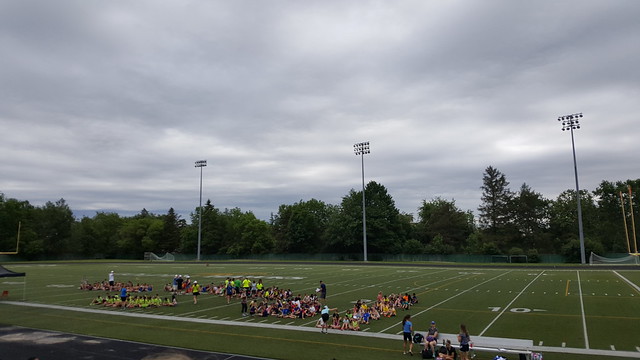
1. I am eleven years old and the stadium is enormous. The track is long and hard and black and very hot. I am wearing beat-up runners, the laces dirty, and I am sure that I am amazing. The sky opens around me. I could throw up. The white lines are chalked in. After the gun goes off, we stay in our lanes until we reach a certain mark, and then we funnel in together. The stands hum with kids, teachers, some parents (not mine), and underneath the stands the light filters in stripes and the ground is wet with spilled drinks. When I run I am not afraid, only that I won’t win; I must win. Afterward, under the stands, a teacher congratulates me in a teasing way, and I am offended by his tone. Why should he act surprised? Did he not see my brilliance? The way I ran down the tall girl in grade seven, the way I opened up a lead with 300 metres to go? The way I could not, thereafter, be caught.
2. It is going to rain. I park my bike and lock it. The underside of the stands is a sticky zone of concrete splashed with soda and dripping popsicles, spilled popcorn, children in pinnies darting, and I am too late. Rushing up from underneath and out into the seats, I see her bright yellow shirt at the finish line. The race just over. I did not see her run! I can’t stop telling people, even though it disappoints them unnecessarily, how I missed the moment. The moment was there and is gone.
3. She is sturdy and wonderful and fleet and strong. She runs so hard she will throw up, crawling off to the edge of the track, afterward. She has run faster than the girls a year old, faster than every girl on the track, and with an ease and power that I am certain I could never match, nor never did match. When she stops running, two years from now, what will I do? She waits in full sunlight beside the stands while I take her picture, her eyes squinting. “Wait,” I say. “Let me take another!” But she is impatient. She doesn’t care about pictures. She is unpinned in time.
4. Last year, in grade six, I was the fastest girl in the school. I won two red ribbons racing the 800 metres (harder for me) and the 1500 metres (I could have run forever, it felt like). What has changed? The stadium is the same, the same spilled drinks under the stands, the same open sky as I step out from under the stands and into the heart of this place–grass field and oval track, little black stones, white chalk lines. I will lose the pace in the 800 metres; I won’t even attempt the 1500 metres; and in my new speciality, the hurdles, I will hit several. I won’t fall, but I won’t win. Everything is the same except for me. I shouldn’t have cut my long, long hair. I shouldn’t have gotten older. I don’t know myself at all. My capacity for suffering is diminished and I will never again win a red ribbon at a track meet.
5. There is no last track meet. There will always be more. The light will always slant through the stadium seating, the canteen will always serve popcorn and icy sugar drinks, the teachers will always tell you where to stand and remain surprised at who you are and what you can do; or surprisingly disinterested, just as irritating. There will always be safety pins to attach the coloured ribbons to your shirt, fluttering, proof of your achievements. You will always feel sick before your race. You will fight the feeling that you can’t bear to lose. You will have to live with it, live with the possibility of losing. You will sublimate your competitiveness, you will try to bury it. You will become a nice person. You will miss the uncomplicated, greedy, gritty child whose cells you have shed, entirely.
xo, Carrie
Friday, Jun 16, 2017 | Big Thoughts, Coaching, Confessions, Parenting, Spirit, Stand, Success, Teaching, Work |
Something rather odd about my life right now is how much time and energy I devote to doing things that are outside the realm of my natural inclinations (and, I might add, training and talents). As someone who could happily hole up for hours and days, reading, researching, thinking, writing, completely in my own head, alone, I find myself surrounded by people almost constantly, and often in a position of leadership, influence, or decision-making. Writing is almost about absence, about sublimating the self to the work, but teaching, coaching and parenting require presence — and not only that, they require a presence. I can’t merely observe and reflect, I have to express my observations verbally, often immediately, without time to weigh my words, in response to whatever is happening in the moment. It’s like doing improv. Some people are born to express themselves in this way. I’ve had to learn it. I’m still learning it. I will never stop learning it. I was a shy child, a tongue-tied adolescent, happy in the company of a best friend rather than a crowd, and I’ve always preferred the scripted scene to the unscripted one. I wish I were a bigger personality, sometimes. I wish I liked tap-dancing in the spotlight.
But what can I say? I’ll just have to go on being myself.
One of my favourite professors in undergrad was so painfully shy that you almost had to strain to hear him. He lectured to a spot on the floor, or gazing out the window over our heads, caught up in his train of thought. Yet I remember him well, his gentleness and humanity. So maybe being a presence is inconsequential in comparison to simply showing up, simply being present, being yourself. Why yearn endlessly to be who we are not? Why not, instead, accept, embrace, trust and marvel at who we are, and how even with our limited capacities we are able, nevertheless, to do and be more than we could have imagined?
You who let yourselves feel: enter the breathing that is more than your own.
xo, Carrie