
Ten tips from an organized life
I’ve been thinking that I need a better answer to the question: How do you fit everything in? I usually laugh and say, I have no freaking idea, or something to that effect. But that’s not quite true. That’s the lazy answer. Because of course I have some idea. I’m doing it, after all. It isn’t just magically happening, it does take thought, care, effort.
Here’s the thing: the real answer is awfully long and detailed, hardly useful in interview situations, when the pithiest answer is best. But this is my blog, and we don’t care about pithy so much here, at least not all the time. So here, I present to you the non-pithy, heavily detailed, low-down from one woman’s organized life. (Note: I’m not suggesting you adopt these measures yourself; I recognize that many would not wish to lead such a strictly organized life. Please take this as descriptive rather than prescriptive.)
1. First of all, as you already know, I don’t procrastinate. Think of it, do it, done. If it can’t be done, make a note in a calendar so that it will be done. This unclutters my brain a great deal.
2. Keeping detailed notes in an online calendar also unclutters my brain, and prevents me from dropping too many balls in one day.
3. If I drop a few balls, I forgive myself. I think that’s key.
4. I lower my standards and relinquish control. The house isn’t very clean. The sheets aren’t regularly changed. The laundry is washed and dried, but may pile up for days unfolded in baskets in the basement. The meals aren’t planned. The kids aren’t terribly well-groomed. The garden is unkempt. And it’s okay. Because the domestic front isn’t exclusively my responsibility anyway — there are six of us in this house. As soon as I recognized this (and it wasn’t easy), I stopped critiquing others’ contributions. I would observe that an absence of critique makes it easier for others to take responsibility and contribute.
5. I’ve gotten good at assessing my own patterns of behaviour. For example, it’s no good to schedule exercise at lunchtime, which other people seem perfectly capable of doing; that will never happen for me. At lunchtime I will be working so intently on something else that I will forget to eat lunch, let alone remember or choose to exercise. So why fight the pattern? Instead, I schedule exercise early, or at times when I won’t be doing anything else, and will be outside somewhere (i.e. kids’ soccer practice).
6. Yeah, I schedule exercise. I schedule friend-time. I schedule writing time. I schedule everything. Some of it is actually jotted on the calendar, and some is just me, in my own head, blocking out time, observing the flow of the day, grabbing the moment and designating it: writing time. Or: interview time. Or: course prep time.
7. If the schedule isn’t working, I reassess on a deep level, or, often, I just go with the immediate flow and change course in the moment. The schedule is there because it works. If it doesn’t work, the problem is the schedule, not me or my family or us. I ditch what’s not working.
8. I don’t let the work that requires deep thought and focus overlap with all the rest of the work that requires deep thought. If I’m writing an essay, I want to be writing an essay and that is all. I try to apply this same principle to all activities. If I’m reading to my kids before bed, I want to be reading to my kids before bed and that is all. If I’m out for coffee with a friend, I want to be out for coffee with a friend and that is all. Heck, if I’m driving across town on errands, I want to turn on the radio and listen or stare out the window and daydream and that is all. You get the pattern.
9. I try to finish what I’ve started, or finish what I’ve decided needs finishing during this block of time. Big projects will not be finished in one go, or even in ten or twenty. But they can be finished in many small chunks of concentrated time. My dad used to have a sign on his office door that read: “If I do just a little bit every day, eventually I can let the task completely overwhelm me.” I remembered that recently, and had to laugh. Because that pretty much sums up my strategy. I do a little bit of many things every day. Thankfully, I don’t feel overwhelmed. In fact, I feel quite the opposite. I feel interested, engaged, challenged, and fruitful.
10. Finally, I don’t try to do it all.
I realize it may look like I do. But I don’t. Instead, I try to make what I do count. I’m actually strategically and instinctively an opportunist (not in a bad way, I hope; I mean, I look to recognize and enjoy opportunities that exist, rather than demand the existence of ideal/idealized opportunities).
Sometimes opportunity is about efficiently gleaning multiple benefits from one task. For example, my teaching gig is a) a job, b) interesting and intellectually challenging, c) a chance to free-write during in-class exercises, d) helpful (I hope, for my students’ sakes!), and e) excellent training in public speaking.
Other times, opportunity is about embracing what’s immediately important. For example, this fall is about promoting Girl Runner. It is not about writing a new novel. If I try to make it about writing a new novel, I won’t enjoy going out into the world to share Girl Runner. And that would be a real shame. It would be a shame for two reasons. One, because there’s no way I can write a new novel amidst all this distraction, so I would be unhappily beating my head against an invisible wall. Two, if I were wishing to do something else, I would fail to appreciate what’s happening now.
Life’s short. I have right now. If I’m managing to wreck right now with my own expectations and worries, well, I’m wasting all I’ve got. I believe that.
Celebrate good times
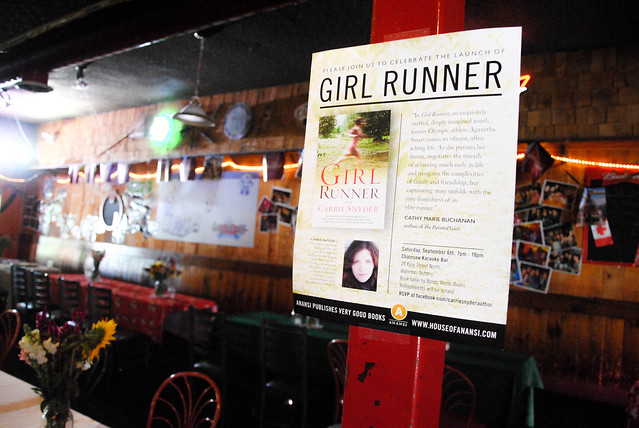
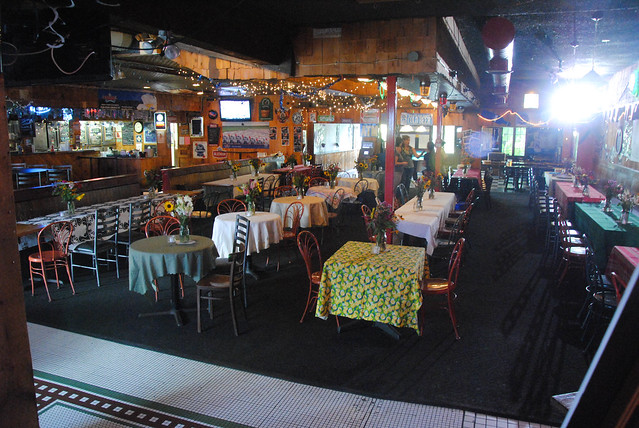
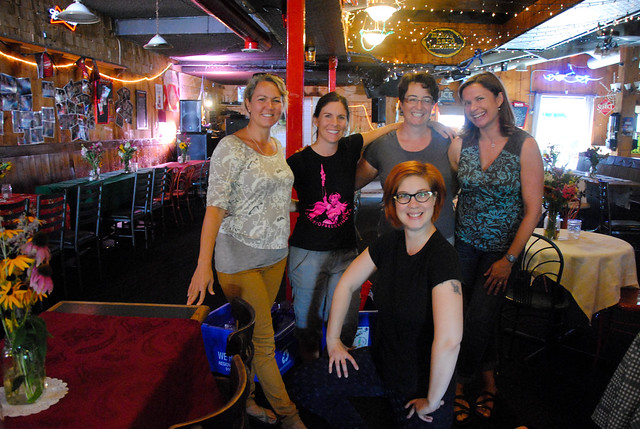
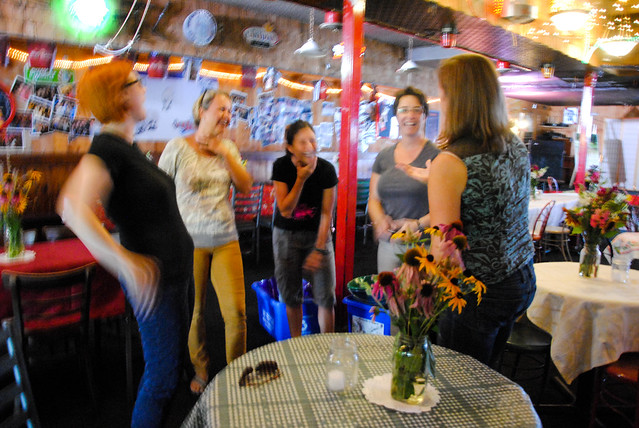 Before, above, with my magnificent party planning crew.
And after, below, as the evening begins to swing.
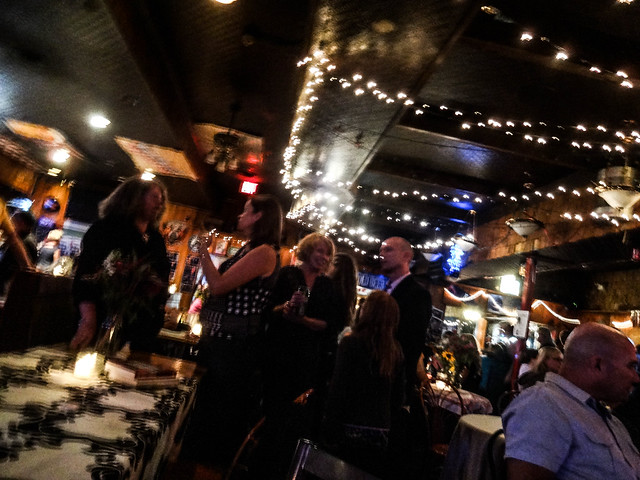
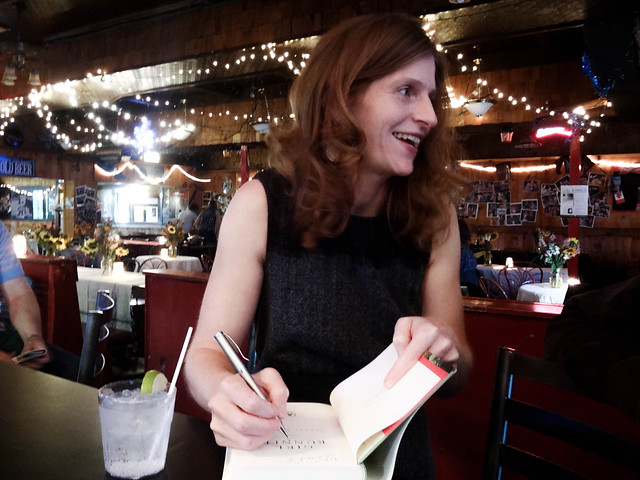 I did not take photos during the party. These are by AppleApple. It was such an evening, a moment out of time, and all I can say is thank you to everyone who made it happen. Kevin told me I was laughing in my sleep last night.
xo, Carrie
Today’s the day
I feel like I should mark the moment somehow. Today, my third book and first novel, GIRL RUNNER, is officially published here in Canada. Dreaming of this day as a teenager in high school, plotting and hoping to become a real writer, what did I imagine it would be like? Feel like? I no longer know. There is excitement, but it is muted with a weight I probably wouldn’t have guessed, as a teenager. There is satisfaction, joy, even, but tempered by perspective, by years of struggle, by a kind of wondering at my own persistence and determination, and I don’t mean that in a self-flattering way — I mean, I wonder at my ridiculous, stubborn refusal to give up this singular dream, even when it made absolutely no sense, financially or practically or even artistically. I had to write a lot of very bad prose on my way to learning how to write like I wanted to be able to write.
I’m thinking this morning of writers I have admired. How I loved L.M. Montgomery’s stories of orphaned girls, soaked though they may have been in sentimental romance. I didn’t want to grow up to discover that Montgomery’s own life had been unhappy. I wanted her as happy as her heroines, as plucky, as daring, as beloved. There can be such a distance between what a writer puts onto the page and her own life. We may write what we wish to have been or done, we may write to seek forgiveness for a wrong or to seek peace, we may write to escape, because the imagination is powerful enough to carry us somewhere else, somewhere better, for awhile.
I’m not sure where I fit into this, exactly, as a writer and a human being.
I was thinking today that my ever-present theme is the connection between past and present, and how the past leaves its imprints on the present. I have an interest in history (thanks, Dad!). But it isn’t the interest of an historian, who tries to piece together from available evidence the most factually accurate narrative. It’s the interest of a story-teller, who needs facts only as stones tossed into a wide lake, so she can see the ripples spreading out across the disturbed surface of what only seems to be.
I’m going hifalutin’ this morning, I see.
I wonder how L.M. Montgomery felt when her first book was published? And her next, and her third? How did she feel when Anne of Green Gables became so beloved that the author herself was subsumed by her invented character? Isn’t it strange how these characters we create can come to seem more real than us? That is a possibility I’m considering this morning, as I think about Aganetha Smart, the girl runner in my book, and Juliet, of my JULIET STORIES, and the man with the hair hat, from my first collection HAIR HAT. I don’t know quite how to express this idea, but it seems those characters are more real, more knowable, more plausible than I myself could possibly be. I’m human, after all. I’ve done all kinds of things that make little sense, or don’t fit neatly into a plot or storyline. I’m contradictory. Sometimes I’m selfish, sometimes generous, sometimes oblivious, sometimes keenly attuned to the needs of others, sometimes a good friend, and no doubt, sometimes not. I’m trying, like we are all.
But my characters, they’re there, fully formed, on the page, comprehensible. Complete in a way I’ll never be.
Tonight, I’m going to the launch party for GIRL RUNNER here in Waterloo. It’s a party for the book, for the character of Aggie and all that she is, all of her accomplishments, and the richness of her life. I’m going to celebrate her existence. How she came to me, and came through me, is a mystery I’ll never know or be able to explain. This is not something I could have imagined, as an aspiring writer in high school — how separate from my creation I would feel. How grateful. How small. How glad.
Reading & writing

Eleanor Catton, the 28-year-old writer who won the Booker last fall for her novel The Luminaries, continues to win further prizes too, and recently declared her intent to set up a grant with her earnings that would give writers time to read. Yes, you read that right. Time to read. Click here to read the entire article in The Guardian.
“My idea is that if a writer is awarded a grant, they will be given the money with no strings attached except that after three months they will be expected to write a short piece of non-fiction about their reading …
“We’re very lucky in New Zealand to have a lot of public funding available for writers, but they generally require the writer to have a good idea about what they want to write, and how, before they apply. I think that this often doesn’t understand or serve the creative process, which is organic and dialectic; I also think it tends to reward people who are good at writing applications rather than, necessarily, people who are curious about and ambitious for the form in which they are writing. I’m also uncomfortable with the focus that it places on writing as production, with publication as the end goal, rather than on writing as enlightenment, with the reading as the first step.”
I’m making several connections as I read this.
I’m thinking about generosity, creativity, and the many reasons a person may feel compelled both to read and to write. I’m thinking about teaching creative writing again this fall, and agonizing over how best to encourage in my students a love of reading and words and ideas and stylistic play and leaps of connection and openness and generosity, yes, creativity, yes. It’s the necessity of marking that troubles me, not because it takes time and effort, but because aiming for a particular grade is not necessarily conducive to developing a love of writing and reading.
Which leads me back to Eleanor Catton’s idea for a grant that does not require of the writer a full-fledged project at the end or the beginning, but rather openness, curiosity, patience.
(And she’s coming to the Eden Mills Writers Festival on Sunday, Sept. 14, where I do hope we’ll get the chance to meet.)
xo, Carrie
Peak busyness?
Have I reached peak busyness? I’m not sure. After all, I start teaching next week. But with the book officially launching in Canada on Saturday, I feel sure that I’ve reached peak anticipatory activity in advance of launching book. I’ve also got a headache. And I could barely keep up with my running partner this morning. It felt like I was running on empty, thank you running metaphor. (There are so many running metaphors. Very popular with headline writers. How could they resist?)
To avoid spamming you with perhaps an unsavoury amount of self-promotion, let me direct you to the “News” page on this web site, where I’m trying to keep track of such things: there’s been an excellent profile in the National Post newspaper this week, for example.
It’s time to meet kids coming home from school. I shall therefore sign off abruptly.
xo, Carrie