Category: Writing
Wednesday, Aug 11, 2010 | Books, Holidays, Kids, Reading, Summer, Writing |
 Why do I feel so slothful while on holiday? Is slothful even a word? My holiday brain cannot compute. Slowly, surely, holiday drains away my ambitions and intentions. I have to work to remind myself that rolling out of bed in the morning isn’t THAT hard.
Cottaging seems to strip me down to a more basic Carrie, a more primitive version of the 3.5 Carrie I currently enjoy. This is dial-up Carrie. This is Carrie attempting to cook delicious meals for nine on two wonky burners in three cottage pans (why do cottage kitchens supply such an eccentric selection of cookware and devices? and could we please ban the production and sale of all non-stick pots and pans? though I did read somewhere–in a study no doubt commissioned by non-stick purveyors–that Teflon is not absorbed by the human body, but passes right through; phew).
So, what are the subtle and not-so-subtle differences between 3.5 Carrie and the dial-up version? The dial-up version washes dishes, folds laundry, sweeps the crumbs and cleans the bathroom, and tries to get the kids to sleep at a reasonable hour. But the routine is off-kilter. This Carrie also drinks a shandy after lunch and sits in removed fashion reading a book (“Okay, Mommy, are you listening for real now?”).
Having worked so hard to develop 3.5 Carrie, I find it jarring, almost troubling, to revert to this more basic version; she has no interest in taking creative photographs (this will be a low spot in the 365 project); she has very little creative interest whatsoever; she slows to a crawl, scarcely able to force herself to keep up some reduced version of exercise. Maybe this is what a holiday is for? To vegetate and sink into words and thoughts, or float amidst them without thinking at all, to check out, to retreat.
:::
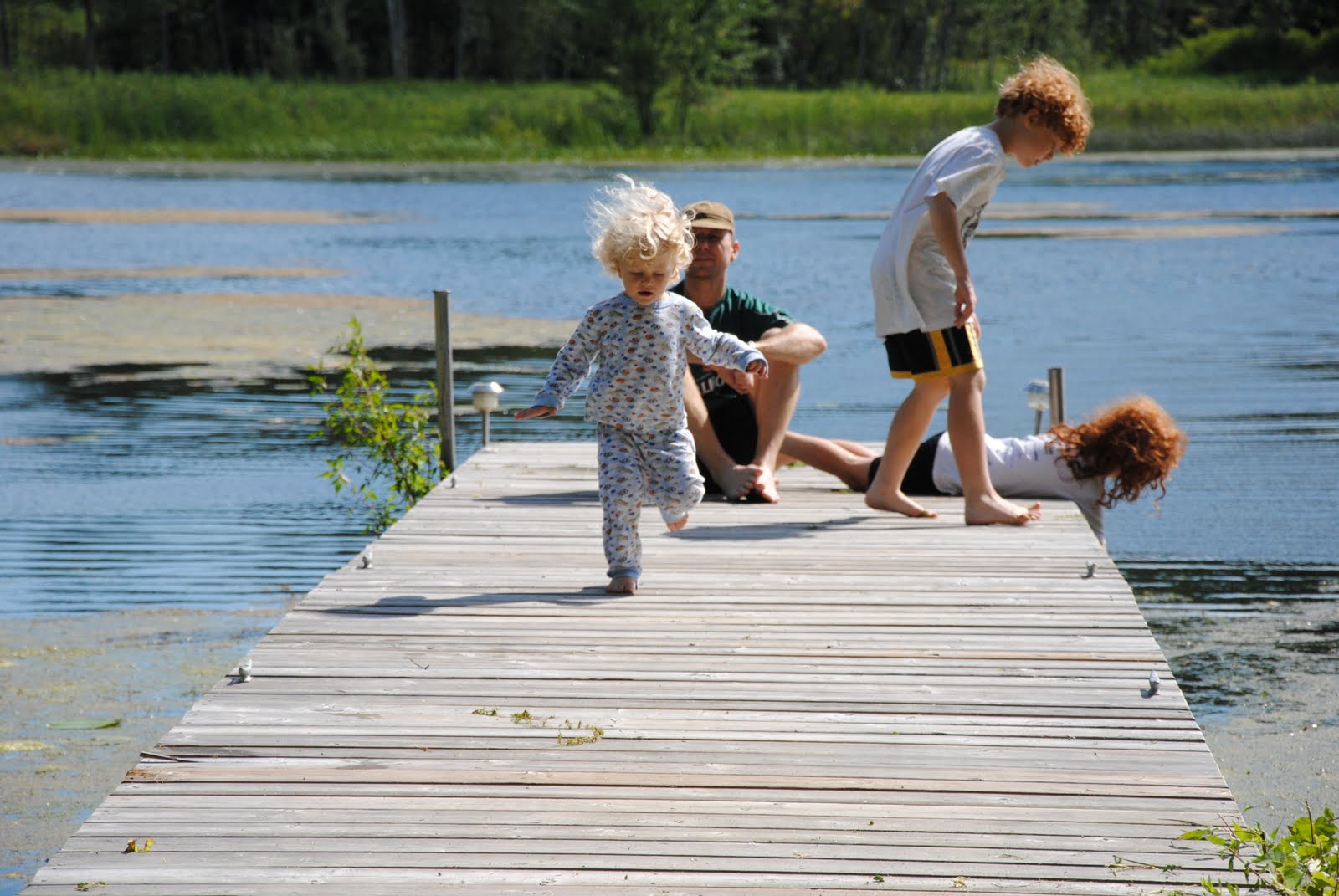
Of course, one must also observe that “holiday with kids” is not precisely the same as “holiday.” Last night we resorted to turning out every light in the cottage in order to impress upon CJ that we were indeed all going to sleep, RIGHT NOW. It was nearly 10pm. He was wired. He’s taken to saying, “I tell you a story,” and then launching into long detailed dramatic inventions about elephants and little lions and turtles who eat persons and wear pants. He had us spellbound after supper the other night (I’ll post video footage). But well after dark, being regaled by the tales of a two-year-old is not on the holiday agenda. No. On the holiday agenda is eating some freaking amazing cheese, a ripened sheep’s milk pebbled with blue purchased at Wendy’s Wigwam, reading a book, and drinking a beer. In adult company only.
:::
Two book recommendations: Truth and Beauty, by Ann Patchett, a memoir by a writer about her friendship with another writer, Lucy Grealy–if a relationship so intense can be pinned down by the word friendship. I’ve never been in a friendship like that. I am not sure whether I envy the author, or feel grateful to have been spared such a friendship. It’s also a fascinating portrait of writers in their developing pre-fame years (because, yes, both women became successful writers). Kevin’s reading the book now, or I’d look up some quotes. I particularly liked one from Lucy’s letters, in which she says that at least, as a writer, there is some measure of glamour to be gleaned from the drudgery and poverty of the occupation. I need to look into that.
The other book, which I’ve not yet finished, is a series of excellent short stories disguised by the publisher as a novel: The Imperfectionists, by Tom Rachman. It’s set in a newspaper, so it has the additional appeal of taking me back to my brief fling with the industry; and it’s currently on bestseller lists. But I’ll bet it wouldn’t have made it there if the publisher hadn’t cleverly marketed it as a novel rather than as what it is: a collection of linked stories. If I feel a touch of bitterness over this necessity, yes, it’s personal. The book I am currently finishing is a collection of linked stories. Maybe my agent will find a publisher who will pretend it is a novel, and we’ll find success together. But I (selfishly) wish more people would embrace the short story (and in particular, linked stories) as a legitimate and complex and pleasurable form.
Now, for the glamour. I must pour myself a shandy or something.
Sunday, Jul 25, 2010 | Kids, Writing |

 Tired. So tired, Kevin and I could have laid in bed with the curtains drawn till suppertime. As it was, we managed to sleep till after 9, with the children (those who were also not sleeping) playing video games on the computer. We’ve canceled the cable.
Writing week ended with a steady, sure march of writing. Wednesday, hump day, was the least productive outwardly, but led me to switch directions entirely with one story. Thursday and Friday were spent writing this new story from scratch. Monday and Tuesday also brought forth a brand new story. Neither were planned and plotted, but emerged. There is no other way to describe the process. I had planned and plotted two very different stories. Instead, the characters took me where they needed to go. In both, I felt as though I were merely observing and recording, rather than inventing. It allowed me to go places I would never ordinarily let myself go; the first story is deeply sad. Oddly, neither is remotely autobiographical; I say oddly because the early material that began these stories was rooted in autobiography. It’s gradually shifted so entirely away from autobiography that it’s given me a more confident appreciation for fiction, and for the way that the shape and haunt of fictitious characters can make sense of life in a way that’s not accessible to us in real life.
I don’t need to experience these things for myself in order to write about characters who do. I just need to be open, and to pay attention.
I have one more story to write. It may take weeks or months, with so much less time to give to it. This writing week made me question whether three hours at a stretch is enough; I do not think I could have written either of these stories in piecemeal fashion. To get there and to live there took going underground, and staying. I’ve decided that parenting and story-writing don’t fit together terribly well. Parenting requires being on the surface, available at any moment–go ahead and write a blog, while simultaneously being the on-call parent, but don’t try to dive for the story underneath. The focus itself is exhausting. I would find myself needing to take mini-breaks, not to plot ahead, but to breathe, to rest my mind. Very brief mini-breaks, I might add; just a couple of minutes. Maybe the way some people run/walk a marathon. And by suppertime each day, I felt spent of originality and syntax and emotion.
:::
At the conclusion of writing week, we went directly to Hillside Festival, dragging the kids with us; an annual event for the past three years.
The best year was the first, when CJ was an infant, and I sat in the shade and nursed him and listened to music while Kevin wandered around with the three other kids. We didn’t stay long, just as long as the happiness lasted.
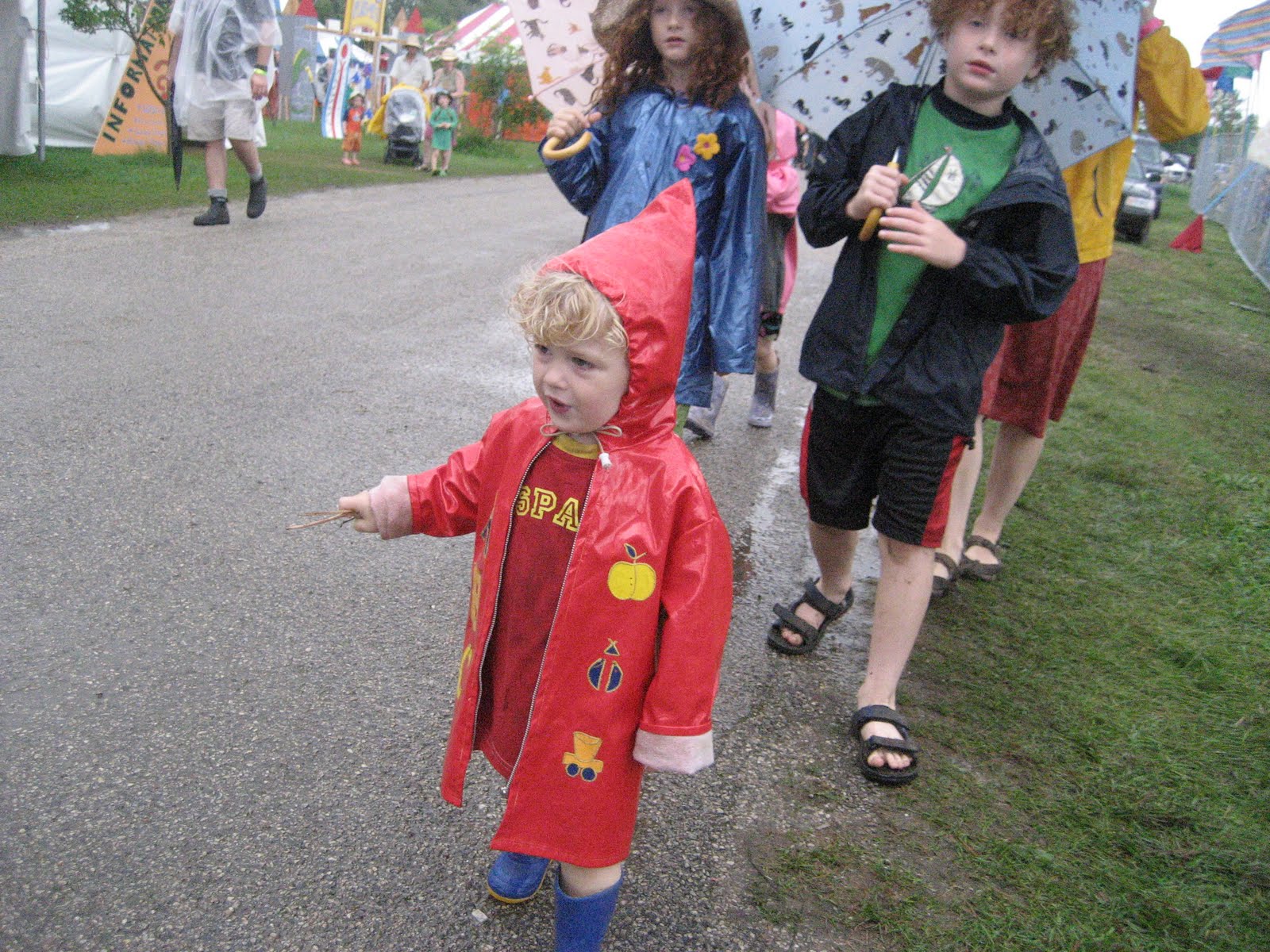
Last year, we went for two full days, and it rained almost non-stop, and there was a thunderstorm of epic proportions that shut the place down temporarily. We slogged through but it didn’t feel super-fun, and definitely wasn’t relaxing.
So this year we decided to go just for one day–Saturday–buying our tickets in advance (as one should; it’s a popular festival). As chance would have it, we picked the day that it rained–not dreadful stormy rain like last year, but rain that persisted into the evening. Albus complained that there was nothing to do, though he was free to walk around with a friend–a new independence. As I sat in a puddle and listened to Jason Collette with appreciation, and looked around at all the other parents with kids, I thought, what isn’t working about this for our family? And I concluded that none of our kids is remotely interested in sitting and listening to the music. And it is a music festival. Additionally, the festival has lost its novelty for us. It’s too familiar.
Well, and then something frightening happened, late in the day, during the last set for which we’d planned to stay–we lost Fooey. Not for long, but for long enough to send us into a frantic panic, our friends hunting the festival grounds, me sprinting in bare feet to the security booth with CJ in my arms and screaming at the security guard who seemed not to be paying attention–apparently, in a crisis I do not turn into a pleasant and patient person. I am mother-who-is-going-to-scream-for-help-until-her-child-is-found. She was found. She was not missing for more than fifteen minutes, at most, and had wandered off on her own (though we did not know that at the time). The crowds are so thick, it is easy to lose sight of one, especially when herding four. Kevin and I were both shaken.
“I don’t think I can do this again,” said Kevin, as we slogged out in the dark through thick mud to our vehicle. That part went pretty well, all things considered; I’d expected the kids to be beside themselves, and they were quite humourous and in good and willing spirits. In retrospect, it might have been my favourite part of the whole day. CJ walked the entire distance from the festival grounds to the parking area–a good kilometre or more through grass and mud. In the dark. By the time we found our vehicle (it was foggy as well as dark, and there were no lights), we were disgusting. We did not care; isn’t that the beauty of spending the day outside, no matter the weather? We found a tap and washed ourselves, climbed into the vehicle and prayed that we’d find a way out of the mud-field.
My first response to Kevin was: well, we could come back next year with no kids. But the terror and shock of losing Fooey, even for such a brief amount of time, is now forefront in my memory of this year’s Hillside, and I’m not sure I want to go back next year either.
I’ll sit with it.
:::
Today, I’ve done piles of laundry (the sun is shining). I’m attempting to make kimchi–get a girl fermenting and she won’t be stopped. And AppleApple helped me make cheese bread, which will be baking in the oven for supper any minute now. Evening menu: cheese bread, red beets, green salad with fruit, and steak (we grill just one; everyone gets a bit, and no one wants more than that).
After watching Fooey and CJ scrub the garage floor with rags this morning, Kevin concluded that our kids are happy with very little; perhaps even happier with little than more, or much, or too much. Just give them a “job,” or let them rearrange the living-room, and the day is a success.
I’m back at full-time parenting tomorrow. Wish me luck.
Thursday, Jul 22, 2010 | Writing |
A couple of morning thoughts.
1. Writing week appears to have had an unexpected effect: it’s crippled my ability to do small-talk. This is a serious problem. I like small-talk. It’s comfortable and puts others at ease. Living so deep inside my head means I’m surfacing slowly, and find myself blankly waiting for a nice ordinary response to float through my brain in answer to questions like: how are you?
It kinda sucks; not kinda, totally. I’d forgotten about that side effect, or never connected it to the writing portion of myself. And honestly, I miss my small-talking self. I like trusting that I’ll know what to say, which is really about being present and listening and having fewer filters–and, frankly, bothering with much much much less reflection.
It’s possible, though I haven’t thought deeply about it (ha!), that my brain operates in an either/or fashion: either verbal, or written. If I’m operating in writing mode, my brain can’t access the words, at least not efficiently, in verbal form. And apparently I can’t turn off writing mode with the flick of a switch. Friends, forgive me in the meantime.
2. I continue to long for a practical profession. The friends I met up with last night are women close to me in age, whose children are now off to school, and who have chosen such interesting and practical directions for their post-intense-mothering lives. Midwife. Nurse. Youth counsellor. Hands on, directly affecting the lives of others in need, being physically and emotionally present, interacting, connecting, empathizing. With real people. In real time. In my work, I do an enormous amount of emotional empathizing, but with makebelieve characters. Gah! I am laughing and shaking my head as I write that. It seems like such a bizarre way to connect with other humans.
Kevin’s response to my morning whine of “I should be doing something practical!” was “strongly disagree.” He suggested I should take my attitude and join Stephen Harper’s conservatives and stop funding the arts and go live in a world where everyone wears grey overalls and does nothing but work work work. You can see why I married him.
3.
This Globe and Mail article on David Mitchell helped me finish writing a story earlier this week. I have not yet read him, but must; it’s on the post-Wolf Hall list, which is growing ever longer as I joyfully wade through the gorgeously written Tudor underworld.
Notes on David Mitchell: a) There is such a thing as literary stardom: he’s there. b) His fascination with, and commitment to, obscure and self-imposed rigorous structural limitations really resonated with my writing/creative mind. c) He advocates a strict, disciplined lifestyle: no tv, no distractions, work. “Living this life, ‘you acquire the pleasure and the discipline of geekdom,’ he says, launching into an animated account of the way ‘perhaps’ and ‘maybe’ strike the eye ever so slightly differently, and confessing that ‘Oooh, I spend long, luscious, sweaty nights thinking about this kind of stuff.’ ” Brilliant! I get it. And I love how happy he sounds. d) He lives in a tiny village in Ireland and he sees his wife, two children, and “about three friends.” e) I wonder how he does small-talk.
4. Funny how a couple of posts back, I said I wasn’t going to write about writing. Have I written about anything but, since?
Friday, Jul 16, 2010 | Big Thoughts, Writing |
In answer to Krista’s comment yesterday, asking why I’ve decided not to write about writing … well, I have at least one defensible reason, along with several indefensible ones; and fully expect none will matter anyway, and my vow will prove an entirely temporary whim, because writing about writing, for a writer, is kinda like enjoying several glasses of wine when you know you should stop at one. Sometimes, it’s just too damn pleasurable and you don’t care about the inevitable hangover.
Here is one good reason not to write about writing: It’s a procrastination technique. I fear becoming a writer who neglects her writing while writing about the process of writing. And the process is fascinating–for writers, if for no one else–and the corollary of this is becoming a reader who neglects fiction and poetry and memoir to read essays about writing.
But here is one not-quite-so-good reason not to write about writing: When you’ve put something down on the page (or into the ether that is the internetten), it stands as if it were truth. But I am the kind of writer more interested in experiment than truth; in flux, in a transitory moment. At the same time, I write with conviction. I am entirely committed to the transitory experiment I’m placing on the page; even while I’m aware, underneath, that this too shall pass. How does one express that duality to a reader without appearing insincere or downright fraudulent? I play with possibilities. I am hyper-aware that everything I write down here, every scene that I paint, is constructed and subjective, even when it points toward an essence that is true. It would be terribly annoying to remind a reader of this at all times; besides, I think we’re all aware on some level that this construction is going on, even here in Blogland (or perhaps especially here in Blogland) where we present ourselves and our families and our lives in a very particular way, through the lens of the blog, to the world at large.
It isn’t a perfectly accurate picture, in other words. It cannot be. It’s impossible to capture the mundanity. We are constantly making choices, conscious or un-, about what to keep and what to forget.
When I write about my writing, especially in the midst of a major project like the one I’m currently hurtling through, all I can see afterward are the flaws in my logic, the mistaken paths down which I enthusiastically trod blindly, and the many ways in which things did not turn out how I’d intended.
In writing about writing, in other words, I create a record of my own failures. It can be, frankly, a little disheartening. I need to believe absolutely in the thing that I am creating, or my courage would fail. If I were reminded, too bleakly, of how often a creative idea does not bloom to fruition, or grow as hoped, I might fear the work ahead. Except, even as I type this out, I think, TOTALLY NOT TRUE!
Because of course I’d do it anyway–I do indeed do it anyway–even knowing the inevitability of failure–failure to realize fully the original vision; rejection letters; a bad review; the variety of opinions and personal tastes and the impossibility of pleasing most; my own wish to be just that inch or two more accomplished at my craft. I am intimately acquainted with all of that knowledge. It does little to impede my attempts.
But, in truth, I’d rather no one else knew. That’s the indefensible reason.
Heavens. I’m in a confessional mood. I had a neighbour, an older woman, when she heard that I was a writer, tell me that it had once been her dream to be a writer, too, and that she had in fact written a book for children, sent it to one publisher, and received a letter of rejection. “So I knew I wasn’t a writer,” she said.
I’d say it’s quite the opposite. You know you’re a writer when you receive a letter of rejection, and with blissful or dogged or determined optimism, you send out your manuscript again. And again. And you rewrite it. And you edit it line by line. And you seek the opinions of others. And you throw it out. And you write another. And you send it out. And through it all, though you question and doubt and your energy dips from time to time, you are filled with purpose and hope.
But you’d rather no one else knew too much about the naysayers.
And that’s why I am not going to write about writing. So help me.
Thursday, Jul 15, 2010 | Big Thoughts, Kids, Spirit, Writing, Yoga |
This is Kevin’s story, not mine. Yesterday evening, while I was out exercising (mental health), Kevin was home with several extraordinarily grumpy children. He set them up with a movie, went outside to water the plants, came back in and sat down with the newspaper thinking he’d grab a minute of calm for himself. He had just read the “thought of the day” in the Globe and Mail.
“There are moments when everything goes well; don’t be frightened, it won’t last.” – Jules Renard
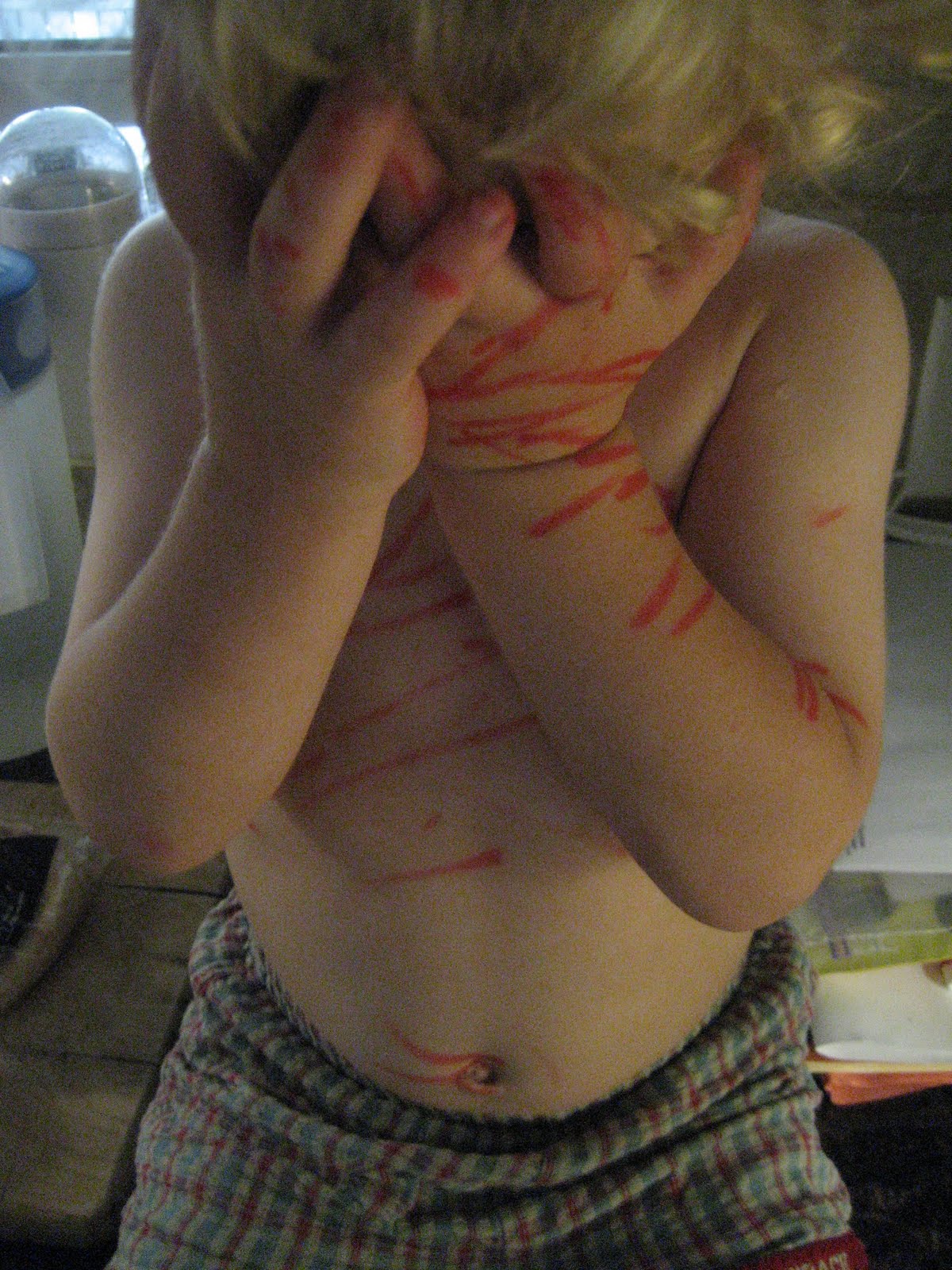
As those words hit his eyeballs, he heard crying from the basement. The movie was over (though he hadn’t realized, it was a very very short movie). The older children were complaining vociferously. And CJ was covered from head to toe in permanent marker (his own doing). He was the one crying. Kevin said he just stood there in horror. Then he popped CJ directly into a bath and the permanent marker proved not so permanent after all. He introduced me to the subject by having me read the quote, then showing me the photo (above) and saying the words “permanent marker.” Needless to say, all my zen calm went out the window till I’d heard the end of the story.
Seriously. I was imagining that child striped with permanent marker ALL SUMMER LONG.
A couple more things, unrelated to permanence.
1. I’ve decided (for now) not to write more about writing. It’s too risky; I’m too superstitious. Everything that I write about writing has the potential to be a complete lie. In the moment, or immediately afterward, I might feel that something I’ve written is wonderful–or terrible–and time might prove it to be quite the opposite.
2. However, I will say that writing and yoga/exercise go together extremely well. I was in a muddle over a story that wasn’t working (there I go, writing about writing), and instead of giving into anxiety, I thought, hey, I’ll take this to yoga. For those of you sick of hearing me blither on about yoga, you can insert the word “meditation” instead. It’s where I go to find meditative space. I haven’t found a more effective method of removing the self from myself than through guided movement that is challenging to breath and body. So, I took the story to my meditative space. And then I didn’t think about it for the entire practice. And at the end, I had a calm reflective observation to take home again: the story wasn’t working because it was trying to do too much. And it was expressing something that I didn’t want expressed through my character. So I scrapped it, and started over completely afresh. It was a relief not to waste more time muddling.
3. Meditative calm: is it a selfish pursuit? Sometimes, when I leave behind a pile of frantic children and kind generous husband, the impulse to go off on my own feels hideously selfish. But here’s what yesterday’s practice brought to me, in calm reflection: self-knowledge is not the same as selfishness. If I did not take time to recognize my own motivations and know my own desires, my boundaries would be muddier, my actions murkier; I would risk carrying anger without knowing why, or bitterness, or fear. I would be more likely to blame my circumstances and my loved ones for anxieties of my own creation. There is no perfection. I might come to know things about myself that are uncomfortable and unflattering. It’s not a route to happiness or contentment, either. What it brings me is access to calm.
4. I’m still looking for ways to find calm within noisy moments. The other evening, this is what worked: I said, “I am not going to start shouting.” No one could hear me saying it, because in order to be heard over the cacophony, I would have had to start shouting. But when I start shouting, whether or not it is in anger, my body interprets it as distress. Even if I am shouting in a calm way, just to be heard, my body hears upset, and emotional escalation is inevitable. So. I just repeated over and over that I would not start shouting–as much to remind myself as to inform the kids. Eventually, I found a break in the sound, and was able to communicate: time to brush your teeth. The evening progressed with remarkable calm (Kevin was at soccer; those evenings on my own are evenings when I really do need to remind myself not to shout).
5. What I like most about meditation is something I resisted strongly at first. Stop telling yourself your stories, my favourite instructor told us. I was like–yah, right, that’s my job, that’s what I do. I’m not about to stop. Slowly, with practice, I got braver. I realized the stories weren’t so fragile that they would get lost; though in truth, they do change. I began to let go of the stories, the interior narration, during the practice. Madeline L’Engle, in one of my favourite books for teens, A Ring of Endless Light, wrote about letting go of “very me,” to make room for “very God.” In other words, make space for illumination. The mind is a miraculous place. Just because you’re not consciously thinking about a problem or a worry or a story doesn’t mean your mind isn’t sitting with it somewhere deep and low. When I practice emptying my mind, afterward amazing unexpected observations (I hesitate to say solutions) come flooding home. There is space where before there was not. And the space is compassionate and open and loving, so there’s room for ideas that I might not accept at other times. How often have I refused an idea out of fear or laziness?
For example, I wanted that story to work and kept muddling over it because it was a story already mostly written (an older story) and it seemed easier to work with something that already existed than to start from scratch. It was a barrier impossible to recognize without calm reflection.
6. I know yoga isn’t the only route to calm, though it happens to be mine, right now. Kevin says he finds that kind of quiet, deep, meditative thought while gardening. I wonder where you find yours?
Thursday, Jul 8, 2010 | Writing, Yoga |
I wrote a scene yesterday. And more. I’m pleased. Since it seemed to warm up my typing/thinking self to blog yesterday, I’ll start this writing morning the same way.
Yesterday afternoon, Kevin came home early with a movie for the kids, so we could watch the Germany-Spain game together; I turned down a beer, but then changed my mind. My plan was to go to yoga over the supper hour, and I didn’t want to go with beer in my system. Or two, as it turned out (I was thirsty; and Germany lost). But after a restless indoor hot and sticky day, I discovered that despite the two-beer afternoon, I had the unbearable urge to exercise. So I went anyway. And here is my conclusion: beer is less toxic than coffee. It was a great class, and I suffered no ill effects. (Note: this is not a recommendation; nor do I plan to practice under the influence in future).
Today, I’m travelling back in time to the age of nineteen. I’ve got earplugs in. Having the big kids home all day definitely makes for more of a writing challenge; I’m debating right now whether I should intervene, as AppleApple and Albus are squabbling downstairs …. (Is it crazy to have air conditioning and not to use it? We have air conditioning. But I’m only turning it on at bedtime, to cool the upstairs rooms as the kids fall off to sleep. Is the heat contributing to the short tempers? Would we be happier with cool air falling upon our heads?).
In a week and a half, I’ll be taking a writing week–something that Kevin and I haven’t arranged for awhile. He looks after the kids, and I write non-stop, sometimes even through meals and past bedtime. That will be the sprint portion of the Juliet marathon. My goal for that week is to frame the three stories. It’s the most labour-intensive work, writing a first draft; after that, the work continues, but it’s being done on top of something–which I can build on or tear down or rearrange, which I find easier to cope with. I can rewrite and edit till the cows come home. That’s my favourite part of writing: reshaping, restructuring. Or, wait. My mind just said, nu-uh, your favourite part is when you’re writing something new and you find something you didn’t even know you were looking for. True. I love stumbling over something much better than I could have planned on finding. But that takes greater effort, harder labour, deeper focus; and it’s rarer. You can’t just demand that it occur.
Today. I’ve got to shut out the noise of the grumpy kids and work my way back towards the beach, the ocean, and, maybe, a grand concert hall.




 Why do I feel so slothful while on holiday? Is slothful even a word? My holiday brain cannot compute. Slowly, surely, holiday drains away my ambitions and intentions. I have to work to remind myself that rolling out of bed in the morning isn’t THAT hard.