Category: Work
Wednesday, Sep 30, 2020 | Art, Big Thoughts, Blogging, Books, Current events, Death, Drawing, Exercise, Fall, Feminism, Fire, Friends, Lists, Manifest, Meditation, Organizing, Peace, Politics, Reading, Running, Space, Spirit, Work, Writing, Yoga |

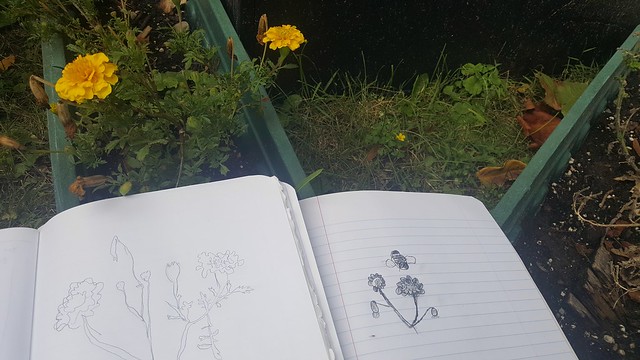
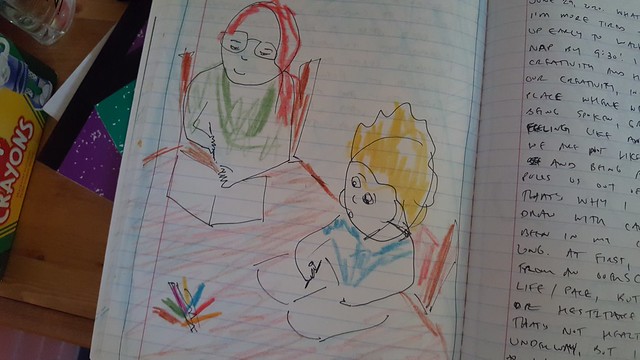
Drawing a flower with CJ.
September Reflections
- What felt good this month? At the beginning of the month, it felt wonderful to be on holiday (we spent two weeks away at an isolated cottage). As always, I hoped to bring that holiday-feeling home; but inevitably it has slipped. I can’t drink a caesar while cooking supper every day! It isn’t even possible to keep up the habit of twice-daily yoga. But it is possible to get up early every week day morning for a walk or run, followed by yoga. It’s also been blissful to take charge of my studio space, to clean and organize and purge and paint, and to set new goals. And we have kept the holiday-feeling going in small ways: Kevin bought a fake fire pit (propane-powered) and we’ve been sitting outside some nights, watching the flames, listening to tunes.
- What did you struggle with? After rejigging my studio, I panicked—as if I didn’t deserve the space, full of fear and doubt about my work and worth as a writer. But then I journaled, meditated, and went for a dog walk with Kevin, and I came out the other side. It helped to reframe my work through the window of books. Books are my life’s work. If I feel unmoored, I can ground myself by reading, writing, or connecting with others who read and write. I am so thankful for this blog as a place to come to, to share ideas, and experiment, too. I am so thankful for each one of you who reads. Thank you.
- Where are you now compared to the beginning of the month? Unexpectedly calm. When my mind spirals away, caught in fear or doubt or shame, I notice, and find a safe branch on which to land. I breathe. I think: Is this true? What’s really happening right now? Are you okay? Is there anything you need to do? I’ve noticed, too, that projects are so very satisfying to work on and complete: my mind is soothed, no matter the task. Cleaning out the bathroom cupboards. Cooking a meal from scratch. Painting a door. Writing a grant application. Revising a story to send to my writing group. In this way, small accomplishments accrue, and the days flow peacefully, but don’t feel dull. And in the evenings, I reward myself with some stretching, watching a show, reading, eating popcorn, letting my mind and body relax. (Note: this is so much easier to achieve now that I’m not coaching! I do not take my easy evenings for granted!)
- How did you take care of yourself? All of the above. Plus, remembering to reach out to friends. Working on my posture, and core strength. Sticking with established healthy routines. Putting away the pairs of jeans that don’t fit anymore. Thanking my body for carrying me through this life. I ask a lot of my body! I am in total awe that my chronic running injury has healed through physio, and that I’m able to run fast again, without pain, at least for now. Every morning run through the park is a full-body expression of thanks.
- What would you most like to remember? It’s okay if I don’t remember very much from this time. Sometimes the best days aren’t super memorable—I don’t remember much when inside the flow, but if I’m fortunate, from the flow will emerge some work of substance, or a strengthened relationship, or deepening insight and capacity for approaching conflict, suffering and pain. I will remember where I was when Ruth Bader Ginsberg died; and my own sadness and immediate despair. But I’ll remember just as much that her passing sparked a renewed connection with one of my beloved American cousins. I’ll remember, too, what she worked toward: equality for all, a far-seeing, long road of commitment that developed from her own experiences, that was encouraged to develop through the support of her husband and family, and that extended till her death. Like John Lewis, she is a true role model of character and vision, beyond the self.
- What do you need to let go of? I deactivated my Twitter account a week ago, after watching The Social Dilemma on Netflix. I also turned off most of the app notifications on my phone. It’s been good, and I hope it lasts. What I’ve noticed: I’m freed to work with more focus throughout the day. But I’m also not filling my mind with fury and outrage, the primary emotions sparked by “doom-scrolling.” True, there’s less to distract me from my own restlessness and boredom, but here’s the strangest part: I’ve felt less restless, less bored, since signing off. There are more productive and meaningful ways to connect with others in this world. I commit to choosing those instead.
xo, Carrie
Tuesday, Sep 1, 2020 | Big Thoughts, Confessions, Current events, Family, Friends, Holidays, Lists, Manifest, Peace, Spirit, Summer, Work, Yoga |
August Reflections
- What felt good this month? Being on holiday and, more importantly, feeling on holiday. Being outside, as much as possible — I’m writing this outside, for example. Daily yoga with Annabella, and in the past couple weeks, we’ve bumped it to twice-daily. Going easy on myself in terms of expectations (especially while on holiday). Seeing friends and family in person, for walks or on porches, or back patios, or back yards.
- What did you struggle with? I’ve noticed a few things. One, it’s harder to remain vigilant about the pandemic, the further we get from its initial shock. Summer has given us a blissful break, but I dread the possibility of an interior, locked-in, limited-contact fall/winter. Two, I’m hyper-critical of my social interactions; specifically, any social error that I make now feels magnified and terrible, and I’ll wake up in the middle of the night replaying these moments. There’s a piece in today’s New York Times about how we’re all becoming more socially awkward, and I, for one, can attest that this is painfully true. Three, I feel a longing and almost a panic about finding things to do that will connect me with other people: I had a dream that I’d gotten a job working at a newspaper as a copy editor two days a week, and in the dream I was thrilled and excited, till I realized that it was likely work I could do from home, and I wouldn’t be with people. I woke up feeling confused, as this hasn’t been a conscious desire — to be with people, to work with people; in fact, I’ve been carefully arranging my life in order to work alone, writing things. Maybe I’ve got this all wrong? Or even somewhat wrong? Maybe I need to find outlets / work that allow me to be with others? (And is this a pandemic-induced feeling of starvation-for-contact, or a more fundamental issue, career-wise?)
- Where are you now compared to the beginning of the month? Flatter. I’m not sure I can explain this better. I feel suspended between seasons. There are too many unknowns looming. I’m riding the moment, trying not to think ahead or get ahead of where I’m actually at. My expectations feel low, and I can’t decide whether that’s a good thing or a bad thing. Mostly good, I think. But sometimes I think I need more … more ambition (?), a defined goal (?), something concrete to bolster my otherwise circular practices (?).
- How did you take care of yourself? Same as last month: I’m practicing radical self-love! (Try saying that out-loud and not undercutting it with a self-deprecating aside.) Reminding myself and my body that to be imperfect is to be human. Speaking up when I feel upset or ignored. Trying to address conflict directly. Trying to notice my own shortcomings and dysfunctional patterns, emotionally, so I can at least take a step back and say, hey, do I like this? Do I want to change this? And if so, try to respond differently than I ordinarily would. I’m talking very very small-scale changes: like, whether I eat a piece of chocolate now or save it for later. (To this point: I’ve noticed I tend to hoard for the future rather than permit myself to enjoy in the present; what does it mean to give myself permission to use my resources freely, without fear? What does a mindset of plenty, of enough, of bountiful, of abundance feel like? How would it change how I live?)
- What would you most like to remember? The lake. The way the water moves differently depending on the wind and the time of day: long ripples; flat; waves; dappled. The sunsets. Card games with the kids. The meals: potato crust quiche, beans and rice, risotto made with homemade broth, roasted beets. Bike adventures with CJ.
- What do you need to let go of? What I should probably let go of is news from the States. But I can’t and I won’t. I’m practically an obsessive about it, even when on holiday. I’m by turns baffled and infuriated, disbelieving, resigned. It’s like everything that’s been simmering under the surface has been turned up to a boil, all the chickens are coming home to roost: the country is armed to the teeth, divided, sick, hungry, the inequality is obscene, the systems corrupt and built on racist and misogynist beliefs, and reality itself seems upended by the lies and false narratives being peddled and eagerly devoured online. What am I witnessing? I can’t make sense of it, and want to. So much doesn’t make sense to my mind, perhaps most basic, the willingness to let so many people get sick and even die, when there are simple solutions that could stop the spread of the virus. If they’re willing, as a country, to accept so much death, what else will they be willing to accept? It frightens me. (And what am I willing to accept, as a Canadian, that I shouldn’t?) So … should I let this go, turn off the news? It doesn’t affect my life directly, does it? Wouldn’t I be more content, more peaceable of mind, if I were to let it go? How important is this form of passive engagement? In what ways do I become actively engaged for knowing more? (For one, as a dual citizen I’ve registered to vote, but that’s not new.) Is it a sick form of entertainment, in a way, or is there value in staying informed?
xo, Carrie
Sunday, Aug 16, 2020 | Art, Big Thoughts, Blogging, Book Review, Books, Confessions, Current events, Dream, Family, Manifest, Peace, Play, Politics, Publishing, Reading, Spirit, Stand, Work, Writing |
This blog is like a corkboard on which to post thoughts, observations, whatever is front-of-mind right now. It acts as a public journal, an I WAS HERE scrawl on the wall. Trouble is, recently, whenever I sit down to post something, it’s not clear to me what’s front-of-mind. Mind is a-jumble. Influences are disparate and scrolling, images aflame, voices shouting, protests, outrage. What calls my attention is both very personal and tiny (my morning routine, for example) and overwhelmingly political and heavy (can’t even begin to list it parenthetically).
This morning I read an article by Lori Fox in The Globe and Mail that pretty much sums up what I’ve been ranting to Kevin about for these past many months. Please read what she’s written and know that I’m nodding along. At one point in the article, she writes about her own “small, selfish” dream. It’s a lovely dream. To paraphrase: Work that is useful and that she loves doing. Enough, and the time to enjoy it. A life with dignity and love.
It’s small enough, isn’t it, that everyone should dare to dream such a dream? Everyone should have the means of achieving it? It doesn’t sound selfish to me.
Originally, when I sat down to write this post it was about my own lovely week, which I spent reading stories, editing stories, and talking about stories. But when I wrote about how lovely it was, and how purposeful and peaceful I felt doing this work (tiny, personal), I also found myself tracking into the weeds of dismay and guilt, confusion and fury (overwhelming, political) as I reflected on how it was privilege that allowed me to do this work.
Earlier in the week, I watched this interview with Kurt Anderson on PBS (my favourite American news source), and it stirred in me emotions that I’ve been unable to unstir. Essentially, he argues that 1976 was the most equitable year on record (in America), and due to a wealth-driven philosophy that focuses on profit to the exclusion of all other concerns, we now find ourselves living in an economy that offers that “small, selfish” dream to fewer and fewer people. I realize that I live in Canada, not the US, but we’re not immune to troubling inequity. When I eat a peach, I can’t help but think of the hand that picked it, and wonder where that person is from, how much they’re being paid, and where they’re sleeping. Essential work is being done by people who are treated as less-than. And the system makes us complicit, even as we’re stuck in it.
How many people do you know whose work is precarious, cobbled-together gig by gig, without benefits or retirement packages? Look around, and you’ll see that defines a lot of us, even those who seem to be doing okay. How many jobs that were once secure and well-paid are now being done by people who work on contract or freelance? Remember when earning a PhD meant tenure-track job-security? I remember when writers were paid a dollar/word for book reviews published in the newspaper. You can argue that sectors that are struggling are sectors that are becoming obsolete in today’s economy; but that’s not necessarily true. Is education obsolete? Are the arts obsolete? What about news? Long-term care? Sectors struggle for many reasons, but what I see is that a profit-only model doesn’t work for the people who actually do the labour. Because in the profit-only model, labour is a cost. You squeeze the costs down, you make more profit. Ultimately, that means you’re squeezing people — you’re paying people less and less to do more and more. And the people are us.
I can observe all of this, and be outraged, but it tends to lead me toward paralysis. What’s the fix, what’s the cure?
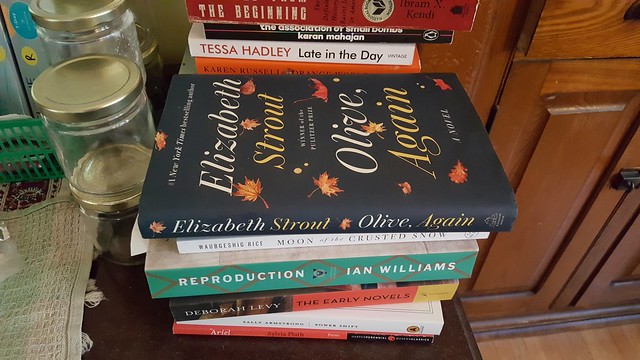
Yesterday, I sat outside and read Olive, Again, by Elizabeth Strout, which I noticed, upon finishing, is labelled “A Novel.” I think that’s an American thing? The book is actually a collection of linked short stories, my favourite form, although I know linked short stories don’t sell well, so maybe “A Novel” is a marketing thing. In any case, the book doesn’t need to be anything other than what it is: stories about characters (often Olive, but sometimes not) navigating their broken paths and trying to figure out how to talk to each other and protect themselves across divides of class, race, culture, age, abuse, pain, illness, secrecy, experience, self-doubt. It’s brilliant, and I wept often, throughout.
Upon finishing, I thought: I just want to sit and read stories all day long. And then I’ll take a break and write stories for others to read. And then I’ll meet with people who love reading and writing and we’ll talk about it, and I’ll edit my stories and theirs. When I do this work I’m not always right, but I know what I’m doing and why.
Is this a roadmap for a career???? God, let it be so. At the very least, it’s a roadmap for making sense of life. For helping me see and understand and know what matters. And it ain’t profit, my friends (but you already know that!). We all know it, gut-deep: profit isn’t profitable when it costs us our communities, our health, our dignity.
Here’s my own small, selfish dream: I want to read, write, edit, discuss; work that has it uses, its purpose. And I want others to be able to do this work too, as they’re called to it.
Truth: A lot of my work is done on a voluntary basis (it’s my speciality!). But here’s the thing: volunteer work is not necessarily noble. People volunteer because they can afford to. I’m worried that my willingness and ability to work for little to no recompense is part of the problem. Consider the arts sector, where many initiatives survive because of people like me: Doesn’t this very structure — reliance on voluntary labour — create barriers toward participation for everyone who can’t afford to work for free?
But what’s the alternative in a sector that’s not profit-driven and never will be, that survives on grants, fundraising … and underpaid / unpaid labour?
It’s a dilemma that’s been troubling me. A lot.
And I’ve come around to a solution, of sorts: Universal Basic Income. It’s not perfect, but it seems like the viable place to start. A baseline of security, so everyone can afford their own tiny, personal dream: Enough and time to enjoy it. Dignity and love. Work that is useful and that you love doing.
(See what I mean? This post is WAY TOO MUCH, but it’s where my head is at, right now.)
xo, Carrie
Thursday, Jul 30, 2020 | Big Thoughts, Confessions, Current events, Death, Manifest, Mothering, Parenting, Peace, Politics, Reading, Summer, Word of the Year, Work, Writing |
The bugs whirring in the trees. The sound of wind through branches. Cars and trucks grinding by on the nearby streets. I am gliding through these days. Maybe I want to keep this time, but maybe I also want to let it be. Let it roll like weather, let myself rest in the grass and look at the sky, so different every time, completely clear this morning with sunlight at the tips of the trees, the leaves lit from behind, green etched on pale blue.
I am waiting to discover something—what?—new?—about myself? about my purpose? about what I might become? I wonder why I always feel so sure that I am becoming—it seems so optimistic; because of course I am so sure that what I am becoming will be an improvement on this present iteration of self.
I’ve noticed that my flaws are magnified by this time of intense closeness with my little family unit. There are fewer of the everyday, outside, fleeting social interactions that help me to see myself differently; at home, my relationships tend to be more raw, less inhibited by boundaries and graces. In the outside world, I perform civility. Home is where I let my hair down (or wind it into a messy bun, more often!), seen only by those closest to me, who are also most bound to me and therefore most forgiving. Within these close relationships, I see reflected my limitations, my tendencies, my patterns, my behavioural tics and triggers. In truth, it is more often than not painful, humbling.
The question presents itself almost non-stop: Do I want to change? And if the answer is yes, what would I like to become, if not this?
Also, acceptance: this is what I’ve got to build upon.
This weekend, I listened to this On Being interview from 2013 with John Lewis. I’ve been thinking a lot about non-violent resistance, and what it means; and its relationship to my faith and faith tradition in the Mennonite church. I am planted in this soil. Here are my roots. How do I flower and grow and express “love in action”? The idea of resistance infers that against which you must resist—there is an implied relationship, a force that is pushing back. What John Lewis seemed to know is that in order for “good trouble” to bear fruit, you must present yourself at the edge, where you can meet resistance. You must be morally unassailable, dignified, restrained, patient, but also forgiving (of yourself and others). Non-violent resistance is hard, it requires self-discipline, rehearsal, practice (you learn to protect your head with your arms, you learn to curl into a ball on the ground, in practical terms). To win the moral battle, which may or may not move you closer toward your goal, you must be spiritually prepared to suffer. But to meet resistance effectively, you also need clarity of mission. The thing against which you are resisting must be clearly in view.
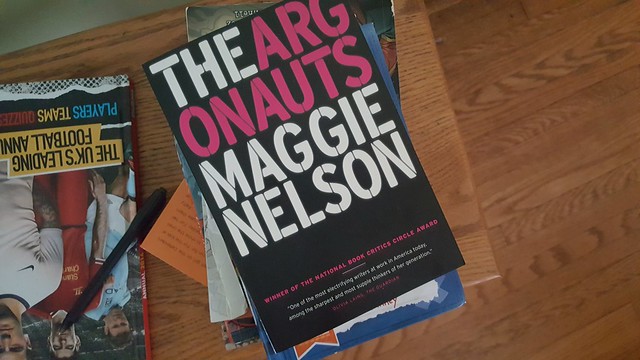
I’ve been thinking, too, that I lack clarity of mission. I don’t know my own goals. And this is why it feels like I’m waiting. (I’ve also been reading Maggie Nelson’s The Argonauts and thinking about the many ways in which human beings cause each other pain and are hurt, despite our best intentions, despite trying to protect ourselves; and how powerless that can make us feel, to act, to respond, to seek out relationship with others.)
re resistance, re mission, re goals, just found this in my notes: I still need to write that blog post about the flaws in the system. Which flaws? Which system?
Too many flaws, too many systems.
On this subject, more to come. But I shall spare you and stop here for now.
xo, Carrie
Wednesday, Jul 22, 2020 | Adventure, Art, Big Thoughts, Book Review, Books, Current events, Fun, Good News, Holidays, Politics, Publishing, Reading, Spirit, Work, Writing |
A marvellous way to escape from the stasis and repetition of the everyday is by reading books. I’ve been reading more books these days than I have for a very long time, reading not merely for professional purposes, but as a fan.
And I just want to say: Read, friends, read!
Read a book! You won’t regret it! Sink in, let your brain get accustomed to taking the long, slow, scenic route instead of scrolling yourself down an endless wall of text. This might sound like self-serving advice, but really, I feel born-again.

Read a book!
It’s an immersion in a way that other forms of “entertainment” and learning are not, because it also involves engagement, as your mind works to build worlds and make connections. There are ideas and images forming inside your brain—new to you, exciting, challenging, alarming, frustrating, fresh and unknown—as you follow the line of words across the page. These brand-new images are transferred into the landscape of experiences, memories, and images that already belong to you. Connections between these worlds pop and crackle and spark something that has the potential to feel revelatory and transformative (at best), or at least interesting, different from your usual point of view.
Inside your mind, as you read a book, you’re actively creating something that is both collaborative and personal. You’re reading something written in a different time that is speaking to where you are right now (or attempting to). I think this is why it can feel like you know an author really well—because you’ve actually made something together when you read their book, even when you’re collaborating across cultures, languages, places, and times.
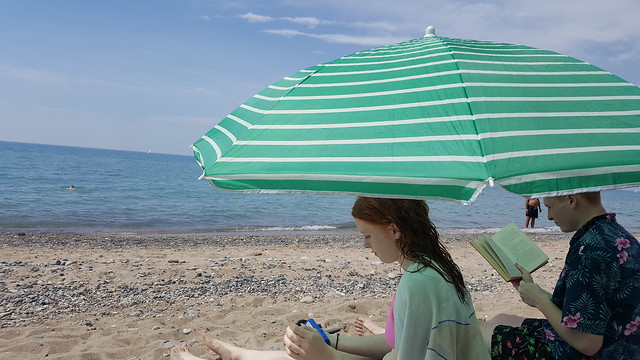
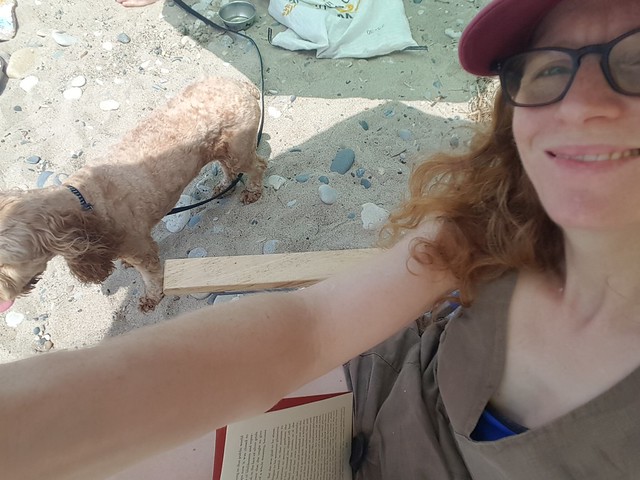
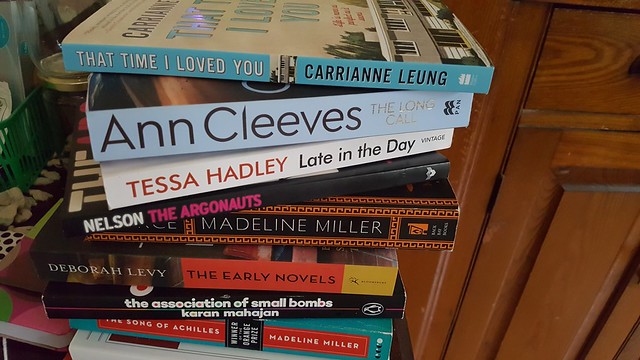
This past weekend, in related news, we camped at my brother and sister-in-law’s farm, and went to the beach. And we read books. I even stayed up late one night to finish a conventional but highly entertaining murder mystery, borrowed from my brother (Ann Cleeves, The Long Call). I’d finished the book I’d brought camping (Tessa Hadley, Late in the Day), a book with which I had an ongoing argument, as it featured wealthy white British characters, several of whom were artists; at times, I strongly disliked everything about the book, but then bits seemed to capture something important about creating art, especially as a woman, and how valuable it is to have a champion, especially a patron with money and influence, but also how dangerous. In the end, it was the engagement with ideas, the argument with the book itself, that kept me transported and hooked.
Books transport me in so many different ways. Reading Carrianne Leung’s That Time I Loved You brought me into characters who broke my heart, and with whom I craved even more time, and afterward I wanted to talk about these people like they were real; reading Kiley Reid’s Such a Fun Age was both accusation and encouragement to reflect on my own transactional relationships, even while it pulled me along with a propulsive plot; reading Glennon Doyle’s Untamed stirred up a mixture of emotions, including the desire to protect this seemingly vulnerable writer from her own blind spots, and respect for occasions of raw insight.
I’ve just started Maggie Nelson’s The Argonauts, and already I feel like the top of my head has been lifted to make room for more seeing, more questions, more ways to jab at and unpeel my identity, my ways and means of performing myself.
Writing is not a glamorous job. Progress is made at a glacial pace, if what you’re doing can be even be seen as progress; it might be more rightly called meandering, looping, wondering, wandering. You can’t see what you’re making. You can’t know how it will be received, if it ever gets loose, let alone completed. You don’t know what arguments a stranger might have with what you’ve conjured on the page.
It often doesn’t feel like important or valuable work; certainly it doesn’t feel very useful a lot of the time. But when I read books, I know exactly why I write, and why I’ve chosen this wondering, wandering path. When I read, I feel belonging and expansion, both, at once. When I write, I feel like a giddy participant in a long, ongoing conversation about being alive, being a part of it all, in my own time and place and body, right now.
Right now, Canadian publishing is suffering. (Read this, if you want to know more about the nitty-gritty business of the industry.) But listen up, friends! If you’re lucky, you still have an independent bookstore operating despite the pandemic, and they’re the ones (according to the cited article) who have the potential to keep this fragile/tough cultural industry alive. All the books mentioned above (and many more!) were purchased at Words Worth Books in uptown Waterloo. Order online, pick up in the alley behind the store; or they deliver locally. Do a bit of searching. Find what’s available near you. There are many independent options other than Amazon, and these options are run by people who love books, too. They love reading. They believe in the collaboration between words on the page and individual minds. They want to challenge your horizons, send you on adventures, keep you up late at night. Amazon’s algorithm just wants to sell you more of the same.
Those are my thoughts for today. More ideas, coming soon.
xo, Carrie
Thursday, Jul 16, 2020 | Big Thoughts, Confessions, Current events, Family, Fire, Friends, Manifest, Meditation, Peace, Space, Spirit, Word of the Year, Work, Writing |
When I think about the word balance, a word I’ve considered maybe somewhat irrelevant or inapplicable to my life, what I’m beginning to sense or feel, as much as understand, is that I am always in transition. I almost never arrive anywhere, and certainly don’t stay. I exist in flux even while viewing myself as being a creature reaching toward, aiming toward, permanence.
Yet I am human, mortal, entirely impermanent.
Rituals exist to pin down significant moments; because the moments in my life run together like water. But what I’m glimpsing in the word balance is a peace in accepting this state. I’m seeing the fluidity in my being in all of existence, in the way time moves, and that I move in time. I’m seeing that I am of my time, immovable from the history that surrounds me even if this history will not remember or know me, especially.
During the lockdown, my work was not deemed essential. Because it isn’t. I am not planting vegetables or stocking shelves or administering tests or researching cures or triaging patients or caring for those who need special care. My work has been on the page, and in the home.
I’ve had time. And I’ve noticed that, given the time, I can write and imagine in a bigger way than I had before. I’ve noticed, too, that I continue to feel anxious, to experience existential dread, to float in the brine of my own small shames, to wish often to be better than I am. That has always been with me, will always be with me. Feelings come and go and come again. I’ll always have feelings, mixed up and catching me off-guard and demanding my attention. It’s my response to the feelings that is changing.
Can I live with discomfort? The answer is yes.
Disappoint myself or disappoint others? Sometimes the choice is pretty stark. Sometimes you can’t square the circle. Sometimes — often, really — you cannot please everyone, and by trying to do so, you please no one, least of all yourself. What is your inner voice whispering? Does it hurt to hear it?
I’m trying out an experiment. I’ve come to believe that I don’t have time to do most things, let alone all things. Just write. Cook. Read, research a bit. Yoga, run. That’s it. A little bit of housework. Parent, pay attention to my kids. Be a good friend. That’s it.
Whether it brings me anything, doesn’t matter. It’s the ego wants things brought to it. This is my river. Is it service enough to just write? I don’t know. But I’d like to find out. Or try.
Time to unfold, unfurl, spread out. What’s the rush?
What am I hurrying to discover? It all comes to light in time.
xo, Carrie