Category: Mothering
Friday, Jun 10, 2011 | Chores, Kids, Mothering, The Juliet Stories, Work, Writing |
Ever feel like you’re just not into the domestic necessities? I can usually find some smidgen to enjoy in some portion of the daily chores that Must Be Done. But not right now.
Right now, due to soccer-all-the-time, I am washing dishes in a grumpy stupor after 9pm. “Remember when I got to wash dishes right after supper while listening to ‘As It Happens’?” I said to Kevin last night, who was also in the kitchen, putting together lunches for school. “Who knew that was such a treat?”
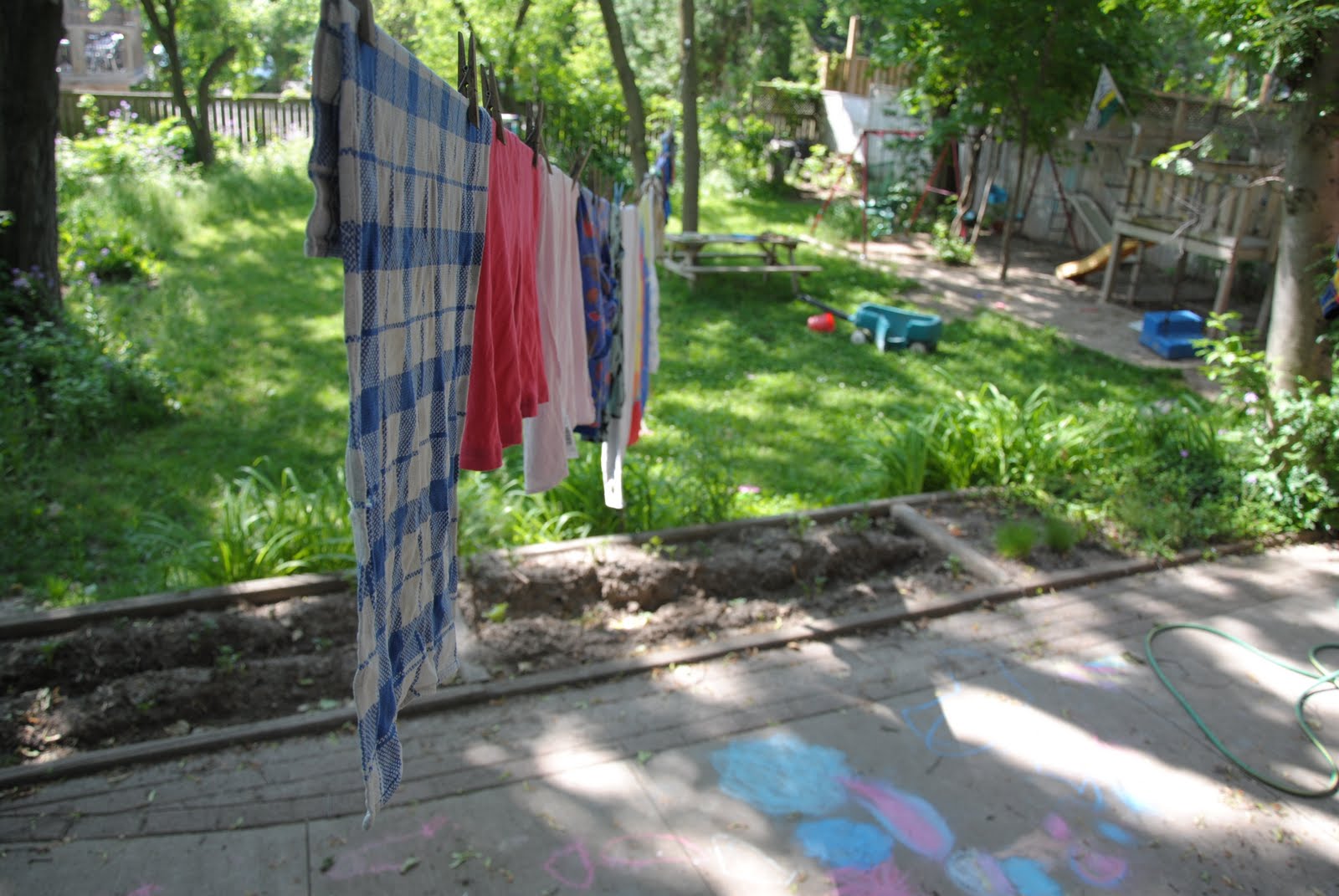
And hanging laundry–an often peaceful activity, a moment of quiet in a noisy day–right now, feels like a relentless intrusion on my time. There’s so much of it and so many stages to the doing of it: gathering, washing, carrying the basket up and down stairs, hanging inside or outside, gathering, folding. The only thing I refuse to do is to put away the stacks of clothes neatly piled and arranged from youngest to oldest, on my bed. C’mon. It’s the least they can do.
Even cooking is not drawing me these days. I haven’t baked bread in over a week. I’ve been stocking up at the half-off shelf at our nearest grocery store (and because our grocery store is frequented by a lot of students, the half-off bread is usually the best they sell: multi-grain or spelt or Red Fife wheat).
I haven’t baked a cookie, square, or cake in ages. I offered my two youngest a half-bag of cheesies to snack on while we sat waiting in the hallway for AppleApple to be done her final piano lesson. I’d assumed we’d be alone, because the music school is pretty much shut down, but of course there was a mother across from us, watching my offspring coat themselves in sticky orange powder. I pretended no shame.
Maybe I wasn’t even pretending, come to think of it.
I am consumed, right now, by two major projects. One is the triathlon, which will happen next weekend (not this one). I am training heavily, and it is eating a great deal of my time, mentally and physically. What I’ll do after it is over, I just cannot fathom. I can’t really think that far. I love the early mornings, but they take a toll. I would like to get together with friends and enjoy a drink of an evening, again, for example. But meantime, I am aimed like an arrow at a target, with a focus I just can’t turn off.
My other major target, on which I feel just as significantly and undistractedly aimed, is my Juliet Stories, several of which I am reworking in quite radical ways. I am rolling with ideas, especially after a conversation this morning with my editor, and trying to be patient and to work within the limits of the time that is put aside for writing work. I am grateful to Kevin, who is taking over everything this weekend, so that I can write.
And so the kids are eating cheesies, and I am resenting the laundry, and we are doing a lot of last-minute barbequeing.
I just realized something. It’s not pretending. There’s no shame. I’ve lost whatever guilt I once had, as a mother, about pursuing interests that don’t revolve around my children and my household. Right now, I am wired tight as can be, focused, excited, energized, exhausted, stretched, and it’s all good.
Friday, May 6, 2011 | Blogging, Kids, Mothering, Parenting, Running |
Awhile back, I wrote a post about “Conscious Discipline.” At the time, I copied a list of ten parenting principles onto a piece of green paper, which is still hanging in our kitchen. I think the list is terrific, and continue to refer to it from time to time.
Most recently, number eight jumped out at me: “Become the person you want your children to be.” I love that line.
I’m becoming a fairly fit adult, and someone who takes great pleasure in running, biking, yoga, swimming, etc. And my kids know how I feel about it. I talk about it as relaxing, or as an outlet for difficult emotions, and a way to make life, generally, happier. The kids have now been to three races and they’ve seen how happy running makes me feel. One might say, job well done, Mom. You’re becoming the person you want your children to be.
So.
Last week, Albus brought home a piece of paper from school, which he grabbed and tried to hide as soon as he saw me heading to check his backpack. What on earth? I thought. Is it a note from his teacher that he doesn’t want me to see? Is he in some kind of trouble? When he sheepishly showed me the piece of paper, it had information about the school’s Running Club. “You’re going to make me sign up,” he said, despondently. Of course, I said I wouldn’t force him to do it, but wouldn’t it be lovely, blah blah blah? And he said, no. He doesn’t want to waste his recess time on running club. AppleApple was equally disinterested. I was mildly disappointed.
But when my eye caught number 8 on my “Conscious Discipline” poster, I just had to laugh. Here I am modeling away, and my kids are, so far, oblivious to the hints; at least to the most obvious and particular of the hints. I do think it’s a good thing to become the person you want your children to be. But hopefully you’re doing it as much for yourself as for them. They will have to make their own choices along the way, and there is only so much a parent can/should push for. It’s just not a one-to-one ratio: do this, and receive that result. Life, and parenting, is much less predictable.
They’re going to break out of my mold, and be themselves, be the individuals they already are. Maybe the more subtle messages will get across; that’s what I hope. The messages about focus, working hard, and enjoying what you do. May it be so.
::::
In other news, please read my latest blog on Chatelaine.com. It’s about learning to swim last summer, with an unexpected teacher.
Wednesday, Feb 2, 2011 | Money, Mothering, Writing |
I’ve been writing more regularly on my side-project blog, Swim/Run/Bike Mama (yup, it’s on the triathlon project), and less regularly, perhaps, here. Since finishing the 365-project (apparently, I thrive on projects), I’ve hardly picked up the camera. I am giving myself a full week of breathing before even thinking about what to do next, photography-wise; but one interesting discovery is that out of 365 photos, there are about thirty that stand out, and among those, a few that might just come together to tell an interesting story quite apart from the project and apparent subject matter: ie. I can make something else out of them. Maybe that’s reason enough to continue taking a photo every day. Because at any moment, something lovely is waiting to come into existence (surrounded by a lot of other moments and attempts).
I’m linking to a piece in the National Post by my former boss, Noah Richler: he argues that funding the arts provides a public service quite beyond what can be valued monetarily. The salient point is: some things aren’t done for profit–how do we measure their value? And what does what we value and support say about our country?
And, you know, on a very personal level my thinking has been heading this way, too: questioning my compulsion to evaluate what I do in a very black and white, cost-versus-profit manner. I wrote a few posts back about wanting to be independent, financially. That’s not a superficial desire. On the other hand, it doesn’t take into account–or value–all the ways that I do support my family and contribute, ways that aren’t and probably can’t be compensated in a “fair” way. In our marriage, we try not to do too much horse-trading, ie. I did the dishes so you have to put the kids to bed. Because that just creates a feeling of unfairness: maybe the dishes are worth only two kids being put to bed; or maybe on that particular evening, the kids need a bath, which is more time-consuming, so it should be worth an extra round of dish-washing; or … well, you see where I’m going with this. In the same way, there is no way of measuring the effort that goes into, say, writing a book, and compensating it “fairly.”
Do I need to be financially independent? That’s a really personal question, I guess. I haven’t got an answer yet. But I’m interested in all the reasons that maybe, maybe that question throws me off track. Maybe it’s a red herring. Maybe the question is: can I accept that the work I’ve chosen to do may never be compensated at a rate that would allow me to be financially independent? What matters? Is it money?
Wednesday, Dec 15, 2010 | Kevin, Kids, Mothering, Organizing, Running, School, Spirit, Writing, Yoga |
Sometimes it’s the smallest of changes that make room for a happier daily life; it’s also easy to forget the small changes, and assume that life has always been just like this. But as I puttered around my kitchen this morning, in the pre-dawn, I realized, no, life has not always been just like this. This would have seemed unthinkable a year ago. What’s changed?
1. Sunday night scheduling. Sounds dull. But how incredibly helpful it is to sit down with Kevin and discuss what’s on the menu (literally and figuratively) for the week ahead. I jot down meal ideas for each day. We plot out car use, and any blips in the routine. No longer am I stuck for meal ideas. And we find or make extra time.
2. Exercise. Guess what I do with my extra time? Some of it is spent going to yoga, or running. I am currently holding steady at two 90-minute yoga classes each week, and two 6-8km runs. This would be unthinkable were it not for advance planning. And because it’s scheduled out, I’m much less likely to skip the chance to go, knowing what I’d be sacrificing.
3. Date night. Part of our problem, typical of partners working and raising young children, is that we are often like two ships passing in the night (is that the phrase?). Kevin plays hockey and soccer, both fairly late at night. My yoga classes are over the supper hour, so on those days, he runs in the door, and I run out. I also schedule evening outings, occasionally, with my siblings, and, about once a week, with friends. So when do we get together to be ourselves and not just to talk about schedules and kids? Earlier this fall, we began booking a regular sitter, and committed to taking one evening a week just for the two of us. Marriage is for the long-haul. We need to stay connected beyond schedules and kids, because before we know it, it will just be the two of us rattling around our house, reminiscing about these crazy busy days.
4. Getting out of the house. This could have come first, actually. It’s a huge change for me, not really a small one. During my early years of motherhood, I was a hard-core stay-at-home mama. I could go months without leaving the kids for an evening (and, no, that is not an exaggeration). I wanted to do it all myself. I loved that time with them and did not resent it. But this new stage is good, too. I think the rule of thumb is: to thine own self be true. And know that part of being true is recognizing shifts and changes within one’s own self, as they happen. The kids have become so accustomed to me getting out of the house, without them, that it’s old hat. I kiss them goodbye, and they know and trust that I will come back. No drama. No fuss. (And no, it wasn’t always like that; and all the fuss and crying and drama made it so much harder to get out).
5. Nursery school. As a hard-core-stay-at-homer, I didn’t even consider nursery school for my oldest kids. I provided them with crafts, puzzles, baking projects, singing, playdates, regular trips to the library, park, Children’s museum, and swimming at the rec centre. But after eight years, or so, I was growing weary. I realized my interest and enthusiasm were flagging. Those two youngest were not getting the enriched childhood they deserved. Almost exactly a year ago, I landed on the idea of nursery school. It was a HUGE leap for me. CJ started a year ago in January, one morning a week, which by April I’d upped to two mornings. And this September, I cheerfully threw him into three mornings a week. I would consider sending him daily next September when Fooey heads off to first grade. (She’s also gotten to tag along to the nursery school experience, going every other Friday when she’s not at kindergarten). And here’s the thing: CJ loves it. I’m not saying the older kids were deprived. But I would be the last to judge or criticize either version of early childhood: either/both can work.
6. Spirit. My word for this year. Bless that word. I don’t know whether I would have necessarily turned down experiences were it not for that word (turning down experiences is not in my nature), but I may not have sought out so many experiences related to the spirit. I don’t know why I need permission or nudging to move me in certain directions. Maybe I don’t. But I like having projects. Especially projects that spread over a long period of time, and require regular attention. The 365-project falls into that category. As I approach this solstice season, and Christmas, and my birthday, and the coming new year, I want to take time to reflect on the projects ahead: small and big, new and old. What word will come to define this year?
7. Confidence. As I walked past my own reflection in storefront windows yesterday evening, I realized my self looked unfamiliar to me: older, probably. I looked like a grownup woman, occupied, on her way somewhere. And I thought to myself, how interesting that as I grow older, I am becoming more and more known to myself on the inside, while on the outside, I know myself less and less. Maybe that isn’t entirely true, given the 365-project. Or maybe it’s just this: the outside seems to matter less. I’d like to believe that who I am shines through, and always will, no matter how much I change on the outside.
8. Portfolios. One last small change. This brilliant, brilliant, brilliant idea, which I may have mentioned before, came from friends of ours, who split up the household tasks, and call them “portfolios.” Bathroom cleaning would be an example of a portfolio. Dentist. School lunches. Kevin has taken over those last two portfolios, and what a difference it’s made in my life (and maybe in his, too).
Friday, Nov 26, 2010 | Kids, Mothering |
A couple of nights ago, I read a bedtime story to Fooey: Danny and the Dinosaur. It’s a book many decades old, in which a boy befriends a dinosaur, and they spend the day wandering around Danny’s city, eating ice cream, and playing with Danny’s friends. When we got to the end, and Danny said goodbye to the dinosaur, and they parted and went their separate ways, Fooey looked at me with puzzlement. She couldn’t understand: Why were the children outside all by themselves? Where were their parents?
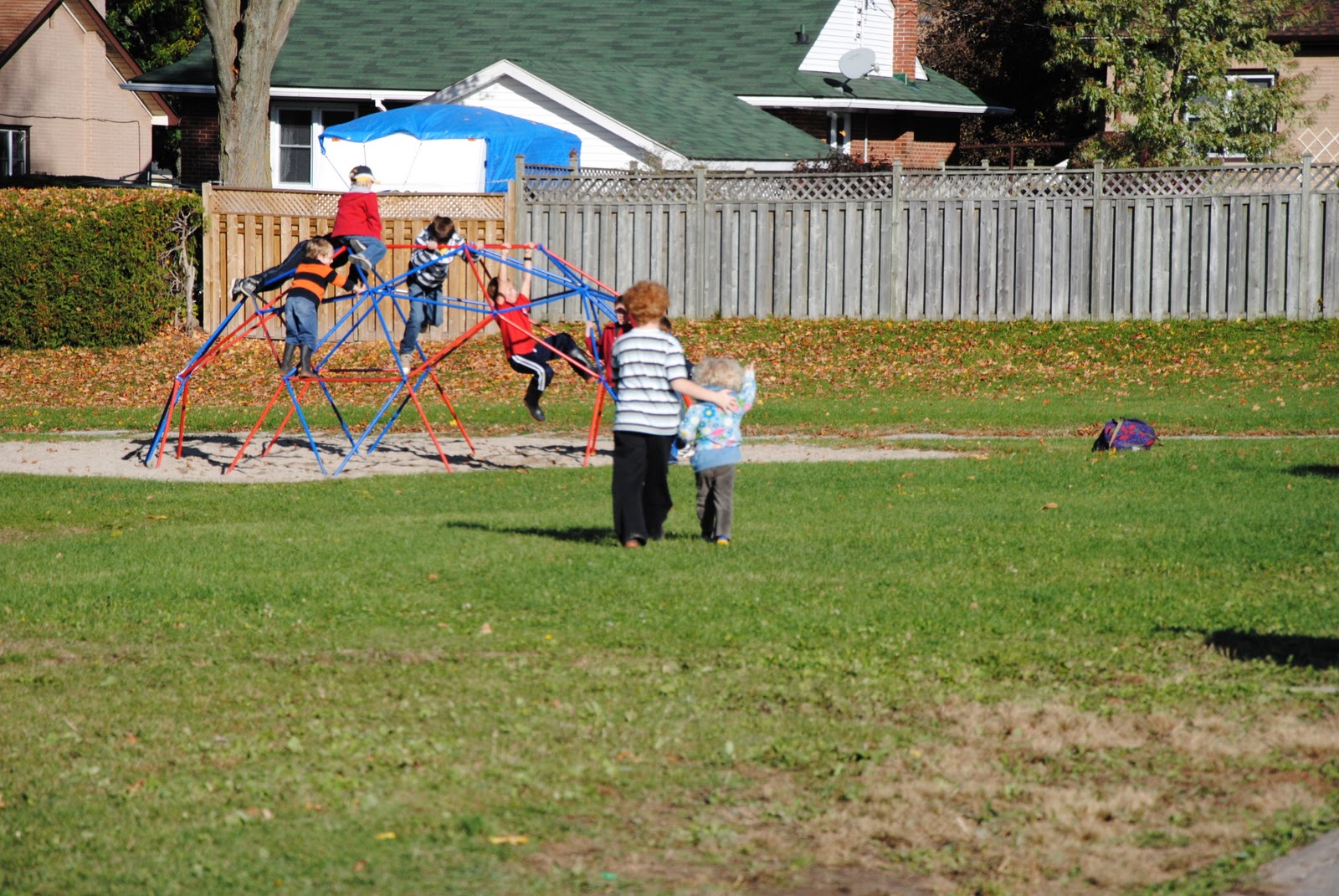
That question has haunted me ever since. Fooey does not see children outside in our neighbourhood all by themselves. It is so foreign to her that it leaps out as an aberration when she sees the idea illustrated. Of course, she is only five, perhaps too young to run around the neighbourhood without parental oversight. Perhaps; but perhaps not. I remember playing outside at the age of four or five with my brother (younger) and a friend (my age), by ourselves, unsupervised. We were given the freedom, and trust, to walk from our house to his, to cross backyards, to play in our unfenced yard and garage while my mother made supper, or put the baby for a nap, and checked us occasionally from the window. When I was not much older–seven, eight, nine–I played freely outside in my neighbourhood. I don’t remember having to check in regularly with my mother, or any other mother, nor do I recall being “street-proofed” in any way. We explored beyond our own yards, we crossed quiet streets, played on the college campus nearby, went sledding in winter, had imaginary adventures in the small woodlots on campus, and dipped our toes in the creek. By ourselves. No parents. Hours spent on our own.
My children don’t get to do that. (They play unsupervised in our fenced yard; and they walk to school with friends; but these are activities with obvious boundaries and safety features built in). My eldest is nine. We don’t live in a small town, and we do live on a busy street, but there is a little park nearby, and the neighbourhood is full of other kids … few of whom I’ve ever seen walking alone, let alone just going out to wander around and play. Something about the lack of kids out and about makes sending my own kids out and about feel much less safe. If the little park were frequented by neighbourhood kids, on their own, if the sidewalks were full of kids roller skating and scootering and building snow forts, without parental involvement, if it were the habit of kids to wander around the corner to knock on friends’ doors to see whether someone was home and could come out and play … how different would this neighbourhood look and feel?
What are my kids missing out on? What should I be doing differently, as a parent? Why am I so afraid to let them be on their own for long stretches of time, without me knowing exactly where they are or what they’re doing? (I know what I’m afraid of–terrified of losing one of my children–but I don’t know why I am so afraid. Is the fear irrational? Is my control over my kids’ activities hindering their development as autonomous individuals?).
Friday, Oct 22, 2010 | Kids, Mothering, Yoga |
I’ve recently noticed that my children blame me for many things; and that they do not aim the blame at their dad in the same way. Perhaps blame is not precisely the right word. Yes, there’s some of that, but it’s more that they direct their negative feedback toward me. I wish I could say that I also get all the positive feedback, but that doesn’t seem to be the corollary.
For example, yesterday evening I went to a yoga class. In order to get to there, I’d prepped supper and left everything ready to go–and I was sure it was a meal that would be enjoyed by all. Homemade mac and cheese baked in the oven! Glowing from yoga, calm of mind and body, I walked through the door and saw Albus, glowering at the emptied table (Kevin had already cleared and done the dishes). “How was supper?” I asked. “Bad,” said Albus. “You didn’t make enough.” “What?!” I looked at Kevin, who sighed and said, “Yes, you did. I cut him off after four huge helpings. I’m peeling him an orange now.”
Oh.
Honestly, I had to laugh. I can make what I think will be The Perfect Dinner and still receive negative feedback–for something I didn’t even do.
At other times, I don’t feel like laughing. Sometimes I’ll admit to feeling deeply discouraged, even momentarily depressed. I remind myself: don’t take it personally! But it is hard to have one’s effort dismissed, even by a group of humans not known for their grace and manners.
However, lines must be drawn. We have a new mealtime rule: no one is allowed to say rude things about the food being set before them. Zero toleration for “disgusting!” or “yuck!” or “why do you always have to make the worst suppers that I hate!” You will try one of the options before you (and I always have options), or you will leave the table. This has been working like a charm.
I’ve noticed that my toleration for negative feedback–for keeping a sense of humour and not letting it get me down–is greatly enhanced when I am able to get out and exercise–when I can burn off some steam by myself, and clear my head. I remember that we all need outlets. Maybe for my kids, I look like the safest outlet around. Maybe I should take their negativity as a compliment. Well. Up to a point. There’s feeling secure enough to let it all hang out, and then there’s a sense of entitlement and a lack of responsibility.
ie. I’m sad/mad/tired/hungry/lonely/bored/forgot-to-study-for-my-test and it’s all your fault.
Somehow, I have to figure out how to remove “and it’s all your fault” from the equation, and from the conversation. Um, is that possible? (Do you still blame your mother for your problems?)