Category: Confessions
Sunday, Jun 28, 2020 | Big Thoughts, Confessions, Current events, Death, Dream, Lists, Manifest, Politics, Spirit |

Last post, I wrote, somewhat tongue in cheek (I hope!) that it had just occurred to me that as I get older, I could be getting worse not better.
Here’s what comes to mind when I think worse, not better: Less ambitious, less courageous, more cautious, more conservative, less likely to throw myself into something new wholeheartedly, crabbier, boring, predictable, less engaged with the world, more fearful, content with the status quo, narrow-minded, petty, envious, self-indulgent, less willing to give of myself.
You probably have your own personal list of worse, not better.
Which makes me wonder, what’s on the better, not worse list? Funnier, looser, less concerned about what others think, flexible, giving, generous of mind and heart, trusting myself and others, sharing responsibilities, moral clarity, openness, curiosity, wonder, kind and tough, practical and impractical, disciplined and relaxed.
Oh dear. Some push-pull on that list.
What if: Instead of fearing that I’m getting worse as I get older, I acknowledge that I’m changing? My ambitions are changing. My desires are changing. Having checked the major life goals off my list (education, family, career), it seems harder to name what I want. Maybe the goals at this stage (mid-40s) are looser.
At moments, I do sense a wholeness, a oneness, an understanding of purpose that feels deep and wordless, and wondrous. But it is fleeting, as ecstatic experiences tend to be. I get the feeling, in these moments, that our purpose here on earth is to be brazenly present and wholly human, insatiably curious vessels of grace poured into imperfect containers, cracked and fragile and not meant to last. We’re meant to be brief, and aware of our limitations; in our brevity, we sense eternity; in our faultiness, generosity of spirit.
I used to dismiss religion’s various visions of heaven or paradise. Hated it, actually. But I’m starting to understand, more deeply, why these visions exist. Because here on earth, we’re bound to invent a series of flawed experiments, no matter how heart-felt our intentions. Criticism is easy, also necessary, also demonstrates involvement in the process; but the ease with which a critic can point out flaws, versus the challenge to she who attempts change, or reversal, or to implement a new idea, structure, system, vision, dream—well, it’s a pretty massive gulf. It’s why Canada keeps commissioning reports and implementing few/none of the reports’ recommendations.
The will to act almost has to be collective.
And while we wait for collective action, people suffer. As individuals, we see our neighbours suffering, and we find band-aid solutions, work-arounds, we tinker with the machinery we’ve inherited, upheld by greed and power and inertia. But we can’t knock it down till enough of us amass at the gates and demand change.

I’ve been thinking a lot about hope. Hope despite set-backs. Hope despite seeing the same script played again and again. How to serve hope, see hope, carry hope? And I think, ah, that’s where the vision of heaven comes in. It’s something to hold onto, to imagine, to dream of. It’s often present in art. Think of gospel songs: crossing the river, being called home, carried home, the relief and sweetness of rest after labour. This represents what we long for, and can’t quite glimpse. Wholeness, resolution, peace.
Yes.
Yes.
I can’t possibly know exactly what a better world would look like, let alone figure out how to get there. Just like I can’t even seem to see what a better Carrie would look like, let alone figure out how to get her there. I do hope I’m not getting worse. I hope the small actions I undertake every day in hopes of being healthy, humble, self-aware, humorous, curious, generous, trustworthy and trust-giving, are not outweighed by my multitude of neurotic tics, anxieties, fears, lethargy, indecision, vanity, ignorance, injury and self-interest. But who knows, really?
I’ll just have to hope without knowing, be without knowing, and take action without knowing, exactly, the consequences. Better or worse? Change keeps happening whether we notice or not, sanction it or not. So, whether better or worse, definitely different. Hopefully braver. Hopefully clearer. Hopefully lighter. But who knows.
Watching: Chimamanda Ngozi Adichie’s “The Danger of a Single Story” (Ted Talk)
Listening: Today’s program from Tapestry, on “how to ethically navigate the pandemic’s new normal as restrictions begin to lift” (CBC Radio)
xo, Carrie
Wednesday, Jun 24, 2020 | Art, Big Thoughts, Coaching, Confessions, Current events, Dream, Fire, Green Dreams, Lists, Manifest, Spirit, Work, Writing |
Lately, I’ve been writing more in my own private journal, circular interior debates questioning my work here on earth (you know, basic existential navel-gazing). I’ve also been recording minor daily interactions that have become normal, but would have seemed strange pre-pandemic. Neither of these genres are blog-friendly, mainly because the posts are lengthy and, as mentioned before, circular. I go round and round, wondering and questioning and hopelessly meandering toward discerning … discerning what, exactly?
There’s the rub.
Lately, I’ve been:
Watching: Never Have I Ever (teen drama/comedy, Nexflix); Slings & Arrows (90s Canadian nostalgia, CBC Gem)
Reading: Untamed, by Glennon Doyle; Such a Fun Age, by Kylie Turner
Eating: greens greens and more greens from two different local CSA farmers
Doing: a 30-day fitness challenge with my soccer girls, which include planks and burpees; ergo, making myself get up by 7 every morning, making myself stretch, do planks and burpees, and ride the spin bike while watching Murdoch Mysteries (almost excessively Canadian, Netflix)
Now is the season of my case-by-case risk-assessment examination of each and every interaction proposed by a family member. It was always going to be easier to shut everything down than to open up again. We knew that. In practice, it feels brutal. What is the emotional cost of weighing the risks versus the reward each time a family member wants to get his hair cut, go to the mall, play outside with a friend? But truly, what it boils down to is: how do I decide, based on guidelines from politicians and public health and my own grasp of available data, whether I’m keeping my family safe or being over-protective? If you think it’s uncomplicated, well, that’s an opinion, one of many gradations of opinions on this subject, because we all have different thresholds, different information, different values, different interior emotional lives, different family dynamics, different pressures, different people we’re protecting, different fears, different experiences, different needs, different imperatives.
So, I revisit my friend Katie’s guidelines: STOMP. Space: more is better; Time: less is better; Outside: better than inside; Masks: important; People: fewer is better. (Maybe it could be SHTOMP, with the H for Hand-washing: often and well.)
Recent thought: What if, as I get older, I’m actually getting worse, not better?
Lately, I have no sense of myself in the wider world, or even in the small world of my own house. Lately, I feel no direction pulling me. I feel no peace, either. I am not content. I am dissatisfied with the state of the world, and with my own response to the needs crying out to be addressed. I am overwhelmed and muddled. I keep thinking that a major plot line will present itself to me, a direction. If I could join the revolution, where is that happening, and how, and can I enlist? What slogan would I write on my scrap of cardboard, to lift over my head, as I march down the street?
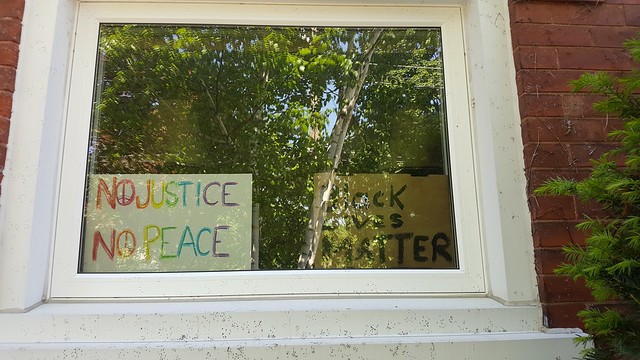
Black Lives Matter
No Justice, No Peace
Migrant Labourers Deserve Dignity and Rights (too long; writing slogans clearly takes talent)
Don’t Bring Guns to Wellness Checks!
Defund the Police
Universal Basic Income
Art is for Everyone
Pay All Essential Workers Like They’re Essential, Because They Are
Fuck the Gig Economy
Ban the Stock Market
Indigenous Lives Matter
Canada: We’ve Got Some Serious Work To Do
Cruel systems surround us. Unless we’re cut by them, we can stay blissfully unaware. If we’re the beneficiaries, maybe we’d rather not know, for when we do know, we don’t know how to untangle ourselves either. Systems are entrenched, heavy, crushing. I’m suspicious of any solution that puts the onus on the individual. But I can’t do nothing with all the everything I’m seeing!
For example: What would make it possible for people to work with dignity at jobs that we know are essential? What if, for example, people who love farming could afford to be farmers? What would that look like? Why do we accept profit as the most important goal? Who benefits from the push for corporate-style agriculture with heavy equipment, ruinous pesticides, antibiotics, fertilizers, and a low-paid migrant labour force? Where is the dignity in that? What if human dignity (and, by extension, environmental dignity) were the focus for all systems instead? I imagine this every day, and I haven’t got a clue what work to do to get us any closer.
One precious life, one precious life, one precious life, and what am I going to do with it; what am I doing with it? What I want to make manifest boils down to this: Dignity for All.
xo, Carrie
Friday, Jun 12, 2020 | Big Thoughts, Birth, Confessions, Current events, Death, Manifest, Meditation, Peace, Spirit, Work |
It was the best of times, it was the worst of times.
While leading a recent yoga class, my friend Kasia said, These are beautiful times and we’re lucky to be alive right now.
I appreciate that perspective.
It’s easy to get bogged down in how hard everything is. How the things that used to be simple to do now require pre-planning and masks and protocols. How our bodies can feel like disease vectors. How familiar I’m becoming with my own physical manifestations of anxiety (tight chest, buzzing brain, inability to alight).
But I don’t deny that what Kasia says may also be true: that these are beautiful times and we are lucky to be alive right now.
Because change feels possible. Because it feels like we’re seeing with new eyes. Because we are freed from what it was like before to maybe figure out how we can make what comes after better. Because our own strengths and weaknesses are more visible. Because we need to know what’s broken in order to fix it. Because we can’t keep building on the same broken foundations. Because we’re being forced to identify our core values, our reasons for being, and what we really care deeply about.
I’m not pretending this is an ideal time to live through, or a fun time. I’m not pretending everyone’s equally affected, either. It’s a scary time, a discordant time, a time when we’re required to hold dissonant information, and altogether too much of it, in our heads all at once.
The interiority of this time has freed me to write a lot. One day, during a meditation, I heard the words create and destroy used together, and my brain suddenly couldn’t peel them apart. It was the strangest thing. It was like the two words, apparent opposites, had fused in my mind. Create/destroy. I saw how interconnected those states of being are, so tightly bound that, in truth, one cannot exist without the other. We tend to posit that one is good and the other is bad. But if both belong to each other, that duality of judgement is rendered inconsequential.
In every end, a new beginning. But also, in every beginning, an end. To make something is to unmake something else.
Create. Destroy.
When I write, I create/destroy.
We are in create/destroy right now. Is it a beautiful time? It’s not a time of symmetry and balance, if that’s what beauty means to you; it’s a time of extremes. Our house is very quiet. The world is roiling. But if beauty means potential (no matter how far from realization), if beauty means truth (no matter how painful), if beauty means invention (create/destroy), then now, right now, is beautiful.
These are beautiful times and I am lucky to be alive right now.
xo, Carrie
Thursday, Jun 4, 2020 | Confessions, Current events, Manifest, Politics, Stand |
Today, I’m researching power structures in late-Elizabethan England, but I’m thinking about power-structures in 2020 North America, and especially, I’m thinking about self-expression. The freedom to think and express what is on your mind. The freedom to be yourself. What does that even mean? I think we’re getting a glimpse into what that means to people of colour living in white supremacist systems; and for those of us who have had the privilege of expressing ourselves freely no matter the circumstances (by and large), it’s a wake up call. I’ve been watching Amber Ruffin’s stories of her encounters with police, on Seth Meyer’s show this week. I want to shout: I can’t stand this! It’s not fair!
It’s not fair! Why did I think things had changed? I think I wanted to believe that in some way, we could all live as equals, especially here in Canada. Easy for me to think. I have white skin. So do my kids. I have never, not once, had an encounter with police where I thought: I might die. Listen to Amber’s stories. What struck me about the one I heard today, which I’ll try to embed below, is how the situation forced her to comply, even to agree with the cop who was threatening Amber on her own front porch—she had to agree, to comply, because it was the only safe thing to do. She couldn’t say: lady, you are lying. She had to swallow the lie.
Freedom of expression: erased. The ability to say what she was thinking: erased.
I get that as individuals we “police” ourselves all the time, we decide what’s safe to say or not say given the circumstances, and that there are legitimate reasons to self-censor, including to be polite, or not to hurt others. I get that. But this isn’t the same. It’s always chilled me to think about what happens to artists in countries where everyone is expected to think the same—or to pretend to. I’ve tried to imagine what I would do if I could not write freely. If every word I placed on the page had to be weighed, or coded, if I was forever compromising the truth of my own experience, hiding it from view. How would it change me? How would I survive self-negation? Well, guess what, Carrie, this is happening right now all around you. You just haven’t wanted to see it.
To be told who you are by someone else: happening now.
To be constrained by pre-judgement: happening now.
To alter your behaviour so as to survive: happening now.
I’m gonna quote Scott Woods’ blog post, titled “5 Things No One is Actually Saying about Ani Di Franco and Plantations,” written in 2014, which has been making the rounds, because he says all of this, and much more, much better than I can:
“The problem is that white people see racism as conscious hate, when racism is bigger than that. Racism is a complex system of social and political levers and pulleys set up generations ago to continue working on the behalf of whites at other people’s expense, whether whites know/like it or not. …
Here’s the deal with racism:
Racism is an insidious cultural disease. It is so insidious that it doesn’t care if you are a white person who likes black people; it’s still going to find a way to infect how you deal with people who don’t look like you. Yes, racism looks like hate, but hate is just one manifestation. Privilege is another. Access is another. Ignorance is another. Apathy is another. And so on. So while I agree with people who say no one is born racist, it remains a powerful system that we’re immediately born into. It’s like being born into air: you take it in as soon as you breathe. It’s not a cold that you can get over. There is no anti-racist certification class. It’s a set of socioeconomic traps and cultural values that are fired up every time we interact with the world. It is a thing you have to keep scooping out of the boat of your life to keep from drowning in it. I know it’s hard work, but it’s the price you pay for owning everything.”
We are living in a moment. It is a very particular moment. It’s not the same moment we thought we were living in, scarcely a week ago. Now it is another moment, replete with other images, some combined with where we were and still are (masks), and some brand new (protestors).
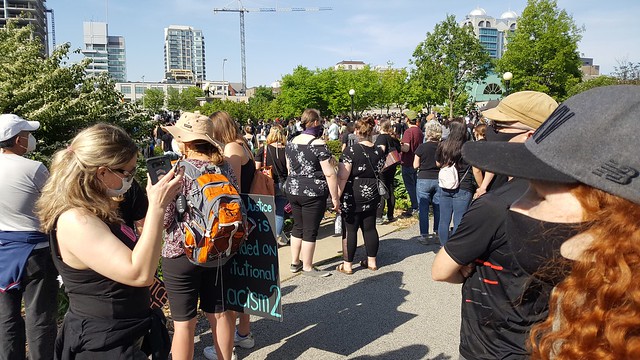
I decided, this week, to attend the protest organized by Black Lives Matters in my home community. I did so even though I’ve been faithfully quarantining and have scarcely left the house for the almost three months. (Yes, I wore a mask and so did almost everyone in attendance.) In Scott Woods’ list of the manifestations of racism, I see myself. I see my privilege, my access, my blindness, my errors. I know that I stick my foot in my mouth time and again due to my ignorance and that others have been generous enough to forgive me for this. I don’t claim to understand beyond my own life experience, despite living a life of imagination. I do not understand. But I can’t stand living like this—in ignorance, in a place where others living next to me are not free to move, speak, be, because of the colour of their skin. I refuse apathy.
When Trump held up the Bible, I recoiled. I’m Mennonite, and even though I have my own arguments with the Bible, the image looked utterly blasphemous to me. I thought: his understanding of the Bible is so superficial, he thinks it’s just a prop, used to intimidate, to confer power, to rally to violence. Oh, and he is right, because it has been used like that, and for that.
But for many of us, our relationship with the Bible is much more complex. Conflicted, maybe, yes, but we also know it as a comfort, with words that connect us with others who are seeking truth, who are suffering, struggling, who know Jesus as a shit-disturber, someone who sought to turn the power structure upside down, a healer who invited tax collectors and women to join the circle, who asked his followers to give everything away and come with him. Give everything away! I don’t think Trump has read that part.
But the truth is, even though I have, I haven’t given much away, let alone everything. I’ve sacrificed almost nothing, really. I’ve been assuming that goodwill and kindness would be enough to bring everyone along on equal terms, and holy shit, that is nowhere near enough. So I ask myself: What am I willing to give away? What am I willing to sacrifice, to challenge, to dismantle, to disrupt, am I willing to feel discomfort and get over myself, and get out of the way?
Discomfort. I think that’s step number one for me, and dammit, isn’t that a doable ask? Lord, grant me the humility to get comfortable feeling discomfort. Being challenged. Admitting when I’m wrong. Although the truth is, step number one has been GRIEF and RAGE.
Because this can’t go on. There’s too much at stake.
xo, Carrie
Saturday, May 30, 2020 | Big Thoughts, Confessions, Current events, Manifest, Peace, Space, Spirit, Work, Writing |
May Reflections
- What felt good this month? Honestly, writing felt good. Specifically fiction. I was able to sink even more deeply into the new routine and spend many hours each week day working on the 16th century novel. It felt easy, purposeful, and like I was entering my own personal escape pod. I can tell it is a balm for my spirit, so much so, that it’s really all I want to do, with little breaks for sitting in the sunshine watching wildlife in the backyard. It felt good, also, to ask my family to do a bit more cooking. And it felt good to refrigerate the sourdough starter during the heat wave and take a break from baking bread every. single. day.
- What did you struggle with? The news. The grim evidence of neglect, inequality, injustice, always present but gruesomely exposed by the pandemic. I know it’s unhealthy to crawl into bed and scroll through that newsfeed of horror, finger-pointing, invective and cruelty in search of the occasional lively bit of joy (like Sarah Cooper!); but I still haven’t removed Twitter from my phone. On a small scale, I struggled with the growing sense that I’m becoming more socially awkward and introverted, to the point that small talk feels almost painful. I haven’t been to a store, or any public and enclosed space, really, since mid-March, and I’ve only driven once since March 13. Once! I’m not struggling with that, rather I’m struggling to imagine returning to a time when I wanted to go out and do things. My social skills are on the decline. I’m becoming attached to my bubble!
- Where are you now compared to the beginning of the month? This is hard to assess. It’s ever more clear that the re-opening process will be slow, at times painful, and that no one really knows what they’re doing or where exactly we’re going. I’m less hopeful than I was a month ago, maybe because the unrest convulsing our neighbours to the south would suggest that they are on a desperate, chaotic, increasingly violent trajectory. And we live next-door. How can there be healing in the absence of justice? This may be a fire that burns out quickly, or it may be a hinge for transformation; or it may end in tragedy. But there is a void in leadership, the emperor most certainly has no clothes, and what frightens me is that tragedies seem to happen in slow motion, but also with a sense of doomed inevitability. I hope I’m wrong. Despite all of this, or maybe because of it, I’m feeling ever more centred in and committed to my discipline as a writer. There are questions that can only be answered through art, which opens us to deeper questions, to pause, to empathy, to challenge, to greater attention.
- How did you take care of yourself? I talked out loud about things that were bothering me, including confessing my own shortcomings. I tried to do so in a way that was honest but also compassionate. I helped organize some fun family events, to give us things to look forward to this past month: fake prom, birthday celebrations, special meals. I asked for help when I needed it. Also: exercise, sweat, braids, incense, turmeric tea, weekly sibs night, Dead to Me, podcasts, sitting outside in the sun, and joining my church’s congregational prayer on Sunday mornings, online via Zoom.
- What would you most like to remember? The quiet of our bubble. The calmness of our house. All four kids in the kitchen, talking and laughing. Running club. The fuzz of green turning to blossoms, to full-fledged leaves. Discovering that our back yard is a nature preserve of bird song and busy creatures. I will remember us sitting around the table in the evenings, lingering over supper. I will be so happy that we had this extra time together.
- What do you need to let go of? Wow. I’ve sat here a long time trying to sort this out in my mind. My gut response is: “I need to let go of worrying that I /we will be changed for the worse by this.” That confuses me. But it also makes a lot of sense. (related: see my answer to #3) I see the pandemic / lockdown as a stripping away of many things, as a great silence and pause. But what roars up when the silence ends? I don’t know. I worry. I think I need to let go of certainty. I need to accept the discomfort that attends this fragile human state of being. I need to let go of “before.” On a personal level, this pause is a chance to notice where the current is pulling me. I’d like to let myself be pulled. And let myself go there, even if it challenges my value system and notions of worth. But — I don’t want to let go of my responsibility to others, nor be lulled into inaction, safe in my bubble. (Damn, this is a convoluted answer to what should be a simple question….)
xo, Carrie
PS What do you need to let go of?
Monday, May 4, 2020 | Confessions, Current events, Family, Spring |
It’s Monday. Yesterday was beautifully sunny and warm, at last, and I did handstands in the back yard and lounged in the sun. It’s also May. And April seemed to pass in a blur, a smear of similar days. My attempts to keep a diary have been sporadic, much like the occasional scribbles I made in a spiral-bound notebook when my children were little; but I love reading those entries now, clues from a similarly blurred time.
A lot of things about now remind me of then.
Then, I did almost all the cooking, baked homemade bread, made yogurt. My social life was constrained and revolved around the children’s social lives. My professional life was even more constrained, almost non-existent. Now, I do almost all the cooking, bake bread and make yogurt. My social life is temporarily constrained and while I am spending a lot of time with my kids, it’s tonally and texturally different. They’re older, of course. And my professional life is more firmly established. During the day, I go to my office and close the door, and they do their thing and I do mine. When we meet up again, it’s quite civilized and the conversation is enjoyable.
Easy.
What’s similar is the blur. The sameness of the days.
Which is why I was inspired when I saw this reflective exercise, with six guiding questions, on meli-mello’s blog. So I’m going to reproduce it here, even though we are already four days into May.
April Reflections
- What felt good this month? The quietness felt good. I appreciated the quietness in my mind that freed my thoughts to roam through fictional worlds. The pace of life was quieter, calm. Family supper every evening. Preparing and eating good food from scratch, and not on deadline. Yoga to wind down in the evening. I did not drive once in April. Nowhere to race to, nothing to be late for.
- What did you struggle with? Routine. Getting out of bed early. Creating a purpose and shape to my days. At times, in April, I found myself overwhelmed with free-floating anxiety that seemed to settle into my body for a day or so, and then vanish. But that was earlier in the month. Later in the month, things just felt dull. I was irritable, but couldn’t put my finger on why. The weather was cold, grey. I was hard on myself. I tried to notice when I was being irrationally down on myself, and to counteract my negative inner-talk by journaling through it.
- Where are you now compared to the beginning of the month? Better. Less anxious. Hopeful. I’m feeling comfortable living day by day. I think I’m noticing little fluctuations in my emotional state more easily, and I’m being kinder to myself. I’ve been focusing on the word “mercy”: trying to view myself and my flaws honestly but also with mercy, and extending the same mercy to those around me. I’m not too worried about what happens next. This pause has reminded me to focus on what I can control, and let the rest of it go.
- How did you take care of yourself? Beyond the obvious (exercise, talking to people, journaling, eating well, getting enough sleep), I turned off my access to the news for large chunks of the day. During writing hours, I didn’t answer emails or texts. I tried to make sure I was choosing my distractions, rather than being sucked in to something I didn’t want to participate in. In terms of the news, I’m staying informed, and accepting that there’s a lot that isn’t known yet; maybe I’m extending mercy to the experts and scientists and politicians, too. (Even while I’m seeing ever more clearly the gaps in our system, and feeling pain and sadness for everyone who is falling through.)
- What would you most like to remember? The details aren’t important. I think I’ll remember this sense of being cocooned with my family: warm, comforting, interior images. I’ll also remember this office smelling of incense, lit by candles, as I practice yoga or meditate.
- What do you need to let go of? Even more control. Something I’ve noticed is that even petty criticism and eye-rolling from my children gnaws at my self-esteem. The temporary feelings of defeat and failure I experience are not proportionate to the criticism. Can I see myself more clearly, and be grounded and whole, no matter the external noise? I’d like to let go of the need to be seen in a certain way by others. I’d like to be good-humoured about criticism.
I hope to check back in with these questions at the end of May, and see what’s changed. Something surely will have, even if this month passes much like the last one, all in a blur.
xo, Carrie
Page 16 of 38« First«...10...1415161718...30...»Last »