Thursday, Jun 18, 2015 | Parenting, Running |

Another girl runner in the family.
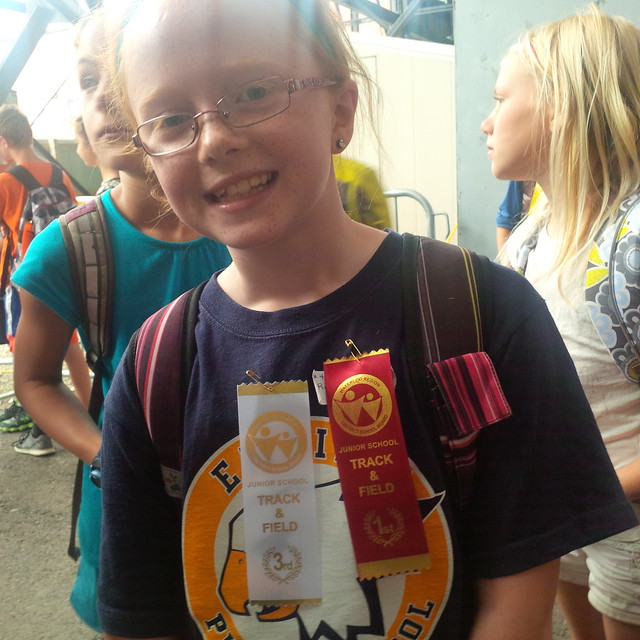
This morning, I biked to watch my nine-year-old run her first ever race at a track meet: she was representing her school in the 60 metres. She was in the fastest heat and she placed third. She was glowing and proud. Then I sat in the grass and read a book and waited two hours for her next race. She popped by to sit with me a few times. She was nervous, proud, and excited about the meet.
Her second race was the 4 x 100 relay, one of the last races of the day. She was on the 9-year-old girls’ team representing her school against five other schools. All of the girls on her team are friends. She was running the anchor leg. They’d practiced and practiced at school, passing the baton, but this was the first time trying it out on the track.
I texted Kevin so he could be there too. We were standing near the finish line. I hoisted myself up on a railing to see better. Her friends are a speedy group, and when she got the baton, she was already in first place. I can see her running, running, running, arms pumping, up the black track, face shining. She crossed the line and knew she had won. The juniors at the school had walked over to watch the meet, and they were in the stands, all cheering for her: what a moment! Her second race ever. She crossed the line and her face broke wide with the thrill of it, the joy of it, and she jumped with her hands in the air, turning toward us. I won’t forget it. I’ll keep it here in my mind’s eyes, where I can see it anytime. She was shining.
I was crying, a bit.
What is the mixture of emotions that rise when watching your child accomplish something like this? She’s played soccer for many years, but she’s never competed as an individual before. We didn’t even know she could run so fast! Suddenly, I’m seeing my younger daughter with new eyes, seeing her as competitive and spunky and fierce and willing to throw herself into the race. So the emotions that rushed through me (and rush through me even now as I see that moment in my mind’s eye) are complex: pride, awe, joy, love. There is something amazing about seeing a child attempt something brave, something that requires courage, that asks the child to put herself—her effort, her identity, her physical self—on the line.
Were you nervous, I asked her afterward, and she grinned and nodded, Yeah, really nervous!
She was nervous but willing. And her nerves showed she cared.
In parenting, the reward is getting to see your children make their attempts. But it can also be heart-rending. There is a lot risked when we care and they care, no matter what it is we’re caring about—a big race, a tough test, a friendship, being on a team, performing at a recital or on-stage. These are risky moments that make us vulnerable—they are vulnerable and we feel vulnerable too. I don’t talk often about parenting through the experiences in which effort goes unrewarded; but those happen too, and those experiences are among my most gruelling parenting challenges, especially when the child cares deeply.
Yet, I wouldn’t change it. I wouldn’t change being present to watch, win or lose, because it isn’t win or lose. It’s try. It’s do. It’s be. I wouldn’t wish not to care: them or me. The reward is seeing them present in their moments of effort and risk, pushing themselves, and, occasionally, flying.
This is the parent I strive to be: See the child; respond to the child’s needs and individual character.
See the child. See the child.
xo, Carrie
Wednesday, Jun 17, 2015 | Adventure, Fun, Girl Runner, Holidays, Interviews, Travel |

We’ve been on a whirlwind adventure, and now we’re home, with all the laundry that implies. I am trying to write this with a chatty 7-year-old nearby, who is missing out on his class’s field trip to the African Lion Safari due to an upset stomach (barfed on the bus, apparently; luckily this occurred before this bus had left the school grounds). So, yeah, we’re home.
Where have we been?
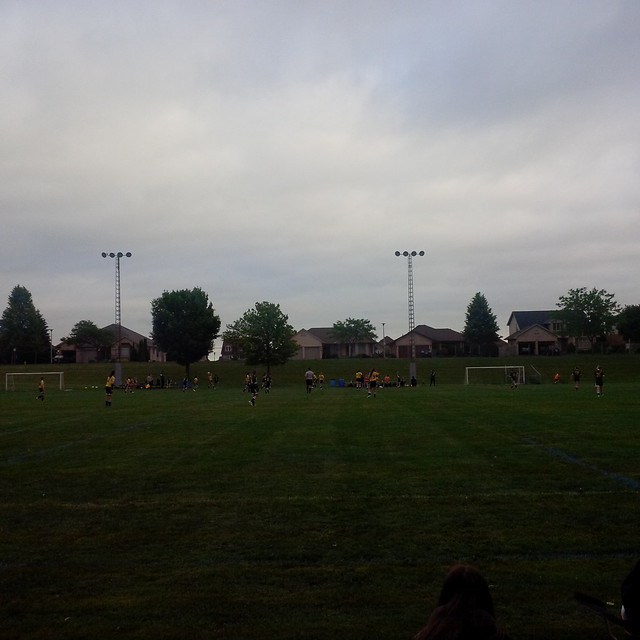
On Friday, I drove to Stratford to pick up AppleApple, who had been to see a play at the Stratford Festival (The Diary of Anne Frank). We had a bite to eat, then drove on through ominous weather to London, where she had a soccer game. So, here is another soccer field in my summer 2015 series.
Home, late. Exhausted. Weary.
Up, early. Packing for a variety of activities and adventures: everyone in the truck, and we’re off!
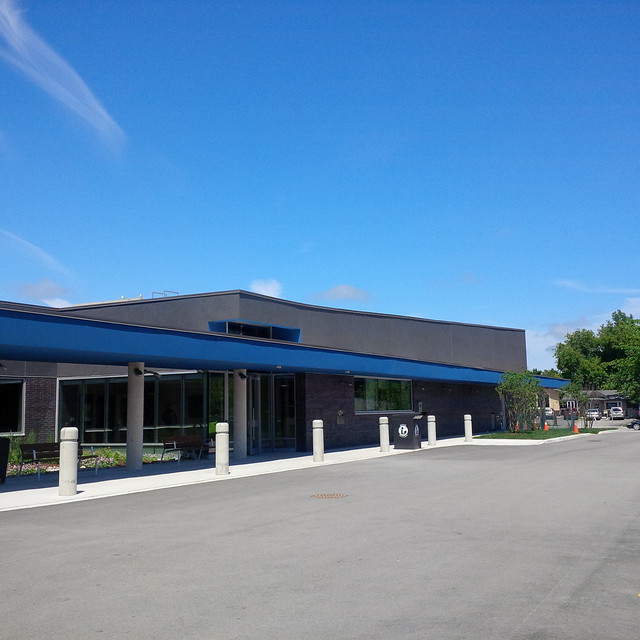
First stop: Innisfil, Ontario. Brand-new library. (Brand-new everything, from the looks of it; this is a fast-growing town.) Reading from Girl Runner. Kids had fun too. All good. Back in the car, headed down the highway.
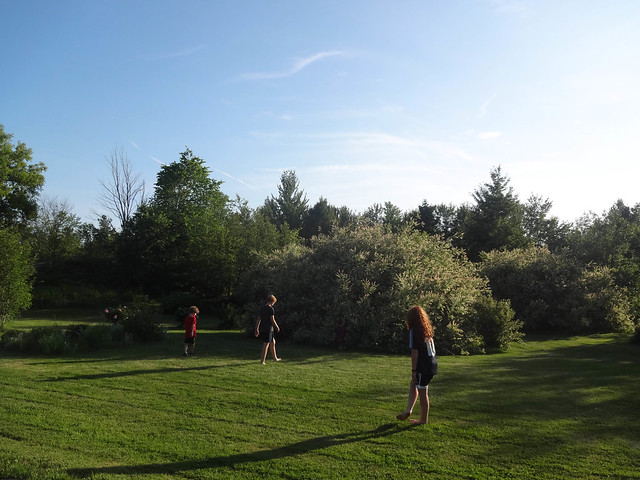
Second stop: Seeley’s Bay, Ontario. Visiting Kevin’s family, cousin-time, playing soccer and badminton, sleeping soundly, sleeping in! (Fooey appeared at bedside to inquire “Why are you still in bed, Mom? It’s 9 o’clock!” And it was …) Kevin and I even went for a run together, and managed not to get overly competitive (there’s a reason we don’t play Scrabble anymore). Packed a lunch, then back in the truck, headed down some back roads.
Third stop: Brockville, Ontario. I interviewed the son of Myrtle Cook, who won gold in the 1928 Olympics. What a treat to hear his stories about his mother’s career, both as a young athlete and later as a sportswriter, the only woman in the section. The kids were generously welcomed by our hosts, and treated to a swim in a nearby pool, and cookies and juice. It reminded me of my own childhood, when our family was frequently hosted by kind strangers, so often that we almost took it for granted that we would be welcomed no matter where we went. Maybe I still carry a bit of that with me. (This was a two-way street: our family home was also open to strangers and friends alike, and I remember playing with any kid or set of kids who happened along; my siblings and I could mix in with anyone, boys, girls, older, younger, didn’t matter, by dusk you’d have to holler to get us to come inside, we’d be having so much fun. It was an advantage of a peripatetic childhood.) Interview over, we were back on the road, with some pits stops for supper … and bathroom breaks … and more bathroom breaks …
Bathroom break # 542
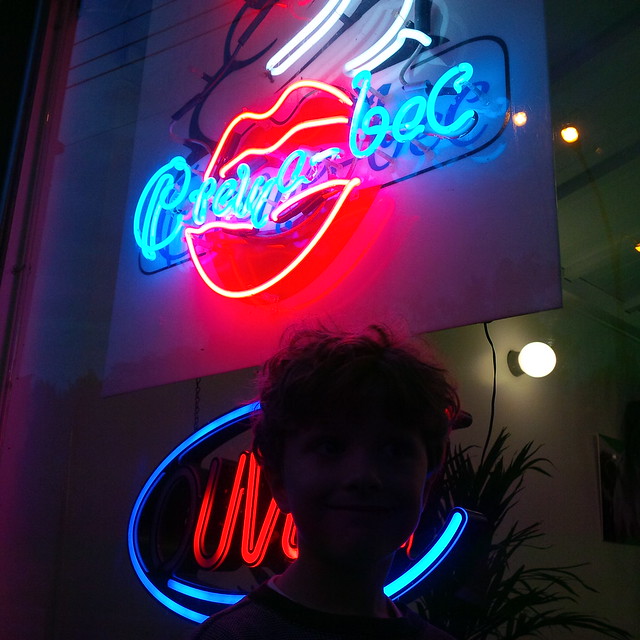
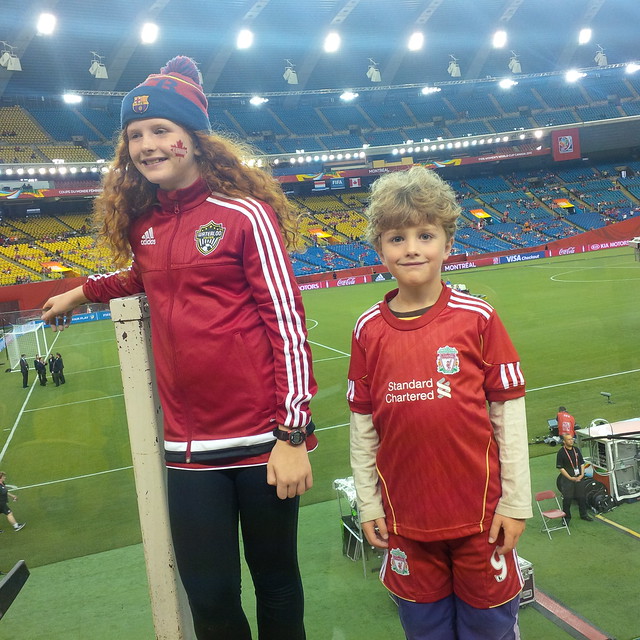
Fourth stop: Montreal, Quebec! We stayed near the Olympic Stadium for two nights, and went to a women’s world cup match: Canada v Netherlands (which ended in a 1-1 draw). There were 45,000 or so people in attendance, and the place was humming with energy. Such a fun game to watch: cheering, shouting, clapping, oohs and aahs, highs and lows, fresh-squeezed emotions. I do love live sporting events. While in Montreal, we wandered the neighbourhood, and found ice cream at a place with a banner that read: “Cremerie/Sushi.”
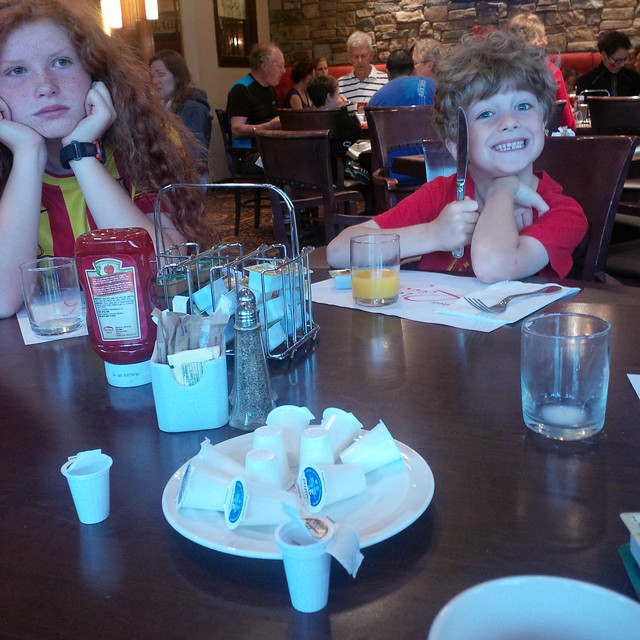
CJ at the Cremerie/Sushi spot
We rode the subway. Tried to walk to Mount Royal, but were defeated by a) the distance and b) more importantly, the whining about the distance. So we stopped for poutine instead. We found a bakery selling the most delicious Portuguese-style custard tarts, and visited a famous bagel shop. The kids swam, I went for a run in a beautiful park. It was a holiday. Everyone was so relaxed.
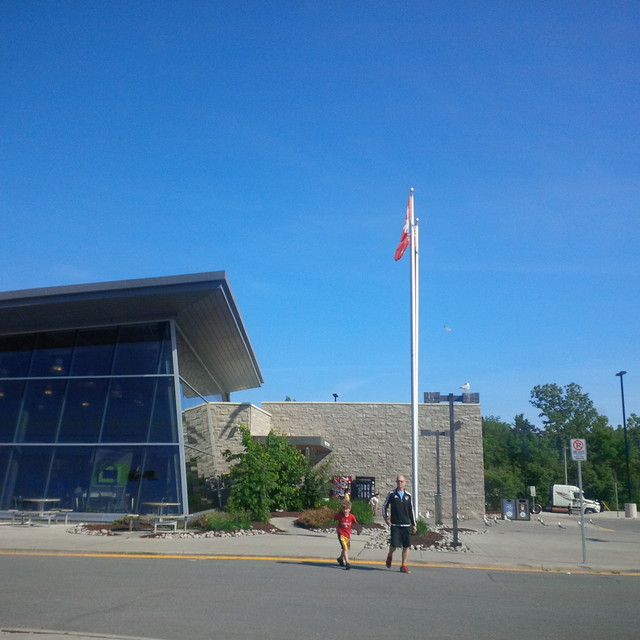
We arrived early. Very early. This makes it look like we were the only people in the stadium, but we were soon surrounded. In the excitement I forgot to take more photos.
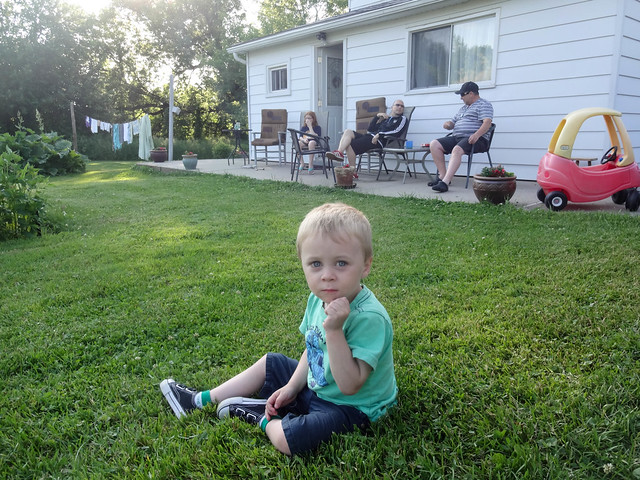
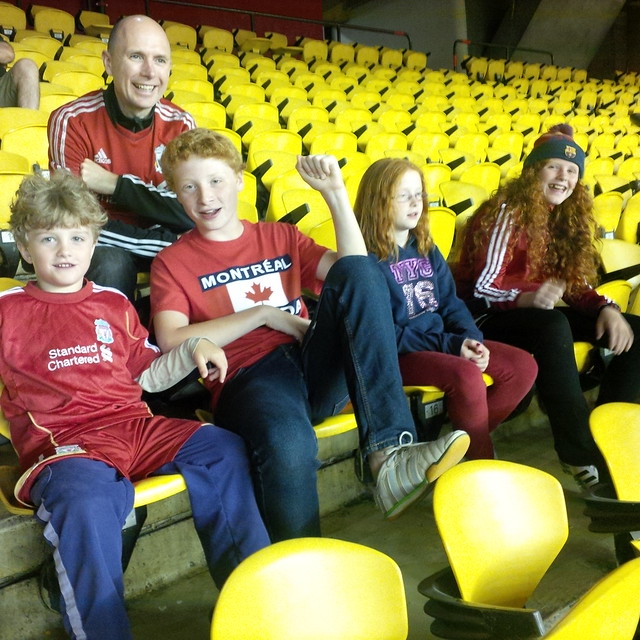
Ah, siblings.
And now, home. But despite the sick kid nearby, and the immensity of the laundry pile, I feel that holiday feeling lingering. It was hard to get packed up and leave, but once we were gone, it was easier and easier to be away, to imagine ourselves somewhere else, leaving everything behind. Not that we would, and we’ve got a lot to come back to; just that it’s possible to imagine escape and adventure when you’ve removed yourself from the physical trappings of home. It’s a kind of wonderful feeling, I must admit.
All for now.
xo, Carrie
Thursday, Jun 11, 2015 | Adventure, Backyard, Big Thoughts, Blogging, Exercise, Kids, Lists, Organizing |
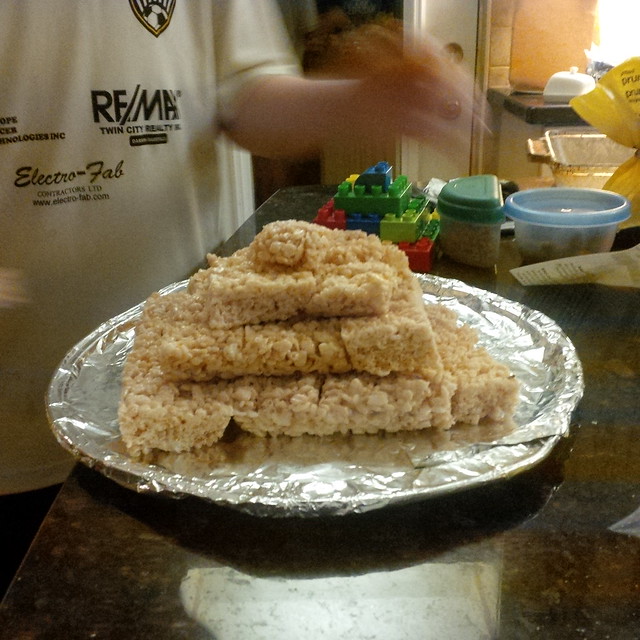
School project being completed at 10PM by kid after soccer practice: not exactly what I wanted to be assisting with, but nevertheless well worth my time. Why? Read on. (Yes, that is a pyramid made out of rice krispie squares.)
On Facebook last week, I posted a photo of my daughter at one of her track meets, and expressed my pride at being there to watch her race. Among the complimentary and sweet messages in response, an acquaintance posted this comment: Can you write a book or blog about how you manage your time?
It got me thinking: could this be a book that I could write? (Kevin says no; he thinks the subject would bore me silly.) (Note: “Could this be a book I could write?” is a surprisingly common question that I ask myself.) I do have a facility for squeezing a great deal into my day, including time for watching my kids do the wonderful and ordinary things that they do. And yet I often think my facility for organization has more to do with privilege than talent, because I don’t have to spend a great deal of time on tasks that may be essential or unavoidable to others, such as a long commute whether by car or public transit, or a full-time job performed primarily for money. Truth is, I resent and rage at any perceived waste of my time, such as waiting in long line-ups to sign official forms, or sitting in traffic on my way to an event I don’t want to attend. I’ve tried my best to work at being patient in these situations, and to learn patience and stillness from them, but I feel keenly any waste.
What’s being wasted? Time. Precious and diminishing with every breath.
Yet I’m quite willing to “waste” copious amounts of time doing things like this: meditating followed by journalling / blogging.
So it strikes me that a significant element to effective time management is defining what you consider wasteful, and rearranging your life to perform those tasks as infrequently as possible. Again, I recognize that it’s a privilege to be in position that would allow a drastic life change, like quitting a job, but most of us can probably find some small ways to change the lives we’re living if the lives we’re living cause us enough pain. How does change happen? In my own experience, it happens in a variety of ways, but most often it happens because I notice a point of discomfort, pain, unhappiness, and recognize that things I am doing (or not doing) are at least in part the cause of my unhappiness.
What comes next is that the routine has to change. The structure has to change. You can’t say “I’m going to make a change,” and not create the structure to support it. Small example: None of us are getting up at 5AM to run because we feel like it; it’s because we’ve decided it’s worth doing, and we’ve arranged our schedule, our habits, our routine to support our choice: we’ve checked the weather, we’ve laid out appropriate workout clothes, we’ve gone to bed a bit early, we haven’t had a drink, we’ve set our alarm, we’ve arranged to meet a friend or friends, and with the wheels in motion, we simply show up and do what we’d planned. But without the supporting structure to carry us through—to carry the idea through to action—we’d sleep in, telling ourselves, I’m too tired right now, I’ll just do it tomorrow, or I’ll run tonight instead, or … and the imagined moment never arrives.
It’s like painting lines for bike lanes sandwiched between live traffic and parked cars and then blaming cyclists and drivers for colliding. It would be more useful and more accurate to blame the structure instead, rather than putting the onus on human beings to make rational, correct, perfect choices at all times, in all situations, in all weathers. Human failure is inevitable. Therefore, change the structure, put the bicycles in a separated, unobstructed lane, and everyone will both feel and be safer.
Structure is what shapes our lives, far more than we accept or acknowledge, and this is true right down to whether or not we floss our teeth, or eat lots of veggies. That we are “creatures of habit” is a truism because it’s true. So scan your daily life for routines that aren’t serving what you value. Maybe there’s room for a change, here and there.
I realize it’s more philosophy than step-by-step advice, but here is my time management strategy in a nutshell.
1. Identify what matters to you.
2. Be curious, be open. Respond to pain or unhappiness (and to joy too!)—recognize it, don’t ignore it.
3. Figure out what changes are possible.
4. Don’t think about making a change, actually force change to happen by altering the routines and structures that govern your daily life.
One last piece of my time management strategy: celebrate every little thing worth celebrating. The sandwich that tastes good, the kid who is telling you a story, the green of the clover coming up in the back yard, being outside, a good nap, holding a 3-minute plank, chatting with other parents beside a soccer field on a particularly fine late-spring evening, driving with a child and having a side-by-side conversation. Don’t waste your own time by wishing you were somewhere else. Whatever it is, wherever you’re at, take it in. Tell yourself: This is not a waste. This is my life.
xo, Carrie
PS I feel like this post has a slightly preachy or evangelical tone. Please don’t think I think you should be getting up at 5AM to run; rather, I think you should be getting to do your own personal version of an early-morning run, that is, the thing that’s kind of hard but makes you feel alive.
Tuesday, Jun 9, 2015 | Backyard, Blogging, Running, The Candy Conspiracy |
Today I went to my 9-year-old’s grade four class to read them The Candy Conspiracy and talk about writing. For the venture, I brought along a file folder of all the edits and original storyline ideas and drafts, and read to them from the very earliest draft. The funny thing was, it was really funny, perhaps rather more darkly funny than the version that made it to the published page. The original draft included mysterious characters called Grubbers (which vanished entirely by draft 3). The kids spontaneously imagined their own versions of the characters, with hands up afterward to describe what they thought the Grubbers looked like. Shrivelled up vegetables, elves, gremlins, little green blogs or specks, tiny green worms. Everyone had a different version in his or her imagination.
And that got us talking about the magic of the imagination. Don’t get me wrong. I love illustration, and illustration paired with text can make magic too. But the simplicity of words on the page, projected into our minds, is at once personal and collective. We all hear the same words, but what we see comes from our own personal landscape of experience, textured with individual differences.
I have left myself a mere eight minutes to write and publish this post before picking the kids up from school. There is much I could write about, perhaps too much, and here is a shortlist of topics I was thinking about covering.
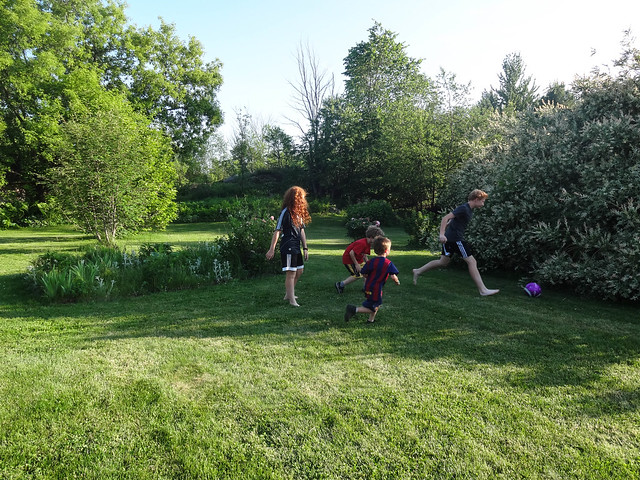
Playing soccer in the back yard. (OMG so fun! Even I’m getting into it and testing out my mad dekes on … okay, on my 7-year-old, whose mad dekes are way madder than mine, but hey).
Being a depressed miserable writer. (Such a great topic, right up there with my collection of belly-button fluff. I’m sure you’re all sorry not to hear more about it.)
Our continuing efforts to try to train the dogs. (Having a dog is like having a toddler FOREVER.)
Coaching soccer. (Best game ever last night, as our Mighty Green Grapes, with only 5 players on the field for a 7 v 7 matchup, held their own mightily and with an intensity that could only be admired and cheered in the off-and-on rain. The coaches were verklempt by the end.)
The weekend. (That seems like a long time ago.)
Food I haven’t had a chance to cook or bake. (Just kidding.)
Laundry. (Sorry. I do like talking about laundry.)
Running without pain! (Hurray!!! In this beautiful spring weather! This is what I worked for all winter!)
Time. (And the way I’m forever running on the edge of behind, and yet not quite falling off, like a tiny figure on a giant treadmill, arms and legs whirling. Or like a metaphor with the wheels about to fall off.)
Happy Tuesday.
xo, Carrie
Thursday, Jun 4, 2015 | Big Thoughts, Parenting, Politics |

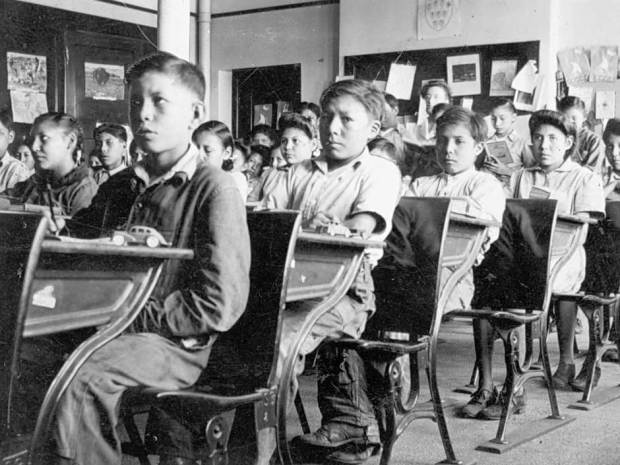
From the Anglican Church archives, no date
I’m going to do something I don’t usually do and quote from a Globe and Mail editorial (yesterday’s): “Close your eyes and imagine you are at home with your two children, a boy aged six and a girl aged eight. There’s a knock at the door. It’s a moment you’ve dreaded for weeks. You answer it and there is a man from the government and an RCMP officer who order you to turn your children over to them immediately. The children are led away and placed in the back of a truck in which you see other children crying. The boy and girl are screaming that they don’t want to leave you but, the minute you show any resistance, the policeman steps in to enforce the law. You are compelled to give up your children, because the state has judged you to be unfit as a parent on account of your race. That night, you are alone with your spouse in an empty house, brokenhearted, powerless and without hope, everything that matters from you stolen by the state.”
It goes on to state these facts uncovered by the Truth and Reconciliation Commission: “An estimated 150,000 First Nations, Inuit and Metis children were stolen from their families and communities over the course of 100 years of Canadian history.” (I’ve since heard that residential schools existed in Canada for 140 years.)
I wasn’t taught this version of Canadian history in school. But the Truth and Reconciliation Commission hopes to change this—the commission filed its report this week after six years of listening to and recording the stories of indigenous Canadians forced to attend government-mandated residential schools, or whose parents or grandparents were survivors of this system; yesterday the end of the commission was marked with a ceremony attended by the prime minister and other dignitaries, and followed by silence from the current government, which appears to believe it has now done enough. Education is an important part of reconciliation; may this part of Canada’s history be taught in all schools and not forgotten, or worse, deliberately silenced. But what else can we do, those of us whose families came to this country as immigrants, as settlers, without much thought for the people who were here before us; and who have benefitted enormously from the wealth of this land?
I’ve skipped over the part of the editorial that describes what happened to many of the children in the residential schools, not because it isn’t important, but because I found myself, as a parent, stopped dead at that opening paragraph asking me to imagine losing my children. I had to cover my eyes and weep. Because my gut response was, this would end me. I would end here.
Everything that matters to me lives here in my family. When I think about my response to watching AppleApple race earlier this week, and genuinely feeling that it was the MOST EXCITING MOMENT in my life, I realize that all of my MOST EXCITING MOMENTS of PRIDE and PURE JOY arise directly from witnessing my children accomplish what I couldn’t have imagined for them (and it goes beyond measurable accomplishments, and includes the surprise of witnessing moments of generosity, maturity, empathy, thoughtfulness). That’s it. Nothing compares. Certainly nothing I’ve accomplished compares, and I mean that sincerely and absolutely. In fact, I’m convinced that my greatest job right now is as witness to my children’s development. So to imagine them stolen from me, by people who couldn’t even address me in my own language, to imagine them being hurt and beaten or worse by these people, to imagine them returning home months or even years later, terribly altered by their experiences, our mother tongue forgotten or beaten out of them, and being unable through it all to offer them any protection: well, it is too painful to imagine. I imagine that I would run after that truck screaming and yelling, that I would walk hundreds of miles to look for them, that I would find the school that housed them and stand outside demanding to see them, that I would try to steal them back and bring them home; but this is fantasy because even if I could do that, would it matter? If I was wrong in the eye of the law? If the government judged me unfit? Because of my race? It would not matter. And so what would keep me going?
I do not know. My ability to imagine ends here.
And what to do now, knowing that so many families endured this tragedy in our country, and that the reverberations of this policy continue to be felt and lived, and that so much is still so very wrong with the way Canada engages with indigenous communities? I don’t know.
I came across this link on Twitter to a web site that proposes planting a “heart garden” to honour children who died in the residential school system; maybe something like this would be a small gesture our family could offer. Kevin and the kids who were in the kitchen yesterday when I was making supper were all receptive to the idea. We talked about what messages we might want to share, what plants we could plant.
But I also think about how arrogant it was/is of the Canadian powers-that-be to believe that indigenous people needed to learn the white ways—that this would improve their lives and well-being. What if we spin that around and decide that the powers-that-be need to learn the values and systems and beliefs of indigenous people? Is it too much to hope that we could become a real family, sharing the best of our knowledge, changing and compromising for each other? And maybe, just maybe, if I look into my own life more closely, I’ll recognize that it’s my values that need shaking up and changing. Maybe more, more, more at any cost isn’t the answer. I’m thinking of the Lax Kw’alaams band in northern B.C. who recently turned down a deal worth $1.5 billion, offered by a gas export company, because the land that would be spoiled by the project being built has no monetary price. To think of the land as something that can be bought and sold is to think in very temporary, solipsistic, morally questionable terms. This is just one example of an indigenous community leading the way, by looking at the land and at money through a different and maybe unfamiliar lens.
All for now. I welcome your thoughts on this subject.
xo, Carrie