Wednesday, Feb 20, 2019 | Adventure, Art, Big Thoughts, Cartoons, Confessions, Drawing, Writing |
 I’ve been doing an intensive writing week. I have little transferable advice to pass along regarding strategies for how to write a novel, unless you’re interested in the pathological approach. I’ve spent seven days writing almost non-stop, abandoning all else, and I can report back to you that the overwhelming sensation involved is: compulsion; essentially, it felt too psychologically painful to stop until done. So I wrote till I was done, and the whole book was out of me. (Important side note: Much editing awaits ahead.)
I finished this morning. I was working off a previous draft, and an outline, so this wasn’t material conjured from thin air, these are characters I’ve been exploring in one form or another for several years now. I know them. Writing scenes felt like describing events that I’d witnessed. I just had to look around, pay attention, and write what I was seeing.
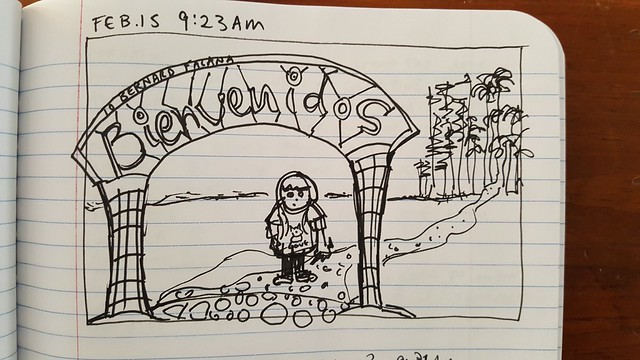
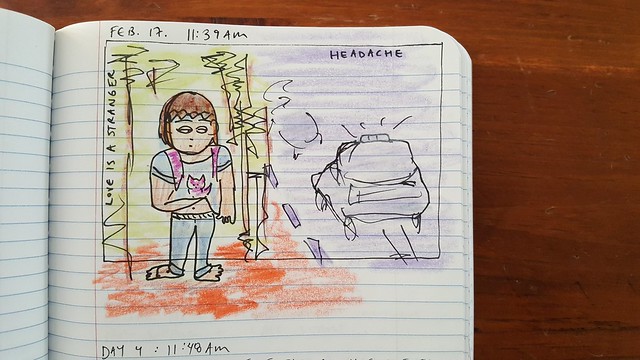
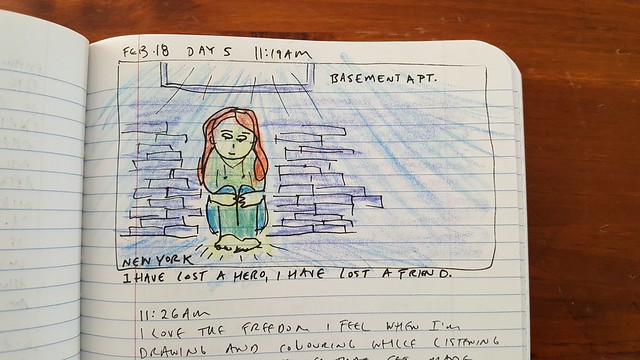
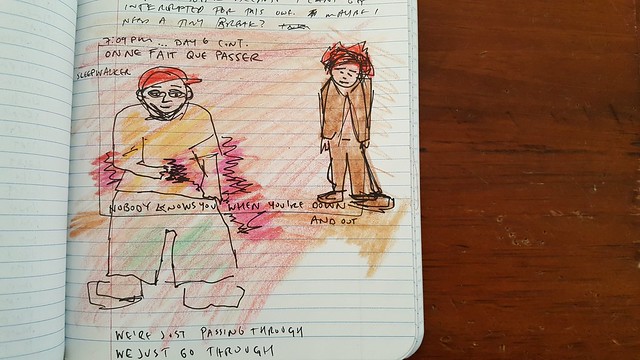
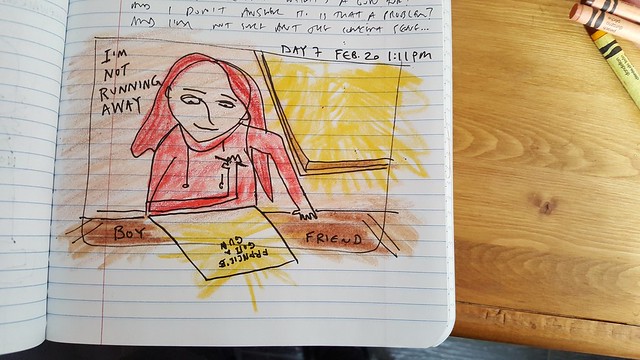
I marked each writing session by drawing — the drawings I’ve used to illustrate this post — while listening to music (the song titles are incorporated into each drawing). After drawing, I wrote for three minutes — “What’s on your mind?” — the same prompt I use when leading creative writing classes, and it’s brilliant. Just dump it out. And then GO.
There must be another way to do this work, of course, and my goal is to give myself enough space during my regular life that I can aspire to write under more regular, ordinary circumstances. Because, I’ll be honest, all I crave is more of this. More and more and more and more. Writing like this feels as natural as breathing. Effortless? In truth, yes. The way that going for a hike in the woods is effortless. Because I was so occupied, it was like I was living in another world. And now, thankfully, that world exists outside of me in a form accessible to others.
The relief I feel is extreme. I can’t describe it accurately. I was so afraid that something would happen to prevent me from pouring the whole thing out — the whole story. And to imagine leaving those characters half-formed, half-finished with their tasks, was excruciating.
I’m writing this now to help myself remember what it feels like to be in this rare place. I want to record what it feels like to be inside this altered state, because I can’t assess it clearly from inside, yet I know I’m not exactly myself, even now. I’m still too attached to that other world, which feels more vital, more marvellous, more enticing than the mundanity of this real world, which is loaded with responsibility, distraction, good intentions (mine) causing problems, irritating details that mustn’t be overlooked. I know it’s good in the real world too, but this other world — it’s like getting to live inside of a novel, which is somehow even more profoundly affecting than simply reading a novel. If you know the pleasure of reading a novel, and falling into that other world (or any invented and stylized world, of any form), I hardly dare tell you that writing a novel is a million times more intoxicating, more absorbing, more wonderful, because that will sound like hyperbole. (Or maybe, too, I fear sounding like a junkie craving another hit.)
But it’s not hyperbole, it’s true. It’s that wonderful, that absorbing. I must make space to do this — just this.
xo, Carrie
Wednesday, Feb 13, 2019 | Adventure, Art, Cartoons, Creativity course, Dream, Exercise, Family, Fire, Friends, Fun, Laundry, Lynda Barry, Spirit, Work |


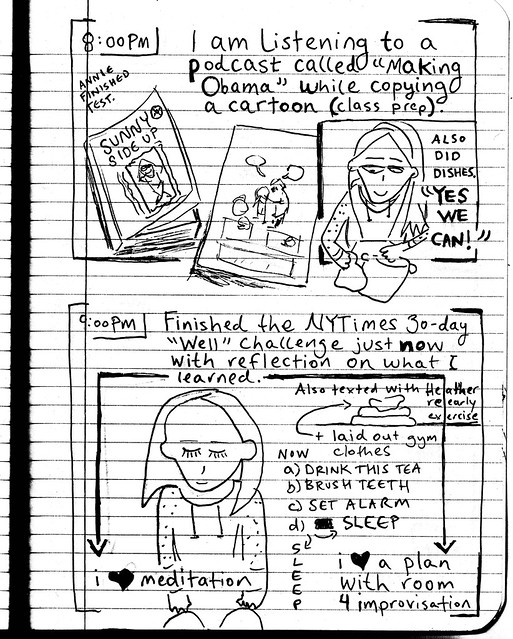
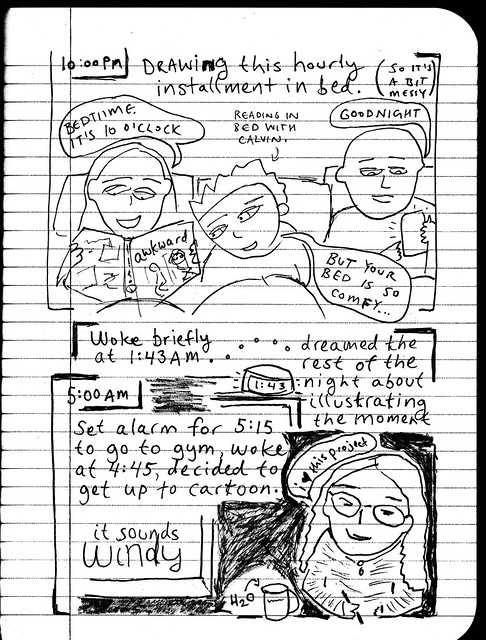
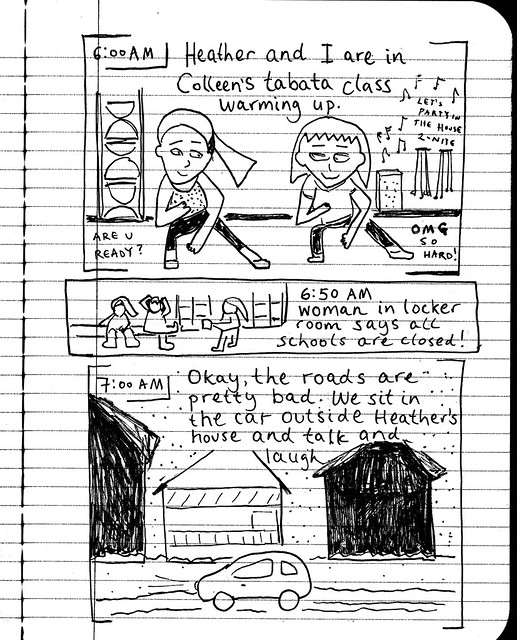
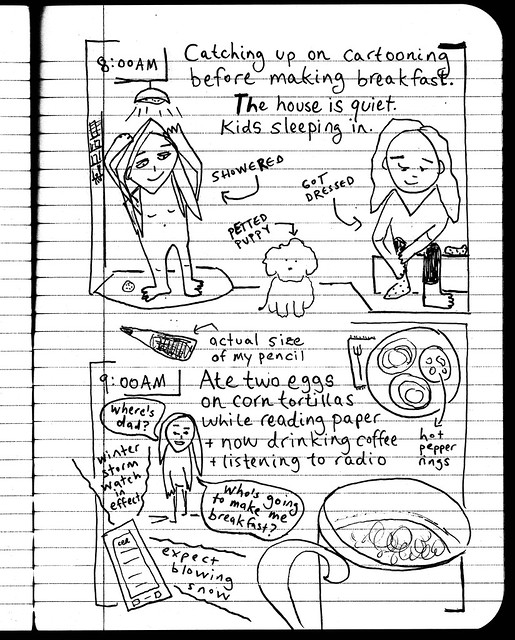
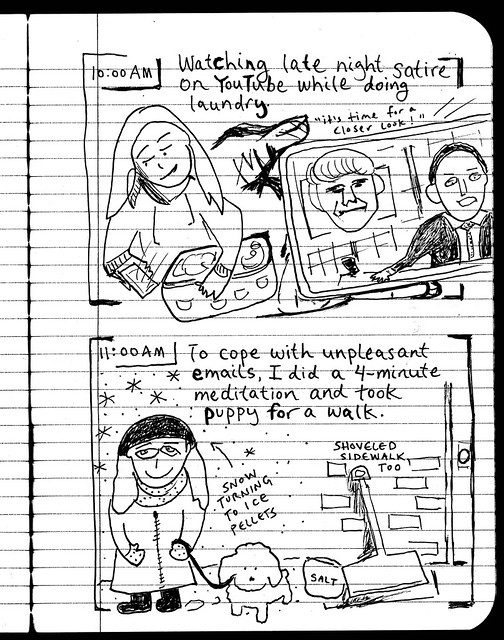
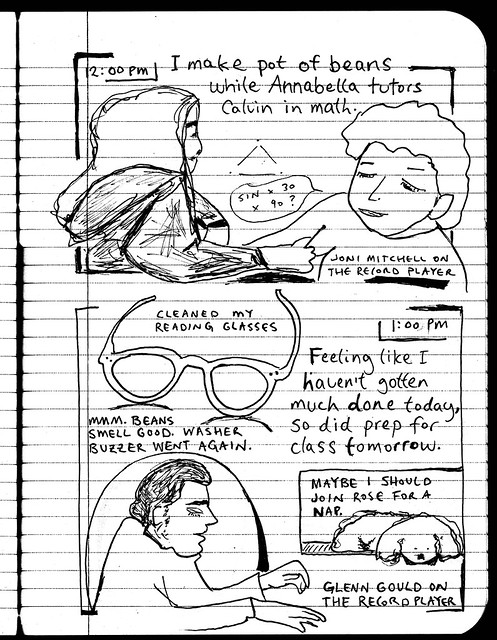
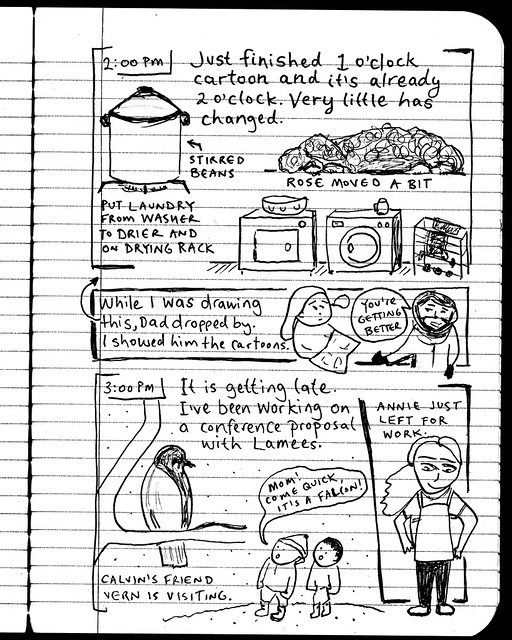
Context: A student introduced me to the Hourlies project, wherein you draw a cartoon marking each waking hour over the course of a 24-hour day. I’m going to assign this as our class’s Reading Week homework. Fortuitously, I decided to test it yesterday/today, on what would become a snow day, and therefore essentially useless to me for other purposes.
Observations: I couldn’t do this project while doing any other project requiring sustained attention. But I’m playing around with ideas for how to do it again — perhaps once a month, or perhaps, when I’ve got time to spare, doing a marathon version over a week; and I’m brainstorming about how to do it as its own standalone project. I really really really did not want to stop today, and in fact made an extra panel (there are two 4:00PMs). I learned a massive amount, which you can see for yourself by comparing the first panel to the last.
Feedback: Welcome, please.
xo, Carrie
Wednesday, Feb 6, 2019 | Art, Big Thoughts, Confessions, Fire, Good News, Publishing, Spirit, Stand, Success, Work, Writing |
I’m sitting in my cozy office, wearing reading glasses, listening to my favourite Spotify playlist (song of the moment: “Ya veras,” by Systema Solar), office door closed because my elder daughter is practicing piano obsessively. Kids are all home from school, which makes Rose-the-pup very happy. Kevin is mid-flight to Fort McMurray for a work trip. All schools, including the universities, are closed today due to freezing rain. I started teaching more than six years ago, and today’s is the class I’ve ever missed. (Not-Humble-Brag # 1)
I’ve decided that this post’s theme is the Not-Humble-Brag.
I’m uncomfortable with bragging. But it makes me even more uncomfortable to pretend that I’m not bragging. (Side note: Why call it bragging? Why not label it differently in my own mind, as good news, and own the sharing of it?) (Side note # 2: My superstitions are kicking in strongly, as all my instincts scream: if you announce that you have good news, you will be deservedly and instantly punished with bad news!)
Okay, superstitious self, what if the Not-Humble-Brags are less earth-shattering, more like gentle observations of loveliness? Hey?
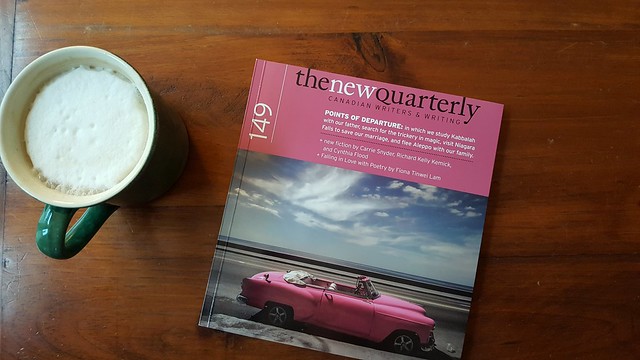
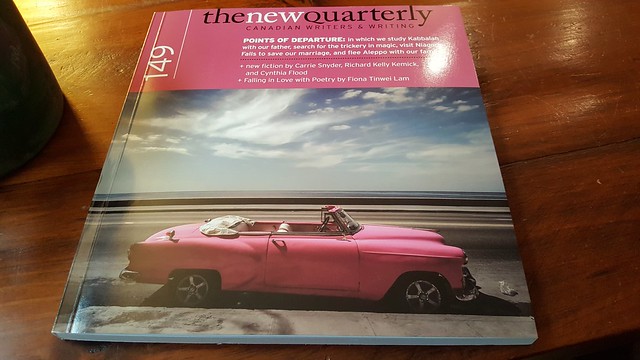
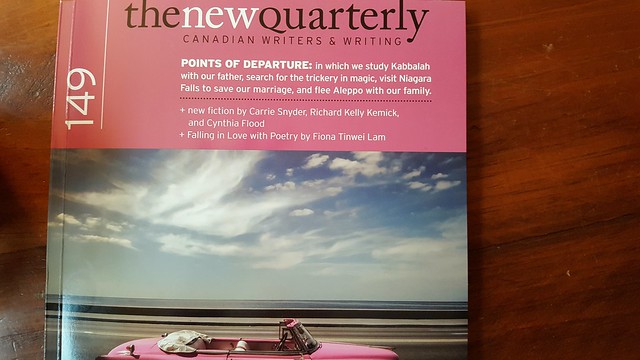
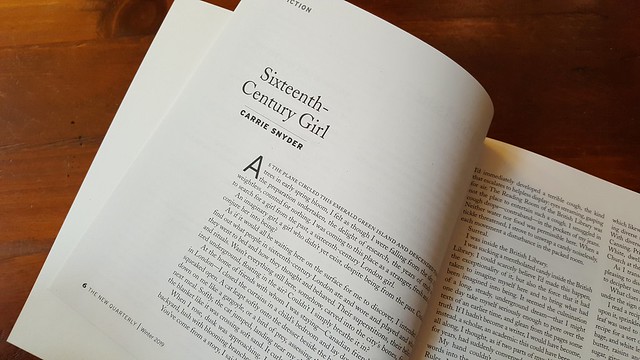
For example, I’ve got a new story in the latest edition of The New Quarterly! (Not-Humble-Brag # 2)
The story is from an auto-fiction collection I’ve been working on steadily for a rather long time, and which makes me happy every time I dip into it, to revise, edit, polish, or write a brand-new story. On Monday evening, when I was in my office marking madly, my eldest daughter came rushing in. She was glowing. She’d just read the story in TNQ — “16th Century Girl” — and she’d loved it. She said, You should just do this, Mom. You should just write. She said she’d been thinking about writers who just wrote regardless of success during their lives, just wrote anyway, no matter what, and that could be me, as she saw it. You’re such a good writer, Mom, she said.
That night, I woke in the middle of the night and wondered whether I could “just write.” Would it satisfy me? What sacrifices would be involved?
Last night, I again woke in the middle of the night. This time, I asked myself: What is your ideal career path? Who is your role model?
I remembered that for a very long time, my ideal was Alice Munro. A mother and grandmother, devoted to the short story, who dabbled in other money-earning ventures, such as a bookstore she owned with her first husband, and teaching creative writing for a year or so early in her career; but mostly, who simply sat at her table, stared out the window, and wrote and wrote and wrote and wrote. Brilliantly. When I appeared at a literary festival named in her honour, I was told that she was known as a quiet, dedicated volunteer, serving pie at community functions to people who had no idea who she was, even if they’d come to the small town hoping to catch a glimpse of her. Even before her retirement a few years ago, she rarely engaged in readings or public appearances. Add the Nobel Prize on top of that, and could there be a more romantic ideal?
Next, I thought of Grace Paley, the American short story writer, teacher and activist. Here’s what Ann Patchett writes about Grace Paley, with whom Patchett studied in university: “Grace wanted us to be better people than we were, and she knew that the chances of our becoming real writers depended on it. Instead of telling us what to do, she showed us. Human rights violations were more important than fiction. Giving your full attention to a person who is suffering was bigger than marking up a story, bigger than writing a story. Grace turned out a slender but vital body of work during her life. She kept her editors waiting longer than her students. She taught me that writing must not be compartmentalized. You don’t step out of the stream of your life to do your work. Work was the life, and who you were as a mother, teacher, friend, citizen, activist, and artist was all the same person.” (from “The Getaway Car,” an essay in Patchett’s This Is The Story of a Happy Marriage.)
In my mind, Alice Munro and Grace Paley don’t represent competing versions of “how to be a writer”; for both women, being a writer was not about performing as a writer, it was about doing what needed to be done. There are different ways to do this.
If I were an academic, I would keep very close track of every publication, conference, appearance, event, workshop, review, panel, and award. I discovered this lack in my own accounting last fall when a colleague and I were applying for an academic grant (a SSHRC). Creating a somewhat comprehensive CV involved picking through old calendars, emails, and boxes of clippings. The exercise was instructive, and weirdly buoying. Look at all these things you’ve done, woman! (Not-Humble-Brag # 3)
But there’s a reason I haven’t kept track of these things very well.
As a writer, what I’ve done is not as important as what I’m going to be doing. What matters is what I’m making, not what I’ve made. (I realize that’s not completely accurate; past publishing history opens doors unavailable to many, which is a privilege and not to be minimized.) But there is no tenure. No security.
To be a mid-career, mid-level literary writer is … well, it’s a form of invisibility, to be perfectly frank. It takes fortitude. It takes devotion to an idea of oneself, an aspirational self, and it takes devotion to a singular cause, which is craft. Like Grace Paley, I don’t (can’t) compartmentalize my writing from my life. And yet my life ranges rather widely and wildly. It sprawls. My attention is divided. My loves are many. If I were to “just write,” as my daughter says, what would that mean? What path am I carving, in this career my CV claims I’m building?
We were awarded the grant, by the way. (Not-Humble-Brag # 4)
Now, to spend the rest of the afternoon, this gift of unexpectedly free mid-week calm, “just writing.”
xo, Carrie

 I’ve been doing an intensive writing week. I have little transferable advice to pass along regarding strategies for how to write a novel, unless you’re interested in the pathological approach. I’ve spent seven days writing almost non-stop, abandoning all else, and I can report back to you that the overwhelming sensation involved is: compulsion; essentially, it felt too psychologically painful to stop until done. So I wrote till I was done, and the whole book was out of me. (Important side note: Much editing awaits ahead.)
 I finished this morning. I was working off a previous draft, and an outline, so this wasn’t material conjured from thin air, these are characters I’ve been exploring in one form or another for several years now. I know them. Writing scenes felt like describing events that I’d witnessed. I just had to look around, pay attention, and write what I was seeing.
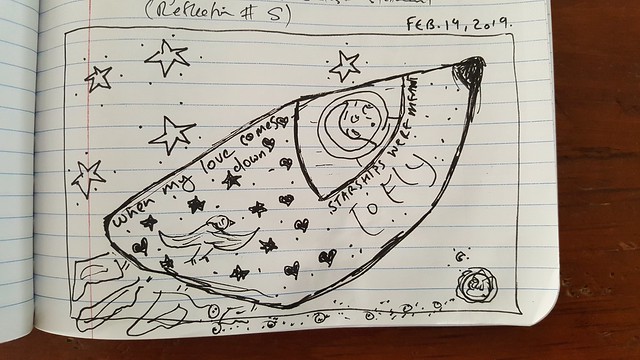
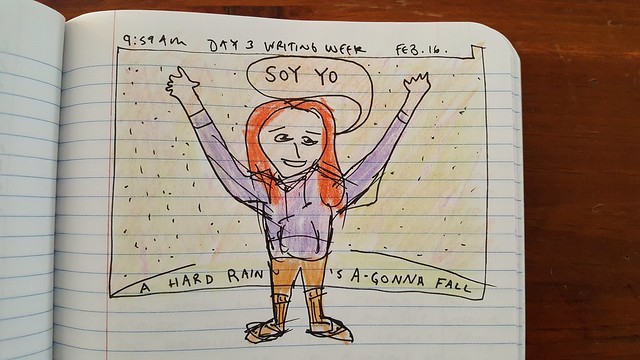 I marked each writing session by drawing — the drawings I’ve used to illustrate this post — while listening to music (the song titles are incorporated into each drawing). After drawing, I wrote for three minutes — “What’s on your mind?” — the same prompt I use when leading creative writing classes, and it’s brilliant. Just dump it out. And then GO.
 There must be another way to do this work, of course, and my goal is to give myself enough space during my regular life that I can aspire to write under more regular, ordinary circumstances. Because, I’ll be honest, all I crave is more of this. More and more and more and more. Writing like this feels as natural as breathing. Effortless? In truth, yes. The way that going for a hike in the woods is effortless. Because I was so occupied, it was like I was living in another world. And now, thankfully, that world exists outside of me in a form accessible to others.
 The relief I feel is extreme. I can’t describe it accurately. I was so afraid that something would happen to prevent me from pouring the whole thing out — the whole story. And to imagine leaving those characters half-formed, half-finished with their tasks, was excruciating.
 I’m writing this now to help myself remember what it feels like to be in this rare place. I want to record what it feels like to be inside this altered state, because I can’t assess it clearly from inside, yet I know I’m not exactly myself, even now. I’m still too attached to that other world, which feels more vital, more marvellous, more enticing than the mundanity of this real world, which is loaded with responsibility, distraction, good intentions (mine) causing problems, irritating details that mustn’t be overlooked. I know it’s good in the real world too, but this other world — it’s like getting to live inside of a novel, which is somehow even more profoundly affecting than simply reading a novel. If you know the pleasure of reading a novel, and falling into that other world (or any invented and stylized world, of any form), I hardly dare tell you that writing a novel is a million times more intoxicating, more absorbing, more wonderful, because that will sound like hyperbole. (Or maybe, too, I fear sounding like a junkie craving another hit.)
 But it’s not hyperbole, it’s true. It’s that wonderful, that absorbing. I must make space to do this — just this.
 xo, Carrie