
We would be poets

Last night, I read the news that Leonard Cohen had died. Immediately, I wanted to call my college roommate, who introduced me to his music and poetry. She was the one person on earth who I wanted to talk to, to say, have you heard the news? I feel so sad. When Carol Shields died many years ago, it was my mom who I wanted to call. It is as if relationships are embedded with art, or art is embedded with relationships, intense, personal relationships. A song is more than a soundtrack to an experience, or some songs are. Some songs are experiences.
I learned to play piano by ear by playing Suzanne and Bird on a Wire.
That’s an experience.
I’m writing this while listening to CBC Radio Two’s special on Leonard Cohen. So my thoughts are scattered. I’m listening to Leonard Cohen sing Suzanne, in fact.
Yesterday, I went to two movies at a feminist film festival playing town. Both movies were labours of love, the filmmakers following their subjects for years. The first movie, called Driving with Selvi, was about an Indian woman who became a taxi driver; but it was also about child marriage, and forced prostitution, and the precarious existence as a young woman unprotected by her family or the law. Through it all, Selvi’s radiant personality shone like a beacon of joy and gratitude, for all that she had. The second movie, called The Apology, told the story of three women, known now as the grandmothers, who had been forced into sexual slavery in World War Two by the Japanese military; all were teenagers when they were kidnapped, two were 13 or 14. I watched this movie with my mom and my almost-14-year-old daughter, and we wept. A lot. The grandmothers carried so much pain, decades of hiding and shame, and yet here at the end of their lives, as they protested to publicize this hidden chapter of history and supported each other, it was their dignity that shone through. They were tired. But they had a vision for peace and healing.
Both were Canadian-made films, by female directors.
Both were an antidote to the despondence I’ve been feeling. These were not perfect stories about perfect people with perfect endings. These were stories of perseverance and injustice and work and hope and love. These women, in both movies, were so loved.
I went for a run this morning, a pathetic wheezing run into the chilly wind, and I went with a friend, because I wouldn’t have gone otherwise. My friend told me that she wished her work involved making things; to which I replied that I wished my work involved doing things. We laughed. We wondered if we were on the right track, in that general way that people wonder; is it too late, am I locked in, now, now that I’ve devoted myself to a single pursuit?
I think, way back when, that I wanted to be an artist, the way the Leonard Cohen was an artist; I think this is what I imagined, along with my college roommate, when we listened to his songs and read his poems. We imagined ourselves immersed in ideas and emotion and symbolism and significance, which sounds abstract, but felt, in the moment, intensely real, like we would be swimmers in a great universal ocean, like we would be poets.
Wherever I was going with this post, it’s gone. I’ve lost the thread.
I think we have much to struggle against now and going forward. Art is where I’m turning for comfort. Art is what I’ve got, and so far it’s the only answer I can give.
xo, Carrie
Neighbours
All is not well in my mind. I am uneasy, restless, despondent, flat. I woke at 4AM and could not sleep. I feel aimless and free-falling despite the structures that surround me, including this solid house.
Yesterday, I read an article from The New Yorker, on the multitudinous self, which is at odds with the idea of the holistic self we seem to admire and aspire to. Yet we are not the same across time or within our different relationships; we are not as consistent as we imagine we should be, or perhaps we imagine we are. The essay tried to put the divisiveness of this election into context, by discussing the difference between neighbourly relationship, which are governed by decency and revolve around the particular, and politics, which is ideological and abstract; a single human being may present one way in one sphere and another, seemingly contradictory way, in another sphere (not to mention the further spheres in which the self must operate — family, job, religion, soul, etc.).
And in essence, the essay was an argument for accepting the multitudinous self rather than striving for a holistic impossibility. It pointed out that the characteristics that make a great leader in the corporate world may not make a great parent in a family; but that doesn’t mean one person can’t do both, or be both, only that we behave differently in different contexts, within our different roles. That is why politically at-odds neighbours can meet in the park and talk about their dogs. Because those are two separate spheres.
But social media challenges us, the spheres cross and so we are behaving politically in our neighbourly spaces; and that complicates and divides us in ways that make us deeply uncomfortable. The argument being, I think, that it is not a character flaw to behave differently in different situations; it is the basis for community survival.
xo, Carrie
Election preparation
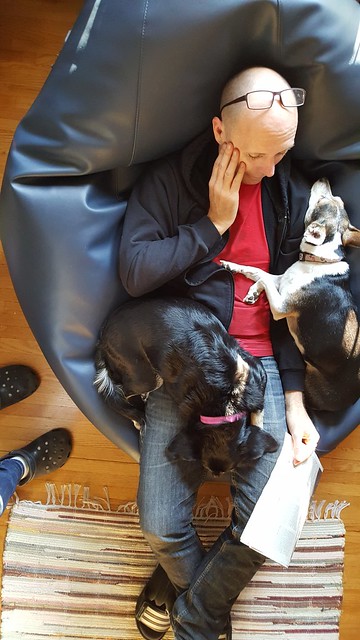
Took dogs for long, early morning walk.
Fried eggs. Made lunches.
Played Bach on the piano. Slowly. From the Preludes.
Journal.
Kundalini yoga.
Class prep. I teach tonight.
Laundry.
Toast.
Listened to the news; turned off the news.
Dressed in a white blouse.
Voted. (But I took care of that last month, early.)
You?
xo, Carrie
Sequencing exercise # 1: The boy on the swing
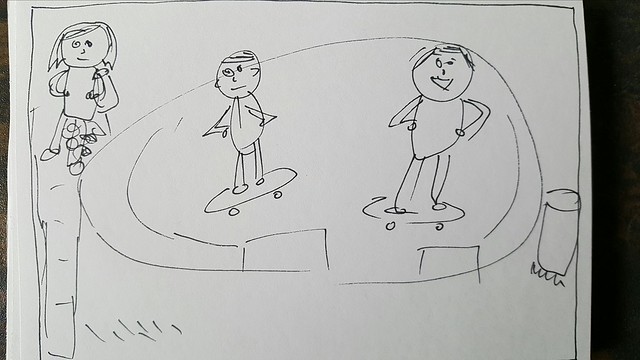 I am walking into Waterloo Park through the entrance by Father David Bauer Drive, my bag heavy over my left shoulder, filled with everything I will need for class tonight. It is cold but I’m starting to sweat under my pink jacket, which I bought on sale two and a half years ago, when I spent some of my earnings from my book on cross country skis, and this jacket, now a bit dingy and dirty.
It is the first day this fall that I have worn the pink jacket to teach.
I walk through the gravel parking lot and past the skateboard park where two young men are showing off their tricks. They’re pretty good. I admire their focus and their bursts of energy followed by relaxation. I notice that the trash I stopped to pick up last week has not been replaced by more trash, and I feel satisfied; perhaps I feel self-satisfied.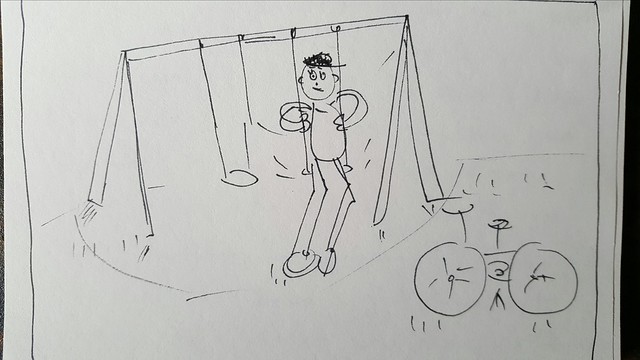 I look to the swing sets and I am so happy when I see him, there again. Last week, he wasn’t here, and I wondered if something had happened to him, or even if perhaps I’d invented him or imagined him — he is a teenager, an older teen, who sits on the swings every Tuesday afternoon at 4 PM. He doesn’t just sit on the swing and look at his phone, he swings, pushing himself into the air, pumping his long legs. His bicycle is parked nearby. My heart is happy to see him — I feel this literally, a little popping of happiness under my ribs.
 And then I’m on, not stopping to watch him, of course, not stopping at all, only glad to know he is there, a grown kid, swinging back and forth, faithful to some impulse only he can know.
I cross the bridge over the little creek. And through the trees on the little dirt path to the vast parking lot.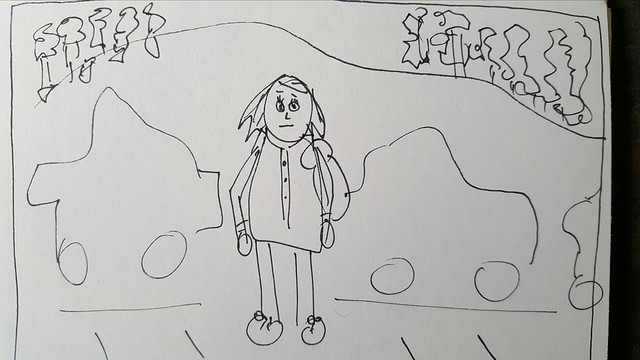 I forget and step onto the pavement, rather than walking the narrow strip of grass along the edge of the parking lot, like I always do. Quickly, I step back into the grass, but is it too late? Too late for what. You’re being obsessive compulsive, I tell myself, the universe does not care whether you step on pavement or grass. Your habits and rituals are here to serve you, not to ensnare you. I know, I know; I don’t stop until I reach the road, the long line of cars stretching in both directions like a fast-moving river.
xo, Carrie
Notebook exercise # 4


Write a love letter to someone you do not know.
Dear child playing the piano behind the closed door,
I can’t hear your voice, only your teacher’s, and she accompanies your ragged efforts with a determined tone, as if her words will pull from you the correct notes and rhythms. I stand and casually walk past the closed door, peeping through the narrow rectangle of glass, into a room that isn’t exactly how I would have imagined it: larger, and with more light. It has always sounded like you are playing in a dark closet. I glimpse you in this stolen way. You are older than I’d imagined, a young teen with hair cropped short into a pageboy cut; you might even be a boy rather than a girl, as I’d assumed. How can I write a love letter to someone I cannot see?
I sit again, and listen intently to the music you are making with your fingers. You keep a patient beat, hesitating as you try to read the notes you have failed to practice at home. I know this sonatina, by Muzio Clemente, one of my favourites as a young musician. You start, you pause, you try again. You have a dogged patience to your persistence, a haphazard understanding of what you’re trying to achieve, but a willingness to go on.
As I turn the page, you lose the beat altogether, and your teacher steps in to direct you, her tone not patience but not unkind. She sings along. She claps. She makes counting noises to pull you onward, and for a little stretch, here, it is only her, and you pause as if unable to continue. The song seems to grow longer and longer, and I wonder if you will ever finish it. You were wearing a white and grey t-shirt on this hot day, your face bent away from the door, as you perched on the piano bench and watched your teacher gaze at your music, which she was holding in her hands. On a chair nearby, your school backpack.
You have reached a form of conclusion, though I’m not sure it’s yet the end, and your hands crash out two chords — smash, smash — after which you continue on, your fingers chopping at the keys, dragging yourself toward the end, which requires a trill to complete. “And that’s a sharp,” the teacher reminds you, and you try to trill a second time, then stagger into the real end, the one we’ve all been waiting for.
You whack at the finishing chords. They are not the correct chords.
“What key are you in right now?” asks your teacher, and you are forced to backtrack, to begin to take another crack at this ending, again.
Have you practiced this song, this week? Are you sight reading the notes and hoping the teacher won’t notice? What are your expectations for yourself? Do you enjoy playing the piano? Does this song speak to you, or is it like a truculent closed mouth, a turned head, an impenetrable mystery whose meaning is contained behind the closed door, and which even your teacher cannot illuminate for you, though she tries, a scene you might remember when you’re older, much older, with some fondness, and, even, then, regret.
xo, Carrie