
In praise of plenty of emotions
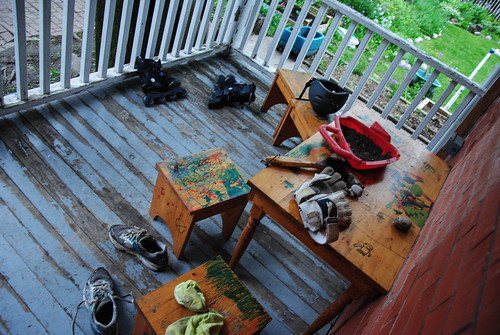
Back porch: a collection. Roller blades and helmet, new for his birthday and much used. Goalie gloves, for after-school practice with little brother taking the shots. Dirt, from the snails, who returned to the wild with great sobs of sadness from CJ. Dirty running shoes. Dirty socks, examples of which can be found almost anywhere. I found one on the driveway yesterday. Yes, it belonged to someone in our family. I have a gigantic single sock collection on my dresser and never give up hope of finding matches.
I’m going to insert a tiny rant here about the sliver of hell that occurs daily between 4 and 5:15. This is when a) the kids are newly home b) hungry for snacks c) I’m cooking supper d) supervising playdates e) trying to catch up on any issues f) reminding kids to get ready for soccer/swimming g) packing my own gear for running h) texting Kevin for missing ingredients i) asking for help setting the table j) suffering increasing disbelief that we’ll be able to meet the deadline for multiple departures while k) throwing hot food on the table and demanding it be eaten in five minutes flat. Soccer and/or swimming begins at 5:30 five nights a week. There is no way to make this easier that I’ve discovered. The good news is that as soon as the 5:30 people have left, the others can relax and enjoy dinner and dog-walking until their own 6:45 deadline arrives, which, the other good news is, only occurs three times a week.
Monday evening, returning the carshare car to the library post-swim-girl pickup with little kids in tow, we took the opportunity to pop in and exchange books. It had been raining, lightly. I was slightly worried about the walk home in the cooling rain, as darkness and bedtime edged closer. The kids ran ahead to the children’s section while I unloaded a pile of books at the front counter. A woman stopped and said, “Are you Carrie Snyder?” I didn’t recognize her. “Yes.” “I just wanted to say that I read your book — The Juliet Stories — and I liked it very very much. Thank you for writing it.” Oh! “Thank you for letting me know!” Glow! (Vainly, I simultaneously wondered how bedraggled my hair, how rumpled my clothes, how pursed my forehead might, at that moment, be.)

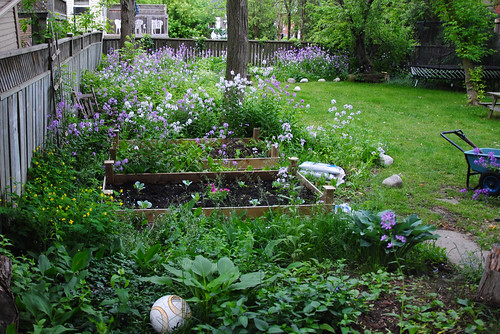
hide-and-seek soccer ball
This week is thin on running/exercise time (unless I want to set my alarm early every morning), so I packed my soccer cleats and some balls and the little kids and I played together yesterday evening while waiting for AppleApple’s game to start. It wasn’t the same energy-burst and release as going for a solo run, but it helped. Except maybe it didn’t help enough because by the time we were all reunited at home, it was after 9pm, supper was still sitting on the table, we appeared to be all out of snacks, people needed showers, someone had forgotten to study for a test, and then it was discovered that a mysterious blue substance had been spilled on someone’s sheet, apparently a disaster worthy of dramatic meltdown. By the time I’d gotten the little kids in bed, I was this close to meltdown myself. I’d scarcely landed in the downstairs world of dishes and table clearing when I heard a little voice: “Mom???” Well. “No you did not just do that!” I hollered up the stairs. Screeched might more accurately describe my tone. “I am not coming up there again! I am taking a shower and going to sleep, which is what you’d better do too! Minus the shower!”
After the shower (mine), those of us still awake discussed subjects covered in our fifth grader’s health class that day — a public health nurse had visited, apparently with a vagina puppet and tampons (I must say that sounded really cool, and much more helpful than the weirdly uninformative movies we were forced to watch in my era). Anyway, the topic of PMS came up, and I said I never noticed it myself. “I have plenty of emotions at all times,” I said, and everyone in the kitchen agreed. Lest you think we’re a cool quiet and collected house. And I am a cool quiet and collected mother. We aren’t. I’m not.
And then we all went to bed.
This day is off to a fine start. One contract signed and sent. Notes from an editor on the new children’s picture book to mull. And another application completed and ready to be sent. Also, I began with an early morning run. That might have helped too.
Life as a gambler
Opened the fridge this morning, looking for an egg, and suffered a flicker of regret at turning down a new career path (ie. midwifery; perhaps the egg twigged it). I remember blogging last winter about wanting to escape out from under the expectation that my writing would need to earn a living (even a modest living) — a sweet dream of writing for pleasure, while pursuing work that would be very different indeed. I blogged about the writer’s cycle of survival, which involves filling out many application forms, a cycle that feels like one is perpetually asking for help. How exhausted I felt by the cycle. How I hated asking for help.
And yet here I am, several months on, willingly filling out more application forms.
It doesn’t feel like I’m asking for help, just now. It feels more like an elaborate gamble, which is how my writing life feels, in truth. My maternal grandfather was a gambler. He loved the horses. Like most gamblers, he probably lost more than he won, but he talked a big game. I think of myself as essentially cautious — hey, we’ve lived in the same house for a decade and I never try anything new with my hair — but that may be partly illusion.
When I consider the choices I’ve made in my life, the risks I can stomach, the hope I can generate against slim odds, the faith in the race, I’m not so far removed from my gramps. When it comes right down to it, I’m pretty much a gambler at heart. Or maybe it’s at gut rather than heart, the gut being the location of much of the gambler’s decision-making. It feels right, or it doesn’t. That’s as clear as it gets for me.
I have the gambler’s ability to look forward rather than back. Or elsewhere, rather than here. I separate myself into possibilities, hiving off rejection, stepping free from what isn’t to be with an energy that may flag but oddly doesn’t seem to deplete. I just finished reading Aleksander Hemon’s collection of essays “The Book of My Lives,” and he writes in his final essay something that rings true to my instincts, to what I know about why I write, too: “In my books, fictional characters allowed me to understand what was hard for me to understand (which, so far, has been nearly everything). I’d found myself with an excess of words, the wealth of which far exceeded the pathetic limits of my biography. I’d needed narrative space to extend myself into; I’d needed more lives. I’d cooked up those avatars in the soup of my ever-changing self, but they were not me — they did what I wouldn’t or couldn’t.”
My agent tells me, gently, that very few fiction writers survive on their writing alone; most have other jobs. I know this is true. I did very much want to develop a different and separate career, especially one with security, but the truth of it is that my writing hours are essentially full-time as it is, and I am also in the thick of it with my four kids, and there isn’t time or space or energy to add a third parallel life into the mix without sacrificing one or both of the other two occupations.
So I’m back to gambling.
But more precisely, I’m back to the imagination. This is a gamble both literal and figurative. I gamble every time I send a project out to be assessed, in hopes it will find favour and win support, and that process I could take or leave, quite honestly, except that I can’t and I won’t because it’s in support of the larger and more profound gamble to which I see I’m truly bound, and that is the wild, wonderful, risky, ever-creative, potentially illuminating, grace-filled gamble of making something from scratch, of writing more lives than I could ever live. How could I give it up? What wouldn’t I do to keep this gamble going?
It’s unsteady ground, and it has its practical limitations, as Hemon goes on to express heart-rendingly in the same essay, but it’s familiar. It’s known. I know here. I am suddenly reminded that I used to listen rather obsessively to Kenny Rogers’ “The Gambler” the summer that I was ten, and we were living with my aunt and uncle in Tennessee, before moving to Canada. “You’ve got to know when to hold ’em, know when to fold ’em, know when to walk away, know when to run. You never count your money when you’re sitting at the table. There’ll be time enough for counting when the dealing’s done.”
No counting shall I do.
Welcome to Monday
Sunday at the farm
My Monday contains an early morning yoga class, the coordinating of this week’s many details, a really good bowl of soup for lunch, a finalized book contract to sign and send (details coming, I promise), and eight loads of laundry (no exaggeration).
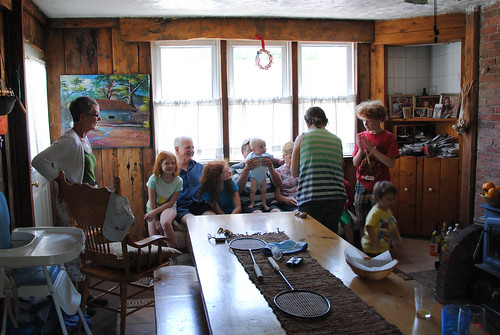
family
This past weekend we travelled north of Kingston on Saturday, home again on Sunday, to visit with Kevin’s family, some of whom had come all the way from Scotland.
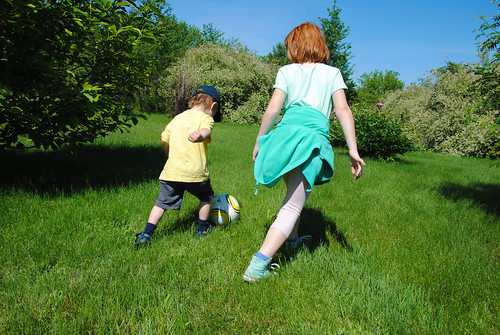
cousins
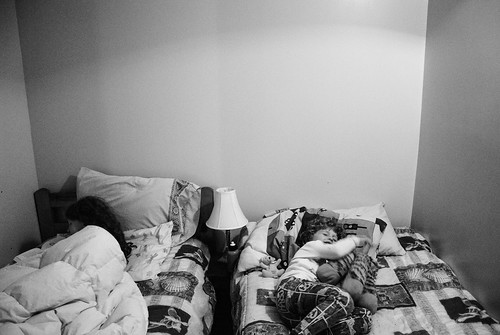
roommates
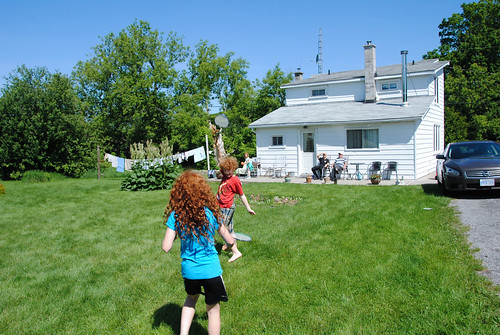
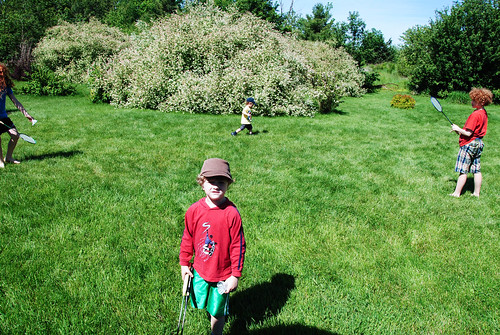
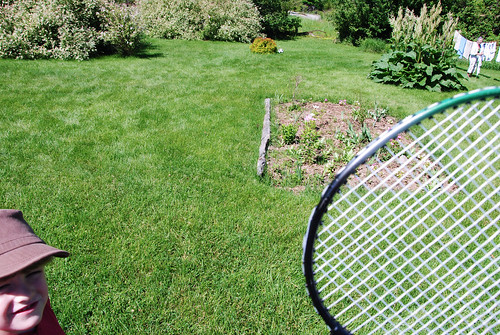
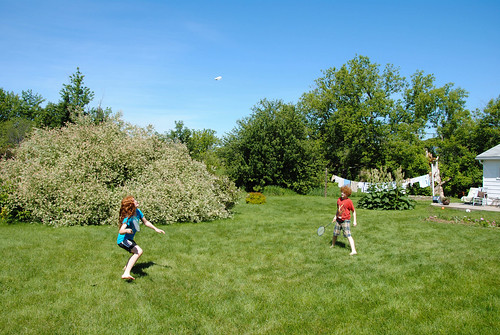
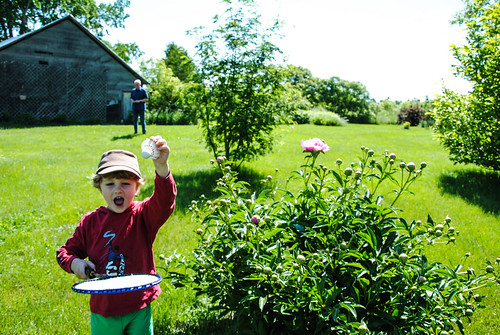
Badminton was the popular sport, with soccer coming a close second.

cousins
There was even a baby to hold.
:::
Our visit was preceeded by a minor home renovation. On Friday, I realized that our front hall reeked. The smell was distinctly dog, and I don’t know how to describe it other than to say, come smell our carpet, which, trust me, you really don’t want to do. In any case, you can’t. Friday afternoon, tormented by the smell, I abandoned my office to scrub the carpet before leaping to the sudden conclusion that the carpet had to go. Like, now. I vacuumed the rest of the house in an attempt to bring order to the chaos that had become instantly apparent to me, everywhere, not just in the front hall. And on Friday night, after we’d packed and the kids were all in bed, and we should have been too, Kevin and I ripped up the carpet. Lo and behold, the wood floor beneath was pristine, and after a late-night scrubbing, reeked of nothing at all. I find it funny how often Kevin and I make snap decisions, together, that feel absolutely right. It seems to be how we operate.
Let me ask you a question about cleanliness. Would you agree that women are still judged on the cleanliness of their homes, while men (even those who participate fully in household chores) are not? I think it’s true. I would like it not to be. (She says, heading down to the basement to deal with laundry load number 6. Only two more to go!)
Assortments from Life on this Thursday, June 6th
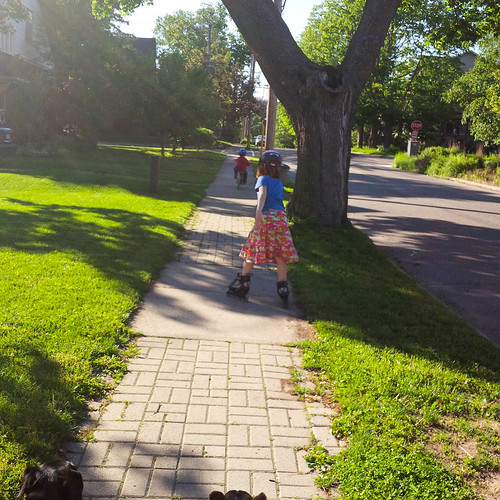
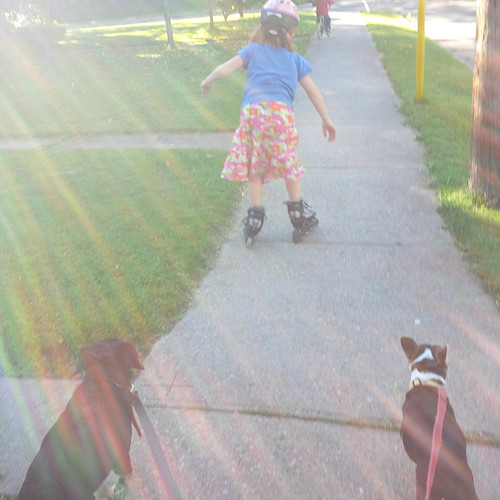
kids + bike + roller blades + dogs + mom
* We still have no internet, and the promised technician still hasn’t turned up. But I’ve learned how to use my BlackBerry as a hotspot, so it’s a win for advancing my IT skills.
* Over a 24-hour period on Tuesday and Wednesday, I ran 25.5 kilometres. I spread the distance over three separate runs, thankfully before the weather took a chilling nose-dive this morning. I’m not sure what compelled me. Dreaming of another marathon? Despite trying, I can’t squeeze my time to fit in those necessary long runs. Would a series of shorter back-to-back runs boost endurance enough?
* Also, on a similar subject, I ran barefoot in sand this past weekend. It felt light and fast, as if I were a child again. The muscles in my feet complained for the next couple of days, but in a good way, like they’d awoken and wanted to be used more often. I wouldn’t run more than short distances barefoot (I went 5km on Saturday), but would love to do it once a week, to strengthen different muscle groups. If only there were always a sandy beach nearby, and temperate weather.
* A mom at soccer, who manages the local YMCA, said she thought I’d make a good spin instructor. The idea probably appeals to my vanity, at least a smidge, but nevertheless I find myself rolling it over as an interesting possibility.
* Walking the dogs with the two little kids is the perfect post-supper occupation.
* The dishwasher works. My goal is that each child stacks his or her dirty dishes into the miraculous cleaning device without being reminded. Given how well the socks-tossed-on-the-floor lecturing has gone over the years ….

* I finished a project last week. I always forget how finishing unbalances me for the next little while, until I take up the next new and absorbing something. What will the next new and absorbing something be? There are so many possibilities!
Reading for clues

I’ve been paying attention to my reading habits more closely this year, and I’ve been surprised by what draws me, by what I find my appetite craving. In children’s literature, it’s the classics that pull me in, even on the millionth read. I’ve also enjoyed without reservation reading fiction by men, this year (which, although I haven’t deliberately avoided in my long reading life, seems anomalous somehow). And I’ve been pulled, relentlessly, to non-fiction, especially memoir.
I enjoy a variety of styles, and often stand back to admire the craft involved in, say, a light and amusing “easy” read, as much as in a book that is complex and innovative. Sometimes I want to be entertained, pure and simple. Sometimes I long to be challenged, or to gaze in awe and wonder. The lightness or darkness of a book’s subject matter or intellectual heft does not matter greatly to me. My taste is broad.
I don’t read idly, however. I read professionally. I really enjoy this aspect of my reading life. It’s hugely energizing and inspiring.
Always, always, as I read, I look for clues. I read to discover how to write better — how to write what I would want to read. And what I want to read is a book that connects.
Here’s another way of putting it: I want to want to keep reading.
The books I love are not a chore. They do not bore.
I’ve observed that certain issues get in the way of my pleasure. Some are fixable, some perhaps not. Lazy copy editing is troubling and very fixable. Laziness in general is troubling. If I’m mentally editing out unnecessary passages, paragraphs, or stray words, it’s going to cause me to stumble in my enjoyment. I can forgive a story an enormous flaw, because I truly believe that sometimes stories are bettered by their flaws. (Consider, for example, Little Women, and Jo never getting together with Laurie, instead marrying that shambling professor who, despite Louisa May Alcott’s valiant attempts to tell the reader how much we should love him too, simply cannot measure up to what might have been — that is a flaw that doesn’t ruin the the reading experience, but keeps it going in the imagination ever after.) But I can’t excuse the lazy flaw, the needed-another-draft, the published-too-soon flaw.
A writer who works, that gives me pleasure.
The evidence of a writer’s work, craft, and practice comes across clearly, to me, in a book’s structural and narrative coherence and imagination. That doesn’t happen by accident. That’s not brought about by the kind of writing people imagine writers to be doing: the fevered, drunken, mad creative flurry whose allure appeals in adolescence and fades sharply thereafter. I outgrew it too many years ago now to remember, without some effort, why I ever found it appealing (which I did, and which many aspiring writers/artists do).
What I admire now is the invisible work behind the seemingly effortless offering. Brilliant, I think. And also, thank you. Thank you for your work!
I’m reading two works of non-fiction right now (yes, simultaneously). One I’m enjoying enormously. The other, not so much. The comparison is not entirely fair, as comparisons never are, but there it is.
The one I’m adoring and rationing out while wanting to devour is The Books of My Lives, by Aleksandar Hemon, a memoir that defies easy description because it is about matters moral, ethical, disturbing, and deeply enlightening. The one I just finished, hurrying because I wanted the essays to end, please, is Traveling Mercies, by Anne Lamott, a memoir on spirituality that felt sloppy, incomplete, and, yes, that dreaded word, lazy. It was a book that seemed to want to give me advice. It told me what to think, rather than opened me to new thoughts. Hemon is telling stories. Lamott distracts with anecdotes. Stories are puzzles that go deep and don’t necessarily tell us what to believe, but instead ask us what we do believe and why, and we wonder how we got to where we are and whether we might change, and how. Where does an anecdote take us? Back to the writer herself, who sure as heck doesn’t want us to forget she’s there. Be brave enough to get out of the way, I wanted to tell Lamott, and let your stories speak for themselves.
I don’t think this necessarily divides along gender lines, although I’ll admit it troubles me slightly that the books I’ve been loving this year have mostly been by men. I don’t know why that is, and there may be no conclusions to be drawn. But here’s what I’m learning from my reading this year: I want to get out of the way when I write, whether it’s non-fiction or fiction. I want, also, to connect. And I do not think those ideas stand in opposition.