
The truth stays the same
Can an evening be both packed and relaxed?
After piano lessons yesterday, Kevin and I tag-teamed supper prep: chicken fajitas with leftover refried beans and accoutrements from Taco Farm (radish salsa, pickled jalepenos, cabbage crudito). We were all home to eat together.
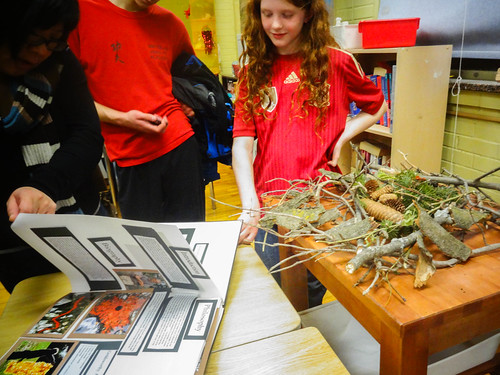
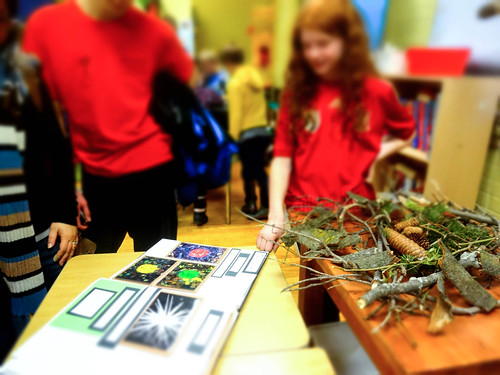
I left Kevin with the cleanup, and the girls and I headed off to AppleApple’s open house, where the students had set up displays on their arts projects. (They do a project on social studies in the fall, arts in the winter, and a science project in the spring.) Among the topics were cake-decorating (with slices on offer), magic, opera singing (the student composed and performed her own aria), and radio drama. AppleApple’s scrapbook on Land Art was well-written, beautifully illustrated, and seemed to be well-received; I observed two dads reading her text and commenting on the fascinating strangeness of Andy Goldsworthy’s art. It struck a chord.
After some cake, Fooey and I left AppleApple to mingle with her friends, and we headed off to gymnastics, picking up a carpooling friend on the way. In the quiet car, on the way back to the open house, I caught part of a well-produced profile of Buffy Sainte-Marie. Almost the first thing I heard her say was (and I paraphrase): “I’ve travelled all over, and the lies are always different, but the truth stays the same.” She was saying that the universal truths that resonate between cultures and times don’t change; it’s the lies that are shifty. So speak your truth, people. That’s what I took, anyway. She also reflected on her parentage, saying she was sure she wasn’t pure Cree, but had some European blood in her, somewhere along the line. She put it like this: “It was either an act of war or an act of love.” I was struck by the stark clarity of that dichotomy of possibilities.
I picked up AppleApple and we headed over to the university, hoping to arrive in time to hear Lisa Moore read. It was really cold last night. We got to St. Jerome’s and discovered in the frigid blowing wind that we’d need $4 in change to park in the lot. I had $1.75. “I can’t believe we’ve made it this far, and we might not get to go!” Luckily we discovered meter parking nearby, and purchased an hour, spending every last nickel we could find in our pockets and in the car. After a quick detour to the library to drop off books (some of them on Andy Goldsworthy, in fact), we settled into chairs: just in time.
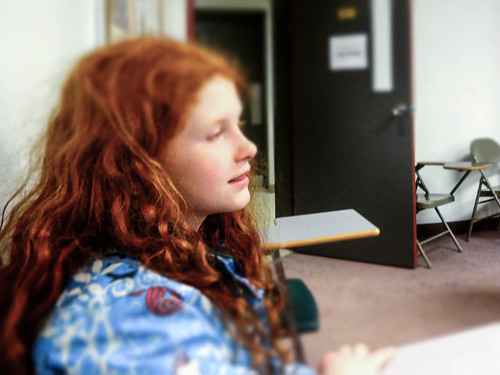
“Is this what university classrooms look like?” AppleApple wondered. “How do students fit their notebooks onto the tiny desks?”
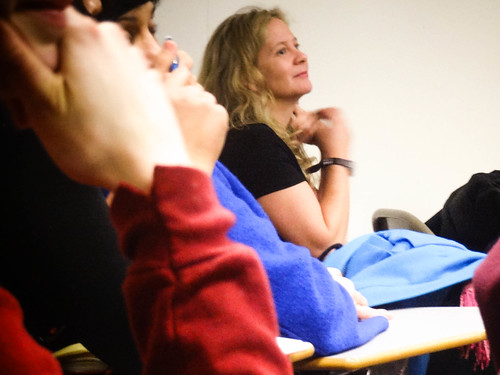
Lisa Moore, before her reading
I worried a little bit throughout the reading that it might be too intense and at times too imagaic and densely poetical for my 11-year-old, but she listened raptly and clapped with enormous enthusiasm at the end. We were fascinated by Lisa Moore’s answers to questions about her process: she described setting herself a problem when writing her novels, usually of form or structure, that she worked to solve, such as telling the story entirely in flashbacks, or telling the story entirely in a forward-moving trajectory, or telling the story from a cacophony of viewpoints (all different problems for her different novels, obviously). She also talked about being part of a writer’s group, and how important feedback is to her process: she described button-holing family, friends, strangers off the street to read and comment on her work-in-progress. I shuddered to imagine it. My own process is so intensely private. No one reads my first drafts, a) because they’re terrible, and b) because I fear that critique at that early stage could kill or muddle my long-term vision for the project.
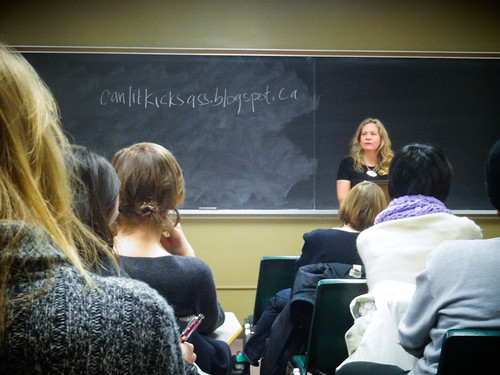
Discussing this on the way home, AppleApple wondered if I was insecure about my writing in the early stages, or maybe too much of a perfectionist. Either theory might be true. But I guess what works for one writer doesn’t necessarily work for another. I am a meticulous and hyper-critical editor of my own writing. It isn’t that I don’t want critique, but I don’t want it until I know the project is ready for it.
Here was AppleApple’s take on Lisa Moore’s reading: “She had such a good presence. She was very confident and calm, kind of laid-back but also serious. It’s so different hearing someone read their writing than reading a book.”
“Would you like to do that when you grow up?” I asked AppleApple, who certainly has a facility with language.
“Um … I don’t know.”
“Well, I’m going to be doing that again, very soon,” I said. And I realized I’d spent the reading taking mental note of the very things that AppleApple had observed: Lisa Moore’s calm and welcoming presence, her intensity mixed with humour and lightness, her frank and open manner. I was recalling how much effort and discipline and practice it takes to make a presentation like that flow so naturally — how much energy it takes to be the person at the front of the room; a fully present and true version of yourself. And I was reminded that readings can be quite wonderful events to attend. I’m glad we found that parking meter.
Slow burn
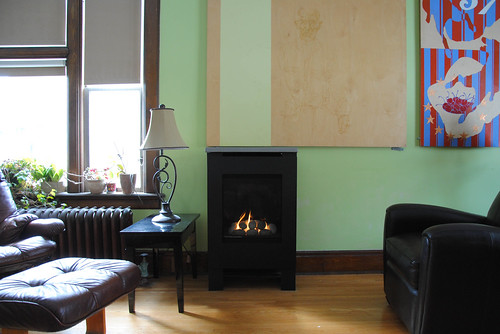
We’ve added an element to the house: FIRE. It’s a gas stove, not wood-burning, placed in the centre of the wall in our main room. I’m sitting in front of it as I type, with my feet up (sorry, treadmill desk; I’m cheating on you with my new flame). As you can see from the photo below, this room remains a long-term work in progress. Kevin and I have two plans, one a total dream and the other something we could hack together ourselves with some help from Ikea. The latter is likely the route we’ll take… when we get a spare moment. Meanwhile, the room looks like this:
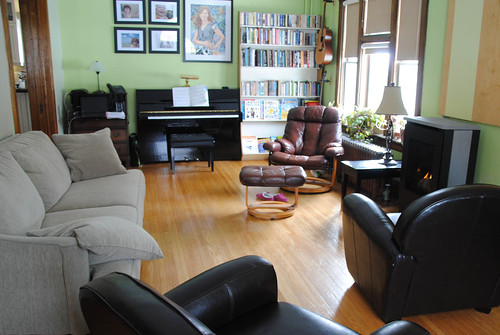
I read to the kids in front of the fire last night, snuggling up for the first chapter of Farmer Boy, which CJ had strongly objected to reading (but I can’t read any more Calvin & Hobbes comics, which he loves but totally doesn’t get, requiring a lot of difficult explication). After some stomping around, and “I’m not listening to that,” he came around to “Fine!” when he realized what he’d be missing out on — namely the snuggling in front of the fire.
Farmer Boy begins with children walking through deep wintry snow to a schoolhouse that seems remarkably lawless and dangerous, the scene of potential violence and humiliation where big boys want to “thrash” the teacher and the teacher is considered especially kind because, unlike previous teachers, he does not beat a little boy for not knowing how to spell. The Wilder children are close in age to our family: Royal is 13, Eliza Jane is 12, Alice is 10, and Almanzo is 8. Almanzo, the littlest, has to carry the dinner pail (CJ, the littlest: “That’s not fair!”). By chapter’s end, CJ was hooked. Here’s what the Wilder children found in their dinner pail: bread and butter and sausage, donuts and apples, and one big flaky apple turnover each. (CJ: “Do they only have one nutrition break?” Me: “Yes, but they call it dinner, not nutrition break.”)
We only read one chapter, but it took ages; the conversation around the story could have gone on and on. The little kids were tucked into bed quite late, and Kevin left for hockey. When I came downstairs, the big kids were so perky and happy and chatty that I couldn’t send them to bed. It was the fire. We just couldn’t help but gather and linger and talk … about everything and anything. I learned more about Albus’s school day than I’ve heard all year. They wanted to know what school subjects I was bad at (domestic science and art), and what I looked like in grade 7 (plain and unfashionable: I mostly wore my hair in braids), and I could see them wondering, would I have liked Mom? I’m pretty sure I wouldn’t have been cool enough for Albus. But I grew up so differently from them: never staying in the same place for more than a few years, often the new kid at school, shifting between countries and cultures. By age 12, I’d lived in four different countries, and moved approximately 10 times. The life I’m offering to my children is a settled one, rooted, with privileges that they take for granted, and that I remember not even bothering to envy as a child, because they weren’t things I wanted or needed. Swim lessons, sports teams, fancy gadgets and the “right” shoes and clothes. I was a clueless 12-year-old: dreaming about getting a pony. At the end of grade seven, we moved to a farm and I got a pony! I never felt deprived.
It’s funny how we want to give our kids the things we didn’t get (i.e. swim lessons); but also give them the things we valued from our childhood. I valued my freedom to explore, and I valued being an outsider. It gave me a special status, a special vantage point from which to observe. My kids aren’t getting those things; they’re getting rides to soccer fields instead, and new jeans. What terrifies me is raising entitled kids. I struggle constantly not to do too much for them, to ask them to pitch in for the benefit of the family (and not to earn an allowance, another perk they have, which I did not grow up with). I want them to do the right thing; but more importantly, I want them to choose to do the right thing, not be forced or punished into doing it. You know? I want their inner fires stoked.

So here’s my slow-burning hope. Gathering, talking, sharing, instilling values (one hopes), connecting, laughing: these years go by so fast. Last night, I let the kids stay up late. It seemed like a rare occasion, but I hope it happens often, now that we have something to gather around, something warm and ever-changing and comforting.
Imagine your way to success
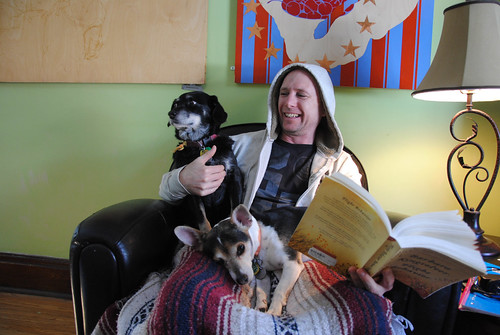
DJ is posing for the camera, which we’re all finding hysterical
Somehow, last week’s brief thaw fooled me, despite knowing better, into thinking that spring-like conditions were in the offing. I keep stepping outside and registering the cold as a shock — as a personal affront — as if it weren’t absolutely to be expected at the end of February. The windchill registered at -21C on my run this morning, for heaven’s sake! AppleApple has told me that on April 1st, she is wearing a sweater to school no matter how cold it is. I was just glad she didn’t set that particular deadline for March 1st.
To further gather my thoughts regarding yesterday’s post on fear and unwinding, I would like to observe that there’s a fine line between acknowledging and reflecting on one’s fears, and becoming mired and stuck in an introspective feedback loop of one’s fears. I feel like I’m atop a small hill that I’ve been climbing for awhile, and this is a good place to pause and acknowledge that it was hard to trust my brain post-concussion. It was hard, and it was scary, but I don’t want it to colour my life. I’ve got other hills to climb.
That’s why I played soccer a few weekends ago. That’s why I write every day. That’s why I meet friends. That’s why I want to go out dancing and do kundalini yoga again and get a decent pair of snow pants and maybe some cross country skiis so I can play outside whatever the weather — take that, February! I’m a huge believer in imagining your way to success. You have to know where you want to go or you’ll never get there.
Writing and meditation and reflection are expressions I’m naturally drawn to as an introspective person. It’s why I’m a writer, I am sure. But life is lived concretely. It’s hands in bread dough. It’s running as the sky grows light. It’s vacuuming the dog hair (or teaching the five-year-old how to vacuum the dog hair).
Here’s what I’m visualizing. And doing.
My big (overarching) goals for the year:
* write the first draft of a new novel
* promote Girl Runner
* create a solid curriculum for my creative writing class
My small (everyday) goals for the year:
* read
* write daily meditations
* run, weight lift, yoga, spin, bike, dance, play soccer
* help and support my family
* give the kids more responsibilities around the house
* bake
* offer and accept invitations to spend time with friends
* play the piano and sing
I could go on. But that’s a good start.
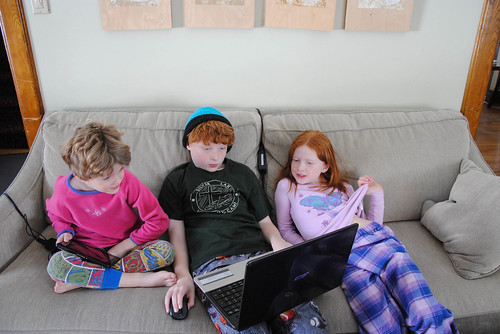
two Saturdays ago: this was taken after we all pitched in to clean the house together; I hope to blog more about this new plan, if all goes well
A total side note that spoke to the fitness guru in me: I read in yesterday’s newspaper that sprinting is more beneficial to the aging body than distance running (the caution being that you need to be a strong runner, and probably a distance runner, before attempting sprints, because non-fit sprinting an excellent way to injure yourself.) No wonder I love soccer so much — it’s basically sprinting, except you get to chase a ball.
I also read that going for a walk has an almost medicinal effect on the mind and body. Why don’t we build our cities and communities around that simple concept? Imagine the health benefits. Imagine how we’d all be walking off the edges of our worries. Wouldn’t that be a wonderful thing?
Unwinding
I went away for the weekend.
I needed to be unwound. That’s what it felt like: a slow and steady unwinding of the tightly knotted self. It was almost like I’d forgotten how to have fun. How to partake of fun. How to be fun.
Responsibility requires armour, maybe.
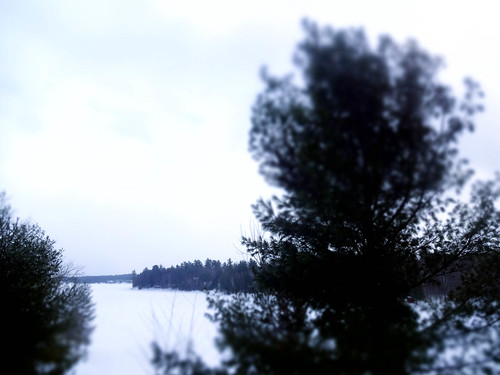
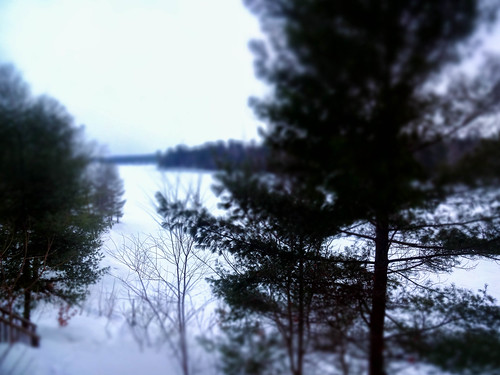
I skiied on this frozen lake. I hadn’t been on cross country skiis since childhood, but it felt like I could have gone forever. It’s much easier to glide across the snow than to slog through the snow in running shoes. Winter’s long long iteration spoke so differently when I was gliding like a hot knife through butter into the wind. Isn’t this a blast, it said.
Our oven has been fixed, have I mentioned this?
AppleApple baked an apple-cranberry crisp to christen it. The crisp took all evening to prepare, and we devoured the entire pan in fifteen minutes flat. Fooey made brownies a few days later. I’ve used it to bake potatoes, but that’s all so far. I’ve got to get some veggies roasting while winter’s still on.
Oh, yeah, winter’s still on. I checked the 7-day weather forecast, and it’s going to be cold, cold, and also, cold.
I’ve come home thinking: I’ve got some work to do. I don’t mean the laundry or the scheduling or even writing. I mean something different. Maybe I don’t even mean work. I mean: I’d like to figure out how to unwind myself. How to be unwound. How to break down my fears.
I don’t like to think of myself as fearful, but it’s there, so why hide it or hide from it? I’m not afraid of external challenges; I accept many things I cannot change. What I fear is closer to the bone: it is the bone, and the guts, the heart, the spirit. I fear the limits of my mind and imagination, and the limits of a body that ages and changes. And I’m afraid of my fears, closing me off from laughter and lightness of heart.
But I’m not afraid to call them out. And I’m not afraid to chase the light — or maybe it’s enough simply to turn toward it. Throw open the windows and doors. Bask. It might be cold, cold, cold, but the days are getting longer, the sunlight is growing stronger.
AppleApple is obsessed with names. Yesterday, while we were sitting around the supper table, she looked up all of our names in one of her (many) baby name dictionaries: according to this one, Carrie derives from Caroline, which means small and strong. I like that very much.
“Like a bird on a branch”

dress-fitting
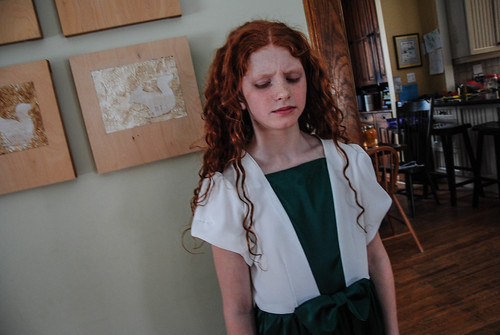
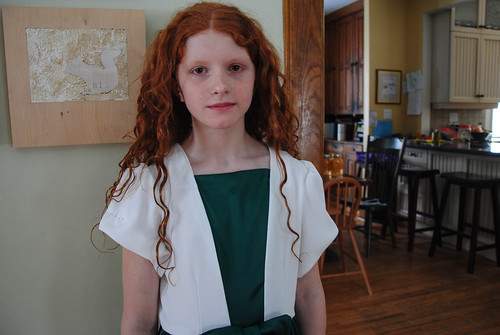
I just accidentally erased the most darling photos of CJ, taken by AppleApple, after Fooey had styled his hair into a swoop across his forehead. I’ve lost other things over the years, too, to digital carelessness or breakdown. It’s always hard to believe something’s gone, when it’s gone. But those comical photos are gone. Loss is a painful emotion, complicated by regret. I’ll get over it in a moment. This post will suffer from their absence, however. Photos affect tone, and those were really funny photos. But these photos are lovely too, taken during a recent fitting; my mom is making AppleApple a dress with puffed sleeves and a puffed skirt (that she might wear to my sister’s wedding this summer).
There’s a commercial running during the Olympics right now with the tagline: Your someday is here. It shows athletes ready to compete, while in the background run faded film scenes of their child-selves, practicing their sport. I find myself curiously affected by these ads; I’m not moved to tears, I’m moved to a faint frisson of panic. Your someday is here. Yikes. Talk about pressure. It also whispers to me: your time will be here and gone before you know it. (I’m obviously in a cheery headspace.) Because doesn’t it also shout: Everything you’ve worked for has brought you here! Celebrate! Enjoy the fruits of your labours!
This week, the Globe and Mail ran a comprehensive obituary on Mavis Gallant. It was heart-breaking to read that she spent her last decade “plagued by ill health and poverty.” Poverty. That word guts me. I reflect on the number of times I read and re-read Gallant’s stories during the past decade, for inspiration, for pleasure, and to admire and try to parse her technical skill as a writer, and how that pleasure received should have been repaid, somehow. Yes, I’ve bought her books over the years. But considering how many times I’ve read them, those purchases were bargains. How to repay a writer for her gift? How to offer appreciation that affords a great writer simple comforts as she ages? Gallant said in an interview in 2006 that “luckily” she had the temperament to be a fiction writer: “I never wanted to own anything — like a bird on a branch.” So maybe I’m projecting my own worries about future financial stability onto a writer who perched above all that, like a bird on a branch. She always noted that her name, Mavis, meant song-bird.

Mavis Gallant was 91 years old when she died.
It’s hard to believe she’s gone. Loss is a painful emotion, complicated by regret.