Category: Writing
Wednesday, Nov 27, 2013 | Confessions, Morning, Running, The Juliet Stories, Writing |

Last week I blogged about fiction versus non-fiction, and a friend posted a link to an article titled “Based on a True Story. Or Not.” If you’ve got time to ponder the subject, go off now and read it. If you’re in a hurry, here’s my brisk summary:
The essay is about the use of autobiography in poetry. We, the reader, tend to assume that a personal-sounding poem is autobiographical. So what happens when we, the reader, discover that a personal-sounding poem is in fact fictional? Do we have a sense of being cheated out of something “real,” or of having been fooled or tricked by the poet? Why do we want so badly to know that the poet wrote out of experience rather than imagination? Why does it matter to us?
Because it does matter, at least to many of us.
I’ve visited quite a few book clubs for The Juliet Stories. There is one question asked every time, usually immediately, a variation of: “Is this story something that really happened to you?” How I answer the question probably depends on my mood, and I often feel rather weary as I try to explain my creative process. But even if I don’t welcome the question, exactly, I don’t disdain it. I’ve come to believe the question must tap into something fundamental within us, something held in common, as readers. That we come to a story looking for truth. We come looking for the connections between author and subject. We want to believe in the veracity of what’s being told. (Maybe we want to be part of the story or become closer to it, by being witnesses rather than “mere” readers.)
The closer a story appears to be to autobiography, the more jarring it is to be told: this is fiction. We’re not comfortable with something we suspect to be full of half-truths, which are also, of course, half-falsehoods. I find it very difficult to wrestle with these distinctions. I’d rather say, “None of this happened” than “Bits of this happened”; while the thought of saying “This all happened” makes my skin crawl. I’ve got no desire to be a memoirist, clearly.
But every story I’ve ever written has been inspired by a glimpse of something actual, whether it be a house I once lived in, or the memory of an emotion that washed over me in a specific situation, or an amulet from childhood, or by knowledge I’ve personally gained cooking or horseback riding or running. I get my ideas from life. But an idea isn’t a story, an emotion isn’t a story, a glimpse isn’t a story. To make a story, I imagine what might have been if life were different. I seek alternative explanations for those things I can’t explain. I go off the trail. I wonder. I make it up.
As a fiction writer, I’m not asking my readers to be witnesses, to paraphrase the conclusion of the essay cited above. I’m asking my readers to imagine.
Curious, though. What am I asking of readers here on the blog? This isn’t fiction, obviously. This is it. Here, perhaps, I’m asking you to be witnesses.

Yesterday at 9AM I wanted to write a post that listed in fine detail every damn thing I’d already accomplished since waking four hours previously; but I was too tired to do it, and instead went upstairs and fell into the oblivion of a nap. It will sound like bragging. Maybe it is. I don’t mean it to be. I myself am astonished and only want to record it because I doubt I’ll believe it years from now, the pace at which I’m currently pushing myself, wondering whether it’s too much, whether I’ll stumble, and badly. (Note: Kevin was working in Toronto yesterday, and usually shares half these duties.)
5:04 – Alarm. Brush teeth, dress.
5:11 – Daughter’s alarm. Help her get ready for swimming.
5:19 – See daughter off with carpooling friend.
5:33 – In darkness, leave house for a run on snowy roads.
6:29 – Home after 10.2km (slow; muscles never warmed up in the cold).
6:33 – Dash out with whining dogs for walk, chilled.
6:47 – Feed dogs. Shower. Dress. Scarf toast with PB.
7:00 – Wake eldest son to watch dogs and be on alert for rising children. Leave for pool. Listen to news on the radio, blast the heat.
7:15 – Pick up daughter and friend at pool. Feed them bananas. Chat.
7:25 – Drop off friend.
7:35 – Home. Feed myself and daughter poached eggs on toast.
7:55 – See friends waiting for elder son to walk to school, run out and tell them go; he’s sick. Call school to report his impending absence.
8:00 – Send daughter to bed.
8:03 – Wake small children. Dress smallest.
8:15 – Feed small children vanilla yogurt with cut-up pears. Empty dishwasher, begin filling again.
8:19 – Check lunch boxes, add desserts, make snack to put into smallest’s coat pocket for field trip, as per instructions on form sent home by teachers, lost, and then after much searching, found. Start load of laundry. Wash beans for supper.
8:29 – Get small children into outdoor clothes. Not quickly enough.
8:37 – Wake eldest daughter. Drive small children to meet friends for their walk to school (they usually walk there).
8:47 – Wake eldest daughter again. Pack her school bag.
9:01 – Drive eldest daughter to her school (she usually walks there, too).
9:10 – Check on sick eldest son, returned to bed. Make him a cup of tea.
9:20 – Crate dogs. Nap.
9:50 – Woken by whining dogs. Get up. Feel grumpy. Get on with it.
Wednesday, Nov 20, 2013 | Blogging, Chores, Driving, Interviews, Kids, Soccer, Swimming, Writing |
Yesterday, while grabbing a book to bring along to a soccer field I mentally composed a perfect blog post. Maybe I’ll blog on my phone beside the soccer field, I thought. But the post vanished, and instead, beside the soccer field, I chatted with other parents (whom I see far more often than I do my closest friends) and watched, mesmerized, our daughters pass the ball with great skill and determination. The book stayed unopened in my hand.
The perfect imaginary blog post is not unlike the perfect imaginary book, I suspect, a subject Ann Patchett addresses in her very funny and quite serious essay on writing, “The Getaway Car,” in her new book of essays, THIS IS THE STORY OF A HAPPY MARRIAGE.
Logic dictates that writing should be a natural act, a function of a well-operating human body, along the lines of speaking and walking and breathing. We should be able to tap into the constant narrative flow our minds provide, the roaring river of words filling up our heads, and direct it into a neat stream of organized thought so that other people can read it … But it’s right about there, right about when we sit down to write that story, that things fall apart.
Two things in that passage. One, the obvious point that writing is not a natural act; and two, that we narrate our lives, and it’s the second I’ve been thinking about most.
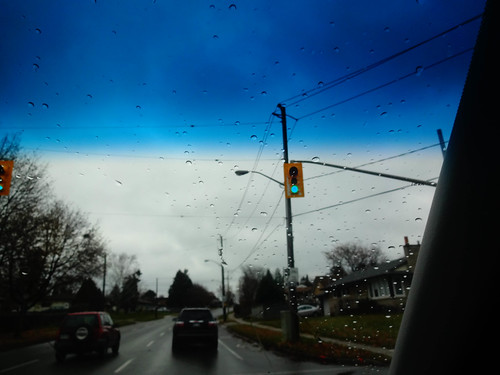
Yesterday, I imagined writing from inside the new car. I would tell you about the sudden shock of snow, the windshield wipers working, the warm hum from the vents. I might add in a snippet of caught conversation between me and a child. I might even admit to a burst of irritation at the stupidity of another driver. There would be the hush of tires turning. The flash of lights and the smear of their colour across the wet windshield in the early dark.
It’s fitting that I put my book advance toward a new vehicle, as the new vehicle has become my second home in a way that seems almost outrageous when I add up the hours. I’ve undone every green dream I ever had, whilst supporting my children in their extra-curricular interests. On Monday, between 5:05pm and 9:15pm, I spent a total of two and a half hours in our new vehicle, including an hour and a half venture, around town, that had me climbing out at home with a numb posterior. During that particular round, “Aggie” and I visited a far-flung indoor soccer field, a gymnastics club on the opposite side of town, and a pool, before returning home. And it snowed the whole time. The best part was when the eldest voluntarily joined me for the final trip of the evening. “What should we talk about?” he asked cheerily, and, as we’d already covered the intricacies of the PS4 gaming system he’s hoping for, we moved on to music, and soccer, and the mall, and fantasizing about food we’d like to eat.
That’s the one good thing about all this time in the car. It’s time with the kids, and we talk, a lot.
But later, home again, kids in bed, I said to Kevin, “When I’m all done driving these kids around, I’m going to be old. That’s what’s going to happen. I’ll be done driving them, and I’ll be old.”
photos in this post taken by child in passenger seat
Meanwhile — and this may save me — I’ll be “narrativizing” my life.
Yesterday afternoon, I listened to a Writers and Company podcast: Aleksandar Hemon interviewed by Eleanor Wachtel. Hemon uses his own experiences in his fiction, without qualms or apology: “The way I write fiction most often is that I imagine a different outcome of a situation.” Hemon observes something unfolding and ending, a snippet, a glimpse, or a straightforward hike from A to B, and he wonders: what if X had happened instead? A character might appear to be based on himself, yet he seems to harbour no worries about being mistaken for a character. In short, the line between fiction and non-fiction does not seem to trouble him. He’s writing stories, not history, whether they are “true stories” (non-fiction) or fiction. “We go toward the things we do not know in literature. To go in the opposite direction is to write only about the easy things.” (I’m paraphrasing; I took notes while listening, as non-fiction versus fiction has become a bit of an obsession while I try to teach it to my students, and while I reflect on what writing/publishing The Juliet Stories has both given me and cost me.)
I feel myself urgently wanting to use what I’ve got at hand, and to spin it into something different; “to arrive at something,” as Hemon puts it. There is life. There is the rendering of life into story. I’m missing quite a few pieces in my life, right now. Apparently I can’t squeeze everything in to satisfaction, not while driving for hours a day. What gets lost? Wouldn’t I love to host more suppers? Yes. My social life is pinched. I’m tired far too early in the evening. The laundry overwhelms. But there’s something about writing that can set life into balance, for me. I arrive at something there that I can’t here.
Friday, Nov 15, 2013 | Kevin, Teaching, Work, Writing |
Lunch date with Kevin. We took the food back to his office because sometimes we like to do take-out. We don’t always eat at home. It’s not that we don’t have enough to eat home, just that sometimes we like to get take-out. I’m sorry. I can’t help myself. All I can do is move forward.
This was going to be a serious post about serious things, and what could be more serious than poetry? A friend in my poetry book club made copies for the group of an article in Harper’s Magazine, by Mark Edmundson, from July of this year called “Poetry Slam: Or, The decline of American verse.” Whilst waiting in my quiet office for students to come and talk to me, I read through it, underlying bits here and there and scribbling arguments in the margins. What spoke to me directly was his suggestion that it took three qualities to write “superb lyric poetry,” (and in my mind I couldn’t help but substitute “literature” for “lyric poetry”).
First, the writer must have something of a gift: she must be able to make music, command metaphors, compress senes, write melodiously when the situation demands and gratingly when need be. … [Second,] she must also have something to say. There must be some region of her experience that has transfixed her and that she feels compelled to put into words and illuminate. … [Third,] the poet still must add ambition. She must be willing to write for her readers. She must be willing to articulate the possibility that what is true for her is true for all.
He goes on to say that ambition might just as rightly be called courage. I like that view of ambition, frankly. Moreover, I like that view of what’s required to write well, and plan to offer it up to my students before the term ends (two more classes, my God, it’s not enough!). I think most of us who are drawn to writing come with the first talent: a facility for language. It’s why we’re drawn to writing. It may also be what stops many of us from moving on much further, and why agents and publishers tear their hair out trying to get young and talented writers to write about something, and not just beautifully or masterfully or lyrically. That’s why theme is so important. You have to have something to say. But I knew both of those things before reading this article; it’s his third point that is a new idea for me. And I like it, very much.
Ambition. Courage. Willingness to put one’s grand ideas on offer for public critique. The daring required to engage. No wonder a writer needs a hide tougher than a rhino’s. How does this willingness to stand out, to say something out loud, to take a stand, to care about something publicly, how does all of this fit with the necessity of being vulnerable? Because if you’re writing about something that compels you, something you care about, you can’t not be vulnerable. It’s what makes what you’re doing matter. We all know it, as readers.
One more thought from the article, on writers who teach.
Teaching poetry means talking about it in a highly self-conscious way. It means bringing the judging facility to the forefront. … But poems, especially vivid, uncanny poems — ones that bring stunningly unlike things together in stunningly just and illuminating ways — don’t come from anywhere close to the front part of the brain, the place where (let us say) judgment sits.
Now. I like to think that teaching creative writing this fall has forced me to distill and make useful much of the knowledge I’ve gained instinctively over my years of practice. I appreciate being forced to bring the judging facility to the forefront. But I’ve written next to nothing of creative content this fall, and though it wouldn’t be fair to blame this entirely on teaching, I do wonder if he’s got a point. By picking something apart, analyzing its pieces, well, the thing you’re dissecting is dead, isn’t it. It had better be, for the sake of all involved. When I’m writing, it’s like coping with a living thing that seems almost unrelated to the suggestions and guidelines I keep trying to share with my students. Sure, there are rules. There are excellent, tried-and-true ways of doing things. But I’m not thinking about them. I’m writing. I’ll save the analysis for later, for revision and editing.
For the record, I had the pork belly with the papaya salad, and Kevin had the fried chicken, and both were very very good. If you live in town, follow @westofseoul on Twitter for menu updates and to find out where the truck is parked from day to day.
Tuesday, Nov 12, 2013 | Driving, Kids, Mothering, Parenting, Soccer, Swimming, Writing |
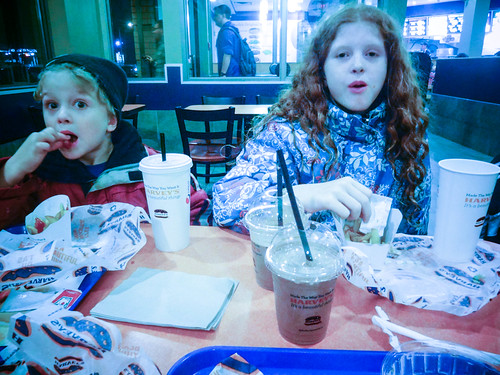
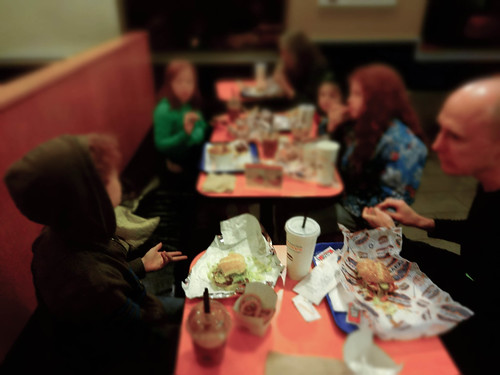
our Canadian celebration: fast food at Harvey’s, Sunday evening, 6:15
Sometimes it looks, from the blog, like I’m hyper-productive. And sometimes that’s true. But not always. Today, for example. Today I got up at 5am, yet I’ve done nothing more productive than a load of laundry. I just heard the washing-machine buzzer go, so if I get up off of this twirly stool (formerly part of a drum kit) and toss that load into the drier, that will be two loads of laundry, making me twice as productive.
I exaggerate only slightly.
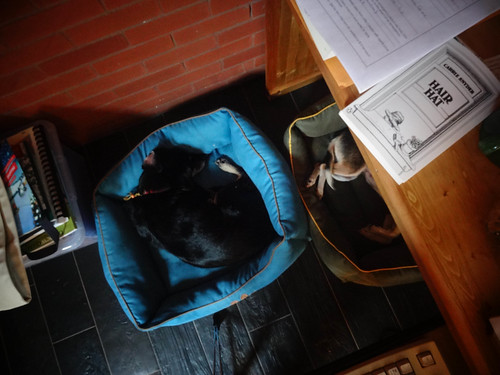
office, with dogs, Monday, around noon
I took photos of most of the places I’ve been over the past two days. Maybe I need a day like today to do nothing and not be productive, who knows. A body can get tired, and so can a mind, worn down and flattened to dullness by the necessity of production. My energy and drive are renewable resources, but maybe to renew them, I need to sit fallow now and again.
Here’s where I’ve been, since leaving the wild Wild Writers Festival on Saturday afternoon, flying home filled to brimming with words and names and ideas and emotion.
That same evening, Kevin and I went out together to a dinner hosted by the festival, and then to a reading afterward. It really is a treat to be surrounded by writers, to hear about their struggles, and their secrets to survival. I rely on this blog, frankly, to keep me connected to other writers, because I really don’t move in literary circles. My actual physical circle is basically my neighbourhood, and includes friends I’ve known for years, and friends I’ve made since having children. In some ways, I think I’ve been protected by this, and allowed to make my own mistakes and explore my own interests, but in other ways, I miss the camraderie of running into people who do what I do. It’s why I love the Wild Writers Festival, and feel blessed by its existence, and thankful to those who put their energy into bringing it into being.
Kevin and I did not stay late. That is the theme of our lives at present. We do not stay late. Ergo, our social lives are somewhat shrunken. I wilt around 9 o’clock. That’s my glass slipper hour.
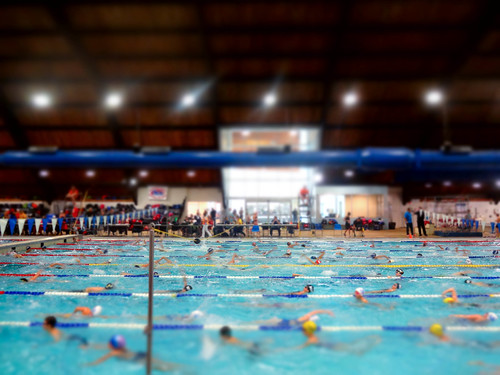
Wayne Gretzky Sports Complex, Brantford, Sunday afternoon, 1:15
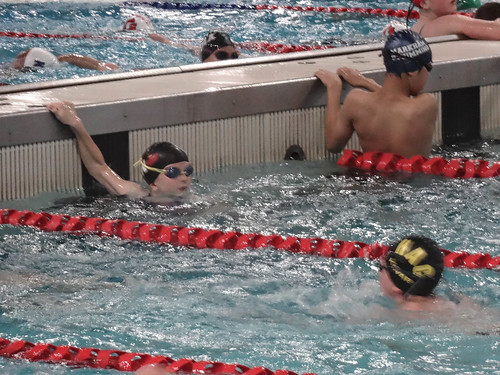
Sunday saw me and swim girl driving rainy country roads to a swim meet. It was her second day, and she’d already won a bronze medal in the 200m breaststroke (looked after by her coach, as neither Kevin nor I could be there). I failed to appreciate the significance of this accomplishment until arriving at the meet: it was a big meet! Teams from all across southern Ontario, from Toronto to Windsor, and there was my kid in her purple suit swimming to another medal — silver, this time — in the 100m breaststroke. I got to hug her immediately afterward. I spent much of the meet crouched on a stair-step on the jammed pool deck, reading Ann Patchett’s THE STORY OF A HAPPY MARRIAGE, and wishing myself more tolerant of violations of personal space. I’m so Canadian that way.
Home from the swim meet, we went out for a family meal at Harvey’s. We had a gift certificate, that’s why. It was ridiculously fun. Hey, maybe we can count it as our Canadian celebration.
Up early yesterday for kettlebell class. I’m back! And symptom-free! And my muscles ache! So yesterday was kettlebells, followed by nap, followed by getting kids to school, followed by office time. Blissful peaceful office time, with dogs snoring underfoot. I’m sifting through my HAIR HAT stories. Not much happened for many hours, and I enjoyed it. Because by 3pm it was kids home, and snacktime, and laundry folding. So much laundry! Three days of laundry! Despite a full half hour invested in folding, I had to abandon the still-overflowing basket because it was time for the hellish Monday swim commute. From our house to UW’s pool (where AppleApple swims) to the Rec Centre is probably less than 4km, all told, if we could go by bike or on foot through the park. But we can’t (aka don’t want to) because it’s dark and snowing. This trip via car, is beset by road closures and heavy traffic, and takes us a full half an hour. We arrive at CJ’s swim lesson just in time, every time.
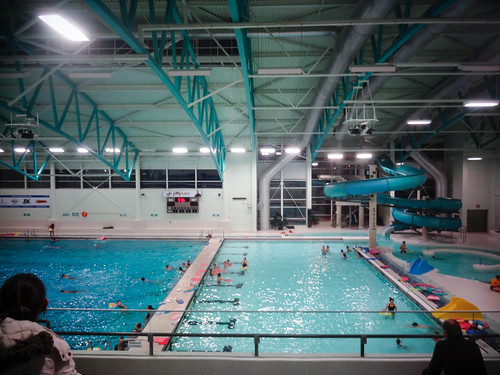
swim lessons at 5:30 on a November afternoon
I sit in the stands, and breathe. I watch him kick, kick, kick, and move less than an inch, yet he doesn’t seem discouraged. His googles (as he calls them) are too tight and leave marks around his eyes, yet he doesn’t me to loosen them. He talks non-stop in the shower, by the locker, in the parking lot, all the way home. This is a good stop along the way.
At home, there are 15 minutes in which to devour a tofu stir-fry that Kevin’s whipped up in my absence. My mom has arrived too, to babysit and let us borrow her car for the next portion of the evening’s adventures, as Kevin and I will be going in two different directions.
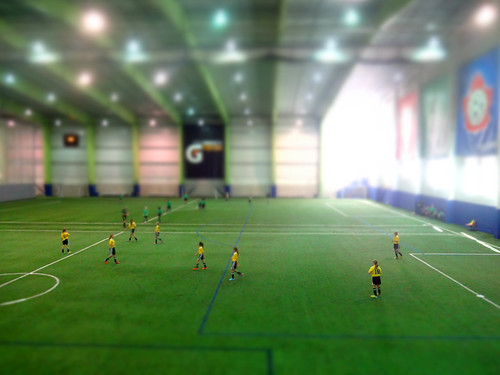
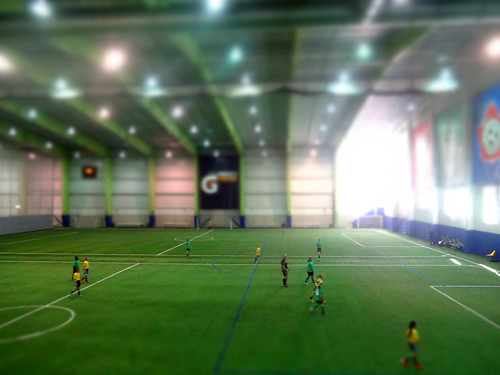
soccer field at RIM park, 7pm
I get to go to Albus’s indoor soccer game! I don’t do enough with his boy, and he notices, so I’m making a conscious effort to do more. I believe showing up is a big part of parenting, and matters more than anything I could try to say with words. And it’s doable: it just means shifting things around a little bit, here and there. Kevin will take the gymnastics run (Fooey and her friend) and pick up AppleApple from swimming, instead. It’s companionable with my boy, and I manage not to embarrass him with my (inevitable) running commentary and encouragement from the sidelines, if only because he claims afterward not to have heard me (phew!).

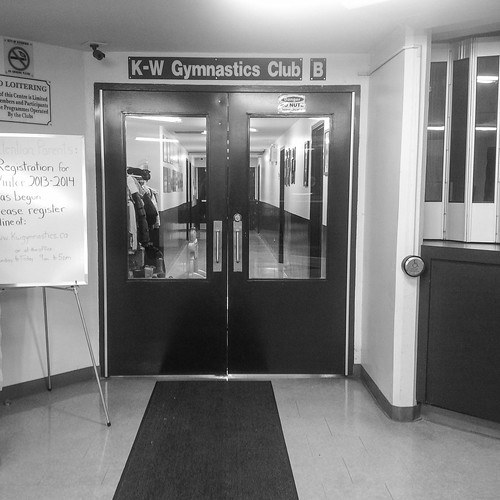
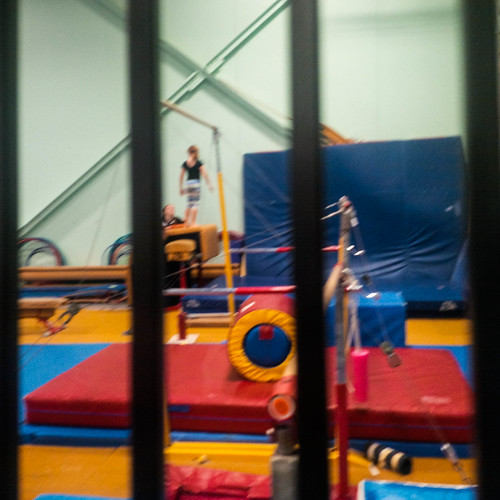
gymnastics club, 8:50pm
We’re home again. I help load the dishwasher. I dress CJ in pajamas and leave the bedtime tucking to Kevin, because we’re off again, me and Albus, to stop at a convenience store for milk and bananas on our way to pick up the gymnasts. “I forgot my camera!” I say, and Albus reminds me that phones have cameras these days. I finish off the mini-this-is-where-I’ve-been session with a few terrible shots from the gym.
blurry gymnast daughter: damn you camera phone
And that’s where I’ve been.
Thursday, Nov 7, 2013 | Teaching, Work, Writing |

Not having time to take and process new photos is not a good reason not to post, I’ve decided. That’s a lot of nots. Not having time to write a new post is also not a good reason not to blog, I’ve decided. I’ve got fifteen minutes, tops. So this ain’t gonna be uber-reflective or even mildly reflective. Think: stream of consciousness.
The phone keeps ringing, but it’s not good news, or news of any sort, in fact. It’s those people longing to clean my air ducts. “I don’t have air ducts.” “What do you have, ma’am?” “Nothing that you could clean,” I say, and he laughs — mockingly? The line goes dead. “I was supposed to hang up on you,” I say, too late.
This week, I’ve been reading through all of my students’ rough drafts for the short story unit, in preparation for a workshopping session tonight. I’ve prepared a “helpful” mini-lecture on the difference between description and story. These are not the same thing, not at all. I’ve looked longingly at the new book by my elbow, Ann Patchett’s THIS IS THE STORY OF A HAPPY MARRIAGE, and wished to cast aside all cares and responsibilities and gulp it down, and I have not. I have resisted and scribbled comments in pencil on all of my students’ stories.
I haven’t been reading so much at night. The tired leaks into my free time. Tuesday evening, the kids in bed and Kevin off to hockey, found me folding laundry for a full hour (three days’ worth) while streaming a new sitcom, “Mom,” which was not as funny as advertised, although not terrible. (Be warned: my standards for sitcoms are pretty low.)
In other news, I wasted the better part of Tuesday paying stupidly avid attention to the not-so-mysterious but nevertheless mind-boggling show put on by Toronto’s own mayor, Rob Ford. As AppleApple (also an avid news-watcher) and I stared at Ford’s “apology” streaming live on the kitchen computer, we provided shocked running commentary that mostly revolved around the slow-dawning realization that the man fully intended to ride this out, God bless the good people of Toronto. And bless ’em indeed, for he’s causing exactly the trouble and chaos that any addict causes his family and friends, all the while insisting it’s not him, it’s them. Anyone who’s seen a family go through this pain knows exactly what we’re all watching here, and it’s not funny at all.
But there, more time wasted. And it’s not him, it’s me. Where are your boundaries, woman?
A student asked me whether I write every day. I replied, Yes.
It’s true. I do write every day. But let’s be frank. I’m not writing books every day. Most days this is what I’m writing: other things, smaller bits, random and not held together by any particular theme aside from necessity. Notes. Marginalia. Lists. Letters. Journal-type scribbles. Stream of consciousness blog posts.
Today’s session is out of time.
Tuesday, Nov 5, 2013 | Exercise, Kids, Mothering, Readings, Spirit, Work, Writing |
It’s only Tuesday, right? I’m apprehensive about my responsibilities this week. The layers of planning material in my head keep shifting, and I’m terrified of what might be falling to the bottom. It’s dark down there. Things might biodegrade without me even noticing.
I fall asleep to syllabus material, and wake considering supper plans versus ingredients on hand. A small but persistent section of my brain is wholly devoted to identifying time slots in which I can fit in a run. I’m visiting a book club this week, there are teacher interviews to arrange for each child, and I’m in charge of facilitating a panel discussion at the Wild Writers Festival on Saturday, at which I’d like very much to appear a) prepared, b) composed, and c) sane. (If I could actually be all of these things, that would be even better.) The clock is ticking on resolving a gymnastics decision, swim girl has a big meet in Brantford all weekend, and we need to plan a birthday party for next weekend. What else? Oh, the asthma puffer ran out this morning. Our tub tap is leaking rather frantically. Our stove needs repair.
I wrote a piece for Open Book Ontario, which they’ve posted today. I’ll admit it reads rather manically. It’s on my writing habits, and the peacefulness of my office. This office is my calm centre. I’ve started doing yoga in here some mornings, with kundalini music playing, and it’s pure bliss.
Much of my happiness comes from motion. I see my eight-year-old spin on a bar, hold herself upside-down, toes pointed, strong and glowing. I see the game unfolding on the field, the risks being taken. I see my eldest and me racing up and down grocery aisles late at night, revelling in the hunt for bargains, laughing at our impulses and follies: for me, corn flakes; for him, anything new and available for a limited time only, such as the soda that purports to taste like chocolate.
But I’m tired. I’m tired, and I know, too, that much of my happiness comes from points of connection, from stillness within the motion. Holding CJ’s hand on the walk home from the school bus. Washing his hair in the pool showers. Conversations as we drive somewhere together, me and a kid, or two, or three. I’m always looking for what I can share with each child, and that keeps changing. I remember when I gave the kids a bath every night before bed, and they remember how I pretended to be a giant making kid soup. Now we’re splintered and running, and I’m looking for those moments to stretch out my hand and grab on to theirs, figuratively if not literally, as we whirl in our separate circles.
The days look impossible if I try to hold them all at once.
So maybe, really, I shouldn’t try. I won’t try. If there’s any secret to this time, it’s that. Do what you’re doing, be where you are. Make your lists, prepare, yes, but know what you’re waiting for, and recognize it when it arrives, no matter how small it seems. It’s none of it small. You know what I mean.