Category: Work
Sunday, Jul 21, 2013 | Backyard, Friends, Fun, House, Kids, Running, Soccer, Summer, Weather, Work |

Well, the heatwave broke. And rather dramatically, from our perspective. I was on the phone with a friend when suddenly the sky went dark and the wind blew high. She lives just up the street, so we were both looking out our windows at essentially the same storm, unable to comprehend what we were seeing as the trees were whipped into a furious tumble and the rain came down, lashing so thickly it looked like a descending fog. “Um, what’s happening?” we asked each other.
I think it takes the mind a little while to catch up to an unusual and unexpected event. For whatever reason, I was slow to grasp that there might be any danger.
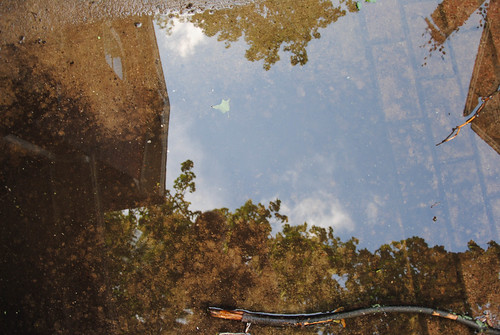
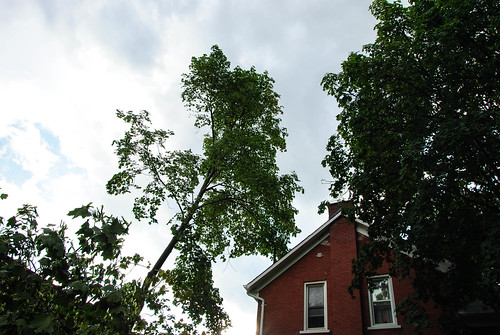
My kids were standing on the back porch filming the storm with our little camera — I’d told them they were allowed on the porch, not to go into the yard. Suddenly the phone line went dead and a sound like an electronic buzzing — like a paper bag being torn close beside the ear, as a Facebook friend put it — filled the air. It was incredibly loud and innately disconcerting. I ran onto the porch and called the kids inside (we have video of this). That’s when AppleApple and I watched, through the kitchen window, half of a tree come down in our backyard. It fell silently and smoothly and without any ceremony whatsoever.
Our brains couldn’t seem to register what we’d just seen. I said, not at all concerned, “Oh, a tree’s come down.” The winds seemed to turn branches into paper versions of themselves, tossing them wildly.
And then I snapped awake, and we all ran for the basement, dragging the anxious dogs with us. Kevin had left, just before the storm hit, to go to a soccer game. I was thankful for texting. The power went out soon after. The storm passed almost as quickly as it came.
We left our dark house and joined neighbours gathering at our intersection to survey the damage. Every street had big limbs fallen, power lines down, branches and debris everywhere. We walked the dogs slowly around the block, keeping a sharp eye on the trees over our heads, many of which had dangling branches.

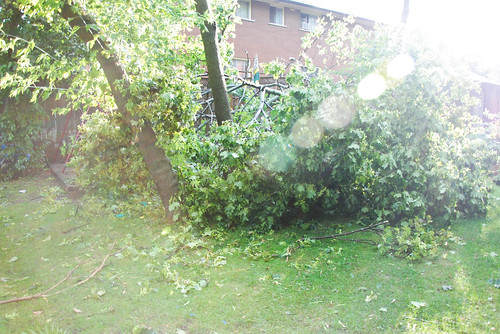
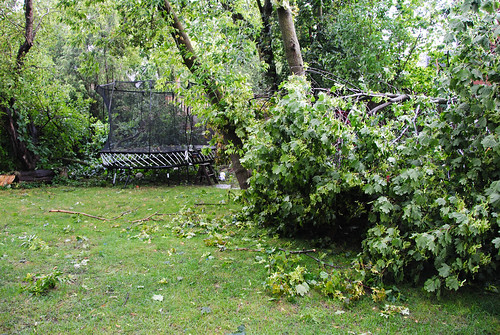
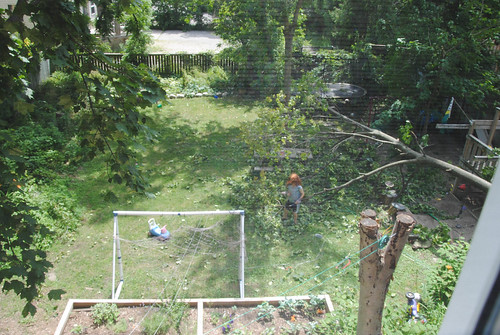
Kevin was training in Toronto all day yesterday, so the tree stayed down in the yard. I almost wanted to leave it there. The split down the side of the tree is so long that I’m afraid the half that still stands can’t be saved. I found myself touching the smooth skin of the newly split tree, just under the bark. It was soft, almost silky, though it has since gone hard and dry. It smells like cut boards in a lumber yard, faintly sweet.
The branches spread over the picnic table, creating a little shelter. Miraculously, a blue glass bowl that had been left out on the table, filled with watermelon rinds, was untouched, perfectly intact.
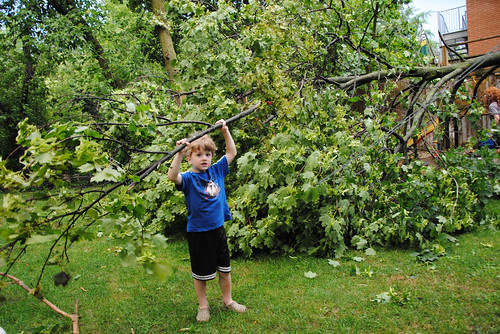
The kids pretended to hold up the tree.
Today, Kevin and AppleApple have spent the entre day slowly removing the fallen tree. Our front yard is now piled with cut branches. It is an enormous job. The yard is a mess. Even half of a tree is huge.
I realize as I write this post that I’m mourning the loss of the tree. But I don’t mean it to be a sad post. In fact, as the kids’ smiling faces show, we came through the storm just fine. We’ve been sleeping better with the cooler weather, especially once the power was restored and we could run the fans again.

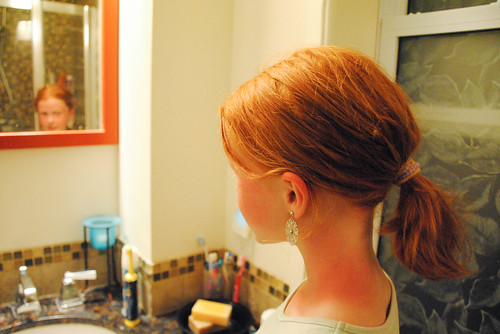
Yesterday, I managed a long run during the afternoon while AppleApple was at her goalkeeping clinic. We’ve been biking there, and we passed many fallen trees in Waterloo Park, but the area beyond Columbia Lake, where I ran, seemed untouched by the storm. It was a highly localized event, it would seem. In the evening, after we ate takeout fish and chips, and I did yoga (read: napped on my yoga mat in our living-room in shavasana heaven), we walked uptown, dogs too, to Open Streets, which had a lively relaxed street festival vibe. We listened to a young woman with a huge voice perform in front of the Chainsaw: AppleApple’s face was shining with delight. “I would give up a lot to have a voice like that,” I admitted. Meanwhile, Fooey talked her “very nice parents” (her words) into letting her buy a new pair of earrings from a craftswoman on the street nearby.
She was sunburned from a happy afternoon playing in a soccer game and then swimming. We all had frozen yogurt. The dogs were well-behaved. The kids and I skipped rope in the street. And we walked home in the gathering darkness with paper lanterns lighting our way.
Summer rolls along, sweet and languid, with sudden flashes of strangeness and wonderment. Tomorrow, a good friend and her family leave for year of sabbatical. The following week another good friend and her family will be leaving too, for the same. I wonder what will have changed, again, in another year. Things we can’t guess at, I know, even if we can predict some, and hope for others.
Wednesday, Jul 17, 2013 | Kids, Play, Reading, Summer, Work, Writing |

hot and grumpy
Inevitably, having said I was doing a lot of training, along came a random stomach bug (food poisoning?) to lay me low early yesterday morning and now I’ve missed two planned runs. But I prioritized rest and recovery, and am feeling back to normal today, if normal includes being covered in a sheen of perspiration. We don’t have air conditioning. The upstairs thermostat reads 89 degrees (why Fahrenheit? I don’t know).
hot but less grumpy
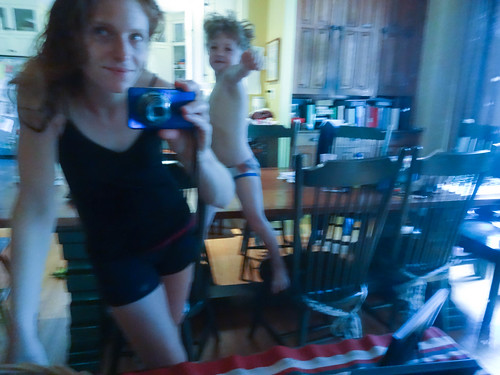
Kevin gets to go off to his air conditioned office every day, but the rest of us are here, making do with a few fans and running low on popsicles. I’m wearing clothes I’d wear to hot yoga (see photo above), and brainstorming cool foods for supper: gazpacho and fattoush!
even the dogs are grumpy

I don’t envy AppleApple her babysitting duties
On Monday evening, I took the kids to the pool for two hours (two hours!), and discovered that CJ swims far better than I thought he could, given his general sinky-ness in swim lessons, while Fooey swims rather worse (she needs to learn the flutter kick, mainly, and become more efficient at breathing between strokes). CJ wanted to practice, but Fooey was annoyed by my instruction. It’s funny how my kids break down along these lines: Albus and Fooey are similar in many ways, while AppleApple and CJ are similar in others. The latter two accept my instruction as helpful, while the former two loathe it.
I’m more like the latter two. But I try to work with what works for each kid. So Fooey played and splashed, while CJ played and practiced and splashed, and AppleApple did laps and dolphin dives and dove to the bottom of the deep end and found $2.50 in change. When we clambered out two hours later, we were actually, wonderfully, briefly, COLD.
:::
photo bomb!
This morning I received a letter from a reader, through my publisher. She’d read both of my books, going so far as to track down Hair Hat, which is out of print, at U of T’s Robarts Library, and she wanted to tell me that she foresaw a bright career developing for me, if I could keep my focus.
Interesting, huh.
Because I do wonder about that: are my chances for success, for a long and happy career, all wrapped up in the focus, in the drive, in the setting of high expectations? At this stage in my life, I’ve come to think the answer to that is No. There’s luck, too, and striking the geyser of zeitgeist, which is beyond unpredictable. And yet, I’ll tell you too, that I keep operating as if the answer is Yes. Because it’s what I’ve got, and I seem to have lots of it. (It being focus, drive, high expectations, etc.)
I operate with the knowledge that failure is ever-present and ever-possible, and that it can only harm me if I let it get in the way of trying. Knowing failure keeps me oddly serene, oddly comforted.
I just keep writing. Like Dory hums in Finding Nemo (yes, I’m quoting a kids’ movie): “Just keep swimming, swimming, swimming,” only I hum writing instead of swimming. I’m nearly midway through my revisions of Girl Runner, or at least midway through the manuscript. I’m writing lots of new scenes and loving my main character ever so much. I think you’ll love her too. My editor said she thought readers would Google the character’s name, believing her to be real, and I almost feel that way about her too. What a strange job I have, making people up from scratch. I can’t explain why it makes the slightest bit of sense to do it.
Am I keeping my focus in order to have a bright career?
Probably not, though I’d welcome it if it landed on my doorstep. I keep my focus because I love telling stories. I love digging into the lives of others. I love having them say and feel and do things I could never say or feel or do. I love asking enormous questions. I love being allowed to wonder.
Monday, Jul 15, 2013 | Kids, Running, Soccer, Weekend, Work, Writing |
I love the summer photos. Bright skies, bright colours, squinting eyes.
This past Thursday evening illustrates our family’s collective obsession with soccer. With surprising ease, between the hours of 5:30-8:30pm, five out of six of us were involved on soccer fields in multiple locations. Kev and Albus scarfed down hot quiche and were at their practice at 5:30. Using the carshare car, I dropped AppleApple at her practice at 6:45, then drove CJ and Fooey up to another field where Fooey had a game at 7:15 (Kevin coaching). We met Kevin and Albus in the parking lot with a picnic snack, and I zoomed over to Cambridge to play a 7:30 game with my indoor team. Kevin and kids picked up AppleApple on their way home, and serendipitously saw me, just after I’d returned the carshare car, walking home with my gear. Talk about coordination. It felt effortless.
Of course, Thursday also marked the end of regular season play for Fooey — we’ll have to find a new groove, all over again.

On Saturday, Kevin and Fooey had an end-of-season “festival,” and we all came along to cheer. In the afternoon, AppleApple had a goalkeeping clinic, and I brought my yoga mat to stretch. Afterward, we biked to a nearby pool for a cooling dip.
On Sunday, I drove around southwestern Ontario, retrieving one child from a friend’s cottage and dropping two at overnight camp (one not my own): Albus will be gone for two weeks. CJ is already bereft. I arrived home in time to drag my well-numbed butt off to my evening soccer game (we won!).
I’ve been doing a lot of training. Training for what? Not sure, exactly. I’ve signed up for the Toad (25km trail run), and that seems to have given me the drive to follow a regular training schedule. I’ve gone steadily, from weight classes to soccer games to runs, for over two weeks now, without missing a day. Thankfully, I’ve got time for long runs again. I’ve gone out the past two Saturdays, aiming to run approximately an hour and a half to begin. I made it 15km the first week, 16km this past week (in the same amount of time). Sloooow.
It feels different to train myself back up, having done this before. The first time I trained to run long distances (two years ago), I was doing something I’d never imagined I could. So it was a pretty amazing process. Every extra kilometre felt like a miracle. But now I know what I’ve been capable of, and I’m so far from it. It could be discouraging — and I’m grateful that I don’t feel discouraged. I do feel slow. But I recognize that long runs are about reminding yourself that you’ve always got more than you think you do. That’s another way of saying: you have to learn to trust your body. That’s what endurance is actually about, as much as it’s about putting on mileage (though mileage is critical, too).
(And maybe, too, it’s harder to trust your body after injury. I am running on an ankle that is improved, but still not perfectly healed.)
Training for what? On reflection, I think the what doesn’t matter, it’s the why. Training is just a way for me to keep going. I’m in the midst of some very challenging work. I could get discouraged or weary, and I need, somehow, to remain calm, focused, and strong. Training seems to remind me of my own capacity to work hard. It gives me a parallel (and easier) kind of work to counterbalance the extremely quiet interior efforts required here in my office. Training every single day toward an end that isn’t obvious doesn’t feel frivolous or extreme, though it may look that way. I couldn’t sit still — hold so still — without some sense of being in motion. I’d go crazy, I think.
I’ll admit this is not an easy time in my professional life. It’s a lovely time in my personal life. I’m a truly fulfilled mother of wonderful kids. But professionally I feel a constant low-level anxiety. I wonder about the choices I’m making. I question my direction. I’m unsettled.
This may be a function of being a creative person. I wonder: am I by nature an unsettled and restless woman? Then I need a firm, sound body to carry me through. My mind settles when my body is working hard. It gives me peace.
Saturday, Jul 13, 2013 | Bicycles, Swimming, Work |
I’ll miss this routine, now that we’re done: riding our bikes to swim lessons every morning for the past two weeks. Fooey is a demanding task-master who had us out the door early every day, with much grumbling and foot-dragging (on my part). This kid! She is so impressively punctual and organized. I started to sympathize with how the kids must feel as I urge them, constantly, to ready themselves and exit the house: I didn’t want to go yet! I still had things to do! I hadn’t even gotten a sip of my coffee! But, no, Fooey insisted: We are leaving and NOW!
Okay, then.
I’ll miss the routine and seeing them paddling in the pool, but I won’t miss drinking cold coffee. Or the endless visits to the bathroom (that rec centre has an instant laxative effect on my youngest — seriously, we just have to walk through the door and he’s making his announcement about where we must go immediately, and why.)
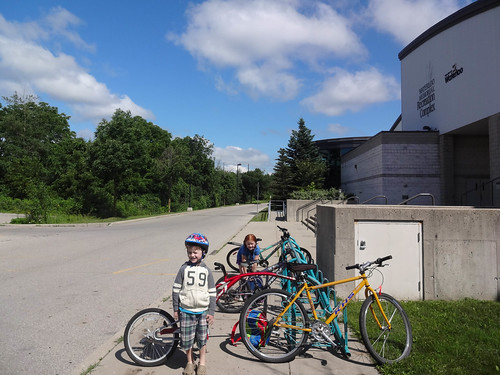
The older kids were very independent and biked together, not with us, except for the last day when we all had a snack afterward (hot chocolate, french fries, a bag of chips, and a handful of multi-coloured banana candies from the 25 cent machine). Then we biked to the library together, and home. With five of us on bicycles, I felt like a mama duck leading her family along treacherous roadways, on the look-out for danger.
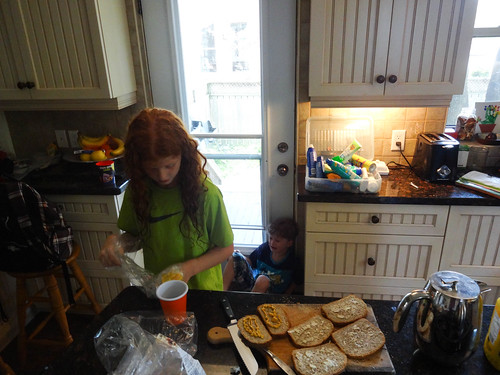
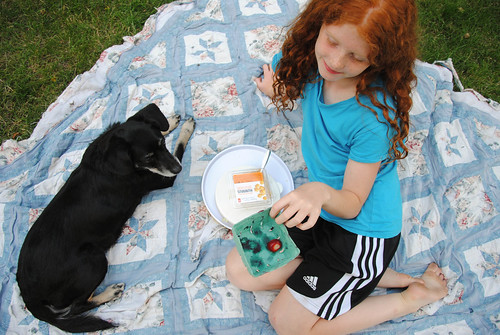
Here is babysitter AppleApple, post-swim, preparing a picnic to take to the park. Behind her, observe her little brother in the midst of a meltdown because he does not want to go to the park for a picnic. He will not go! He hates both picnics and parks! Etc. Well, somehow she got him there. I’ve been hugely impressed and gratified and proud of my kids as both babysitters and babysats (picnic meltdown notwithstanding). Lunches are being planned and prepared independently, I’m writing alone in my office without being disturbed, and there are no electronic devices involved whatsoever. Sure, I’m doing more laundry due to wet/sandy/muddy clothing, and no one appears to have taken up vacuuming, but these are tiny details.
With responsibility comes power, with power comes freedom? I just keep telling my kids how great they are.
Tuesday, Jun 25, 2013 | Big Thoughts, Photos, Play, Work |
I’m suspicious of leisure, but why? If it’s too easy, if I’m enjoying myself too much, if there is too much time in the day for sitting and sipping coffee, I feel uncomfortable. What should I be doing? (There is always more to do, and perhaps my anxiety arises from the fact that often the reason I’m relaxing and sitting is because a) I’ve forgotten about something I’m supposed to be doing or b) am ignoring things that need doing.)
I could fight this character trait, or I could give in to it. Generally, I give in because I feel better about myself. Somehow, all of this doing gives me a sense of purpose and progress, or even just basic maintenance. Which could be utterly false, even self-deluding, and I get that. I get it, but, still, I crave the sense of purpose and progress.
Today I am thinking about photography. On the weekend I read Ian Brown’s essay on being a judge for a photography contest in which no prize was awarded — none could be, because none of the hundreds of photo essays submitted met the criteria of not just being aesthetically appealing, but also narratively significant. In other words, none of the photo essays needed to be, in the judges estimation; their beauty was superficial because it did not matter, as nothing was at stake.
Brown wondered whether with our excessive photo-taking and recording of our lunches and pets and children’s every move, we’re losing the ability to recognize, tell, and maybe even to look for the deeper stories, the essential and underlying and specific stories that make us look and think and stop, rather than entertain us. I feel myself guilty of exactly this: pulling out my camera to capture “a moment.” Am I looking for a story? Or have I already decided what the story is simply by pulling out my camera to snap the photo? What’s the difference? In the latter scenario, I’m thinking of my photos as illustrations. X marks the spot. We were here. I was here. I’ll admit that I find poignance in snapshot, but I’m kind of nostalgic, I guess. I’m hyper-aware of the passage of time, and of change.
The former scenario, is, however, more interesting and more challenging and more difficult. Looking for the story means admitting from the get-go that I don’t know the story. That the story might only become apparent through work and time and effort, that it isn’t immediately available, even if the technology is instant.

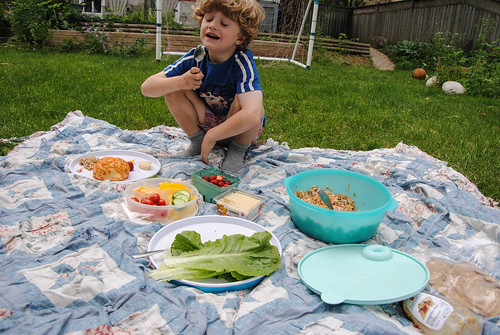
When I took the pool photos on Saturday afternoon, I pulled out my camera because I noticed the way the light was hitting the water. That was what I wanted to capture, as much as the event itself, and then I saw through the zoom my daughter waiting for her race, drawn into herself, looking solitary and private even while surrounded by crowds of others. There was a story waiting to be told. The picnic photos, on the other hand, are merely decorative, illustrative: I wanted to note what we were up to. The noting was almost as important as the doing, maybe. I carried my camera out along with the dishes and food. I sense that there is a difference between motivations.
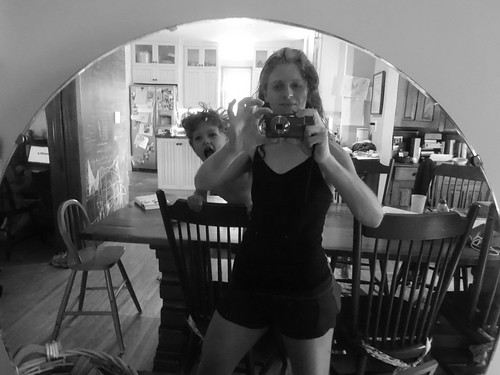
The year that I spent taking a self-portrait every day, I began to get bored of my own face and of our house and yard. Toward the end of that year, I found myself experimenting with composition, trying to tell stories that weren’t my own, that were projections (see above). The limitations forced me to become more creative. Every day, I struggled to choose just one photo. But the whole project was stronger because of it. I believe in limitations, in art and in life. Boundaries, strictures, rules, natural or artificial, make us work, make us choose, make us care.
This week, Brown’s article has me stopping myself from automatically picking up the camera. Asking, is this necessary? Or does it just add to the noise? (Hence, the recycled photos in this post …)
Maybe I photograph the moment because I’m caught up in wanting to do, do, do. Or maybe, sometimes, if I am to be honest, to distract me from what I’m stuck doing. Maybe it makes me feel less anxious about all I don’t understand. Maybe I photograph the moment because I am terminally nostalgic. Maybe because a photograph seems to make living itself more real, by committing it to images that give the illusion of permanence. And maybe, too, I’m looking for the larger narrative. I’m hopeful. I think I’ll find the story here, and that it will make sense. Maybe that’s what we’re all doing as we snap away with our digital cameras, creating too much, not knowing what to do with what we’ve made, nor how to keep it once we’ve got it.
Maybe the story comes in the curation afterward. The cull. The work. And also the pause, the stop, the stillness. That could make all the difference. I suppose it does.
One more thing: the photos I like best are the ones that are a bit askew, the mouth open or the eyes closed — something is not quite right, not quite perfect, and that makes it interesting.
Tuesday, Jun 18, 2013 | Kids, Photos, Work, Writing |
We’ve entered end-of-school-year madness. I added to the madness by turning my ankle in Sunday evening’s soccer game, which we won short-handed, and so it was worth it. Right? Priorities, Carrie, priorities. I actually heard my ankle make a snapping sound as I landed on the grass, and so did the woman with whom I’d collided, and she looked at me, lying in the grass, and said, “Um, are you okay?” and I said, “Yeah, I don’t know.” In fact, it didn’t hurt, and still doesn’t, just feels stiff and is swollen. I’m taking a few days off to see how it heals, but so far my body seems to know what it’s doing. I’m icing it, resting it, and I promise not to play on it until it’s healed. Promise. Okay? Because I’d like to play all summer, please.
Yesterday morning, bum ankle and all, I headed off to Toronto to meet with a new editor. We got to work in a pleasant coffee shop and ran all the way through my new novel. I’ve now got tentative deadlines toward which to work on both of my new book projects. Woot, woot! The first of the picture book revisions are due at the end of this week (this will go back and forth a few more times: a couple hundred words is harder to perfect than you might think), and I’ll be revising the novel over the summer. My older kids have been officially hired to babysit their younger siblings, for a fair whack of cash, and both are treating the project with respect. Hopes are high, all around.
Now I’m between appointments: allergist this morning with my asthmatic athlete, and grade six graduation ceremony in a few minutes, for which I volunteered to stay afterward and clean up (why???). And then I’m praying for a few hours in which to work. Please.
I love to sit and work. And be quiet.
And: go!
:::
I must add a P.S.
No one told me to bring tissues to the graduation ceremony. I mean, it’s just grade six, right? Sure, he’s going to a new school next year, and he’s been here for EIGHT YEARS, and oh, wait, this is a big deal. One of the teachers put together a video that had me wiping away tears from the get-go. The grade six graduates were shown in side by side photos, as kindergartners, and as they are now, young people on the cusp of teenage-hood. Something about witnessing their changes turned me wobbly inside, and it wasn’t even about looking at my own kid, or at kids I’ve known all these years — it was all of them, all of these precious lives blooming in what seems like fast-forward. We don’t get to stay the same. We don’t get to keep these kids, either. How caught we are in time.