Category: Books
Tuesday, May 23, 2017 | Big Thoughts, Book Review, Books, Feminism, Green Dreams, Peace, Reading, Spirit, Word of the Year, Writing |
 On the weekend, I walked to the library with my elder daughter. While she browsed in the non-fiction stacks — the theoretical physics section — I played a little game that has served me well over the years: I wandered a little further (no theoretical physics for me) and plucked titles at random from the shelves, my choices based only on title or subject. In quick succession, I skimmed and rejected two books on Scottish folk and fairy tales, but my third choice had me sitting cross-legged on the floor, entranced.
It was a biography of Rachel Carson, the American scientist who became famous for her books about the sea and the beauty of the natural world, and who is remembered now as the author of Silent Spring, a book that warned the public about the dangers of pesticides and other chemicals. Silent Spring was published in 1962; Rachel Carson died in 1964 of cancer. If you google Rachel Carson, you will find that to this day she is reviled in some circles as a “feminizi ecoterrorist.” The biography, Witness for Nature, by Linda Lear, and published in 1997, is a little more nuanced. It evokes a portrait of a self-effacing, deeply intelligent, patient, hard-working woman who was led by her love of nature and science to become outspoken on conservation issues. Rachel Carson began her career as a government biologist, writing educational pamphlets on a variety of subjects. But she’d always wanted to be a writer. Science became her subject. And with enormous effort and obsessive care, Rachel Carson fashioned a successful literary career; eventually, she became successful enough that she could afford to resign from her government post, in her mid-40s, to devote her life to writing about science in poetical narratives that appealed to a broad audience.
It goes without saying that Rachel Carson was an unusual woman for her era. What strikes me most, however, is how fresh and relevant her message remains today.
Even though the book was an enormous tome, I decided to check it out and carry it home, and I spent the weekend reading it with pleasure. I’d forgotten how much I enjoy biographies, especially of writers. I look for clues, I nod in recognition, or admit to envy for those who have a knack for self-promotion. Rachel Carson’s attention to detail, her push for publicity, her irritation with her first publisher, who failed to promote her first book — all of this impressed me. She had a vision for the entire publishing process and she saw it through, little deterred by criticism, yet open to critique, actively seeking it out, so as to better her own work. She also frequently turned down promotional opportunities, speeches, honorary degrees, etc., to preserve time and space for her research and writing. She knew how to say no. (Is it too late for me to learn?)
Rachel Carson lived with her mother, who kept house for her; she was the main breadwinner for her family, which included at times her older sister and brother, mother and father, and later, her orphaned nieces. She did not marry, had no children. Our lives, in their domestic details, do not much meet and overlap.
But reading about her life has got me thinking about the importance of devotion to a subject; no, the critical imperative of devoting attention to a subject, if one is to hope to learn, to understand, to teach, to share knowledge, to find solutions to human problems large and small. Our lives on earth depend upon it. We cannot be lead by those who would ignore deep, complex knowledge in favour of simplistic superficial fixes. We cannot give power to ignorance. (Too late? Well, then let’s stand true against powerful ignorance.)
Here is Rachel Carson on her belief in the universal accessibility of science:
“We live in a scientific age; yet we assume that knowledge of science is the prerogative of only a small number of human beings, isolated and priestlike in their laboratories. This is not true. It cannot be true. The materials of science are the materials of life itself. Science is part of the reality of living; it is the what, the how, and the why of everything in our experience. It is impossible to understand man without understanding his environment and the forces that have molded him physically and mentally.”
Here is Rachel Carson on the human tendency to focus on egocentric problems, and to fail to see our place in the vast sweep of time:
“Perhaps if we reversed the telescope and looked at man down these long vistas, we should find less time and inclination to plan for our own destruction.”
And here is Rachel Carson on the danger of seeing humankind as separate from nature:
“Mankind has gone very far into an artificial world of his own creation. He has sought to insulate himself, in his cities of steel and concrete, from the realities of earth and water and the growing seed. Intoxicated with a sense of his own power, he seems to be going farther and farther into more experiments for the destruction of himself and his world.”
Her solution? Wonder and humility.
“Focus attention on the wonders of a world known to so few, although it lies about us everyday.”
Recognize your place in the grand sweep of time. Know yourself to be part of the natural world. Wonder at your participation in the cyclical turnings. In this way, by becoming very small, by being a piece of something much larger than yourself, you will be of the world around you, not against it. I am fascinated by her repetition of the word “destruction” — her insistence that the human belief that we are above nature, not of nature, springs from a dangerously destructive impulse, that it invents and experiments with destruction.

I love when a book finds me.
xo, Carrie
Monday, Jan 9, 2017 | Art, Books, Creativity course, Teaching |
If you’re following along at home, here is one version of my course outline for week one.
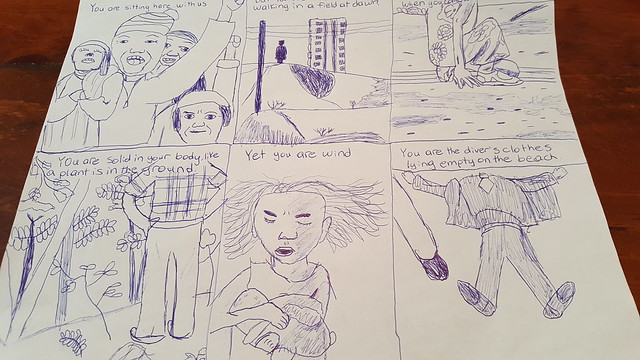
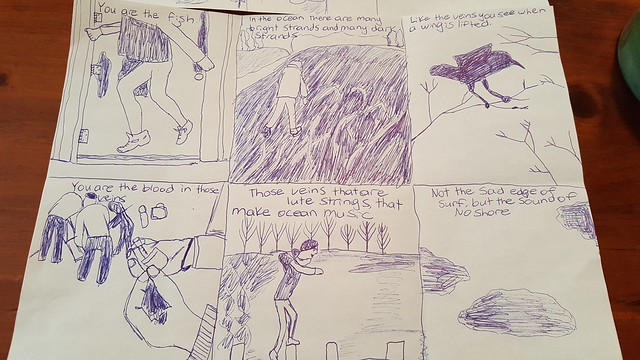
One of the exercises is to memorize and illustrate a poem.
This is my daughter’s version.
I think it’s insanely beautiful.
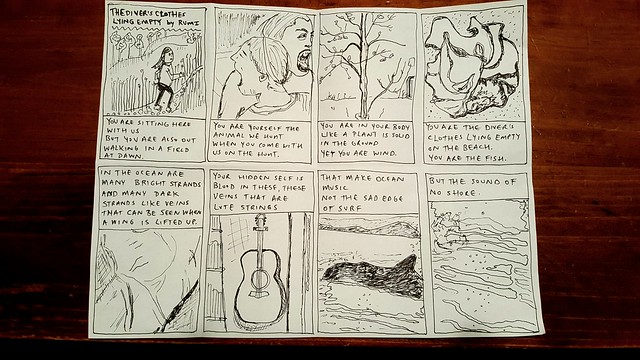
We drew from pictures we’d clipped from the newspaper and magazines. This is my version. I started with a cartoon, but switched to realistic drawing after the first panel.
This is the second time I’ve done this exercise. Here is my first version of the same poem, illustrated.
I think the exercise could be completed in a number of different ways. It could even be done without doing any drawing whatsoever: the text could be illuminated with interesting lettering, or by changing the shape on the page.
The poem is “The Diver’s Clothes Lying Empty,” by Rumi, as translated by Coleman Barks, if you want to look it up.
xo, Carrie
PS The tiny print at the bottom of the Record/Collect section of the course outline includes the instructions to collect graphic novels and comics you admire, i.e. Skim, by Mariko Tamaki and Jillian Tamaki; and Jane, the Fox and Me, by Fanny Britt and Isabella Arsenault. I will keep adding to this list. Do you have any favourites?
Wednesday, Mar 16, 2016 | Books, Confessions, Holidays, Reading |

I haven’t been inspired to write much this week. We are on March break in Canada, which means the kids have the week off school. Yesterday, I basically drove back and forth between our house and indoor sports fields: twice to basketball camp, once to a soccer game, and once more to take a child to a referee clinic and then pick her up. I considered, briefly, going to one more indoor field to watch one more soccer game, but couldn’t muster the strength. Instead, if memory serves, I sat in my office in my coat and looked at videos on FB. People post a lot of videos there, now. I reposted one, which shows the faces of every woman who has won a Nobel prize. So I’m part of the problem, not the solution.
The solution, I find, is not to go onto FB. In fact, when I’m writing well, I’m not tempted and check it rarely. I go there to be entertained, and I’m aware of that.
On the weekend, I read Sarah Waters’ The Paying Guests, which I couldn’t put down, plus it was scaring me, so I had to read it during daylight hours, not before bed. I rarely read books during the day, almost only before bed. This seems ridiculous given that every day I read magazines (including The New Yorker, Harper’s, The Atlantic, Macleans) and the daily newspaper (The Globe and Mail). I’m reading all day long! So why not books? Why reserve book-reading for just-before-sleep? I wonder if it’s because books are so consuming? I need to fall asleep in order to stop reading them. If I were to pick up a book during the day, I wouldn’t want to put it down. Newspapers, magazines, these are meant to be digested in short spurts, glanced at; but a book is immersive.
Maybe people join book clubs to give themselves permission to sit and read a book, especially fiction. There’s almost something illicit about the attention a book demands. You’re going to another world, you’re time-travelling, you’re living inside someone else, seeing through another’s eyes, you’re lost to the present moment. I have found books to be healing, necessary, important. But despite this, my mind categorizes books as indulgences, sweet treats, guilty pleasures. I have to let myself go in order to enjoy them. Maybe I should do that more often … especially during a week when I haven’t felt much like writing.
xo, Carrie
Wednesday, Dec 9, 2015 | Books, Dogs, Exercise, Fun, Mothering, Music, Play, Running, Soccer, Swimming, Writing, Yoga |
Today, I want to write about the little things. Little things that might seem unimportant because they’re not on any to-do list, they’re not responsibilities. Little things that might seem incidental in a bigger picture, not the heart of any day, but the flavour. Little things that give me a little peace. I’m knee-deep in marking and have to stay on schedule, so this is not what I should be doing, but I’m going to make a list of “little things” to mark this particular moment in time. At other moments, I might put other things on this list. But today, now, here is what’s given me a little peace recently.
Playing the piano. Either my own improvised noodling around, or sight-reading cheesy Christmas songs, or accompanying my ten-year-old during her violin practice.
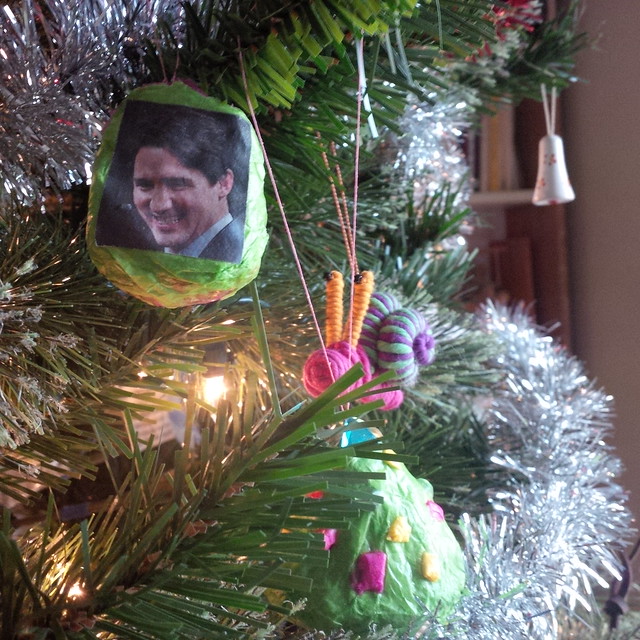
Crafting. I know, weird, right? Not my usual thing. But I’ve gotten into a latch-hooking project, initiated by my ten-year-old (who loves her crafts). Same child also initiated an ornament-making craft-time this weekend, and everyone in the family got involved. My personal fave are the Trudeau ornaments, crafted by my thirteen-year-old (who has a new haircut, very stylish, if I do say so myself; I gave both my teenagers haircuts recently, which is another kind of craft, in a way, I suppose).
Walking the dogs. I’m running very little right now due to injury, but I’ve found surprising peace in walking the dogs before bedtime, or on an early weekend morning when the neighbourhood is quiet. The pace is gentle. The dogs amuse me.
Swimming. To replace the running. Monday was my first day, and I went with my swim coach, who also happens to by my thirteen-year-old daughter. She should be your swim coach too. Our session was as tough as a boot camp. She’s demanding, encouraging and kind, and smart about correcting technical flaws in my stroke. (She also coaches Kevin and her younger sister on Thursday mornings. So this is a little thing many of us in the family are enjoying right now.)
Coaching. Right now, I’m coaching my fourteen-year-old’s indoor futsal team (similar to soccer), and I’m volunteering with my ten-year-old’s soccer team, too. I love working with both groups of kids — the teenaged boys and the younger girls. I’ve been practicing my deeper coach’s voice around the house, and every practice or game is another opportunity to learn something new, or put some new concept into practice (for me, and for them). It’s the perfect activity for a person with a growth mindset outlook. We can always get better! Hurray!
Writing. I haven’t had a lot of writing time, recently, so I’ve been taking my laptop to basketball and soccer practices at which I’m not involved. Earplugs in. Sweet vanishing into another world.
Stretching. My body needs to stretch, loves to stretch. I’ve been squeezing in a few yoga classes.
Reading. A couple of days ago, I thought I had a few free minutes. Ever have those moments? When you think, how strangely wonderful that I should have nothing to do? So I sat in front of the fire devouring Elena Ferrante’s The Story of a New Name. I was so relaxed, so blissful — so blissfully forgetting that in fact I did have something to do. This strangely wonderful moment had been brought to me by a memory lapse. I’d forgotten to pick up my youngest at school; friends had to help out; and I felt embarrassed and somewhat shamed for my parenting lack as I jogged along the sidewalk, late, late, late. Nevertheless, I can’t help but wish for more of those rare “free” minutes for daytime reading.
All for now. Please comment if you have “little things” that give you a little peace, too.
xo, Carrie
Wednesday, Nov 18, 2015 | Birthdays, Blogging, Book Review, Books, Kids, Reading |
There are times when the world is too much with us, and a gut response is not sufficient, what’s needed is time and reflection and perspective. I’m not ignoring what’s happening in the larger world. I’m interested, I’m engaged, I’m paying attention, but I don’t have anything useful to say about it, here.
As of today, I’ve got two teenagers under this roof, and I think their growing independence and autonomy is stoking my growing impulse to step back into the shade of obscurity. I don’t know what the purpose of this blog is anymore, which is why I post here more and more rarely.
I still want to keep this space open, for when I do have something to say. But I don’t want to say something just because this space exists.
Today, I want to tell you about the wonderful books I’ve been reading.
I finished My Brilliant Friend, by Elena Ferrante, and immediately dove into the second book in the four-book series, translated from the Italian. I’ve heard this series compared to Karl Ove Knausgaard’s My Struggle, but to my mind, they are unrelated. Ferrante has a wider world view than Knausgaard, even if she is examining in detail a very particular time and place: she is depicting the assertion of power itself through the generations. It is the story of a friendship, and of two girls (now young women, in the second book), and it is told from the perspective of one of the women, but it is not about the rigidity of an individual point of view (which Knausgaard’s series seems to be explore), but about the flow of power and knowledge and ritual that shape an individual in ways that are beyond her control, even if she is aware of them. Ferrante observes patterns, large and small. The patterns of place. The patterns of family, of neighbourhood, of wealth and poverty, of knowledge, of culture. This is extremely rich and immersive writing, but it is also propulsive in its pacing. I won’t be reading another book until I’m finished the whole series, but at the same time, I don’t want it to end. It will be like saying goodbye to a friend.
I am thinking of My Struggle in relation to this book because I recently finished reading the third book in that series, Boyhood Island. I can’t read this series quickly. It’s like being trapped inside someone’s mind, someone who has a limited understanding of how he is being received in the world around him, and the effect is claustrophobic, and sometimes even alarming. But I remain interested. I will continue reading through this series, but at a much slower pace. I have no sense of urgency in my quest. It’s more of a commitment to see a thing through.
Another recommendation: Outline by Rachel Cusk. She is the British writer who was born in Canada and whose book was a finalist for two major Canadian prizes this season; there were complaints about how Cusk scarcely qualifies as a Canadian, and that may be true, but I’m glad she made the lists or I wouldn’t have discovered her. I devoured this book. I loved it unreservedly. It is highly stylized, enormously intelligent, and although told in the first person almost erases that person entirely, so that everyone around her leaps into the world fully fleshed, but she never becomes more than an outline on the page. It is the strangest feat, an accomplishment of great discipline. It made me question the purpose of the first person narrator, and the purpose of the writer, too.
Meanwhile, I’ve been reading out loud to the kids in the evenings: especially the two youngest (ages 7 and 10). So far we’ve read Tales of a Fourth Grade Nothing by Judy Blume, and we’re nearly through From the Mixed Up Files of Mrs. Basil E. Frankweiler, by E. L. Konigsburg, both set in New York City, both stories about siblings.
All for now.
xo, Carrie
Friday, Aug 7, 2015 | Adventure, Birthdays, Books, Exercise, Fall, Family, Friends, Fun, Good News, Running, Travel |

While I’m blogging lots this week, and because I won’t be blogging much (I suspect) in the week or two ahead, I’ll take this moment to highlight another tab, above, on my web site: Upcoming Events. It’s not new. But it’s handy. It’s where I keep track of readings, speaking engagements, festivals, launches — everything book-related.
For starters, next week I’m heading to the Sunshine Coast Festival in Sechelt, B.C. This is my first time at the festival, which I hear is amazing, and my first time on the Sunshine Coast, and my first time bringing the whole family along to an event like this (they likely won’t come to the reading itself, but the organizers have kindly invited our family to several other events and found us a family-friendly cottage by the ocean to stay in, while we’re there — see, amazing!). This is also our first major summer family holiday ever. The last time we flew somewhere together, we spent Christmas in Nicaragua — and we only had three kids. That’s a long time ago. (Note to self: must find a way to return to Nica again; I’ve visited once a decade since childhood.)
Then, in September, I’m going to Spain! I’ve been invited to the Hay Festival in Segovia, with the Spanish-language version of Girl Runner: La corredora. This trip will be a whirlwind, hosted by my Spanish publisher, Alfaguara, which is launching the book this fall. (The family is staying home; sorry, guys.)
I return home in time to visit the Halton Hills library, which has chosen Girl Runner for its One Book: One Community program (very exciting!), and then just a few weeks later, in October, I’m flying out to Victoria (solo) where I’m a guest speaker at the Victoria marathon. Sadly, there’s no way I’ll be in shape to run the marathon, but in my dreams I somehow manage to conquer the half. This hasn’t been a high-mileage summer. I’ve been averaging three runs a week, rarely more than 10km, often less. One change is that I rarely run alone anymore. Almost all of my exercise is social, right now: meeting a friend is motivating, and it’s fun. But if I’m going to add more miles, I will have to do some longer solo runs.
Kevin is recommending that I start listening to podcasts while running. He’s become a convert to the short story form by listening to The New Yorker fiction podcast while running around the neighbourhood with the dogs. I listened to one just this morning, while making poached eggs for Fooey (it’s her Birthday Eve!): a story called “Love” by Grace Paley, as read by George Saunders. If you think you don’t like short stories, try out this podcast. It combines the reading of a story with a conversation afterward between a well-known writer and the New Yorker story editor: it’s like listening in on a really informed book club discussion.
Love is poaching eggs for your almost-ten-year-old; love is kicking a soccer ball for two hours with your seven-year-old; love is watching a leader’s debate (Canadian version) with your twelve-year-old; love is driving back to camp to fetch your fourteen-year-old; love is sharing earphones and stories with your husband.
Hm. That was really cheesy. I feel compelled to apologize a) for writing it and b) for not erasing it. But hey, maybe you’ll want to make your own list? Enjoy your weekend.
xo, Carrie
Page 8 of 25« First«...678910...20...»Last » 
 On the weekend, I walked to the library with my elder daughter. While she browsed in the non-fiction stacks — the theoretical physics section — I played a little game that has served me well over the years: I wandered a little further (no theoretical physics for me) and plucked titles at random from the shelves, my choices based only on title or subject. In quick succession, I skimmed and rejected two books on Scottish folk and fairy tales, but my third choice had me sitting cross-legged on the floor, entranced.
 Here is Rachel Carson on her belief in the universal accessibility of science: