Wednesday, Jan 15, 2014 | Books, Confessions, Friends, Kids, Organizing, Play, Reading, Running, School, Soccer, Swimming, Work |

good morning
Alert: rambling post ahead. My thoughts are failing to cohere around a single theme, and so I shall offer a messy multitude.
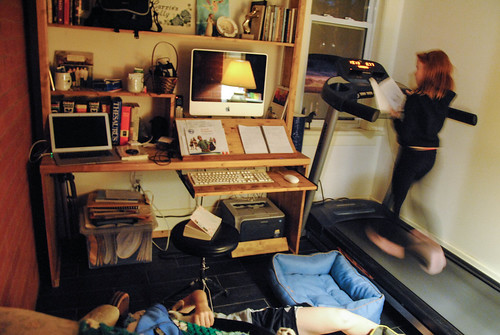
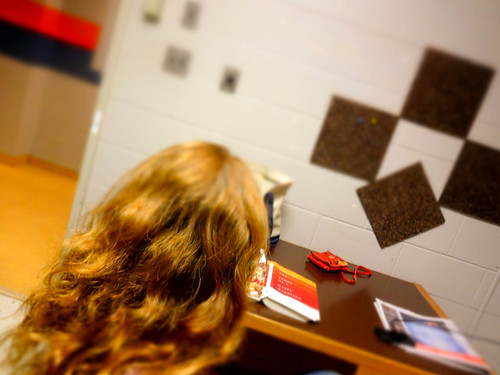
Above, my desk. Coffee cup, cellphone, book I’m currently reading, computer-now-used-mainly-for-processing-photos-as-it’s-dying-a-painful-death, and calendar. Good morning, this desk seems to greet me. I didn’t run because the roads are super-icy, so I didn’t set my alarm, so I overslept, so the getting-everyone-out-the-door portion of the morning was hairy, so I decided to walk the little kids partway to school, so Fooey forgot her glasses, so I had to run back home to fetch them, so I had to drive anyway to get them to her, so I drove her big sister as well, so I stopped for coffee and a croissant at Sabletine on my way home. Ergo, I’m over-caffeinated.

the days are packed, and so is this office
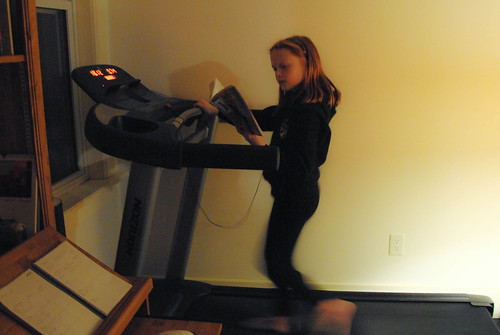
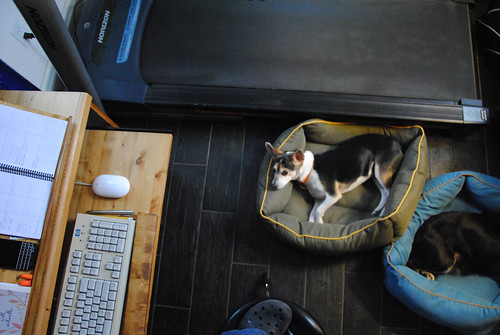
I’m not sure my office could accommodate much more than it already does. It’s a small space. And yet it feels almost miraculously expansive. At times I think that could be a metaphor for life itself. Look at what’s going on here: we’ve got a reader and exerciser walking on the treadmill (she read for TWO MILES on Monday evening!); we’ve got another child, legs and arms just visible in the bottom of the photo, lying on the warm tile floor soaking up some doggie affection; we’ve got books, light, art, work, family, all tucked into this small space.
Some days feel like they have themes or threads tying them together.
Saturday was “free stuff” day, as mentioned in my previous post. By early afternoon, we’d received a free treadmill and a free foosball table. That evening, Kevin and I went to the Princess theatre for dinner-and-a-movie, using a gift certificate given to us over a year ago. (We saw Philomena, which I recommend, although we were a good twenty years younger than anyone else in the theatre). We also scored “free” babysitting from Albus, who agreed to be in charge during our absence in exchange for pizza. On the walk to the theatre, I found a pair of i-pod headphones lying in a puddle, which I decided to rescue rather than leave to ruination in the puddle. I feel slightly guilty about that free find.
Yesterday’s theme was good news on the professional front, with hairy/heart-rending complications on the domestic front.
The professional news is nothing to share, particularly; more to do with ongoing conversations and future plans. But it was lovely to receive pleasant messages in my inbox sprinkled throughout the day.
Not much else went smoothly. I’d planned to pick the younger kids up from school to take them to swim lessons. I sent a note to CJ’s teachers to tell them “no bus,” please. I arrived just as the bell rang to discover the note had been missed, and CJ had been sent to the bus line. I tore through the school to retrieve him (thankfully, in time), but by the time we got back to our original meeting spot, Fooey had come and gone, all in a panic at not seeing us there, so we waited and waited and waited not knowing what was happening while Fooey ran around the school (it’s become very sprawling since they built on an addition). By the time we found each other, she was breathless and in tears, and we were late.
Meantime, Albus texted to say he was at a friend’s house, which left me worried about AppleApple, home alone — did she even have a key to get in? Did she know about her soccer practice, starting early? I texted Kev to call home, and added, “You will have to do supper.”
I’d planned to run at the track during swim lessons. By the time people had changed and gone to the bathroom and made it into the water, I had about twenty minutes total to run. So I ran as fast as I could, round and round and round, blowing off steam. As I helped CJ shower and change, I realized I was pouring with sweat … and that my best-laid plan did not include time for me to change (let alone shower!) between dropping the kids at home and racing with AppleApple to the early soccer practice. Suffice it to say that we arrived slightly late at the indoor field, my face lightly splashed with water from Fooey’s shower, wearing decent clothes.
The heart-rending bit went like this. I met a friend for lunch. We had a lovely time together. On the walk home, the weather warmer and sunnier than expected, we passed the social services building, and a young mother exited behind us. She was berating her child, who was no more than two, and who made not a peep. Her tone was loud and angry and caught our attention. My friend and I both kind of froze, went silent. We kept glancing over our shoulders as we walked, keeping the young woman and child in view. Should we intervene in some way? We asked each other. We didn’t know. I think it haunted us both — not knowing whether to speak up, and haunted even in the moment by the fate of this child, and by extension the fate of every child made to feel unwanted or unloved. (I must add that at no time did the child appear to be in any physical danger.)
I’m currently reading a book sent to me by my UK publisher (Two Roads): The end of your life book club, a memoir by Will Schwalbe. Read it. It’s a meditation on the shared reading experience, and the mother/son relationship, and all the while it illuminates and reflects on the particular life of the author’s mother, who is described as a woman always open to the world around her. She’s a natural leader and visionary who believes in action. She meets everyone’s eye. She asks questions of everyone she meets. She listens and responds. She never feels she knows too many people or has friends enough or worries about having too many relationships to sustain — she faces the world (and its pains and problems) with genuine welcome. I’m a bit in awe of her. I want to learn from her.
I wonder whether she would have found some entrance into the young woman’s life. I wonder, thinking it over later, whether it would have been helpful to approach and offer to watch the child or carry him to the bus stop, so the young woman would have had a moment to collect herself and burn off steam. (I didn’t think of this in the moment.)
I felt that my posture and response to the situation was fearful. I was afraid of appearing judgemental and intrusive rather than helpful. I was afraid of getting in over my head. I was afraid of having the young woman’s anger turned on me. I was thinking of the invisible enormity of the problems, hidden like the tendrils of mushrooms, underneath, and I was overwhelmed and paralyzed.
In the end, we walked on (after observing the young woman reach the bus stop with her child), unable to speak of anything other than what we’d seen, weighed-down and saddened and heart-broken, a bit. Truthfully, I don’t know whether we should have done anything differently. But I haven’t been able to let it leave my mind either.
Saturday, Jan 4, 2014 | Book Review, Books |

Last year was the first that I kept track of the books I read: see Reading List, 2013, on ongoing project. (For stats from 2013’s reading list, please go to the bottom of this post.) I liked keeping track so much that I’m doing it again this year. I will be updating the list regularly, and there will be a link to this page on the RH side of the blog. As before, I will arrange the list in blog fashion, from end to beginning, with the current month and most recently read book appearing first.
July
My Struggle: Book One, by Karl Ove Knausgaard
* bought at Words Worth Books
Too much to say. Was only going to read the first volume, but have since bought the second. Yes, it’s as advertised: an oddly compelling “autobiographical novel.”
June
The Clocks, by Agatha Christie
* borrowed from my brother’s shelves
Not one of her best. Written rather late in her career. I guessed the ending, which always disappoints me in an Agatha Christie book.
Shakespeare: The World as a Stage, by Bill Bryson
* book on tape, borrowed from the library
My daughter and I listened to this ebook on our drive to and from Ottawa. It was a pleasure, and we learned lots, although Bryson’s stylistic tics were pronounced, somehow, by his reading. If something wasn’t described as “excessively” something or other, it was “astonishingly” or “shockingly” or “thoroughly,” etc. We got a kick out of noting every hyperbolic exclamation.
May
Farmer Boy, by Laura Ingalls Wilder
* from our shelves, dating from my childhood
It felt like we read this book all winter. Our energy for the series kind of waned (we’d left this book to read last). In fact, we’d had only one chapter left to read for the better part of the month, but just hadn’t finished it off. I insisted we finish it before May ended, so we literally read it on the last chapter on the last day of the month. The kids felt like it ended abruptly. (In fact, it may have ended abruptly because my copy is completely wrecked and missing its cover. Hm. Was the last chapter really the last chapter?) The book is an idealized portrait of farm life, but appealing for that. Who could make, yet alone consume, all that luscious food for ordinary every day meals? I skipped any sections that detailed the building of things. The kids’ favourite chapter was my favourite in childhood too: where the parents leave the kids home alone for the week, and the kids eat all the sugar. AppleApple was particularly taken by the idea of being home alone and in charge, and thought they could manage it, if we’d like to try going away. Yeah. Not going to happen anytime soon…
All My Puny Sorrows, by Miriam Toews
* bought at Bryan Prince Booksellers after a reading there (with The M Word) earlier this month
I wrote about this in detail on my main blog. I was deeply moved by this book. I have quibbles with it, but only quibbles. I think that its structure is a bit rough and the writing seemed flat at times, the sentence structure repetitive, but I couldn’t decide whether or not that bothered me (I’m looking at it from a technical standpoint, and I’m a bit of a perfectionist when it comes to structure; but I don’t think this detracted from the reading experience, so here is a case of a looser structure serving a larger purpose). There was a lot of bitterness in the book too, expressed by the main character — rage at a health care system that treats mental illness differently than other illness (a rage that is more than justifiable); and the gutting portrayal of abuse of power within the Mennonite church (an experience that doesn’t ring true to mine, but I didn’t grow up in a conservative, isolated Mennonite community). So there’s anger coursing through this book, as well as genuine peace. I was deeply touched by what Toews offers her reader.
My Life in Middlemarch, by Rebecca Mead
* loaned to me by a friend who thought I would love it
And she was right! I really loved this book. Part biography, part memoir, part literary investigation (not quite critique). The author is a gifted writer and reader, and also researcher. I didn’t know as much about George Eliot as I’d imagined I did. I found it interesting that her partner, George Lewes, referred to her, when she was working, as “him” or “he.” But it doesn’t seem that she was at all conflicted about her sexuality — George Eliot was a pseudonym taken for practical reasons, as Mary Ann Evans (or Marian Evans) was already a well-known critic and essayist, and she needed to separate her fiction from her reputation. Writing fiction was a much better money-making proposition in the mid-1800s than writing essays; she did very well, and was able to support her partner’s children and his former wife and the children her partner’s wife had had with another man (these were complicated domestic arrangements, not sanctioned by church or state). It strikes me that the most interesting and often the most creatively accomplished individuals do not abide by the constrictions of their time. (But I do. Should that concern me?) I like to write about that character, but perhaps I’m not brave enough or adventuresome enough to take big risks. Or maybe, like Mary Grant in Middlemarch, I’m devoted to the “home epic.” I live it out. I may be making other sacrifices I’m not willing to acknowledge, by living this way.
God Loves Hair, by Vivek Shraya
* bought after seeing Vivek read at an Indie Lit Night in April (where I also read)
Vivek has huge stage presence and confidence, and I had to buy his book after hearing him perform several of his stories. They are sweet and short and autobiographical, snapshots of a Canadian childhood and adolescence very different from own, which is one reason I loved reading them. At times very moving, and at other times very funny, the stories address self-discovery, bullying, sexuality, religion (specifically Hinduism), and family — being part of a tiny family unit living in a country and culture far from extended family, who live in India. Most moving for me is the depiction, in stripped-down not-at-all sentimental terms, of the loving support of a mother who seems to see her child as he is, and to celebrate him (she buys him his own eyebrow plucker, for example). I wonder if my older children might be able to read and relate to these stories too.
April
The Prime of Miss Jean Brodie, by Muriel Spark
* copy from my shelves
This is such a good book! If you haven’t read it, you must. First published in 1961. Read on assignment for a piece commissioned by the lovely editor Kim Jernigan, to be published in CNQ, so technically it was work, but for all practical purposes it was a complete joy to devour again.
Ellen in Pieces, by Caroline Adderson
* read from ARC
The M Word: Conversations About Motherhood, edited by Kerry Clare
* contributor’s copy
I read through the whole book on an afternoon when I was feeling wiped out by the demands of motherhood mixed with maintaining a professional career as a writer. I was poolside watching my daughter swim interminable laps. I was jet-lagged from having been overseas. I’d meant to go for a run, and instead I sat and read these essays. This is not a book about how to be a mother. It’s not prescriptive. Instead, I think it’s about why we are or aren’t mothers, and how we came to be (or not to be), and how our choices affected and continue to affect our identities. So it’s an interesting conversation, as you can imagine. I hope you’ll consider reading it too. My essay is about being the mother of four children.
Twenty tabloid-type texts, plus maps, plus broadsides, printed between 1548 and 1688
* read at the British Library
Research.
Philomena, by Martin Sixsmith
* bought for my Kobo, to take to London
The book that the movie was based on. I didn’t like it enough to finish it, and probably never will. The writing was a bit simplistic for my taste, and the story it tells is so horrifying that having been through it once in the movie version, I didn’t feel like stomaching it again on the page. If you’re already not a fan of the Catholic church, this story is so obscene in its abuses of power and corruption that you’re likely to run screaming in fury. Another story of power gone wrong. What is it with the powerful institutions and individuals? Is there any way to be powerful and behave in ways that aren’t merely neutral or benevolent when it pleases those who will keep them in power (which seems the best we hope for these days), but that actually benefit those they are supposed to serve regardless of whether or not it serves them too.
First chapter of The Devil Wears Prada, by Lauren Weisberger
* plucked off the shelf at a friend’s house
Dreadful. Painfully bad writing. So I stopped reading.
Word Nerd, by Susin Nielsen
* borrowed from the library (I should really buy these books for our shelves!)
Loved it. Couldn’t put it down. Stayed up past midnight reading it. (A young adult novel.)
March
Dear George Clooney, Please Marry My Mom, by Susin Nielsen
* borrowed from the library
Another brilliantly written, unputdownable book for young people (to use a blurb word that isn’t really a word and should probably be outlawed; sorry. It really is impossible to put down!). This writer is wonderfully capable at capturing the adolescent voice.
Imagined London, by Anna Quindlen
* bought at Words Worth on my birthday gift card
Really lovely little book by a writer I haven’t read before, and would very much enjoy reading again. The book describes visiting London as an adult, after having absorbed London into her imagination through decades of reading about the city, across the centuries. I’m about to go to London for the first time in my life, and it seemed a prescient book to pick up and read. I’m wondering how much of the old city I’ll be able to find and whether I’ll be able to feel its age as I walk around.
The British Library Guide to Bookbinding: History and Techniques, by PJM Marks
* borrowed from the WLU library
A short sweet guide to a history of bookbinding, with illustrations. I see that it’s the British Library’s guide, and I’m going to be at the British Library in a week! Hurrah! Bookbinders often worked separate from other craftsmen in the book trade. Books could be shipped and stored in sheets, and then bound on demand, sometimes in other countries, and sometimes months or years after the original publication. Bookbinders would sew the sheets together, and then create a spine and cover, using different materials, like vellum, made from animal skins (which was cheap to produce) or leather or actual wooden boards (oak in England). Some bookbinders were known for their talent at decorating the covers, sometimes with elaborate insets, painted pictures, embossing, engravings, etc., but most worked in more rudimentary ways, using the cheapest and quickest techniques: it was a poorly paid trade, which nevertheless required a seven year apprenticeship. This information is only moderately helpful to my research, as I’m more interested in the short, unbound broadsides and quartos, but still fascinating as I figure out who was involved in the book trade, and how all the pieces fit together.
The Stone Angel, by Margaret Laurence; A Jest of God, by Margaret Laurence; and Lady Oracle, by Margaret Atwood
* from my shelves
I tried and failed to finish re-reading all of the above. I’ve got a writing assignment that involves re-reading a book that I haven’t read in years, but remember as foundational or influential in some way. I’ve been striking out cold. I may yet try The Handmaid’s Tale, by Margaret Atwood. I know better than to pick up In the Skin of the a Lion, by Michael Ondaatje, which was a hugely important book for me from the ages of 16-20, nor would I deliberately ruin my lovely memories of Franny and Zooey (the cigarette smoke!) or any other J.D. Salinger; I think Di Brandt’s “questions i asked my mother,” discovered at age 15, might also be ruined by re-reading now. I am still considering trying Northanger Abbey, by Jane Austen, which I found and LOVED during my homeschool years, around the age of 13; and Middlemarch, by George Eliot, which I only read once, during grad school (and not because it was assigned, only because I wanted to). All of these books, with the exception of Middlemarch, are books I read not once, not twice, not three times, but so many times over I couldn’t count them–books read for comfort or to match a particular mood, the way other teens might turn to favourite songs.
The Reluctant Journal of Henry K. Larson, Susin Neilsen
* borrowed from the library
I borrow a lot of children’s books from the library to feed my children’s enormous appetites for reading. I try to choose a variety of books to entice their different interests and ages and reading abilities. Albus tends to enjoy non-fiction, and still prefers easy reads like graphic novels; AppleApple reads really widely, but has only recently become interested in books with “real” characters and more mature themes; Fooey likes many of the same books that Albus enjoys, plus she’s drawn to the girlier themes and covers; and CJ is loving reading books with simple vocabulary to me. But I also choose books that don’t fit in any of these categories — I wasn’t exactly sure who this book would appeal to, and in fact, no one spontaneously picked it out of the library basket that I keep in the living-room. In fact, I grabbed it at random to take to a soccer game as entertainment for AppleApple — mostly because I was pretty sure she hadn’t read it, and it’s hard to find books she hasn’t read around our house. She devoured it. I read it immediately afterward, having observed the effect it had on her. I’m still thinking about the book days later. It’s not for the younger reader, and it should be read with a parent on hand to discuss the issues raised (and there is some violence — it’s a book about bullying in the extreme). But it’s also funny and heartwarming and heartbreaking and fast-paced. Highly recommended.
One Summer: America, 1927, by Bill Bryson
* birthday gift (to Kevin)
I always enjoy Bill Bryson’s writing, but must admit this book seemed a little flabby, in need of a good sharp edit. I was curious to read Bryson’s take on that fascinating decade in which my own book is set, but I came away feeling like it was a very white male history. I don’t say that to sound reactionary. It was honestly as if women and people of colour scarcely existed. I know Bryson was writing an entertaining romp about the big events of that summer, including Babe Ruth’s home run battle with Lou Gehrig, and Lindbergh’s flight across the Atlantic, but I kept wondering where everyone else was. Maybe I’m more interested in social history than big event history. (No need to mention it’s also a very American perspective.) The most fascinating insight I gained from the book was the apparent mass acceptance of extremist thinking that coloured the era: Hitler’s ideas and methods had roots that spread far and wide, including in North America. Anti-semitism was casually accepted, for example. Lindbergh himself turned out to be a vocal eugenics supporter (not to mention bigamist, but that came later). On the whole, it was an entertaining book, with lots of Brysonesque tidbits to enjoy. But I’d like to read an equally entertaining history of the era that would include marathon swimming and dancing (women excelled at both events), Edna St. Vincent Millay, the poet who in her time was so popular that audiences packed great halls on see her, and some of the musical history, too. What was happening inside those speakeasies during the Prohibition years? (Note: Canada ended Prohibition years before the U.S., so those histories don’t neatly align).
Crazy Town: The Rob Ford Story, by Robyn Doolittle
* borrowed from a friend
This book got me thinking about tyrants and celebrities and leaders. Larger than life. That’s how we want our heroes. That’s why the most impossible-seeming characters wind up in power, despite being bumbling fools or ruthless autocrats or outright sociopaths. We want stories: we want myths. We always have. The gods and goddesses had outsized appetites and were obviously flawed, but we never said we wanted perfection, we the people. We are awed by enormity, by behaviour on a scale we can’t imagine of ourselves, whether it be idiocy or tyranny. Vladimir Putin is larger than life. He may appear bizarre to the Western eye, posing shirtless while conquering a variety of wildlife, but he knows what he’s doing: he’s creating a potent myth of himself. What an oddly self-inflated little man, we might think, while he smiles like the Mona Lisa and crushes his opposition. Rob Ford is larger than life. His appetites are renowned, his body enormous, his ego inflated, his inability to speak the truth unstoppable, his buffoonery legendary. Larger than life figures are built on their own lies. It is not their truth-telling or transparency that gives them power. It is their ability to create and sustain a mythology that absolves them from the ordinary rules of behaviour and self-governance. But they couldn’t achieve this alone. They needs us. And we comply. It makes sense that it’s the tyrants who are best at constructing mythologies. If the means are corruptive than the ends must be bad. We know larger than life figures have sold their souls for fame, power, wealth, even the lesser lure of celebrity. We get that desire. It’s the same one we recognize in ourselves: the desire to outlive death. Immortality. It takes the rare human being to transcend the artificial means of myth-making and become larger than life by virtue of a life lived largely. I think it’s why most true heroes live and die anonymously. Their humility prevented them from becoming larger than life.
February
Writing the Way Out: Inheritance and Appropriation in Aemilia Lanyer, Isabella Whitney, Mary (Sidney) Herbert, and Mary Wroth, by Ann Margaret Lange
* borrowed from UW’s library
Research. This was not a fun read, and I didn’t force myself through the rather tedious line-by-line reading of the women’s writing (these were some of the first women known to author and publish their work in the English language, circa 1570-1620). What I found most interesting were the biographical tidbits. Lanyer in particular lead an interesting and unusual life, born to court musicians and a musician herself, educated well enough to write and publish, and conducting an affair with a powerful courtier that did not damage her reputation in any way — when she became pregnant by him, a marriage to another court musician was arranged as cover. I also now want to know what a “bookwheel” is. It was mentioned in relation to Mary Herbert, who spread her books around to do research, or arranged them on a bookwheel (in a bookwheel?). The reference was in a text written in Mary Herbert’s time, and the author of this book didn’t seem to think it needed defining. But I’ve never heard of a bookwheel.
English Almanacs, Astrology, and Popular Medicine: 1550-1700, by Louise Hill Curth
* borrowed from UW’s library (on my alumni card)
Research. One interesting tidbit I noted was that the midwifery manuals of the time gave instructions on how to bring on a late cycle (ie. terminate an early pregnancy), as pregnancy wasn’t considered to have begun until “quickening,” which is when the mother could feel the baby moving inside her (usually sometime early in the second trimester). Another interesting tidbit was that some “hack” writers worked directly for printers and actually lived on the premises, churning out cheap text, basically.
Little Bee, by Chris Cleave
* bought from Words Worth on my birthday gift certificate
I loved this book. It’s haunting, though. I met Chris Cleave when we read together on stage at the Vancouver International Author’s Festival. He’s a talented writer who knows how to craft a good story. He also writes compellingly in the voices of his characters — in this case, a teenaged refugee girl from Nigeria, and a high-powered British women’s magazine editor. It’s the refugee story that’s haunting. It’s set in Britain, but feels relevant to what’s happening here in Canada, too, as Canada’s federal government takes a hard turn away from helping refugees, including cutting access to health care. A refugee is by definition a person who is seeking refuge. Refugees do not leave their homes by choice. Many have survived horrors we fortunate Canadians can’t fathom. To criminalize, marginalize, or further disadvantage those who come seeking help seems at best callous, and at worst actively evil. I wonder: why do we think we deserve our wealth and comfort? Doesn’t everyone deserve to be treated with dignity, no matter where they’re born?
The Days Are Just Packed, by Bill Watterson
* from our shelves
More Calvin and Hobbes as bedtime reading for the little guy (and sometimes other listeners too). I think we might have found our favourite strip in this one, though. Calvin’s mother is walking through the house discovering a complete disaster, obviously caused by Calvin. She roars out, “CALVIN?” Calvin appears before her, wearing one of those masks that has eyeglasses, nose, and moustache attached. He affects an accent: “Who eees theees Kahlveen?” That is one of our new favourite lines. But I’m ready to find a new bedtime book to read! Maybe when we get the gas stove installed in the living-room we can start reading together in front of the fire. I think part of our problem right now is location: I read to CJ in his bunk bed, which has room for the two of us and maybe Fooey, although AppleApple tries to crawl up sometimes too, and all the while I’m worrying that the whole thing is going to collapse onto Albus who is lying in the bunk below.
How To Be A Woman, by Caitlin Moran
* bought and read on my Kobo
I’ve wanted to read this book for awhile, and came across a snippet quoted in Macleans regarding hair removal, and that sealed it: I was sick and couldn’t get out of the house, so I purchased it instantly for my Kobo. (This is the excellence and danger of e-books, and it makes me nervous for traditional bookstores, which of course I continue to love and support). This was a good Kobo book. I probably won’t read it again, and don’t particularly feel moved to share it, although I enjoyed it very much, and would recommend it to other feminists c. my age. The author is, in fact, almost exactly my age. Many of her observations (this is billed as a feminist manifesto for our era) felt familiar, like I’d thought them already myself. Her style is witty and very British, and she has a much more casual attitude toward drinking, smoking and doing drugs than I do (in fact, I thought the chapter titled “Intervention” might be about her family doing an intervention on her, given the number of times she describes being falling down drunk; but it turned out to be a lucid argument against plastic surgery). She grew up poor, the eldest of a very large family (even larger than mine! 8 kids!), and was homeschooled (like me!), and became a wunderkind writer in her teens (not at all like me!), and perhaps its the proximity with celebrity that pressures her to behave in ways that I actually don’t feel remotely pressured to conform with, such as Brazilians, plastic surgery, and owning a $1000 handbag and staggering about in stilettos all day. Honestly, I feel neither pressure nor interest in any of these things, nor do I feel less of a woman for not caring. The chapters on those subjects felt beside-the-point. Her view of women as history’s “losers,” however, makes a lot of sense: that the reason women continue to struggle for equality is that for millennia we were shut out of doing anything: pre-20th-century there are virtually no female philosophers, scientists, artists, composers, architects, politicians, or explorers. We got to be muses, nuns, mothers, or whores. We’ve therefore left a thin trail of visible accomplishment over many centuries, and this has been treated as proof of our inferiority. But we’re not inferior: what we lacked was birth control and antibiotics to treat UTIs (a compelling theory, I think). She suggests asking a simple question to identify insidious forms of sexism: do men have to do this too? i.e. Do men face pressure to totter around in shoes that prevent them from running away from a predator? Nope. There’s some sexism right there. So recognize it, and be done with it. Unless you really love your stilettos, I guess.
January
What We Talk About When We Talk About Anne Frank, by Nathan Englander
* bought at Words Worth, part of my birthday gift
Short stories. Jewish characters, most of them contemporary, some stories set in the US, and several in Israel. This felt like encountering a view of the world so different from my own that I pained me to think in the patterns I was forced to think in; I don’t say that as a negative, but a positive. Most of the stories dealt up moral quandaries that the reader was forced to weigh in on, as witness, just like the characters themselves were caught up in impossible scenarios with no morally just outcome (that I could see). These stories seem to show how easy it is to tumble from being an innocent bystander to willing witness; and also how culpable the witness can become, and how steep the drop. Once you’re in, you’re in deep. (Not coincidentally, most of the stories are directly or indirectly about the Holocaust.) The story that will stay with me longest is set in Israel, on two hills that have been claimed, one each, by Jewish settlers. It moves from the early 1970s to the present, skipping forward in time, and it moves in directions you’d never predict at the outset, and ends with a situation that seems so absurd and yet so immoveable that is gets my stomach churning just thinking of it. Most of the stories move from an appearance of realism to a tone closer to fable by their end, moral puzzles that could be argued over indefinitely. Most have a timeless quality. This is an excellent book.
Tiger, by Tash Aw
* a gift from my Kobo to me, apparently
One short story, so it really doesn’t count as a book, but it was the bridge between Boyden and Englander, so I need to mention it here (I am reading at an unprecedented clip due to a combination of strep and waiting on ms). I liked it enough that I would look up Tash Aw’s other books — but does he write short stories? That’s what I’d want more of. Hm.
Born with a Tooth, by Joseph Boyden
* bought on my Kobo, but I can’t remember when or why
This book was originally published in 2001 by a small Canadian press (Cormorant). It’s since been re-released by Penguin, no doubt in response to Boyden’s subsequent literary successes, but I think this is his first book. I loved this book. I cannot recommend it more highly. Short stories. Some so tragic they’ll burn a hole in your chest. I was crying in the dr’s office while finishing the last story today. My favourite story was one where professional wrestlers come to the reserve and put on several shows, told in the voice of an eight-year-old boy. It’s brilliant. But I loved them all. I don’t know any way to get closer to the things I don’t understand, and want to understand, than fiction. In the final section, when Boyden writes the same narrative over in four different stories, told from four different perspectives, he reveals so many things impossible to see, unless seen through other eyes. Most of the stories are set on reserves, but the bleakest are off reserve. Another brilliant story is Legend of the Sugar Girl, about the residential schools. I feel like our country is harbouring enormous unacknowledged collective wrong-doing that will haunt us until we collectively act to put it right. But I don’t know what that act would be, exactly. The most hopeless (and useless) characters are the white people, arriving to “do good” and fix things and misinterpreting everything they see. The most hopeful characters are the children and the old people, and the drunks, who are attuned to the spirit world. This book made me feel that this whole world longs for healing–that’s what Wiman (below) is talking about too. Spirit-healing. I want everyone to read this book.
All Hat, by Brad Smith
* bought as a gift for my husband a long time ago; found on our shelves
I read this book after meeting the author at the Wild Writers Festival this past fall. I often buy books for my husband that sound good, but more masculine than my own taste prefers (like Rawi Hage, for example, and Paul Quarrington). But I like to read books by writers I’ve met, and I sped through this in a day (while down with strep throat and looking for a good escape). It’s pulp fiction, really, well-structured, with likeable hard-luck characters. Also, it depicted a world removed from my own, marked by casual violence and small-time crime, and I appreciate being taken out of my element by a book. I was sometimes troubled by the depiction of women as saintly and ruined or hard-core and ruined; but in a sense all the characters were a bit ruined, ragged around the edges, and that was part of the book’s charm. I’m going to call the book: Southern-Ontario-cowboy-noir.
My Bright Abyss: Meditation of a Modern Believer, by Christian Wiman
* a gift from my dad
This is not a light book. The thinking contained here has to be taken in slowly, unpacked slowly. I could only read so much at a time, and it reminded me, in some ways, of a devotional book that one might read a portion of daily. It took me a week of quiet mornings to read once, and I could easily read it many times more and find different things to appreciate. It was written over the course of seven years, and I could feel that in its progression–that it captured and reflected the changing nature of the poet’s relationship with his body (which was stricken with cancer), and with faith. I liked that he acknowledged change in his own thinking and responses, but also that he honoured his whole self, who he had been and also who he would become–and even how he would continue to live even after death in the lives of those connected to him. I’m often tempted to write off my former selves as so much less knowledgeable, as if to suggest that my self has experienced progress, gotten better, somehow. I thought a lot about Nelson Mandela, too, when Wiman wrote about how the rare person seems to allow joy to stream through them–the way a child is so wholly joyful that it brings us joy to witness and remember its possibility. I also found myself thinking about people who have died, whose lives resonate in my own. I’ve read a surprising number of meditations on death and dying in the last year. Maybe it will become part of what I write next?
Dress Your Family in Corduroy and Denim, by David Sedaris
* bought at Words Worth as a Christmas gift for my husband (but I knew I’d be reading it first)
It was a slightly odd experience to read this essay collection after having read Sedaris’s most recent one; this goes back a few years, and the writing style is in some ways less developed, a bit rougher, though highly entertaining. The endings are more abrupt, the ideas not quite as fully realized. But I loved several of the essays. One should be mandatory reading for anyone wanting to write memoir: it was about how his work as a memoirist changed how his family members related to him, and he to them, and it was both very very funny, and truly terrifying (for me, as a sometime writer of memoir).
It’s a Magical World, by Bill Watterson
* from our shelves
Around the age of six, all of our kids have become enchanted with Calvin and Hobbes. We own a number of dog-eared collections. CJ, our youngest, is not quite six and has just discovered the books. He can’t read yet, so I started reading this collection to him, and it became our bedtime reading this month (after finishing this collection we moved directly on to another one). What’s odd, to me, is that there is no way an actual six-year-old can understand what Calvin, the fictional six-year-old, is talking about most of the time, and yet all of my six-year-olds have loved it. My kids are all horrified by Calvin’s behaviour, but it clearly intrigues them, and they follow him into his imaginary worlds (which CJ only partially understands, sometimes confusing the imaginary world for the real world). Often other kids join in the listening, too, although it’s hard to get four kids crowded around one book, and the comic strips need to be seen as well as read for maximum enjoyment. One of the observations that tickled me greatly was when Calvin asks his dad why grown-ups never play. His dad explains that grown-ups do play, but only at inconvenient times when they don’t feel like doing it, and they record all their play so they can feel like they’ve accomplished something worthwhile (ie. I go for a run at 6AM and afterward log my distance, and I call it recreation!). To which Calvin observes that grown-ups really know how to ruin a good time.
Borrowed Finery, by Paula Fox
* borrowed from the library
Memoir by noted children’s author, about her own childhood. I heard her interviewed on Writers and Company by Eleanor Wachtel last winter, and wanted to know more. At times I found the writing dragged, weighed down by a formalism that bored me a bit, which seemed strange because her childhood was bizarre, the parenting and care she received at times completely outrageous. But it seemed to pick up speed as the book went on, and I enjoyed it overall. Maybe the unemotional tone provided necessary distancing between the author and her parents, and even, perhaps, between the author and who she was as a child. I kept thinking: you must have felt something, you must have had some emotional reaction — yet the description was so muted that it seemed stripped of emotion. But who knows, maybe the child had to rid herself of intense emotional reaction in order to survive the temporary and constantly changing living situations her parents abandoned her in, and the countless adults, many of whom were complete strangers, whose care she was left under, often for months and even years at a time. I haven’t read her children’s fiction, that I can recall (I may have read it as a child, when I read everything I could get my hands on.) I wonder whether I would like it. (Here’s an odd tidbit about Paula Fox: she had her first child very young, and gave it up for adoption, a daughter, with whom she developed a relationship much later in life. The daughter grew up to be a famous psychologist, if I’m remembering correctly, and the mother of Courtney Love. So Paula Fox is the biological grandmother of Courtney Love.)
Interference, by Michelle Berry
* galley sent to me by publisher
This is my second read-for-blurb in the past month, which is kind of odd. I haven’t been asked to read-for-a-blurb in ages and was a little worried about saying yes, twice, in such a short time, like I’d kicked off a trend. But no one’s asked me since. And the thing is that I love to read! I love to read and think about why I love a book I’m reading — and I did love this book, just like I loved Tasneem’s; two very different books by very different writers. Michelle’s is set in the present, and deals with some very contemporary and dark issues including cancer, pedophilia, disability, kidnapping, and disfigurement. The thing is, the book isn’t dark! It’s often funny, and although I wondered at times whether I was being led toward a dark turn, that never happened. Instead, Michelle’s writing led me toward the light. I loved that — the surprise of it. I was drawn in by the multiple perspectives, the layers of experience, the tight plotting that kept me turning pages and wondering what would happen next. And I was kept in by the genuine emotion stirred in me. “Tenderly brutal” was the phrase that leaped into my head (for Tas’s book, the phrase was “big heart, big mind”). In the end, I was moved to tears. Plus, Michelle perfectly captures the experience of being on a women’s recreational sports team (hockey, in this case). This book, like Tas’s, comes out in the spring. Look for it!
Eats, Shoots and Leaves, by Lynn Truss
* bought at Words Worth, birthday gift to myself
Such a fun read. I’m passing this on to my husband, who can’t punctuate a sentence to save his life, and would really like to learn how. I learned a lot from this book (or had a lot confirmed), especially about the pesky comma. I like thinking of the comma as a tool for artistry and flow and rhythm, open to interpretation, rather than a rule-bound device of typography like the period (which Truss calls the “full stop,” because she’s British). I also learned why British writers put the full stop outside the quotation marks sometimes, and sometimes not. It was a distinction I could wrap my head around, yet which seemed rather pointless. Then I wondered if that’s how many people feel about punctuation in general: sure, sure, I get it, but does it really matter? Does it really change our basic understanding of the writer’s intention? (Clarification of meaning seems the point of punctuation.) In the end, I realize I’m a bit of a stickler, but also open to and interested in the historical and on-going shifts in all aspects of written/printed grammar. But a writer should know the basics. Caps at the beginning of sentences. Periods at the end. How to punctuate speech. Etc. I think I would ever so slightly enjoy teaching grammar.
Hair Hat, by me
* going over the original manuscript, comparing it to the printed book
I didn’t have a finished version of the book, in a digital file. It was published in 2004 and has been out of print for some time. (I still have copies, which is the only way you can get the book.) I had the digital file that I’d submitted to Penguin Canada prior to copy editing, so I went through it line by line, comparing it to the printed version in the book. Mostly there were small copy editing changes (and I actually found myself agreeing with everything the copy editor had suggested; sorry, 28-year-old Carrie). I couldn’t help making a few other tweaks, here and there, though in no way want to disturb the magic of the original. Would I write this same book now? Of course not. But that doesn’t mean it isn’t a lovely and unique offering, and an excellent first book. I’m still really proud of it.
Where the Air is Sweet, by Tasneem Jamal
* bound galley sent by publisher
Tas is a friend and asked me to consider “blurbing” for her. As always, when approaching a friend’s book, I do so with some trepidation, but I need not have worried: I loved this book. It is set in Uganda before and during the era of Idi Amin, among Uganda’s Asian community, and it is rich with detail and real with incremental change, and as smart as it is moving. It’s a story that reminded me that political buffoonery is amusing only so long as the buffoon has no real power; and it also made me consider the home I want Canada to be in this world. It comes out this spring: put it on your must-read list. I’ve been thinking about it ever since I finished it.
:::
Finally, some not-very-deep stats from 2013 (last year’s reading list). Overall, I read 57 books (not counting the reading I did for a story contest and the class I taught.) Of those, 39 were by women, and 17 by men (and one was a mixed anthology). I read almost equal amounts of fiction and non-fiction, which surprises me: 19 fiction, 18 non-fiction. Plus five books of poetry. I also read 14 chapter books out loud to the kids — aha! And those were all fiction, so when added into the equation I did indeed read more fiction overall. (I didn’t keep track of picture books read to the kids.)
And now for a different set of stats, of interest to me as I carve out a career as a writer. How exactly did I come by the books I read? The majority (23) were bought at Words Worth, our local indie book store here in Waterloo, plus one from an indie book store in Hamilton. Ten were borrowed from the library, and one was borrowed from a friend. Nine came from our shelves, and I purchased and read nine on my Kobo. Three were bought via Amazon, two were gifts, and one came from a used bookstore (via Abe Books) because it’s out of print.
So there it is. A year in books. In conclusion: so many books! I can’t keep up! And yet I will always want more! My bedside table is piled high and there are many more books I’m looking forward to buying and reading in the year to come. How grateful I am for the riches of words and books.