Category: Book Review
Wednesday, Jan 9, 2013 | Book Review, Reading, Swimming, Writing |

“Artistic discipline and athletic discipline are kissing cousins, they require the same thing, an unspecial practice: tedious and pitch-black invisible, private as guts, but always sacred.”
– from “Practice” in Swimming Studies, by Leanne Shapton
I loved this book. I bought it for my new Kobo, which my two eldest got me for Christmas — their own idea, their own money, their own surprise. I hope to use it to buy more of the books that I might not quite make the leap for in the bookstore. But I’ve now learned that it might inspire me to buy certain books twice, because having read Swimming Studies as an ebook, I long for the actual physical artifact of this particular book, so that I can share it, and so that I can leaf through its pages.
I was sad to reach the end of Swimming Studies. It is a memoir written in a style that I found both affecting and aesthetically serene. Shapton shares a series of moments, linked by their connection to her own life, and to swimming. She resists the impulse to analyze (I admire this, being compulsively analytical myself). She draws scenes that are coloured with very specific detail, that open the possibility of a story the way clues do. It gave me the sensation of looking at old photographs, and wondering about the people captured there. It gave me the sensation of disturbing a private scene, almost, and not fully grasping the significance of everything going on.
I find myself wondering over certain small scenes, like one early on: Why did the women behind the counter at the coffee shop rebuff her mother’s friendliness, in the early dark of morning, and why did her mother keep trying to be friendly? Or even just resonating with a familiar sound I have never paid attention to: the clanging of a frozen rope against a flag pole.
I like that the book seemed to belong to no established genre, nor to care. It didn’t need to fit easily into a category. I did not find myself becoming impatient with some parts that I imagine others might find indulgent: the minute descriptions of pools she remembers swimming in, or her collection of swim suits. I kind of just loved the whole thing.
I can’t imagine growing up with an athletic discipline and routine underpinning my daily life. But I know all about artistic discipline. I find it fascinating to glimpse the mind and experience of someone who has lived both. And I wonder if I could find some lesson, some inspiration here, some ease with the small; the ordinary transformed by attention; the possibility for forward motion within a scene that looks set and still. If ever I were to write a book based on my blog, I think this is where I would begin.
Sunday, Jan 6, 2013 | Book Review, Exercise, Kids, Play, Running, Soccer, Swimming |

Nothing very exciting is happening here. It’s the last day of freedom before school starts (that is my 11-year-old’s take, anyway). Swim practice was cancelled. Soccer is on (one game in Mississaugua, hers; another in Cambridge, mine). Soft wet snow is falling in quantities voluminous enough for the building of snow forts.
I went for my first long run of the year yesterday — 15km, which is pretty short by long run standards. It felt easy, and I went slow, and I enjoyed it a great deal. I spent a few kilometres sorting out structural details for the new book, and I spent the rest of the kilometres kind of thinking about absolutely nothing, except for running itself. The discipline and routine of an athletic pursuit seems to keep me happy, grounded.
I’ve been reading Swimming Studies by Leanne Shapton, utterly fascinated at the glimpse into how a young person can be shaped by the rigour and routine and discipline of participating in competitive sport. This was not part of my growing up experience, although I suspect my personality would have been well-suited to it. It might have made my teenage years easier too — a safe place into which to pour those wild energies and the longing for devotion, purpose, “specialness,” which Shapton writes about. But what happens to the athlete who, despite great discipline and effort, does not achieve her original goals? By the age of nineteen, Shapton knew she would never make Canada’s Olympic team, despite intense devotion to her sport. There are limits that we all have to confront. If you’ve devoted five to six hours a day, six days a week, for most of your teenage years, training for a race you’ll never get to race — what then?
Well, I suppose there could be a sense of aimlessness. Or perhaps, instead, you find ways to transfer your disciplined routine to other aspects of your life. Shapton is a very successful writer, artist, and designer. This is not something that just happened, I am sure of it.
I have more to say on the subject, but will have to leave it here for now. I’m off to a soccer game with a child, aged ten, who seems inclined to pursue competitive sport one way or another, who thrives on disciplined routine, and who can’t wait for school to start tomorrow. I wonder, as I read this book, whether I am reading a story that might in some way be hers, in the years to come. I wonder, as I read this book, how my child will be shaped by her participation in competitve sport, with the demands on her time and energies, and the pressure to perform.
Tuesday, Oct 23, 2012 | Book Review, Books, Kevin, Kids, Parenting, Prizes, Publicity, Publishing, Readings, The Juliet Stories, Word of the Year |
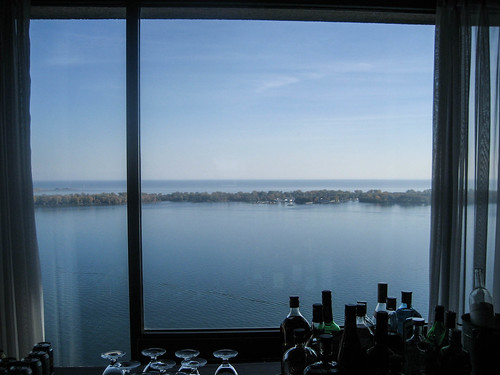
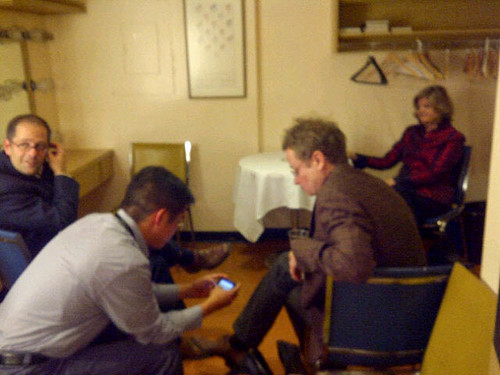
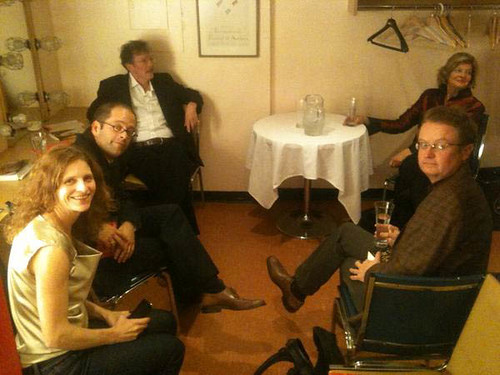
hospitality suite at IFOA
You’re going to suspect that I do nothing but jet around to festivals and parties. Heck, let’s pretend it’s true. Let’s pretend I’m not sitting at home in a slubby hoodie neglecting the sick kid on the sofa who is playing video games. At the very least, I’ll provide no photos of my current state.
I’ll admit it. I ache. I think it’s a combination of playing soccer on Sunday followed by all the driving and standing and sitting required by parties and readings. I have it down now: I’ve got comfy but good-looking shoes for the standing parts and the parties, and I save the heels for the readings themselves.
I’m doing a bad job of telling this story.
Yesterday, Kevin and I drove off to Toronto, mid-afternoon, leaving my mom to look after the sick kid and everyone else (dogs too! good grief!). I checked in at IFOA (Toronto’s International Festival of Authors), and the organizers let me use a hotel room to change in (for some reason, I didn’t get a hotel room out of this event, perhaps because Toronto considers Waterloo to be a suburb or a cousin once removed? In any case, no hotel room for GG finalist Carrie Snyder). Kevin and I also ate sandwiches and eggplant dip in the hospitality suite: supper.
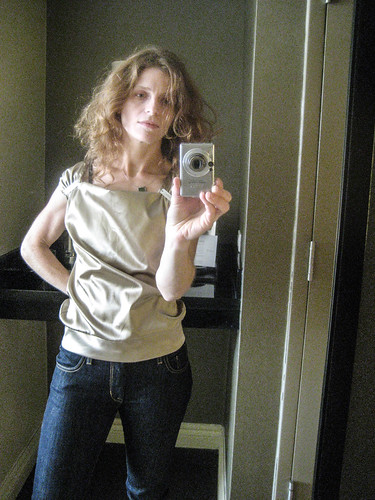
here’s what I decided to wear
Then we went to the IFOA party. I can’t remember the title, but it was crowded with industry folk, and it was hot. I was happy to talk to the people I knew, but equally happy to stand on the sidelines and just observe. Best moment of the evening: when we were approached by a very excited woman who came right up to Kevin and said, “Junot Diaz?!” Needless to say, my husband is not acclaimed American writer Junot Diaz (who wasn’t at the party in any case), but when we checked the author photos in the IFOA guide, we thought, hey, maybe he should put on a name tag. And grow a goatee. Because otherwise, people, I’m basically married to Junot Diaz.
The woman was embarrassed when she realized that I was the writer, and that she’d never heard of me. People keep joking that I may need to change the title of this blog, but I’m not too concerned. I reassured her, and she said she’d buy my book. (But I’m thinking she’ll probably buy Junot’s instead.)
Should I do more name-dropping? It seems almost obligatory. Here’s who we talked to at the party: Sarah MacLachlan (my publisher); various Anansi people; a lovely woman from the Canada Council who had read my book thoroughly enough to know exactly which story I was going to read when I told her the title (I was impressed!); Iain Reid (One Bird’s Choice); Linda Spalding (fellow GG finalist) and her husband Michael Ondaatje; Ania Szado (a writer with whom I toured back in the Hair Hat days); Eva Stachniak (The Winter Palace; she is Ania’s friend); Mark Medley, books editor of the National Post, who commissioned my best writing assignment ever, which just ran on Saturday: a review of Alice Munro’s new book, although it is more ode than review; the woman who thought Kevin was Junot; and a few others, though possibly by accident. We were there for an hour and a half, so clearly we didn’t excel at the mingling.
Then Kevin spotted Vincent Lam (The Headmaster’s Wager; fellow GG finalist). Vincent was leaving the party, so we thought we’d better follow him, because I didn’t really know where I was going for the actual event. Vincent and his wife were both super-friendly, and possibly super-human (he’s an emergency dr and she’s a family doc and they have three kids under 7). We had a nice chat. After awhile, we were joined by an IFOA publicist, and Linda Spalding, and set off for the theatre, quite clearly going the wrong way. There we all were, tramping around in the dark surrounded by a very high fence. “I’m sure IFOA will provide us with a ladder,” said Linda Spalding. Thankfully, no ladders proved necessary. Eventually, we went the right way, and were soon backstage at the theatre. Our group now included Robert Hough (Dr. Brinkley’s Tower) and Tamas Dobozy (Siege 13) and the poet Phil Hall (Killdeer).
I tweeted a terrible photo. Vincent Lam tweeted a better one. Guess which is which.
We met Shelagh Rogers. She gave me a scarf because it was freezing backstage, and you’ve seen what I was wearing. I read second to last, which gave me ample time to freak out. I handled my nerves by going into an almost comotose stillness during the first several readers. Conserving my energy, I thought, if I thought anything at all. It was kind of peculiar, actually, and prevented me from doing any useful networking backstage. But when it was nearly my turn, the stillness broke and I got very jittery, which was quite unpleasant. I don’t usually get so jittery. I had to go for a little walk in my noisy high heels. But then I thought, just harness the energy and be glad you’ve got it: better lots of energy than none. I also thought, perhaps rather melodramatically, You’re doing this for Juliet, so just go out and do it.

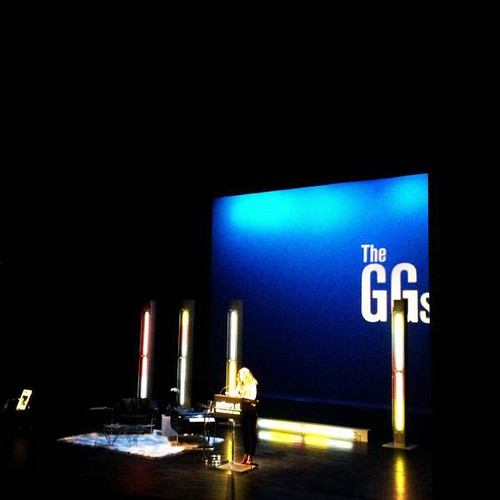
that’s me onstage
So I went out and did it. I settled down instantly, under the lights. I read “She Will Leave A Mark” from the first section. I think the story carries more poignance and depth after you’ve read the second section, but it’s a good story even on its own. I love reading. The only emotion I felt at the very end of the story was, well, a kind of bittersweet sadness. Because the moment was over.
I enjoyed being asked by the stage manager if I’d like something to drink at the booksigning table (white wine, please!). And I enjoyed signing books. Kevin brought our stack and had all the GG finalists sign them, but there was a mix-up with Vincent Lam’s. Kevin is going to need to find a second wife named “Sandra” in order for the dedication to make any sense. More proof that my blog title is in no danger of becoming obsolete. But then Michael Ondaatje shook my hand and told me he’d loved my reading. Hm. So maybe fifty-fifty.
The evening was starting to get really fun, probably because my publisher Sarah and her husband Noah Richler were on the scene, so we were talked into going back to the hospitality suite, which we hadn’t planned on doing, being responsible parents from Waterloo, Ontario. Just being around Sarah and Noah has the effect of regressing me to my pre-child self — almost; but let’s not call it regression. Let’s call it staying in touch with my spontaneous glam girl side. I’m shocked to report that side still exists.
But I’m not shocked to report that spontaneous and glamourous doesn’t go exceptionally well with early mornings and sick kids and walking wet dogs in the rain.
No regrets. This is an strange and happy little bubble of a moment. I’m going to float while it’s floating. (But thanks to kids and dogs I’m quite sure that I won’t float away.)
Sunday, Jul 15, 2012 | Book Review, House, Photos, Summer, The Juliet Stories, Writing |


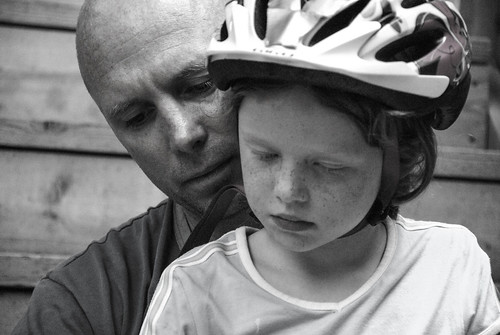
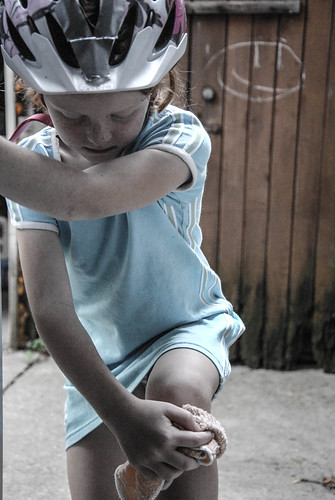
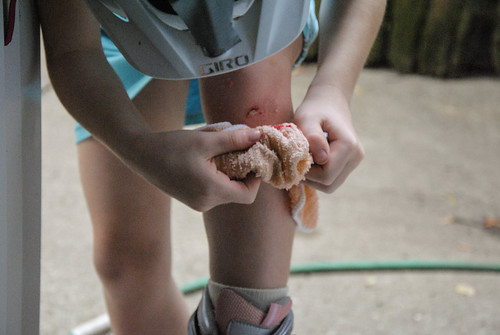
roller blading, before and after
Hot, quiet, humid. That’s our Sunday. Looked like rain. Did not rain. One soccer game still on the menu (mine). Though need bread, have not baked bread; see hot, humid. Can’t bear the thought of turning on the oven.
Today, I’ve spent several hours getting to know my new photo editing software. View experiments above.
Also wrote a new short story this weekend — fiction!!! My first attempt since writing the last of The Juliet Stories (which, a very few of you may be interested in knowing, was “She Will Leave a Mark” from the first section.) It felt like breathing or something. Essential, natural.
Oh, and I have to post a link to this truly amazing review, by a book blogger called Buried in Print. Quite enough to swell the head, methinks, so I’ll only read it once.
Friday, Jun 22, 2012 | Book Review, Family, Interviews, Mothering, Siblings, Work, Writing |

Everything is winding down, summer holidays are nearly upon us, and the truth is that I’m feeling a little bit flat. A little bit weary. I sense that I’m jealously guarding my reserves of creative energy as if in fear they might run out, which is perhaps not the best strategy; after all, creativity feeds on its own bubbling forth. And I don’t actually believe it can be spent, entirely.
But my instincts feel protective, somehow. Cautious. Inward-looking.
I spent yesterday writing. My working title is The Girl Runner; but that might not last. All I will say of what I’ve written is that it’s unexpected in tone and content, and the writing itself feels like disappearing into a daydream. From which it can be hard to emerge. It’s like getting lost. But I’m often not aware I’m lost until I realize how much I’m struggling to connect with what the kids are saying to me, or to respond with coherence to their requests.
It’s possible that their mother memories will include them prompting me to finish sentences, reminding me of what we were just talking about. It’s convenient to blame the writing; but it’s not always even that. Sometimes I’m distracted by a scheduling conflict, or by some errand I’ve just remembered needs doing, or by a voice on the radio, or a newspaper article, or a conversation or dream freshly recalled. I don’t know why it is sometimes so difficult for me to ground myself in the present moment. There are times when I must deliberately force myself to follow a spoken response through to its conclusion, force myself to pay attention to the reply, force myself to hold the thread rather than to drift.
Scattered. I wonder, and worry: How can such a scattered woman manage a functional daily life, manage to keep her children fed, manage deadlines, and plotlines?
Perhaps this explains why I wrote The Juliet Stories as a fragmented narrative: why I ask the reader to piece together clues, and take leaps. I was honoured to read an extremely sympathetic review in The Winnipeg Review posted earlier this week; the reviewer understood and was not frustrated by the leaps in the book. Read her review here.
And if you’re interested in listening to me (try to) talk about the connections between the book and my own experience, earlier this week the CBC ran my “riff” on Shelagh Rogers’ book show, The Next Chapter. Click here, and find me at 37:13 (with thanks to the friend who figured that out).
At the very end of the interview, I mention that I haven’t asked my siblings how they feel about the book, and I say something air-headed like, “I hope that’s not a bad thing! [Giggle]” *(Aside: I should probably make it policy never to listen to interviews of myself.) Anyway, my brother Christian heard the interview, so he dropped by the other evening to let me know that he really liked the book. We ended up having a funny conversation about the real events he recognized, and how they were dropped into such different contexts, all mixed up; and I was relieved to hear that he didn’t read himself as the brother Keith. In fact, I think he might be the perfect degree of closeness to recognize exactly how fictional the Friesen family is. He said his wife, on the other hand, is exactly the wrong degree of closeness, knowing just enough about our family to imagine that the book is somehow veiled history. If you know just a few things about our family’s past, I can imagine it would be easy to make the leap. But if you were there for it too, there is no leap, because it isn’t what happened, and we’re not the characters.
If I ever write a book about my family, it will be a very different book, about a very different family; and, frankly, I can’t imagine attempting it. But there’s no doubt families are enormously compelling, and if I ever storm up the nerve to try, it would make for an interesting exploration.
If asked, I will tell you that I pray none of my children become writers. Personally, I think it would be a bit of a curse to have a writer for a child. We’re dangerous. And probably maddening. *(Another aside: I read a tweet recently in which a writer noted that writers of fiction are constantly being asked “what’s real?”, while writers of non-fiction are constantly being asked “what did you make up?” Obviously, audiences have a compulsion to understand the links between fact/fiction, life/imagination, memory/invention. Etc.)
Which brings me round-aboutly to The Glass Castle, which I’ve been reading all week. In fact, I went to bed extra-early last night in order to finish it. It’s a memoir about a family of such incredible dysfunction that it staggers the mind. What amazed me most profoundly was the love expressed throughout — love of child for parent, and parent for child — despite the author’s childhood of parent-induced agony and chaos and hunger and violence. Love is so complicated. It isn’t reasonable. It guarantees nothing. It can be the source of terrible wrongs. And yet even the most disastrously-expressed love seems to answer something in us; seems to be something we need and crave, and could not survive without.
I’m not bringing this post around to any kind of coherence. Other than this: writing can be an act of love. But it is sometimes — often? — an act that feels more like dire necessity, or selfish need; it takes me away from my children, it removes me from the present moment, it deposits me in imaginary spaces. I don’t know where it comes from, or why I need to do it. I just hope it does ultimately create artifacts of coherence, and patterning, and some kind of connection and truth. Because that’s what love is, isn’t it? Love is connection, no matter how tangled.
Saturday, Jun 9, 2012 | Book Review, Music, Publishing, Soccer, Summer, Weather, Writing |

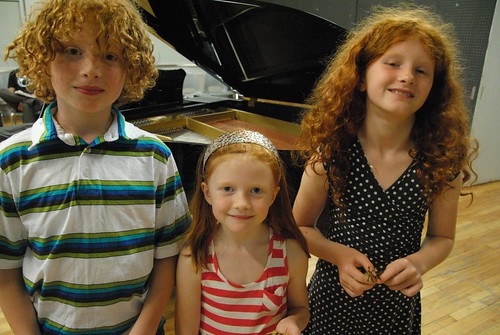
recital kids
Hello, weekend. Hello, rain.
I don’t mind. I feel indoorsy today, sleepy. A long run is planned for late this afternoon, but I prefer running in the cool damp than hot hot heat. I’m baking bread. I’m sipping a cup of coffee and opening the newspaper — and finding a review that I wrote on an essay anthology called In the Flesh (read it here.)
That’s an awfully lovely discovery after a weird writing week. (The dinosaur story got sent yesterday; an interview for another story due next week went well; but I got very little work done on my new novel. It’s always easier to set aside work for prospective payment in favour of work for guaranteed payment.)
Above, a photo of my well-dressed recital children. With the approach of summer holidays, we are coming to the end of lessons. Last piano lessons last week. Last swim lessons next week. Highland dance recital next weekend.
(Soccer, however, will go on. And on. No matter the rain. But it wouldn’t be summer without soccer, at our house …)