Category: Art
Wednesday, Apr 25, 2018 | Art, Big Thoughts, Confessions, Fire, Friends, Spirit, Stand, Success, Teaching, Work, Writing |

People often ask me: Are you still writing?
I can’t help but parse the phrasing. The word still. Of course, it may appear that I might have somehow stopped writing, that I am no longer writing, because I’ve published so little since Girl Runner came out in the fall of 2014. During these past four years, it is true, I’ve published two picture books for children, a handful of short stories and essays in Canadian literary magazines, a performance piece for an arts festival in France, and these personal blog posts. That’s clearly not enough to keep the lights on, so to speak.
Are you still writing?
I understand the question. I know it’s asked out of kindness and curiosity. How to explain that writing is like breathing, for me? I could not stop. When I do stop, it will be because I’ve also stopped breathing. My life depends on this form of expression.
Are you still writing?
I am always writing, I explain. I explain, Not everything I write will be published.
I recognize that this is a painful truth. I recognize that to state this fact makes me vulnerable. We all like success stories. Painful truths we like so much less, we humans. We like winners because they win. We pity losers for losing. Is it shameful and possibly career-ending to admit: I’m trying, but I’m not living up to the standards being set? To admit: Success is out of my control? To admit: What I love doing may not be what the market wants? Some of us would prefer deception to truth. I wonder whether in the arts community, as in any career involving public scrutiny, we are more inclined to stare away the painful truths, to hide them, and perhaps this is the evolutionarily correct instinct.
Well, I’m going to tell you the painful truth anyway. I’m trying. I’m still writing.
There are problems that we have the capacity to solve with ingenuity and effort, and there are gravity problems. Gravity problems are problems that no amount of ingenuity and effort can solve: gravity just is, a force, like time, that doesn’t bend to human will.
I’ve been fortunate to shift some of my attention, these past four years, into teaching creative writing, work I’ve come to love. It is rewarding to receive immediate feedback, to test ideas live, to adventure in the company of others. Teaching is the opposite of writing literary fiction, at least in my experience. In my experience, to write literary fiction requires enormous patience, bottomless trust in one’s own instincts, and the fierce will to continue alone, for long stretches of time. It requires so much energy. All the energy comes from within. This can be hard to sustain in the absence of … I was going to say success, but I think the more accurate word is community.
There must be a better way!
This post has taken an unexpected detour. This isn’t the post I thought I was writing.
I need new fuel for the fire, that seems apparent from what I’ve written here. I’m out of steam. I’m still writing, but I’ve also given up hope. In my classroom, I strive to foster a creative community — it’s a goal that’s set and maintained and evaluated throughout the term. With deliberate effort, I make space for peers to meet, to share their work, to share the weight of vulnerability, and to learn how to offer useful critique, which is really a brave form of support.
I have never created such a space for myself. I’ve never even considered it as a possibility.
This is not a gravity problem. This is a problem that can be solved by ingenuity, effort, and most importantly, the willingness to be vulnerable.
Writing = breathing. If I hadn’t sat down this morning to write, I wouldn’t have stumbled across this discovery: what I’m feeling and experiencing can’t be solved alone. What I need is community, a writing community.
xo, Carrie
Sunday, Apr 1, 2018 | Art, Big Thoughts, Cartoons, Fire, Meditation, Peace, Spirit, Writing |
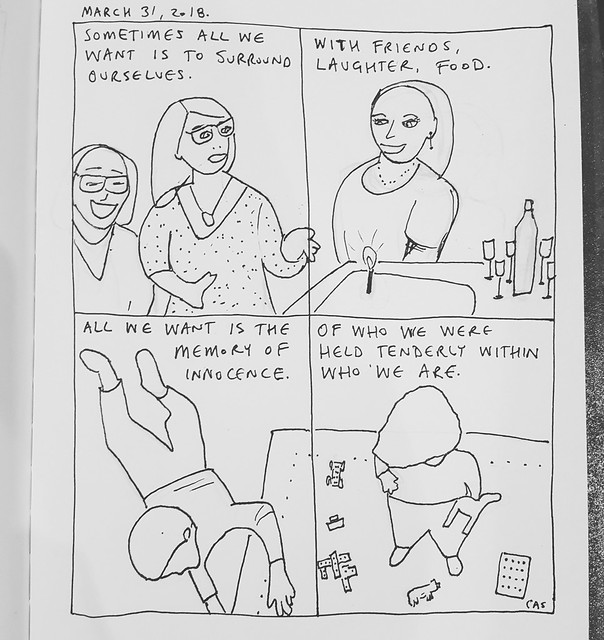
Every day I sit and draw, often for as long as an hour. I listen to music and pencil in lines on paper that recreate small scenes from my day. When I’ve pencilled in the lines to some satisfaction, I take my pen and ink in the drawings. If I had even more time, I would add watercolours. (I’m not ruling this out at some point in the future.) I’ve now drawn 92 daily cartoons and I’m aiming for 365. It’s often what I’m doing in the evening, instead of doing something else, but my evenings were never much use to me for writing anyway, as my brain seems to fog up. Drawing calls on something different than writing. Lines are different from words. Lines slow time. They’re meditative. My whole being follows the line. I can’t describe how content I feel while drawing. Why? Because I expect nothing. Because the discovery is always surprising. Because it occupies all the parts of me that would ordinarily be running madly off in all directions, it pulls them into cohesive effort. Because it stills my thoughts. It takes all of my focus even while making focus feel effortless.

If I hadn’t gone to Lynda Barry’s workshop two summers ago, I would never have known this was possible — drawing. I never would have known, because I would have assumed, as I’d assumed since grade two, that I essentially stunk at art. I haven’t taken an art class since grade seven. Sometimes I wonder whether the concussions changed my brain in some subtle way that has allowed me to focus differently. I remember art class in grade seven — I dreaded it, in the same way that I dreaded sewing in family studies. I had no patience, none, for the projects we were assigned. I knew before I made something that it would be subpar, clunky, painfully literal, the colours weird and blobby, the angles wonky, a minor disaster in the form of clay or pastels or terry-cloth. And it always was.
The things we’re good at are almost inevitably the things for which we have terrific patience. I can polish a story for hours, for example, but I can’t even finish reading an article in the business section; it’s all in the attention, or the ability to pay attention.
I have no idea why I’m making these cartoons. But, you know, I have no idea why I write stories about made-up people. It’s all a bit absurd and indefensible. And it’s also awesome and wonderful, and I’m so damn lucky to have the time, freedom, tools, and privilege to unpack my deepest, most mysterious emotions in these ways. I would call it almost essential. Without art, without these creative forms of expression, I would be helpless beneath the weight of untranslated experience.
Sometimes it feels like I’m bursting to connect what’s inside me with everything that’s outside of me. At least to try. I think maybe all human beings have this need. We need to know our stories. We need release from our stories, too, or to integrate them into our selves, the way a tapestry may be woven from threads of many colour and textures. I sense in art the power to heal (which is different from the power to resolve or simplify or even to comfort). It’s the power of purpose. Art is action, at its core. At its core, it is connection.
xo, Carrie
Wednesday, Feb 28, 2018 | Art, Big Thoughts, Confessions, Fire, Good News, Publishing, Writing |

I’ve got a new essay on mentorship up at TNQ, the local award-winning literary magazine that has accompanied me throughout my career: you’ll find all of the plot points in the essay, including publication, rejection and cause for hope. I hope you’ll read it.
xo, Carrie
Friday, Feb 2, 2018 | Art, Big Thoughts, Blogging, Cartoons |

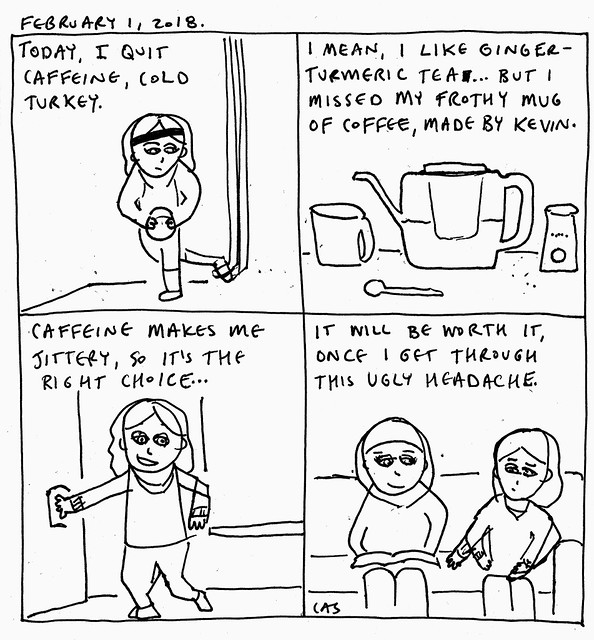
Today, I quit caffeine, cold turkey. I mean, I like ginger-turmeric tea … but this morning I missed my frothy mug of coffee, made by Kevin. Caffeine makes me jittery, so it’s the right choice. It will be worth it, once I get through this ugly headache.
I notice that I’m struggling with how to use this blog as a creative space, now that I’m focused on my cartooning project. I could post each cartoon here, daily, but I worry that my blog subscribers won’t want their inboxes inundated with daily posts. (Our inboxes are all full enough, right?)
Currently, I post the cartoons daily to Facebook and Twitter. (Although after a recent conversation with a good friend, also a writer, I’m considering quitting Twitter cold turkey, just like I’m quitting caffeine.)
I like publishing daily. The cartoons feel of the moment, and I enjoy sending them out in the world almost as soon as they’re made (I’ve given myself a buffer zone of one day, so yesterday’s cartoon gets published today).
I notice, too, that the cartoons are capable of holding a lot of thought, distilled into a few lines, and they seem to be taking the place of my blog, in terms of being a satisfying investment of creative energy, a comforting location for thinking out loud, for marking the moment. I just like making them. I like using this method to reflect on my day: by drawing scenes from it and distilling its meaning into a few sentences, a single theme or image. My journal pages are sloppy and untended, dumping grounds, piles that contain trash and beauty and who can tell which is which in all the mess? The cartoons are contained and coherent.
Life it not always coherent. The purpose of art is to give life shape, and meaning.
So making a cartoon feels strangely purposeful.
My question is: Should I be publishing my cartoons daily on this blog? I’m not sure. I suppose I could publish a cartoon and also write a blog post, should the desire overtake me…
Thinking out loud. Your thoughts?
xo, Carrie
Tuesday, Jan 16, 2018 | Adventure, Art, Big Thoughts, Cartoons, Death, Drawing, Fun, Lynda Barry, Play, Writing |

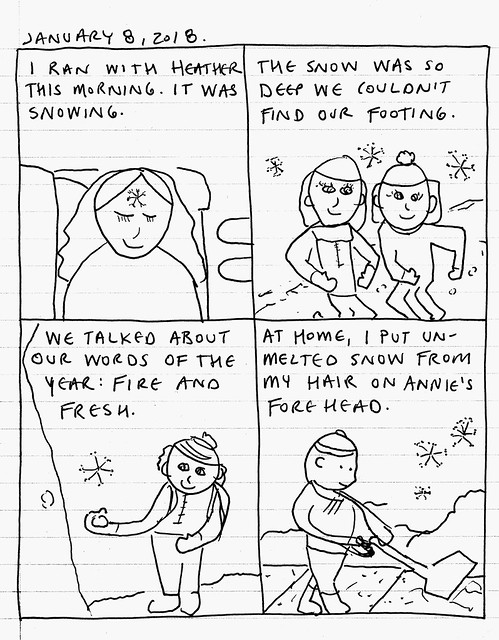
Title: Finding Footing
Captions: I ran with Heather this morning. It was snowing. The snow was so deep we couldn’t find our footing. We talked about our words of the year: fire and fresh. At home, I put unmelted snow from my hair on Annie’s forehead.
(What I like about this cartoon is the image of the snowflake that appears in each panel. It creates a visual motif that links the pictures with the text. The “on” should be “onto” but when writing in pen, mistakes get made and they’re permanent. So be it.)
The joy of embarking on a new project is the mystery of what its process will unearth. It’s too early into the cartooning project to guess what’s yet to be learned by doing it. What I’ve noticed so far is that already I have a sense of how many words can fit into each panel. Brevity and clarity are paramount. Thematic clarity is valuable, but sometimes a scattered cartoon, written and drawn in haste, can have its charms.

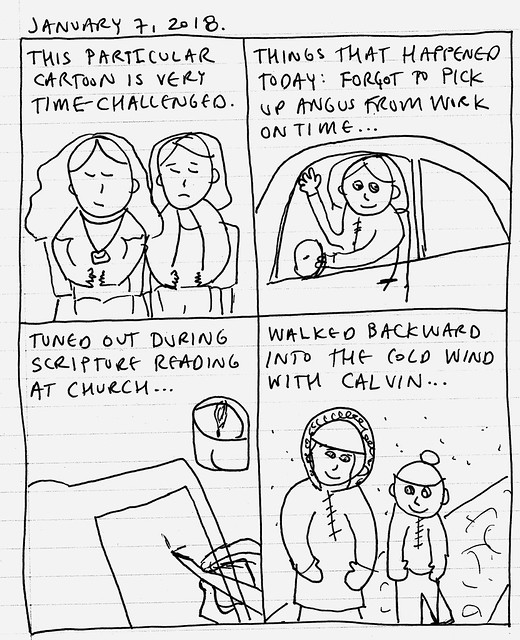
Title: Time-Challenged
Captions: This particular cartoon is very time-challenged. Things that happened today: Forgot to pick up Angus from work … Tuned out during scripture reading at church … Walked backward into the cold wind with Calvin.
(This cartoon was written and drawn in almost exactly 10 minutes, which I think is the absolute minimum amount of time required.)
Some days I’ve drawn two cartoons, one on a political subject, and the other more personal. For the purposes of keeping the project streamlined, I’m allowing myself to post only one cartoon each day (on Facebook and Twitter); so far, I’ve chosen the personal over the political. The political cartoons have gone into blog posts instead. I don’t feel that I’ve settled on a drawing singular style, yet. I like that. I like the freedom to experiment with both subject matter and style.

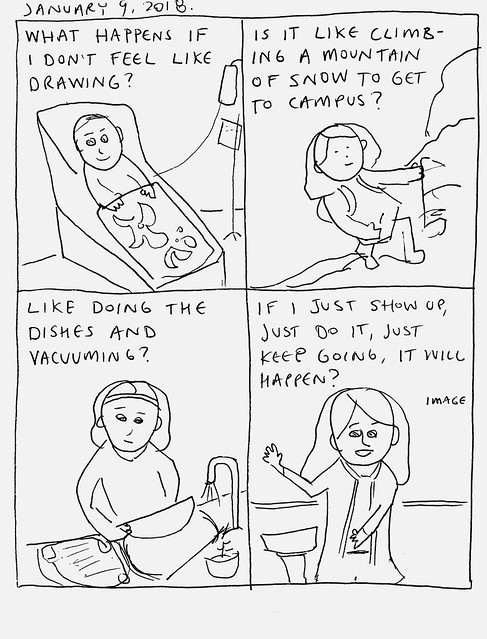
Title: Is It Like Climbing A Mountain Of Snow?
Captions: What happens if I don’t feel like drawing? Is it like climbing a mountain of snow to get to campus? Like doing the dishes and vacuuming? If I just show up, just do it, just keep going, it will happen?
(This was the one day so far that I really didn’t feel like cartooning. I’m glad that I did. It’s a good reminder to just show up and do it, even if you don’t feel like it; good advice for life in general, for writing in particular.)
Questions I’m mulling: What makes a good cartoon? What’s too personal, in terms of subject matter? Would these cartoons be of interest only to family and friends? Is it possible to find the universal in the daily? (Of course it is! The question, really, is how?)

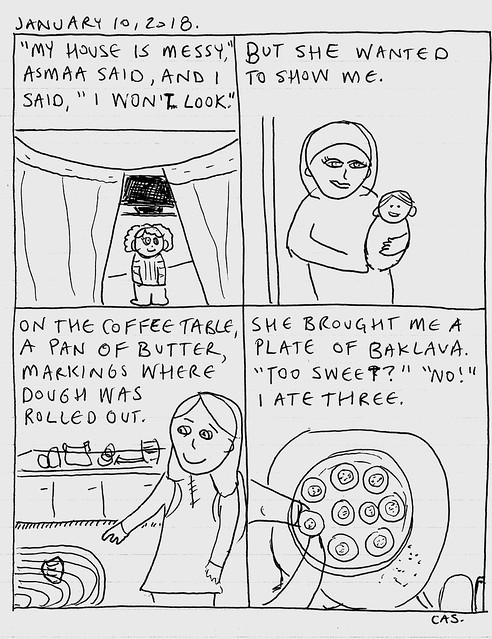
Title: Messy House
Caption: “My house is messy,” Asmaa said, and I said, “I won’t look.” But she wanted to show me. On the coffee table, a pan of butter, markings where dough was rolled out. She brought me a plate of baklava. “Too sweet?” “No!” I ate three.
(Most of these cartoons pair random scenes from the day with largely unrelated captions, and I enjoy discovering how these two dissimilar things respond to each other, but for this one, all the scenes drawn come from the story described in the text.)
Something interesting I’ve observed: that cartoons have the capacity to envelope sad, difficult narratives in a way that eases the pain, I think. Something I think about quite a lot is how to write about trauma without traumatizing the reader. I see in cartooning a possible means of tackling challenging subjects in non-traumatizing ways. Cartoons remind me of poems, a bit.

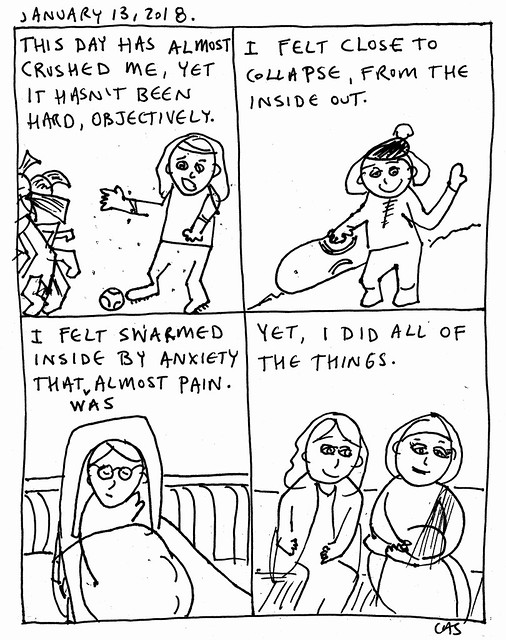
Title: This Day
Captions: This day has almost crushed me, yet it hasn’t been hard, objectively. I felt close to collapse, inside and out. I felt swarmed inside by anxiety that was almost pain. Yet, I did all of the things.
(Here, I think the scenes from the day soften the description of depression/anxiety in the text.)
Things I like about this project: I get to draw everyday. It’s an opportunity to reflect on my day, and pay attention to it in a different, unusual, creative way. It’s also an opportunity to invent thematic coherence and narrative out of the raw material of life. Life is raw. We humans, we have a tendency to pattern. Pattern may be illusion, but it is powerful. Pattern brings comfort — order to disorder, shape to chaos, coherence to uncertainty.

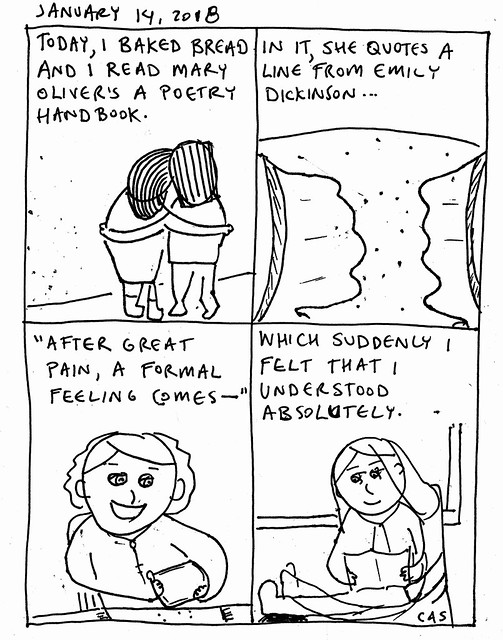
Title: Suddenly I Felt That I Understood
Captions: Today, I baked bread and I read Mary Oliver’s A Poetry Handbook. In it, she quotes a line from Emily Dickinson… “After great pain, a formal feeling comes —” Which suddenly I felt that I understood absolutely.
(The drawing of my hands kneading bread dough didn’t really turn out. But now you know what that panel is all about. Kind of looks like two islands separating in the middle of a lake … or, I don’t know; what do you see? I’m trying very hard not to re-do any “mistakes” in the cartoons, but rather to accept them as speaking from or to some secret part of myself I couldn’t otherwise reveal.)
xo, Carrie
Friday, Jan 12, 2018 | Art, Feminism, Fire, Politics, Spirit, Stand |
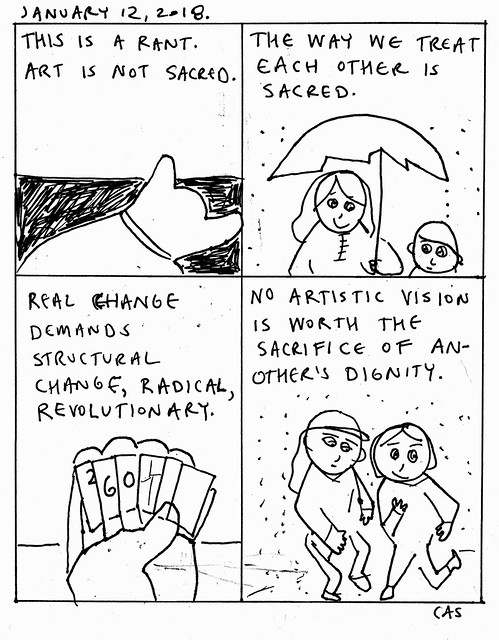
This is a rant. Art is not sacred. The way we treat each other is sacred. Real change demands structural change, radical, revolutionary. No artistic vision is worth the sacrifice of another’s dignity.
Today on our early morning run, Heather and I talked about structure. How humans hew to structure, even if it’s not serving us well, because that is our nature. Real change demands structural change; true on scales both macro and micro, societal and individual. I wish I had the tools and knowledge and education to do something that would support wide and deep systemic change. Or maybe that’s not how systemic change occurs. Maybe it’s more radical and revolutionary. I believe in policy, and the power of policy to affect change, but unless it’s applied, policy is worthless and sometimes worse than worthless — because it provides a mask to corruption while pretending to hold the system to account. Why didn’t they report earlier? Why are they coming out now? They should have gone to police. This is a case for the courts, not the court of public opinion. It’s nothing but unsubstantiated gossip. Fill out the paperwork, go through the proper channels, and we’ll get back to you.
Yeah, this is a rant.
This morning, I heard a snippet from a radio interview: a woman arguing that the penalties against the former director of Soulpepper theatre in Toronto were too harsh — He built the company! His artistic genius! (Full disclosure, one of the complainants in the civil case against him was a high school friend, though we haven’t been in touch for many years.) To the woman on the radio, I raged: You’re arguing that artistic vision is worth the sacrifice of people’s safety. You would protect a man whose behaviour at work harmed people — because he was a good fundraiser??? Because the art was good??? This is skewed morality.
Art is not sacred. The arts are not sacred.
The way that we treat each other as human beings is sacred, or should be.

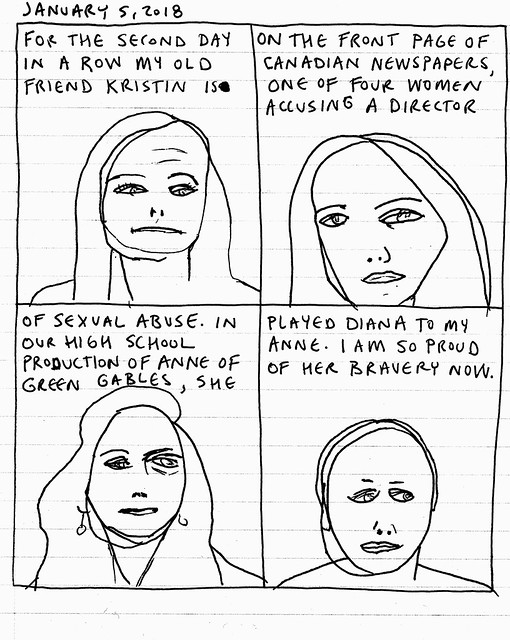
For the second day in a row my old friend Kristin is on the front page of Canadian newspapers, one of four women accusing a director of sexual abuse. In our high school production of Anne of Green Gables, she played Diana to my Anne. We had so much fun. Kristin absolutely sparkled with wit and comedic talent. I am so proud of her bravery now.
I have a theory. Power may indeed corrupt and absolute power may indeed corrupt absolutely, but many who seek power are already corrupt, particularly in systems in which corruption, in its many forms, is rewarded: think manipulation, harassment, bullying, and other norm-flaunting, disrespectful, selfish and narcissistic behaviour. Those more inclined toward self-reflection, those who don’t want to harm others for their own profit (or be harmed), who don’t want to lie and self-inflate and backstab and cheat to “play the game” are weeded out of the system, deemed weak, losers, failures. The powerful believe their behaviour is normal.
Maybe we all do — until we don’t.
Let’s say that time is now. Let’s find ways to circumvent the system until the system changes.
I repeat: Art is not sacred. Neither are artists. The artistic process has never needed to be destructive, harmful, cruel, violent, vindictive, ugly, competitive, or vicious in order for good art to exist. Don’t be fooled by the propaganda.
Bottom line: If you’re hurting people in the process of making your art, you’re doing it wrong. You never earn the right to be an asshole. (Also, side note: nobody needs to see your penis.)
xo, Carrie