Tuesday, May 15, 2012 | Book Review, Books, Chores, House, Photos, Readings, Work |

stop and drink the nectar
The morning is fleeing! I’m running out of time. Stop, Carrie, breathe for a moment. Drink the nectar.
Ahhh.
This afternoon, I’m hosting my literary friend Heather Birrell, with whom I will be reading tonight at The Starlight here in Waterloo. She’s been forewarned about the fact that somehow we’ve neglected to vacuum for, like, weeks, and that there are toys and papers and dishes and stuff on pretty much every horizontal surface, floors included, and she assures me that she’ll feel right at home amidst the chaos. Well, she’s got two young daughters. And a brand-new book. I think we’re good.
I want to tell you about her book. It’s called Mad Hope, and the title comes from a line in a pitch-perfect story, “Geraldine and Jerome,” which is set in the waiting room of a medical clinic and links up two unlikely-to-otherwise-meet-and-interact-characters. I happened to read it in the waiting room of a medical clinic (don’t worry, I’m fine). Be warned, if you’re planning to pick up this book and read it in public places: these stories will make you cry. Or maybe it’s just me.
I’m thrilled to say that Heather invited me to be an early reader of these stories, so I know exactly how damn good they are. And the book has been getting rave reviews all over the place. I’m going to get Heather to sign my copy today. You can too, if you happen to be in Waterloo and come out to the Starlight tonight; or in Toronto tomorrow, where we’ll be reading together again at Type Books.
And to add book news upon book news, my many-moons-ago boss, Noah Richler, has a new book out this spring too. It’s called What we talk about when we talk about war, and it’s about how our current government has been steadily distancing our country from its tradition of peacekeeping, preferring the warring nation metaphors instead. Noah will be in Waterloo on May 30th at the Laurier Centre for Military Strategic and Disarmament Studies. That just happens to be a free evening for me (!!), and I’m looking forward to hearing Noah speak. Join me? I’ll post more details closer to the date.
One last thing. Noah’s written a really lovely mini-review of The Juliet Stories, published on the 49th Shelf. In it, he talks about hiring me as an intern at the National Post, and his description of who I was then gave me a really lovely “how others see us” moment. Because who knows how others see us? (What I perpetually fear is that maybe I’d rather not know … it’s a personal hang-up. I need to get over that.)
Monday, May 14, 2012 | Bicycles, Chores, Exercise, Kids, Laundry, Parenting, Play, Readings, Running, Spring, The Juliet Stories, Work |

party night
My thoughts are all over the place on this Monday morning. I’m wondering: should I blog our week in suppers? Skip over that and write about my weekend of solo parenting? Share news about upcoming events and unexpected Juliet feedback?
Last night, I set my alarm for swimming. I woke at 2am. I’d been dreaming about sleeping (again!). I decided to turn off the alarm and really sleep. I have three early mornings planned this week; given that I also have two evening readings, self-preservation starts to come into play. It was a little easier to turn off the alarm given that yesterday, late afternoon, I ran 12 pain-free kilometres, keeping up a good pace and plotting my return to distance running. That counts as my first real distance run since my injury in January. It’s short, as far as distance runs go, but it was a blast. Next week … 14 km??
Uh. Where was I? Oh yes, self-preserving.
Tonight, I’m ferrying children from dance to soccer practice while Kevin has an early soccer game. Tomorrow, I’m at the Starlight in Waterloo (come, too!), from 7pm onward. Readings start at 7:45. And on Wednesday I’m headed to Toronto for an event at Type Books called the “Short Story Shindig” with Heather Birrell and Daniel Griffin, and hosted by Kerry Clare; 7pm (come, too!). This is all very exciting, but doesn’t go terrifically well with excessive early morning exercise.
As I said to Kevin this morning, “This isn’t the year of the triathlon. This is the year of The Juliet Stories.” (Which may be the first time I’ve admitted that, even to myself. I really really liked the year of the triathlon. I felt so hard-core. Sharing my book feels less focused, less goal-oriented. Maybe I need to start thinking of readings as races. They definitely affect me in similar ways — I’m nervous before, wired and happy during, and it takes me a little while to come down afterward.)
So. Slightly less focus on exercise, slightly more focus on evening events.
Now. Let me tell you all about my weekend with my kids. We had so much fun! Why can’t we have this much fun all the time? Is it because I’m usually trying to get too many other things accomplished? That can’t be entirely it, because we seemed to accomplish quite a lot, even while finding time to relax. Our weekend included …
:: watching Modern Family on Friday night while sharing an entire bag of Cheetos (which were utterly disgusting, may I just add)
:: trampoline ninja jumping (everyone!)
:: a bike trip to the grocery store for picnic and party supplies, followed by a picnic in the park
:: reading outside while two girls rode giggling past me on scooters and bikes too small for them
:: hanging laundry on the line, baking bread
:: playing on electronic devices; taking lots of photos
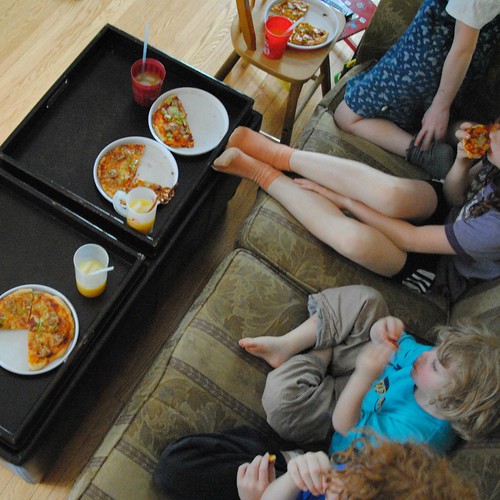
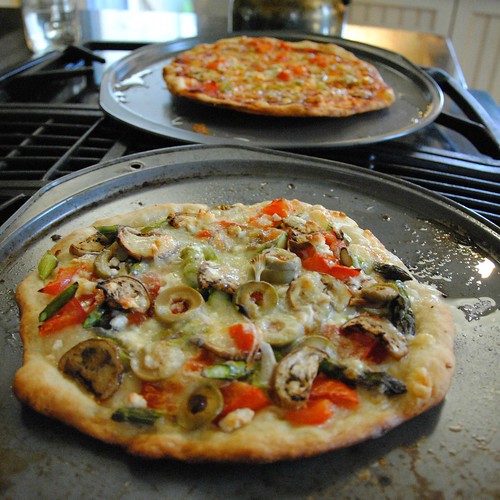
personal pizzas for party night (the one with the olives, asparagus, and eggplant? yes, that’s mine)
:: “Party Night,” wherein we had homemade personal pizzas and punch with ginger ale while watching a movie, then gorged on episodes of Modern Family while simultaneously gorging on boxed cereal and utterly disgusting candy; the rules for Party Night go like this: everyone gets to choose one treat from the grocery store (under $4), and we stay up as late as we want; oddly, three of four children chose boxed cereal (Corn Pops, Frosted Flakes, and Froot Loops, for the record). We have never felt so collectively gross. I blame the milk. Maybe the sugar too. It was surprisingly easy to herd the children off to bed at a not entirely unreasonable hour (9:30ish) …
:: … though AppleApple and I got distracted searching for my old Grade One piano book in the basement, which we never found, but we did find one of my old and relatively simple classical piano books, and ended up staying up for another hour playing songs. The Wild Horseman. The Happy Farmer. One of Muzio Clemente’s simple Sonatinas (she’s learning it!). Minuets from the Anna Magdalena Bach notebook). Bliss!
:: sleeping in
:: making and delivering, on bicycle, invitations for an 11th birthday party (a week from today!)
:: more bike riding and trampolining and laundry hanging; hey, whatever makes us happy
Mother’s day was capped off by the return of Dad, and supper out at all-you-can-eat sushi with my mom, too.
And that is plenty for one blog post. Never got to the unexpected and lovely Juliet feedback. Well. More tomorrow.
Friday, May 11, 2012 | Writing |
canopy
I’m part of the Writers’ Union of Canada, and as such receive a trade-type magazine produced by the union called Write.
{confession: I’m not entirely sure why I’m part of the Writers’ Union, other than it seemed very exciting to join way back when my first book was published; I’ve stayed out of principle, despite the annual dues, because I want to be part of a writing community, even though I’ve yet to feel particularly at one with this community. Hm. Is this something I should be confessing publicly? Do others feel the same way?}
Long aside. My point is that yesterday I read an interesting article in the latest issue of Write. It appears not to be available online, so here is a mini-copy-and-paste of the parts that resonated with me. It’s written by Rosemary Sullivan (who was my professor in grad school), and titled: “The gift-giving culture: In defence of creative writing workshops.”
We writers were seduced for awhile into believing we could speak of culture as a product. We could speak of cultural industries, adopting the commodity model, and asserting that we contributed to the general monetary economy and should be rewarded. But books are not products that earn a market reward. They are works of art that are essential to our collective human experience, and society, for its mental and spiritual health, should sustain their creation in the sheer principle of self-interest.
{and here I shall skip backwards in her essay, because it makes sense to me}
We need to acknowledge that writers live in a different cultural paradigm: they live in a gift-giving as opposed to a commodity culture. … We are so deeply inside consumer culture that we cannot imagine a cultural paradigm other than that of private property. … But in a culture based on the gift (giving without assurance of return) … giving in itself creates a cycle of return. In a gift-giving culture, when you give, you create a moral debt that will be paid back when the circle of giving completes itself.
{this reminds me of Margaret Atwood’s Payback}
Well, what do you think? I’m drawn to the writing-as-gift-giving idea (at least for literary writing). If I bake a loaf of bread and sell it, I can work out a pricing scheme that takes into account labour and cost of materials, and what the market will bear, and I can hope to earn a fairly stable return for my investment. But if I write a book of fiction, there is no way to estimate in advance the cost of my labour (which is essentially time), or whether I will ultimately be producing something that anyone wants to purchase. As Rosemary Sullivan puts it:
There is no relationship, except perhaps that of luck, between the energy and thought put into a book, and the return the writer receives.
She goes on to argue that creative writing workshops and programs are a defence against superficiality, and provide writers with community, with networks of support. She says creative writing programs aren’t trying to teach people how to write, but how to be part of a gift-giving paradigm, as writers, readers, editors, publishers, etc.
I like the idea of being part of a larger collective conversation, through my writing. In a sense, that’s what this blog has become (for me). I’m still not sure I buy her argument about the larger purpose of creative writing programs — but then I’ve never been part of one. Maybe I would feel differently if I were. Anyone out there want to comment on this? I will be leading creative writing workshops for teens this fall, as part of my participation in the Eden Mills Writers Festival. What should I be trying to foster, there?
One more thing on the collective voice. In the past few months, I’ve been invited to contribute essays to four different proposed anthologies. This is hugely exciting; and it is certainly not monetary excitement I’m feeling. It’s excitement about being part of collaborative experiences, being asked to participate, and potentially adding my voice to the mix.
Which brings me around to a final thought on the gift-giving paradigm. Gift-giving is so life-affirming. To be asked to give is in itself a gift; especially when you are being asked to give of a talent, or to give exactly in the way you feel born to give. So when I’m asked to write something creative and literary and thoughtful, I’m thrilled. Really I am. Whoever is asking is recognizing that I (may) have something to offer, and I love giving it, whether or not I receive strictly monetary payment in return.
{note: this does not apply to the freelance writing/editing work that belongs to the commodity culture, and which I am truly grateful also exists}
:::
News: I was interviewed by poet and new mother, Erin Knight, for a piece just published on Open Book Ontario about being a writer and a mother. Take a look, here.
Thursday, May 10, 2012 | Friends, Parenting, Play |

photographer
“Creative discomfort.” I know the feeling well, and now I know what it’s called! If you have 36 minutes to spend watching John Cleese talk about creativity, click here. (As a multi-tasker, I did physio exercises whilst listening, but even without the exercises I would consider it time well-spent.)
Here are a few points that really clicked with me.
Be open. Be silly, be judgement-free, play. There is also a time to be closed and to apply your ideas, to bring them to fruition and into coherent shape. But without time to play freely there is no creativity. He advocates a beginning and an end to play. It’s exactly what we all hated as kids: being told that it’s time to come inside and wash up for supper; time to clean up the toys. Playtime isn’t all the time. There also needs to be time to build your invention.
But creativity is not just about playtime, and structured time. It’s also about sitting with a problem that has yet to be solved. It’s about passing by the easy or obvious solutions, and sitting with the problem/subject and giving your mind time to dig into its unconscious and come up with something original. This is a deeply uncomfortable process. I do it instinctively and not without pain — for me and for everyone around me. When I’m working out a problem, I’m irritable, agitated, distracted. (It’s one of the reasons I exercise.) But I can’t help myself. I can’t accept the easy solution. I have to keep looking until I find something else. I’ve sometimes thought of it as a kind of obsessive personality flaw. After listening to this talk, however, I think it might be the single-most important quality in my personal creative toolbox.
A few more points. When we play freely, we don’t worry about making mistakes; we risk being silly and wrong and ridiculous, because there is no silly or wrong or ridiculous. I think of this in my own parenting. I wonder. Am I too quick to point out problems or flaws? Successful collaboration and communal play comes from building on each other’s ideas, not knocking them down. That doesn’t mean you have to blanket every idea with “Wonderful!” but that you help build on the ideas that come. “Could you elaborate on that? Could you push it futher? What if …?” Maybe it’s also like riffing. When you’re in the middle of a good conversation and everyone is carrying everyone else along, not worrying about taking detours, or getting off-topic.
One final point. Cleese is very much against solemnity. He’s not against seriousness — we can talk deeply about serious subjects while laughing, after all. What gets his goat (and also squashes creativity) is self-important solemnity that refuses humour, that sees it as subversive (well, it is!); the ego that refuses to laugh at itself, that is defensive, that shuts down the house for the sake of propriety.
And on that note … I’m off to ponder and wonder and sit with some pretty grumpy-making creative discomfort. But with a light heart, friends. With a light heart.
Wednesday, May 9, 2012 | Big Thoughts, Kids, Mothering, Spirit |

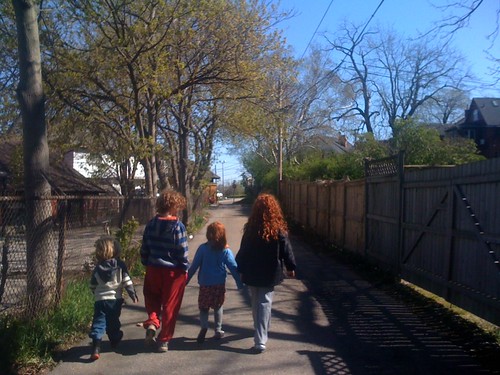
thanks to my mom for taking this photo of my kids walking to a diner for breakfast
This morning, our littlest piano player was becoming frustrated with her practicing. Slam, slam, slam the fingers on the keys, wrong note, BANG, wrong note, BANG, wrong note, BANG. “This song is too hard!” This was preceded by a ridiculous argument with her sister over the “funnies” in the paper (which no one finds funny, yet everyone insists on reading; which I find funny). And it was followed by a ridiculous argument with said sister over a sunhat — she wanted to wear her sister’s hat, which was apparently much superior to her own. “I only have one hat and she has two!” was the cry of misery.
Suddenly I realized — she was tired. It had been a late night, her first soccer practice of the season, bedtime pushed back by an hour, and she’d woken early.
Ah. It all made perfect sense.
I’m feeling a little bit the same way myself, frankly. Need more sleep.