Based on a true story
Last week I blogged about fiction versus non-fiction, and a friend posted a link to an article titled “Based on a True Story. Or Not.” If you’ve got time to ponder the subject, go off now and read it. If you’re in a hurry, here’s my brisk summary:
The essay is about the use of autobiography in poetry. We, the reader, tend to assume that a personal-sounding poem is autobiographical. So what happens when we, the reader, discover that a personal-sounding poem is in fact fictional? Do we have a sense of being cheated out of something “real,” or of having been fooled or tricked by the poet? Why do we want so badly to know that the poet wrote out of experience rather than imagination? Why does it matter to us?
Because it does matter, at least to many of us.
I’ve visited quite a few book clubs for The Juliet Stories. There is one question asked every time, usually immediately, a variation of: “Is this story something that really happened to you?” How I answer the question probably depends on my mood, and I often feel rather weary as I try to explain my creative process. But even if I don’t welcome the question, exactly, I don’t disdain it. I’ve come to believe the question must tap into something fundamental within us, something held in common, as readers. That we come to a story looking for truth. We come looking for the connections between author and subject. We want to believe in the veracity of what’s being told. (Maybe we want to be part of the story or become closer to it, by being witnesses rather than “mere” readers.)
The closer a story appears to be to autobiography, the more jarring it is to be told: this is fiction. We’re not comfortable with something we suspect to be full of half-truths, which are also, of course, half-falsehoods. I find it very difficult to wrestle with these distinctions. I’d rather say, “None of this happened” than “Bits of this happened”; while the thought of saying “This all happened” makes my skin crawl. I’ve got no desire to be a memoirist, clearly.
But every story I’ve ever written has been inspired by a glimpse of something actual, whether it be a house I once lived in, or the memory of an emotion that washed over me in a specific situation, or an amulet from childhood, or by knowledge I’ve personally gained cooking or horseback riding or running. I get my ideas from life. But an idea isn’t a story, an emotion isn’t a story, a glimpse isn’t a story. To make a story, I imagine what might have been if life were different. I seek alternative explanations for those things I can’t explain. I go off the trail. I wonder. I make it up.
As a fiction writer, I’m not asking my readers to be witnesses, to paraphrase the conclusion of the essay cited above. I’m asking my readers to imagine.
Curious, though. What am I asking of readers here on the blog? This isn’t fiction, obviously. This is it. Here, perhaps, I’m asking you to be witnesses.
Yesterday at 9AM I wanted to write a post that listed in fine detail every damn thing I’d already accomplished since waking four hours previously; but I was too tired to do it, and instead went upstairs and fell into the oblivion of a nap. It will sound like bragging. Maybe it is. I don’t mean it to be. I myself am astonished and only want to record it because I doubt I’ll believe it years from now, the pace at which I’m currently pushing myself, wondering whether it’s too much, whether I’ll stumble, and badly. (Note: Kevin was working in Toronto yesterday, and usually shares half these duties.)
5:04 – Alarm. Brush teeth, dress.
5:11 – Daughter’s alarm. Help her get ready for swimming.
5:19 – See daughter off with carpooling friend.
5:33 – In darkness, leave house for a run on snowy roads.
6:29 – Home after 10.2km (slow; muscles never warmed up in the cold).
6:33 – Dash out with whining dogs for walk, chilled.
6:47 – Feed dogs. Shower. Dress. Scarf toast with PB.
7:00 – Wake eldest son to watch dogs and be on alert for rising children. Leave for pool. Listen to news on the radio, blast the heat.
7:15 – Pick up daughter and friend at pool. Feed them bananas. Chat.
7:25 – Drop off friend.
7:35 – Home. Feed myself and daughter poached eggs on toast.
7:55 – See friends waiting for elder son to walk to school, run out and tell them go; he’s sick. Call school to report his impending absence.
8:00 – Send daughter to bed.
8:03 – Wake small children. Dress smallest.
8:15 – Feed small children vanilla yogurt with cut-up pears. Empty dishwasher, begin filling again.
8:19 – Check lunch boxes, add desserts, make snack to put into smallest’s coat pocket for field trip, as per instructions on form sent home by teachers, lost, and then after much searching, found. Start load of laundry. Wash beans for supper.
8:29 – Get small children into outdoor clothes. Not quickly enough.
8:37 – Wake eldest daughter. Drive small children to meet friends for their walk to school (they usually walk there).
8:47 – Wake eldest daughter again. Pack her school bag.
9:01 – Drive eldest daughter to her school (she usually walks there, too).
9:10 – Check on sick eldest son, returned to bed. Make him a cup of tea.
9:20 – Crate dogs. Nap.
9:50 – Woken by whining dogs. Get up. Feel grumpy. Get on with it.
Bedtime, with stripes
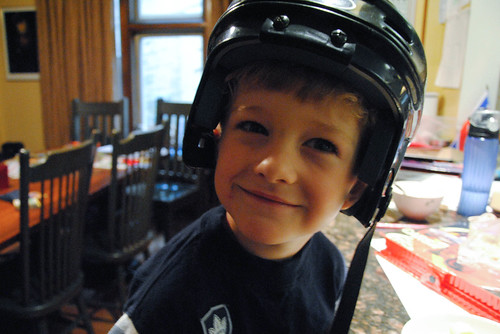
Picture this guy, minus the helmet, in pajamas, tucked into my bed to read stories, which we’ve just finished. Here is the conversation that follows.
“What can we talk about now, Mommy?”
“How about bedtime?”
“Let’s talk about your face.”
“My face? It’s a pretty ordinary face. It’s got two eyes, a nose, a mouth, a chin …”
“And! It has stripes.”
“Stripes?”
“Here, on your forehead. And here, on your neck.”
“Stripes, huh.”(Can’t stop laughing.)
“Now let’s talk about your head.”
“Do we have to?”
“You have a very fat head.”
“I don’t think that’s accurate.”
“I mean, it’s round.”
“Okay.”
“Now let’s talk about your pillow.”
“Let’s talk about your pillow. Your pillow is soft, and cozy, and warm, and you can lay your head down and go right to sleep.”
“Carry me.” (Arms out.)
Of course.
It went and got cold
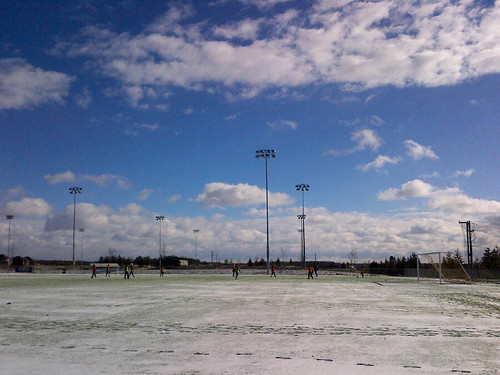
It went and got cold.
AppleApple had an outdoor practice in a snowstorm on Saturday morning, at which I could have chosen to go for a run in solidarity. Instead, I stayed in the car letting the sunshine warm me while starting Hell Going, by Lynn Coady, which I’d purchased on my Kobo awhile back. We passed three car accidents on the way to the soccer field, all fender-benders caused by drivers who had forgotten how to drive in winter conditions. As in: slow the heck down, people! It was a white-knuckle trip, and we were most terrified that someone, travelling too fast, would simply slide into us.
Other activities this weekend included a date night out with friends (no children) on Friday evening, three soccer games and two more practices, one gigantic homework project (still unfinished), and a birthday dinner at a sushi restaurant that was appallingly, and ultimately comically, dreadful. “The only logical way this can end is in food poisoning,” observed one of my brothers. He was hungry — we all were, as wait staff appeared to “lose” our orders in a potted plant near the cash register — but was hesitating to eat what looked like leftover stir-fry rice fashioned into a maki roll, battered, and deep-fried.
I squeezed in a run yesterday afternoon, double-layered, and relished the wind and snow flashing into my face. All was well and good.
But then I crashed. I left Kevin with the supper dishes and crawled into bed early. This turned out to be the perfect medicine. Three of the kids (including my very biggest) snuggled with me and I read them several chapters in The Lion, The Witch, and the Wardrobe, which is the book we’ve chosen post-Little-House. They’re loving it. CJ almost couldn’t get to bed he was so caught up in wondering when the Lion would come in to the story, and would it be a real lion?
Then I read for pure pleasure for another hour, and then two, and then, finally, slept. Up early for kettlebell class. Dithered a bit, considered skipping, but couldn’t sleep anyway. I’ve trained my body to wake like clockwork around 5AM. I knew class would be hard, but worth it, and it was, and it was. I so appreciate having a comforting, familiar place to go to in the early morning, and a friend to go with.

Fooey’s Christmas wish list, my copy; also on desk right now: inspirational “go!” artwork, also by Fooey; and a much-scribbled-in calendar
I can’t believe it’s almost advent.
Will I put up the advent activity calendar that so disappointed my children last year? Can I slow down even the slightest in order to prepare for the season? So many things I would like to do: bake cookies, put up a tree, take a family photo for Christmas cards, buy something special for each of the kids, dream up delicious menus for dinners …
Great grey Friday
It’s a pattern. Every Friday morning this fall, I sleep in (ie. not up at 5AM), yet can barely drag myself out of bed. I eat breakfast, start the laundry, see the children out the door, and struggle to be otherwise productive at anything. The cup of coffee doesn’t seem to help.
Thursday evenings I teach. Friday mornings I’m drained. I think it might be as simple as that. But frustrating, too, because there is so much about teaching that I’ve enjoyed this fall. It’s gone how I’d hoped it would go. I’m accomplishing what I’d hoped to accomplish. So how to explain my body’s reponse to the job?
I’m going to go out on a limb and self-diagnose as introvert.
A long day of writing leaves me pop-eyed and twitching. Manic, you might say. Or, energized. Three hours of teaching leaves me jelly-noodled, spine sunken like a comma. Bloodless, you might say. Glazed. Is this how other teachers feel?
This sounds like an extended complaint. I’m not meaning to complain, only to observe.
I don’t think teaching naturally drains everyone. I’m sure of it. Kevin comes home from teaching buzzing with good energy. I wish that were me. My students are terrific, interesting, thoughtful, hard-working, open-minded, and a pleasure to share ideas with.
So, yes. I do feel frustrated by myself. It’s not that I’m shy. It’s not hard for me to talk to people. But it may be that I’m introverted, and draw my energy from being alone. Any thoughts on this, from introverts or extroverts alike?
Two more things. Okay, could be more than two, but I’ll keep it to two in this section of the post. We’ll call this the newsy section.
1. I did an interview about style for BLUEPRINT, a student-run magazine at Wilfrid Laurier. I liked the questions, and I liked thinking of myself as actually having and even cultivating style. (Long-time friends, please don’t laugh.) You can read the interview here.
2. I’m hearing rumour that the latest QUILL & QUIRE magazine has a blurb about the success of Girl Runner at the Frankfurt Book Fair. Kevin’s promised to pick me up a copy on the way home. (Quill & Quire is Canada’s publishing industry magazine.) Couldn’t find a link.
Final section of Friday’s blog post. This will be the philosophical section wherein I write about an idea that is only half-formed, as bloggers are wont to do. The idea is about work.
Work is a word that I’m beginning to realize has enormous value in my mind. But I define it in very narrow terms. Work is writing. Period. Everything else gets filed under other categories, somehow. This happens unconsciously, and I’ve only just realized that I do it.
Here are some of my (unconciously formed) categories, which all go into the big filing cabinet of LIFE.
Parenting/pleasure. Family. Marriage. Hobbies. Recreation. Obligation. Chores. Cooking and baking. Reading. Friends. And, of course, Work.
Parenting/pleasure encompasses all the things I do for and with my kids. Of course these things have to be done, but they don’t feel like obligations. That’s why I add the word pleasure to the file.
Family is a broader category and includes my wider family systems.
Marriage. Obvious.
Hobbies. I think that’s exercise, for me. It seems to occupy the space that a hobby would. It’s quite time-consuming, and I’m devoted to it for no reason other than I love doing it. Photography fits in here. Blogging, too.
Recreation is anything done in the spirit of pure play.
Obligation is job-jobs. Things I do to earn money. There’s a bit of cross-over here between other categories, and it includes promotional work for my writing life. It isn’t all a grind, and I don’t mind doing it, but nevertheless these are jobs that must be done rather than jobs I would choose to do. These jobs don’t seem to count in my mind as work, no matter the financial value attached to them.
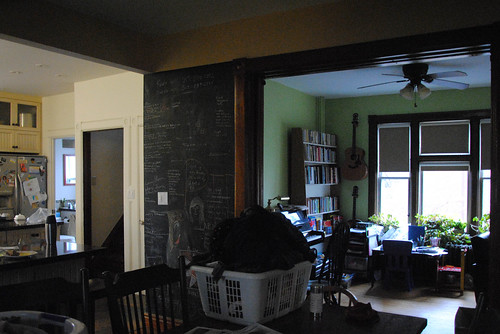
Chores. Also obvious. That overflowing laundry basket on the table behind me right now, for instance.
Cooking and baking. I enjoy doing this too much to call it a chore, and yet it isn’t a hobby either, seeing as feeding everyone is a daily necessity.
Reading. This gets a category all to itself. It comes close to work, in my mind, obviously in a good way.
Friends. Maintaining relationships, trying to keep them fed and nurtured, far and near, in-person and via social media.
And finally, work. As I type out this half-formed idea, I realize that work is a constant, even if I’m not at my desk. I’m feeding my working life, and my writing, by being in the world, by parenting, by playing, by running and reading, by all of it. So work is both a precious and guarded particular part of my life (writing), and work is all of it, all the time, always.
End of idea.
Getting what you want