
Seekers and finders: Karl Ove Knausgaard’s “My Saga”

Well, this wasn’t what I meant to do this morning, while suffering from a sudden and nasty cold, and lying around the house in yoga pants feeling pitiful. But hey, in my pitiful yoga-panted state, I clicked myself over to Facebook to do one tiny thing — instantly forgetting what that was; still can’t remember! — and saw that a friend had posted the link to Part 2 of Karl Ove Knausgaard’s “My Saga,” which would perhaps be better titled “Travels Through America,” freshly published in the New York Times magazine (I read Part 1 two weeks ago).
Here are two passages that jumped out at me, fitting, as they do, into my land and stories theory about power, conflict, and human connection.
“If there is something to be gained, if it is gainable, no power on earth can restrain the forces that seek to gain it. To leave a profit or a territory or any kind of resource, even a scientific discovery, unexploited is deeply alien to human nature. …
Not only is it alien to human nature to leave a profit unexploited, but discovering, inventing or knowing something without passing that knowledge on is alien to us, too.”
– Karl Ove Knausgaard
Read both parts of “My Saga,” if you like Knausgaard’s work. If you don’t, well, don’t bother; Knausgaard is Knausgaard. Either way, you might be forgiven for reading “My Saga” as close to self-satirizing. I found it at times hilarious, occasionally grotesque, Knausgaard willing to set himself up as a curiosity, as the inscrutable Other passing through an awfully familiar (to me) landscape, which he can’t or won’t even attempt to understand. Except he makes some interesting philosophical and cultural observations, and is himself a fascinating study in contradictions, having constructed his persona on the unlikely combination of personal reticence and abject confession.
Yes, I’m a fan.
I happened to be at the Vancouver Writers’ Festival last fall at the same time as Knausgaard, and he was one of the first people I saw when I arrived at the hotel where all of the visiting writers stay. We stood side by side at the front desk, he with one of his daughters, me with my tiny carry-on bag behind me like a favourite pet, on the very day that a lone gunman attacked Parliament Hill. I didn’t say a word to him. He seemed like a private person who wanted to go on a touristy excursion with his daughter, not someone who wished to acknowledge that the person standing next to him at the front desk of a hotel might have read his own hyper-detailed account of his life (I’d recently read the first and second books in My Struggle). Strange, wouldn’t it be? Or am I doing something similar here — on a much, much smaller scale — writing about my life and offering it up to anyone who happens along, yet also certain that I’m essentially a private person, deserving of privacy.
Anyway. I didn’t disturb him. Later, we took an elevator together. In silence.
I’m convinced “My Saga” is a classic piece of travel writing, even if it doesn’t tell a great deal about the land being travelled through; really, it’s about the human condition. How we’re shaped by where we’re born, and by what were willing to do, but also by what we can’t see or recognize, even within ourselves. Maybe most especially there. Writing is an effort to translate emotion and sensation and experience into shared language. This happens, when it happens best, not by explaining what we want to say, but by inhabiting it. So, in writing, a seeker may have more meaning to offer than a finder. A seeker, who doesn’t know what she’s looking at, exactly, might reveal more than she who is quite certain of what she’s found.
Here are links to Part One and Part Two of Knausgaard’s “My Saga.”
Back to my cold-fighting garlic-ginger tea.
xo, Carrie
Monday morning dentistry
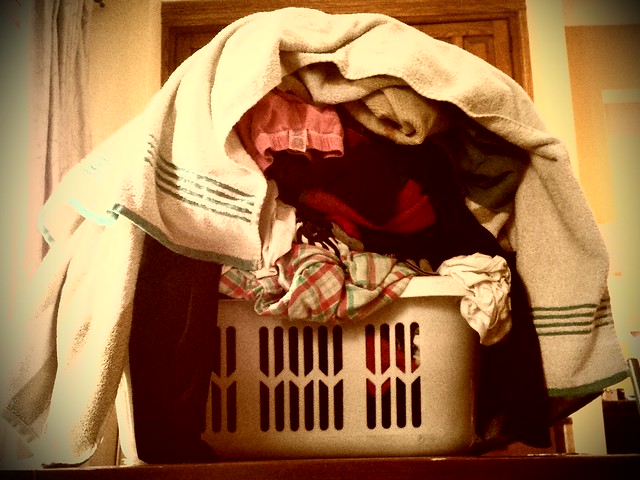
I call this one “Clean Laundry in Basket on Dining-Room Table”
I got my teeth cleaned this morning. You might not categorize this experience under Traumatic, but then, you might not have receding gums and exposed nerves. I almost panicked when I saw it wasn’t the usual hygienist who has been kindly, gently trying to clean my teeth without causing me pain these past number of years. And by almost panicked, I mean actually panicked. I think my fingernails left marks in the arms of the chair. I had to keep reminding myself to relax my tongue (who knew a tongue could be so tense?). And to breathe. Remember to breathe, I told myself repeatedly. I would have confessed any number of things in order to make it stop. But I had nothing to confess that would have interested the new hygienist, who turned out to be kind and gentle and sympathetic too. I did consider begging her to stop early — like, how clean do these teeth really need to be? — but tried to stay focused on the big picture: that I was actually in that chair voluntarily, paying her for her services, because I would like to keep these teeth for as long as possible.
Anyway, I’m writing this post, so I clearly survived to tell the tale.
That’s all I’ve got today. Not a single deep thought appears to have surfaced post-dentist.
xo, Carrie
PS No cavities! So there’s that.
PS # 2 That illustration above is just a little something I need to get done this evening. Along with walking two chatty little boys home from school, violin lessons, picking up local food order from Bailey’s, making supper, and going to the 13-year-old’s final indoor soccer game of his house league season.
Readings, swearing, challenges, and forgetting to set the alarm
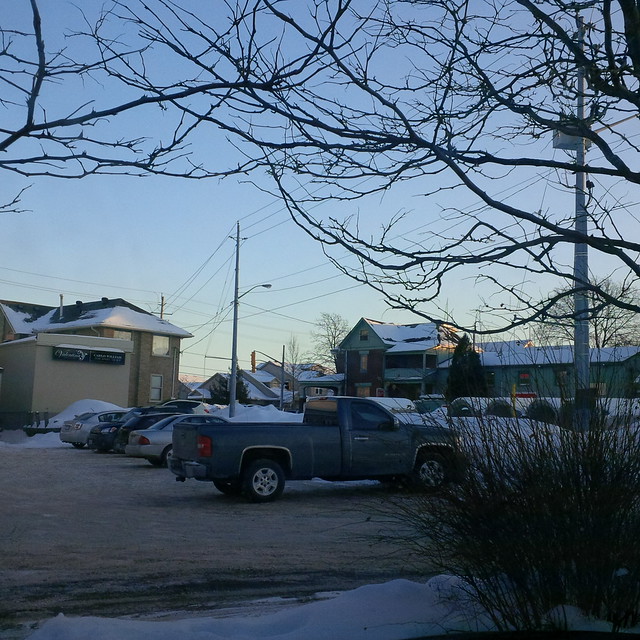
winter, uptown
This morning I woke at 5:54AM, realized my alarm hadn’t gone off, leapt out of bed, and somehow got into running gear with shoes on and teeth brushed before my running friend arrived at the door at 6AM. Good grief! It’s been that kind of week, with little margin for error in the schedule. But I suppose it’s also been that kind of week, with things turning out just fine even if the wheels aren’t turning completely smoothly. (And how about that–I need a mere 6 minutes to prep in the morning? I could be sleeping in!)
I’ve been working on my manners while driving. Driving = swearing, in my world. There’s something about being stuck in a vehicle, possibly but not necessarily late, behind other vehicles that are behaving in erratic nonsensical fashion that brings out a rage I rarely experience otherwise. My kids are very helpful, calling out my muttered curses. “Mom, you said the “H” word,” CJ told me yesterday as we sat at a green light behind a car whose driver did not seem to understand the meaning of green lights. Everyone was too politely Canadian to honk, of course. “I’m sorry,” I apologized to CJ. “I’m really trying to work on not saying bad words while driving.”
“I know what you should do,” he piped up, while munching a cookie. “You should meditate in the car.” This cracked everyone up when I reported it later on, no doubt everyone imagining Carrie sitting with eyes closed ignoring the traffic and breathing deeply; but actually, I did take a few deep breaths–eyes open–and it helped. It’s all about weighing what matters, and whether you really want to work yourself into a snit over [fill in the blank]. Usually, the answer is, big picture, I’d rather have a chat with my cookie-eating kid than be gripping the wheel, shoulders tensed, cursing the eccentricities of those who share the road. If only I could recognize that before I start swearing, not during. Connecting the dots between meditation and real life is the real challenge.
Speaking of challenges, yesterday definitely qualifies. Piano lessons, picking up kids from different schools at different times, writing on laptop in car between pickups. Home to eat take-out pizza fetched by Kevin, then up to the little kids’ school for their arts night, visiting with friends and neighbours, ducking out early, dropping little kids at home in care of their older sister who was distracted by her imminently due science fair project (the dining-room table covered in chopsticks, copper wire, batteries, and bouncy balls), and at last, getting changed and zipping over to Conrad Grebel College to read as the final guest in their Mennonite Writers Series. After all that running, what a surprising pleasure it was to come to a stop in the Grebel Chapel. I could not have felt more welcomed. The evening was a total pleasure, and something about the format felt as natural as if I were reading to my kids at bedtime (dressed in nicer clothes, wearing makeup, with a microphone pinned to my shirt). As I sat there at the end of the presentation looking out at this warm and generous audience, I thought, wow, this is a damn lucky life. Embrace it, receive it, savour it.
And then go home to tea and bed in such a happy state of mind that you forget to set the alarm, apparently.
Anyway … I’m reading again tonight at WLU, at Lucinda House, 6:30PM. Then I’ve got a little break in the readings, with more to come in April. I will keep you posted. And I’ll let you know how the car meditation is going …
xo, Carrie
An exercise that is not interested in right or wrong
Yesterday, my youngest stayed home from school. I didn’t want to alter my routine too drastically and he is old enough now to be accommodating and to entertain himself quite easily. I said I was going to meditate for twenty minutes, and he was okay with it, especially when I told him to bring his little mini-super-hero figures into my office so he could play while I meditated. I told him he could make noise, but please not to ask me for anything for those twenty minutes (genuine emergencies excepted; but the beauty of having an office is that the kids already know that rule about interrupting me).
He played for the first ten minutes or so. Then I heard him leave. I heard him come back. And it got very quiet. I knew he was in the room with me, but I didn’t know what he was doing.
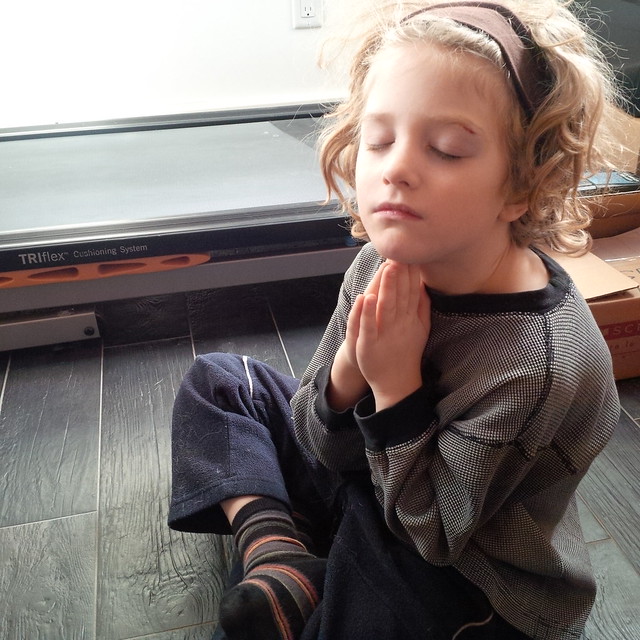
When I opened my eyes at the end of the exercise, that’s what I saw: see photo above. He was meditating. He had chosen to sit cross-legged with his hands in a prayer position. This is not how I sit when I meditate. He wasn’t copying me; it was the position he chose on his own. When I asked him about why he’d chosen to sit that way, he couldn’t explain it. He had a few questions about the voice in the computer (I use a guided meditation app). Who was that man, and is he real, and can other people hear him too?
I have a couple of observations about meditating. I love it. Or maybe I only have one observation. That’s it. Clearly this is something my mind takes to; reminds me of running, a bit, how when I found the running, it seemed to answer some question in me that I hadn’t known was there, silently being asked.
I love following the tracks of my thoughts into a corner of the mind where I am suddenly falling backward into deep snow and staring at an enormous open sky, in awe.
Even today, meditating alone (with dog snoring at my feet), with my mind in a state of apparent dissatisfaction–even today, I loved the exercise. Why?
My mind flitted today, ran everywhere, often to places I did not want to be.
I kept returning to breath and that helped, but didn’t cure what ailed my mind, its anxiety that I was doing everything wrong.
But you know what? Even while I worried, I knew on a deeper level: This is not an exercise interested in right or wrong. Do it, and it counts. You will learn something, every time. Not necessarily something big and astonishing. But something interesting–it’s waiting to be found, every single time. Today’s exercise was a good reminder to the frustrated, dissatisfied self: you won’t always think you’re doing a good job at the tasks you’re doing; maybe you’re even right about that. But the real work isn’t confined to a single instance, it’s in the accumulation of many instances. It’s in repetition of effort, and returning again and again to the discipline you’ve chosen to get to know more deeply. You can’t know in advance where it’s taking you. You don’t know exactly what you’re making. But that’s the beauty and the mystery.
xo, Carrie
Sitting in stillness amidst the whirl
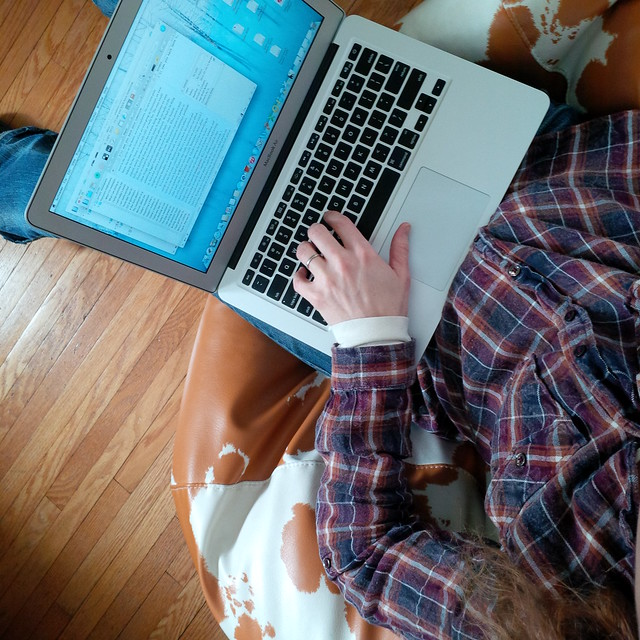
“I am beautiful, I am bountiful, I am bliss, I am, I am.” —from the song “I am the light of my soul”
These are the words that came into my head as I finished today’s meditation, which was for thirty minutes. It amazes me that I am now able to sit still for thirty minutes. Me! Sitting still, doing, apparently, nothing but breathing. Today, as I was falling into and out of my breath, feeling the stillness and comfort of my body, I heard a car zoom by on the street outside, and I had a strong and joyful sense of the world going on around me in its whirl and bustle, and yet here I was, still and at peace. Still and at peace and not necessary. That sounds odd. It’s what I felt.
It was a very peaceful feeling. I felt the world whirling on around me and without me and it didn’t need me to whirl too. I could sit here in stillness and all would be well; maybe I even understood in that moment that sitting here in stillness was as important as all of the whirling I do.
I have filled my life up with responsibilities and cares. I love being in motion, driving somewhere with somebody to something, or setting goals for myself in everything I do, from swimming lengths to running miles to lifting weights, to the word count I keep track of with pleasure on my new novel. I am also keenly aware of the needs that must be met to keep this family operating in a healthy and happy way. The dog hair that must be vacuumed. The meals planned and prepared.
So it is somehow profoundly soothing to also see the flip side, to recognize that I am not as necessary as I tell myself. That if I am busy, it is because I’ve chosen to be busy, not because busyness is essential to my being. That there is always room to sit still for a few moments and breathe, and pay attention.
I feel hopeful today.
I am hopeful about my writing. I am hopeful about my children and my relationship with each of them. I am hopeful about what meditation is bringing into my daily life. I am hopeful about practice. I am hopeful about today. And right now.
xo, Carrie