Sunday, Mar 24, 2024 | Art, Big Thoughts, Books, Fire, Francie's Got A Gun, Girl Runner, Manifest, Peace, Play, Publishing, Source, Spirit, Success, Writing |

I’ve been thinking about a book of linked stories that I wrote around 2014-2015, immediately before and after publishing Girl Runner, the novel that at this point in my career seems likely to be my biggest hit, as it were. Girl Runner sold internationally, was translated into a number of languages, and people still invite me to come to their book clubs to discuss it (which means it’s being read, which is quite remarkable, honestly, for a book that celebrates its tenth birthday this year). In short, that book changed my life; but not in ways that I could have predicted, and I’m curious to re-read stories written in the aftermath of success, because what I remember from that time is that I did not feel successful. I felt estranged from myself. I was stressed and under pressure. I fully expected to build on the success of Girl Runner to publish more and bigger; but nothing came. It wasn’t that I was blocked—I wrote a lot—novel drafts, short stories. It’s that what I wrote wasn’t … well, it’s hard to say this out loud, but it wasn’t what was wanted.
I don’t know if I have a gift for writing, but I have a love for it, and a desire to do it—and so I write. For a little blip of time, a decade ago, I could imagine that the foundation was set, and I could spend the rest of my life writing and publishing books, and, crucially, making a living from that work. This hasn’t been the story, though; this hasn’t been the arc of the plot. I’m no longer grieving this as a loss; but I did, and I think a version of that grief is contained in that short story collection (which I titled Why Give Yourself Away?). Why Give Yourself Away was so unwanted, perhaps so unlikeable, that an editor made the assumption I’d submitted the manuscript in order to break a two-book contract. Yikes. When I heard that, a few years after the fact, it was real blow. Because I’d been serious—that book of stories was exactly what I wanted to write and to publish at that moment in my career. I’m not commenting one way or the other from this perspective—was it better for my career that those stories remain in my attic, or would they have been a worthy contribution to my overall published work? I have no idea. Francie’s Got A Gun probably wouldn’t have existed had that project been published, for the plain and simple reason that I wouldn’t have needed to write Francie—I walked through fire for Francie, and that’s something you only do when the need is obsessive and otherwise insurmountable. Writing Francie was a feat of endurance and single-minded optimism. Not hope—hope is softer and more organic, elegant. Francie exists because I was irrational in my need for her to exist.
(And perhaps I love Francie all the more for it.)
Nevertheless, those old stories intrigue me. I wonder what’s captured there—a mortifying self-pity? A Karen-like whine that the world isn’t bending to my will? Something’s in that collection that made an editor cringe. Yet I recall the stories in my mind as almost magical; maybe writing them was medicinal. It got me through. As writing always seems to. It gets me through.
What fascinates me about structuring a narrative is how crucial the unravelling is—the when and the shape of the viewpoint. Am I more ruthless when following a linear structure? I suspect so. Those stories were linear. The project began as an attempt to record in immense detail a single day, on the day that it was happening. The narrator (a version of myself) was unsparing to the point of cruelty to herself. But if I were to return to that narrator now, wouldn’t I see her actions differently? In returning—in recasting the structure as circular—forgiveness, gentleness, curiosity can’t help but creep into the perspective. I have kind feelings toward my younger self. Sometimes, I pause to thank my younger self for her courage, her wild leaps of imagination, her insistence on becoming, and for her mistakes.
If I am fortunate, I will grow old, I will become elderly, and I will thank all my younger versions of self for their persistence and doggedness and belief that everything they did mattered. No matter how small. No matter the visible result.
Think of everything you’ll do in your day that is unseen or unnoticed or unrecognized. Hold a few of these in your mind for a moment, cup your hands around the small actions, gifts and gestures. I did not know the answer to the question Why give yourself away? when I was writing those stories, but the question itself landed differently in my ear at that time. I thought I was giving away pieces of my life to fiction or poetry, or flaying myself open as a means of creating art, and you know, maybe I was, and maybe that’s exactly what it meant at that moment to give myself away.
I won’t rewrite those stories. They stand, as they were, of that time. But I might write a new book with that title. Maybe. Honestly, who knows? I circle, I alight, I take flight.
Why give yourself away? The question lands differently in my ear now—I hear giving as ongoing life-affirming generosity that returns to you a thousand fold, because now I believe that my self is formed of a deep well, a source that is infinite, and that source is love. Unconditional ocean-like, star-like love. “Not the sad edge of surf, but the sound of no shore.” I can’t always access this love, nor am I always in tune with it, but that’s okay. I’m moving in that direction; I’m circling it, in fact. The tree in Francie represents that circling motion—accumulation of experiences, young/ancient core protected and held by rings of capacity.
Why give yourself away? What choice do you have? What you keep, what you hold tightly and cling to, will wither and harden, or pain you for being unspent. The hours are brief, and what you give will be returned to you in another form that you likely won’t be able to see, but you’ll feel and know because those around you will respond to it. If what you give is harmful, you’ll know that. (And by the way, I believe that even if what you’ve given is harmful, by giving it, you’ve opened yourself to the possibility of change—to give is to transform.) If what you give is greater than yourself, you’ll know that too.
This is not about giving everything to everyone, spilling your guts or breaking boundaries: Love the self you are giving away, meet yourself in unconditional love, begin there and expand ever-outward.
Why give yourself away? Because it’s how you find your way back to your source. But that answer is a bit too long.
Because, love.
xo, Carrie
Saturday, Mar 16, 2024 | Adventure, Art, Big Thoughts, Fun, Good News, Peace, Play, Publishing, Source, Space, Spirit, Success, Word of the Year, Writing |

Contrast. What joy this word brings me.
Contrast isn’t about what’s better or worse, or right or wrong, it’s not about comparing one thing to another — instead, I think about vibrancy, colours, shadow, texture, depth and height, the common structures of my everyday, and how routines and patterns might be shifted to bring even more enjoyment, pleasure, delight to my mind.
Beauty is in the eye of the beholder. Contrast too. My own taste matters in this exercise. What’s delicious for me, attractive, appealing may be off-putting, strange, and discomfiting to you. Maybe I’m not seeking a universal aesthetic. But I confess to wanting to communicate clearly with everyone I meet.
I’m thinking about writing, of course. All the more so, having spent the past four days writing, solo, at my brother and sister-in-law’s farmhouse. Unimpeded, I got a glimpse into my own eccentricities, and let’s just say, I vacuumed obsessively in between focused spells of writing and revision. I ate nothing but cornmeal porridge for the better part of one day. I read what I’d written out loud in wildly dramatic tones, and I talked to myself pretty much non-stop. Muttering about word choices, testing out dialogue, reassuring myself that the scrabbling break-in noise I’d heard was just a squirrel (a manic and possessed squirrel, hanging upside down and staring in at me from a window, sure, but still just a squirrel), that I could do this, I could finish this book, and that at a certain point a person should really take a small break and make herself a cup of tea.
It was delightful, in short.
And it was terrifically fun, and I found myself overwhelmed with gratitude and joy, that my “hobby” or “life’s-calling” (either work, quite honestly!) allows me to retreat from everyday circumstances and escape into an imagined world that seems to live and breathe and dance and shout and bend and twirl purely to bring me delight. I feel very connected to my child-self when playing in my imagination. And yet I appreciate the skills gained over years of practice that facilitate the ease with which timelines unfold, and structure ascends, and characters enter and exit and become.
The hope, as always, is that what pleases me will also please others.
It’s a pretty grand hope, when stated bluntly—maybe even grandiose. Delusions of connection—the belief that the contrasts that soothe my fears, break my heart, speak to my spirit, raise my blood, and make me laugh might do the same for you. That’s a writer dream, to be perfectly frank.
But if it doesn’t happen? Well, I suppose it’s hardly a tragedy, nor cause for giving up the craft! Surely, surely, my optimism assures me that I’ve made a thing that others will enjoy, but way down here at the foot of another yet-climbed mountain (let’s call it Publishing), I’m wrapped up beside a little fire of my own stoking, whistling a happy tune, because I’ve had the pleasure of making something. I’m laughing just to think of it! Such great joy in invention. And come Monday, I’ll be back in the library with the children, soaking up their energy, and being reminded (by them!) of how to live my happiest life: ask lots of questions, be where you are, give your attention to what’s before you, and keep puzzling it out and trying your best to make connections, and understand.
Home again, I’m carrying the residue of concentrated delight and invention, I’m fresh with the contrast—having been away, writing and, yes, finishing the book, and having returned, every hour seems, just now, precious and lit up with all different colours and emotions, aching to be enjoyed. It’s just so darn interesting to be in the world.
xo, Carrie
Friday, Mar 8, 2024 | Big Thoughts, Confessions, Feminism, Meditation, Mothering, Parenting, Peace, Sleep, Source, Spirit, Stand |
Walking home from yoga this morning, I was thinking about my body. I’ve been thinking about my body a lot lately, too often negatively. There is a script from deep in my past, fostered by messages absorbed throughout a lifetime, that says: control your body or you’re worthless. It’s fat-phobic, yes, but it shames on multiple levels, given how little a person controls how she is seen and perceived in this world; given how little she controls the effects of hormonal swings, physical ailments and illness, and the general fragility and fungibility of the human body.
Walking home, someone (a man) started shouting out of the window of his vehicle—I didn’t think he was shouting at me, but it reminded me of being shouted at as a younger woman, even as a young teenager. Words that treated my body as an object, not part of a whole person, and words that told me that attention was to be valued, and also, paradoxically, feared. I remember the relief of suddenly (it seemed to happen quite suddenly) being “too old” to attract the attention of men shouting from car windows. But I wonder whether wanting to be invisible is ultimately damaging to the spirit too. Why should I want to hide myself away, as if in shame of being in this body, here and now?
I do not want this script rolling inside my head, telling me to be ashamed of my body, while also telling me that I need to work harder to change it, somehow. It’s a script that will never be satisfied with my body, no matter its shape, strength, and power. One of my parenting goals has been to break the multi-generational narrative that something is wrong with our bodies—I’ve wanted my children to be free from that internal/eternal script, or at least not to receive it from me. But they might receive it from me, by proxy, if I am speaking it to myself. To break the chain, I need to break it wholly. Or I want to!
Can I change the voice in my head?
Last night after obsessing over a photo of myself as radiantly happy and yet objectively (wait—subjectively??) unflattering, I decided to start an experiment. Every time I notice the voice in my head saying something cruel or self-deprecating or dissatisfied or despairing about my body, I will counter with the words, “I love you, body.” Spoken out loud (or whispered): voiced. The magic will be in the noticing—using the moment, when deep subconscious self-loathing rises to the surface, to turn instead toward love. When I hear that voice, I will be reminded that it is not my voice, and that it has no power that love cannot shift.
I love, respect, and admire people who live in bodies that are all shapes and sizes, and I believe them to be amazing, wonderful, interesting human beings with wisdom and insight; their bodies carry their spirits and personalities and that’s what comes through when I’m with other people, known or yet-to-be-known to me. I want to love, respect and admire my own body in the same way: as a vessel that’s carried me nearly five decades, that’s adapted to enormous changes, like adolescence and pregnancy and peri-menopause, and that radiates with my spirit.
So, to summarize, here’s my plan: Whenever that voice speaks in my head, I will counter with “I love you, body.” I will shout it or whisper it, say it seriously or half in jest, believing the words or not believing them; I will say these words no matter what. I will also seek to give my body what it enjoys—like riding my bike to work, and stretching in yoga, walking, getting enough rest and sleep, eating tasty food, laughing, rubbing minty lotion into my feet, wearing clothes that flatter my shape and feel comfortable, and etc. Whatever I can think of that my body will enjoy, I will try to do.
Walking home this morning, I asked myself: have I been able to shift in-born beliefs or deeply grooved habits? Do I think differently now, have I been able to affect change within myself? And while it feels like discovery is more accurately re-discovery, circular rather than linear, yes, there have been significant changes to my thinking patterns. Most feel too private to discuss here, in a public forum, but suffice it to say, some of my fears have softened or even melted away, and my ambitions have shifted significantly too.
So, body, I love you, I love you, I love you. I’ll keep saying it till it’s the new script, the ongoing and true story.
xo, Carrie
Friday, Mar 1, 2024 | Adventure, Art, Fun, Job, Kids, Peace, Reading, School, Source, Space, Spirit, Work, Writing |
Spending time with children is a fabulous fortune. It’s pure gold.
A friend and I were talking recently about older people whom we love and care about, whose lives have been robbed of dignity by ailments and illnesses, and we wondered what could be done for those we love, when the options for care are so limited? Long-term care: the place where nobody wants to go, nor enters willingly. Could multi-generational living situations be a solution, my friend wondered? But that would require women (most likely) in their prime earning years to become full-time caregivers; our North American culture and norms and the economy itself is not geared toward this, even if it were something women in their prime earning years would wish to do.
What about a dorm-like set-up where university students or young adults lived alongside elderly people, sharing common space and meals? And animals or pets were part of the picture too? Maybe even a nursery school? Personally, I can imagine moving more willingly into a care situation like that. (Yes, even with the germs!)
In the dominant North American culture, we tend to hive ourselves off into age groups. Think of university students who have a tiny window when they can live in dorms communally, then it’s over. We think of independence as living solo or with immediate family. There aren’t many opportunities to experience life as part of a multi-generational whole, and that’s challenging, I think. It’s alienating.
My children are now young adults, and soon they will be quite grown. I don’t want to relive those years again—caring for young children—but I’ve missed the generative energy of children. I’ve missed their naturalness and ease in conversation. I’ve missed their seriousness, too, and the way children pay attention. So it’s been good medicine to be working in an elementary school library. Not only do I get to be in a big quiet (sometimes!) room full of books, but I also get to open those books and read them out loud. Story time is a highly participatory experience (and I need to work on my pacing, to speed this part up a bit, for the teachers’ sake!). But I’m just about nearly as curious as the kids are to explore the effect of words and imagery on the pages. As I read the same book over and over to different mini-audiences, I gain deepening insight into what draws their interest and attention. What matters to them.
The details they notice in the illustrations are fantastic—they’re putting together narrative on a visual level. And they listen carefully to the words, making connections to their own experiences, wondering out loud. Trying to understand.
Working with children, being in their presence again, is like looking into a mirror of how I want to be (on a spirit-level). I hope I’ll always get to be with children, one way or another; or at least I hope I’ll feel free to approach everyone, no matter their age, the way I approach children—with openness and trust, attention, curiosity. It’s in this mind-space (spirit-space) that I am inspired to make things, to write, to draw, to create. It seems to me that the only way to survive being alive, surrounded by inequality, imbalance, suffering and pain—and as a participant in these pain-filled structures and systems too—is to make, to create, to mediate experiences through imagery. To go searching for beauty. And sometimes, to find it.
xo, Carrie
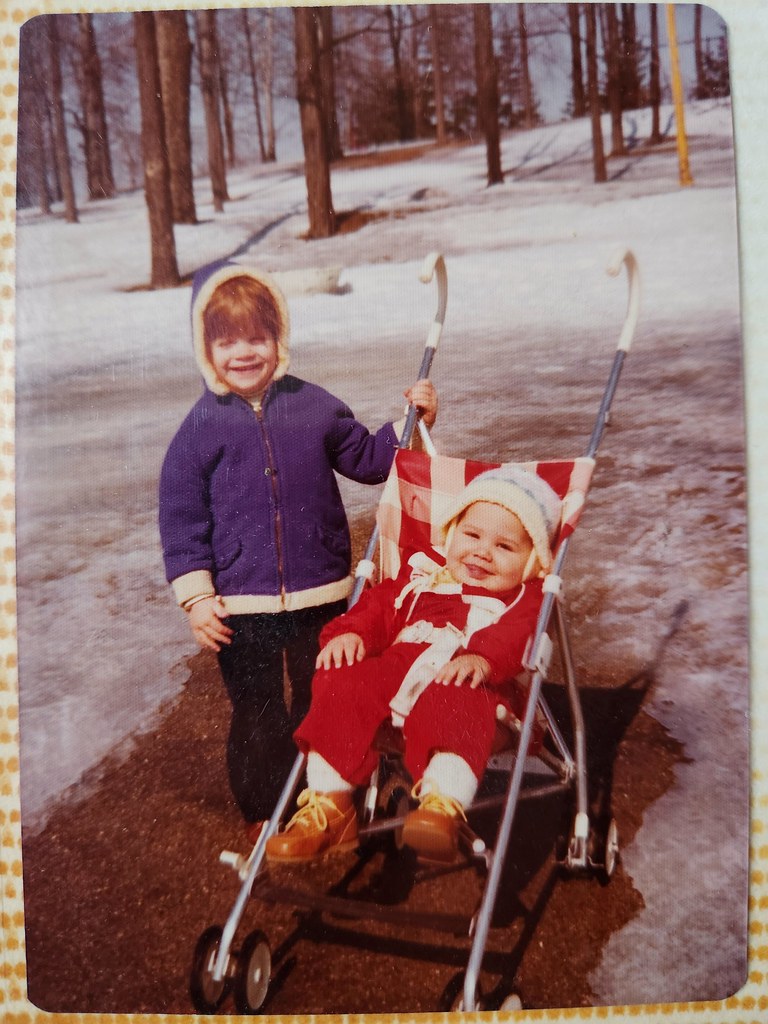
PS That’s me and my brother in Waterloo Park, when we were very young.