
Jammie Day!

I’d like to introduce you to Jammie Day, starring Cliffy!
In answer to a question I’m asked quite often, yes, I do have a new book coming out. It’s less than 800 words in length, and relies heavily on Brooke Kerrigan’s adorable illustrations, but I think you’ll find it genuinely heart-warming. My second picture book, Jammie Day, is due in stores on October 15, published by Owlkids, and it’s just received its first review. In fact, Quill & Quire has given Jammie Day a starred review.
I’m unashamed to report that the star has gone directly to my head. After reading the review, I spent an evening strutting annoyingly (endearingly?) around the house, informing my family of Jammie Day’s triumphs. “Aw, Mom, you’re so excited. You got a gold star.” Hear that being said in a teenager’s tone, and you have some idea of the supportive response I received. I’m pretty sure it’s my very first starred review ever in Q&Q, and let’s be honest, that star is for Brooke Kerrigan’s winning illustrations, but no one’s taking it away from me now.
I would like to pause here to marvel at the uplifting power of the gold star. We need to tap this power, people! I should be giving myself gold stars all day long! Gold star for holding that pike position for the last eight seconds of exercise class while dangling from TRX straps at 6:43AM! Gold star for making three sandwiches for school lunches before showering or eating breakfast! Gold star for a truly excellent nap on the couch!
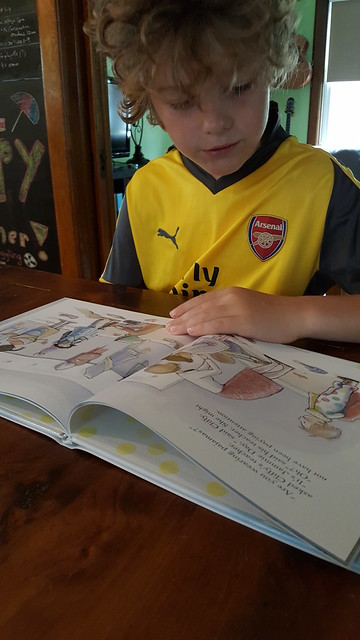
Here is Jammie Day getting its very first read. It really is a wonderful book, if I’m allowed to say so. Well, no one’s stopping me, though it’s probably in poor taste. Have I mentioned that Jammie Day got a starred review in Quill & Quire??!! Insert winky-face emoji here. Totally unrelated: I’ll also be selling Jammie Day through my web site.
Now I’m off to earn gold stars for laundry, class prep, and writing another chapter in my next book (longer than 800 words, no illustrations).
xo, Carrie
Read this post, future self
Hurricanes, earthquakes, floods, fires.
But ordinary life goes on, and outside my window is a cool Friday evening, with sunlight splashing shadows through the still-green leaves of early September. I wrote today. After a week of disappointing attempts to write, this was truly a gift. I wrote with a friend, and when we were done, we read to each other what we’d just written, and that was the most magical part of all — that joy of sharing what did not exist only an hour before. I may have to add this point to my manifesto (see below): read what you’ve written to an appreciative audience immediately upon writing it!
re the manifest0: On one of the last days at the cottage, I wrote out a set of reminders for myself, in an attempt not to lose what I’d gained. But then I got home, and it was all too much — the hours of each day consumed themselves, often quite wonderfully, but with only a few words set to page, and the words seemed weak, the magic drained from them by the heaviness of early mornings, forms to be filled, course prep, answering emails I’d abandoned, meals, scheduling, driving children, walking dogs, and on and on. That is why this afternoon’s blissful writing time was such a gift.
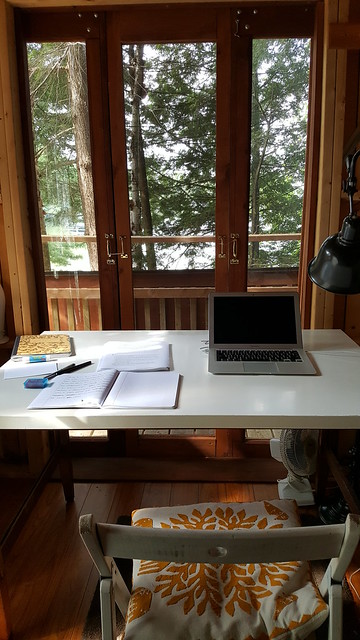
For the record, here’s my message to myself, from the office overlooking the lake.
Something I am learning is that writing by hand is actually the very quickest way to access a character or a scene. Something has changed for me over the past year, and at an accelerated pace this past month (the beautiful amazing writing and resting month of August, 2017, as I shall hereafter recall it). In my hand and on the page, I find access to fiction. This book has been a long time coming to fruition, and perhaps that is due in part to my needing to learn a new way to write and think — the Lynda Barry way (but also the post-concussion way). When this book is done, I will dedicate it to my friend Lisa, who introduced me to Lynda Barry. The detail and complexity of thought that arises now that I’ve trained my hand to listen, to be a force in motion, to be the leader, not the follower, of my thoughts — it astonishes me daily.
The other key to freedom, which I must share with my students, is the lack of a delete button when writing by hand. It sounds so obvious, but if I were writing this on-screen, I would have just gone back and deleted a whole line — probably not an important thought, but nevertheless it would have vanished forever. Here on the page, even a crossed-out line still exists. And there is an impetus to push forward, not to recreate and reattempt what one has already written, but to find out where the somewhat misshapen present is taking one.
I am not permitting myself to delete when I’m writing on the laptop, when I transcribe material — this is the first draft, I’m telling myself, and it can be refined later. I allow myself to add more words, but not to delete. The draft needs to exist as it stands, for now, until it is complete.
I will also print my drafts when they are done.
I’m writing this like a manifesto for my future self, as a reminder!
Something else to remember, for later: the back of the mind needs to know it has time and space to come forward — permission to come forward. That is why ritual is so important, and timed writing is so important, because it is training the back of the mind to trust, and the front of the mind to trust, too. Give it time! I must commit to 2.5 hours every day, if possible, and sacrifice all else. [Future self says: bloody hell, are you ever optimistic, cottage self!] What will this look like in practical terms? I hardly dare ask. I think the habit is imperative, no matter what project I’m working on, now and in the future.
Priorities. I need to stop taking on responsibilities I haven’t got time to learn how to do, or to do well. Instead, I want and intend to focus on what I already do well. Writing. Writing writing writing! I am a writer unleashed! The only person who is messing with my priorities is me. I can see that clearly now. I have put all kinds of blocks and obstacles into my own path as a writer. This may be out of fear. Fear that I will run out of things to say, fear that I’m really not that talented. Fear I’m delusional.
But right now, at the peak of this surge back into writing, I want to laugh at myself, gently mock myself, and say, hey, not everything you write needs to be published. That doesn’t mean you’re not a writer. You’re the one who is going to determine your own writing future, not anyone else. It’s weirdly true, I can see. I can’t determine prizes and publishing deals and grants and recognition and audience, but that is immaterial — material and immaterial. It’s the identity that makes all the difference. It’s being a writer, inhabiting the body of a writer, loving the mind of a writer, making space for this writer, time for writing, challenging myself to difficult tasks, challenging projects, pushing myself to do this thing I believe I was born to do.
And stop undoing all that I’ve done to get here. Stop ignoring where I am and how I’ve gotten here. Stop undermining myself.
I don’t mean to become arrogant. I mean to become fully myself. Sorry, fourteen-year-old daughter of mine, I do believe a person can grow and change. I do. I’ve seen myself at so many different stages, witnessed real change, seen my body change and my mind too. I know this is possible, it is possible to be a writer and be comfortable being a writer. It is possible to nourish and feed myself as a writer, and damn well to do the writing. Damn well do it.
Oh Lord, I want to keep doing it. I don’t want this holiday at the cottage to end. I want every morning to sit at my desk and write. So do it [says cottage self to cowering future self]. Do it, and sacrifice in other areas instead. Experience the discomfort of that. The discomfort of honouring your work and your vocation above your other responsibilities.
Yikes. Onward!
End of manifesto.
Note to self: read this post whenever you’re feeling lost, confused, down, uncertain, anxious, whenever you’ve lost faith. Read this post!
xo, Carrie
A good month
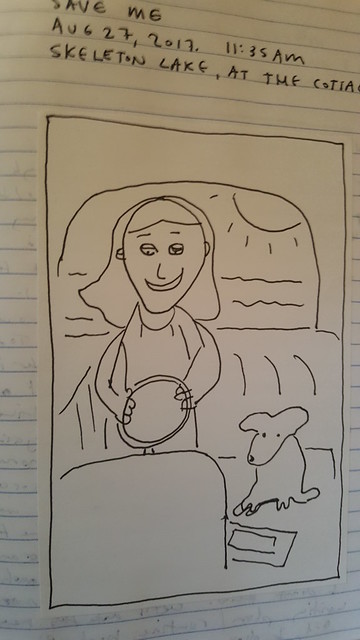
Excerpts from my notebook, written sometime during the past eight days, which we spent at my stepmother’s boat-access-only cottage. I wrote every day. Every time I sat down to write, I began by drawing an “attendance cartoon” (Lynda Barry-style), to a random song from my Spotify playlist. Then I wrote for 3 minutes, beginning with the question: What’s on your mind?
*
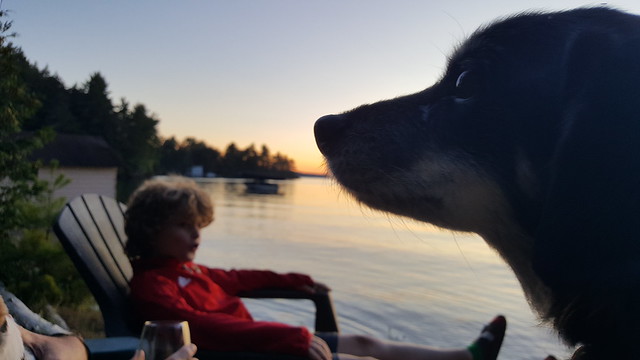
I am staring out at the lake, through the piney trees from my perfect sheltered vantage point in the bunky — my office for this week. We are so fortunate, so very fortunate, to get to spend time here every summer, so that this place has become part of our lives and our children’s lives. Today is sunny and warm, and the water is warm, apparently — I have not set foot into it yet. I did drive the pontoon boat yesterday, proving again that I can.
What would I give up to write more? I don’t know. Let’s make this new writing plan / routine work. Please, dear God, I don’t want to give anything up.
The scene I worked on before lunch is unfinished. Instead of finishing it, I ate lunch with the family, then read in the sun for hours. I am reading I Capture the Castle and I’d forgotten how romantic it is and also how much that romance moves me, or triggers in my mind such delicious feelings.
Finished I Capture the Castle, furious at the description of the constipated mad genius father (a writer), whose inspiration may derive from violently attacking his family members, including throwing his teenaged daughter Cassandra into a wall, almost breaking her arm. Is it that I hate the implied privilege of the artist — Artist with a capital A — or is it the male artist in particular whose privilege I abhor? But haven’t I been reading about women writers, too, how are childless or who steer clear of their children for long stretches, so as to write? And what would I sacrifice in the long run? Would I give up coaching or teaching, let alone parenting intensely, in order to serve the “genius” of artistic creation? No. It seems a nonsensical thought. Yet when I am writing, don’t I want to go on living in this other world and not come back — or not for a long while?
I don’t know how to draw a mosquito. My eyesight seems to be getting worse. I stare at letters that my hand is making and the words are blurred. Somehow I can keep writing without seeing.
From this angle, the boat parked in the middle of the lake looks like a car that’s been driven there by accident, and is half-sinking. I am not doing a good job on a number of fronts. That is the feeling I am having. But it’s been an exciting couple of weeks of writing. Writing and imagining. Yet other things have fallen to the side, and I wonder how I will have anything to give to my students this fall, or even to my children. The forecast is calling for rain. What is joyous about my writing right now is the pleasure I’m taking from it, that doesn’t seem connected to worries about publication. This might not last. My eldest daughter says I’m always trying to improve myself and failing: I’m really just always the same. The more I think on it, the more I’m convinced she could be right.
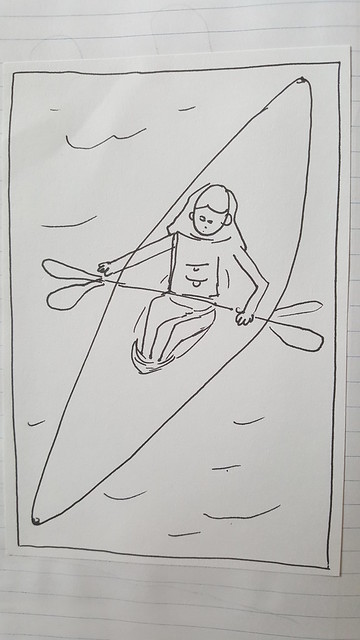
I think all of this burst of writing comes from calling myself, naming myself, WRITER. Can I change in other regards? I don’t want to be a prickly person, constantly challenging others.
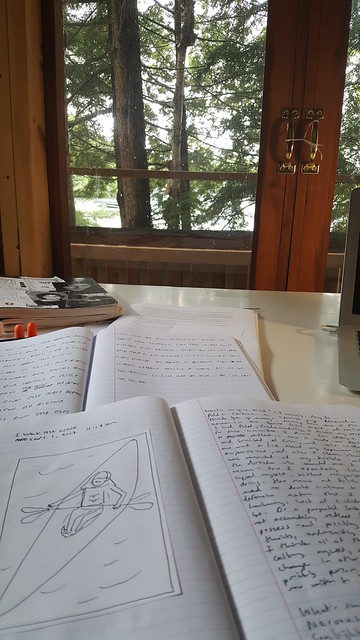
Sunlight is shining through the glass door and warming my office / bunky. I had a feeling after yesterday’s work that I’d written a scene that was the culmination of about 15 years of trying to write that particular scene, with that particular combination of effects — a scene about children playing in a makebelieve world where pretend and real blend together so seamlessly it’s almost impossible for the children to tell them apart. That feeling of being immersed in imaginary play. I’ve been sitting here trying to remember the first version of that scene while staring out the window at the roofline of the cottage, shingles, pines, smoke from the fire, child outside petting Suzi (dog) who was recently sleeping in the sun on my stoop. Gillian Welch is playing “Revelator” on Spotify and this mood seems exquisite and impossible to capture, and yet that’s what I’m attempting to do when I write.
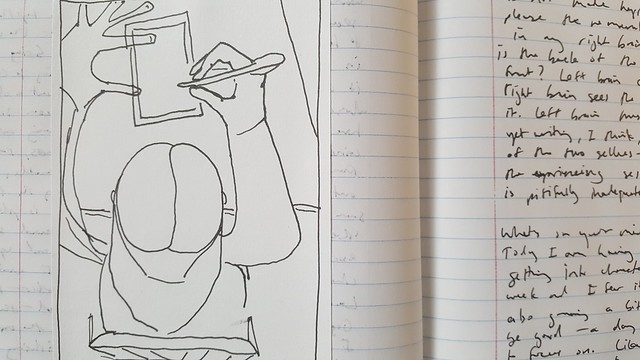
The brain is on my mind, the two selves, as described in Thinking, Fast and Slow, by a psychologist who won the Nobel for economics. The experiencing self is not made happy by the same things that please the remembering self. Writing, I think, is the most peculiar linking of the two selves — the remembering self immersed in the experiencing self. My knowledge on this subject is pitifully inadequate.
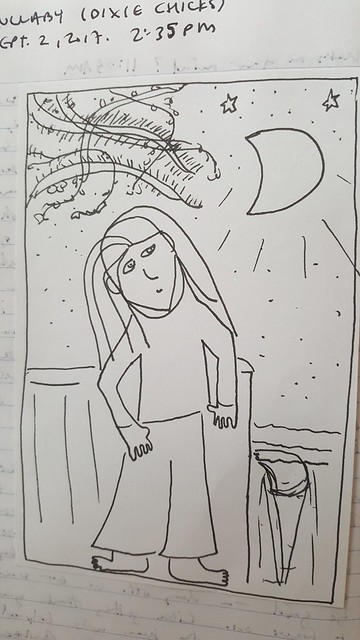
Today I am having difficulty focusing and getting into characters. This has been an intense week and I fear it coming to a close, but I’m also growing a bit weary and perhaps a rest will be good — a day off.
Sometimes I draw something, and I think, that comes right from the back of my mind. The front of my mind couldn’t have drawn that.
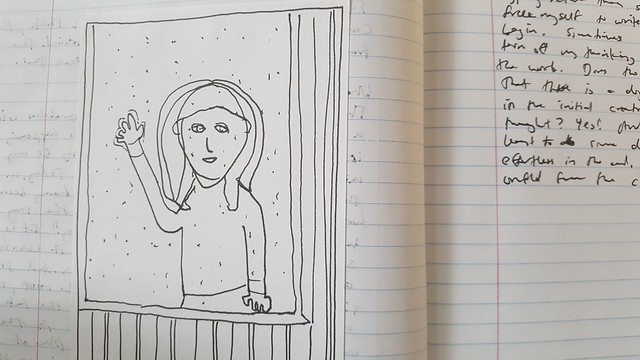
The way my attendance cartoon matches with the song and a mood and whatever is happening is uncanny, although this may only be my mind making magical connections. Today, on the day we leave the cottage after having been here for eight days, the song is Joni Mitchell’s “Urge for Going.” It is a song about the changing seasons; it even has a chevron of geese flying south. And I’m sitting here with rain falling on the roof, cool or almost cold, fog rising off the lake, and smoke rising from the chimney in the main cottage, reflecting on this time of transition. In the cartoon I’ve drawn this morning, I press my hand against the window from inside the cottage and try to say goodbye. This has been the most blessed month. Time has stretched and expanded and we have been content.
xo, Carrie
Treetop Annie comes home
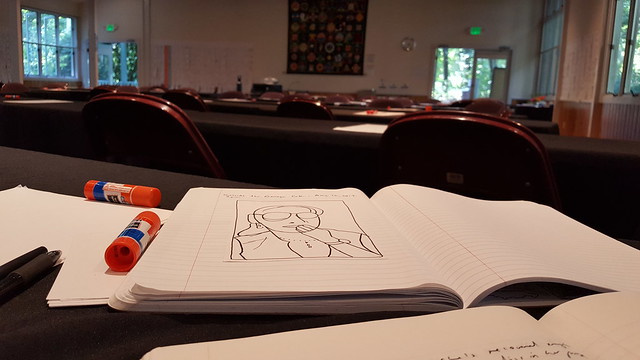
A person wonders whether she can carry home the things she learned, whether transformation in a radically different setting from home is sustainable. A person yearns to be the self she was while she was away. But a person knows, coming home is coming back to a crowd of needs waiting to be met. Even the house needs her. A person has so many loves. Loves are obligations but loves are also earned and cherished and what would a person write about were she to have no loves to tend to?
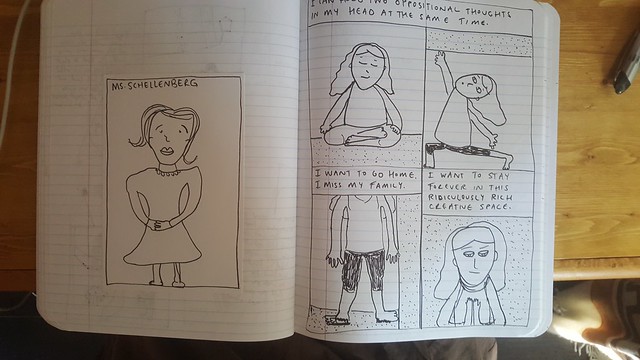
I can hold two oppositional thoughts in my head at the same time. I want to go home. I miss my family. I want to stay forever in this ridiculously rich creative space.
What I’m trying to say is that I’m home from Omega, in upstate New York, home from the Lynda Barry + Dan Chaon workshop, a 5-day intensive experience in a summer-camp-like setting, with an amazing yoga class every morning, ultra-healthy vegetarian/vegan food served three times daily, virtually no responsibilities, no chores, and perhaps most critically, almost no emotional labour except for the work that poured onto the page. My mind was uncluttered and immediately more open to images and connections. Will I be able to be joyful, I wondered on the evening we arrived, will my spirit find lightness? Is it still possible? I had my answer in less than a day: yes. It was so easy, under the circumstances, to be playful, attuned to what’s under the surface, easy to meet any challenge.
Writing isn’t easy, but it’s enjoyable, said Lynda Barry. She likened it to seeing runners go by in the middle of the day, and you can tell they’re enjoying it, but you never once think, hey, that looks easy. Writing — it’s the same. What this week kindled in me is a fire for the writing. For the possibility in writing, which is seductive to someone who entertains as rich a fantasy life as I do.
After Lynda Barry said goodbye, on the last morning, Dan Chaon, with whom she co-taught this workshop, helped us debrief our experience. Someone asked him about writing to an audience, and his answer had me in tears. It must have answered something very deep inside me, something neglected, lost, forgotten. I’m writing to my peers, he said. I’m writing to the writers I love, my kindred spirits.
I’m writing to my peers.
Am I capable of thinking of the writers I admire as peers? How does it change my mind and body to think: I am writing to Helen Oyeyemi. I am writing to Rumi. I am writing to Eden Robinson. I am writing to Ann Patchett, to Rilke, to Mavis Gallant, to Chimamanda Ngozi Adichie, to Mary Oliver. Feelings of love and awe and excitement come over me. I am writing so my work will speak to their work. In Lynda Barry’s classroom, we show our drawings to each other, but we also show our drawing to each other’s drawings. It sounds flaky, but it’s a reminder: this work, once created, lives a life separate from our own.
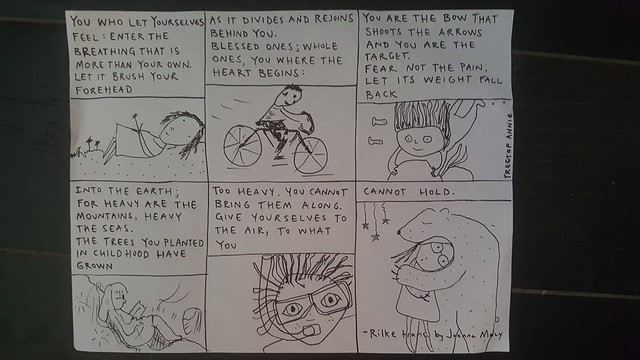
On Wednesday, I walked the labyrinth on campus, and spent a lot of time writing — my own writing, not guided writing. It was late in the evening. I decided to do one last project before snack and bed, something I’d been wanting to do for awhile: make the Rilke poem I’ve memorized and repeat often into a little cartoon. For the pictures, I looked at my peers’ attendance cards, hanging from the walls, and I chose images that seemed to speak to the words in the panel, and I copied them as best I could. All the drawings are drawings I admired, made by hands and minds I did not know. Then I taped the cartoon to the classroom wall and left it there for the rest of the week.
It was the kind of space that makes a person want to leave behind gifts. But on the last day, I untaped the cartoon from the wall and brought it home. It was the kind of space that makes a person want to believe she can bring what she found there home.
I know we were in another world, a bubble of creative vibes and chickpea scramble, but what was happening in the world was with us too, if at a remove. I mean, there we were in the United States of America during the week when the president spoke out in support of Nazis. There was pain and confusion in that classroom too. This feels like a crisis, said Lynda Barry, doesn’t it feel like a crisis? And everyone said yes. We are facing a crisis. What are we going to do about it? What are we going to do?
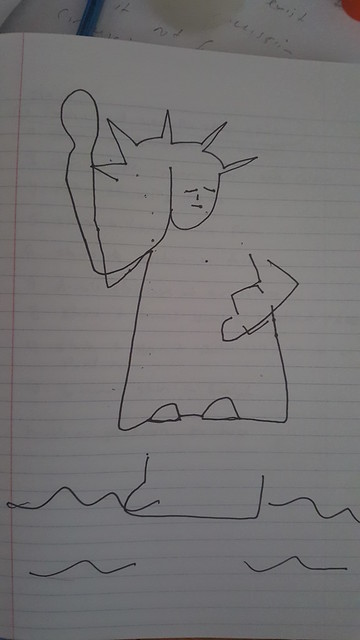
She didn’t have an answer. She just had us knuckle down and draw ourselves as a dejected Batman, draw the statue of Liberty with our eyes closed, make a map of a familiar walking path. And then she made us show our neighbour.
xo, Carrie aka Treetop Annie
Holiday album, summer 2017
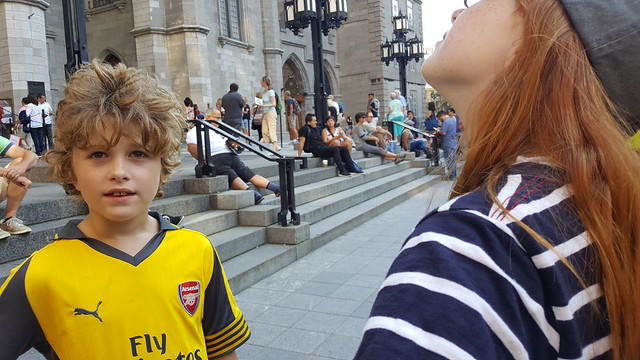
Being tourists outside Notre Dame cathedral in the old city of Montreal.
We’ve been on holiday. A real holiday! Away, not checking email, not doing any work, not cooking meals, no laundry. Just spending time together, exploring landmarks and historical sites, walking long distances, eating at restaurants, staying up late, sleeping in, and reading for pleasure.
We went to Montreal and Quebec City, with stops in Kingston to visit family on either end.
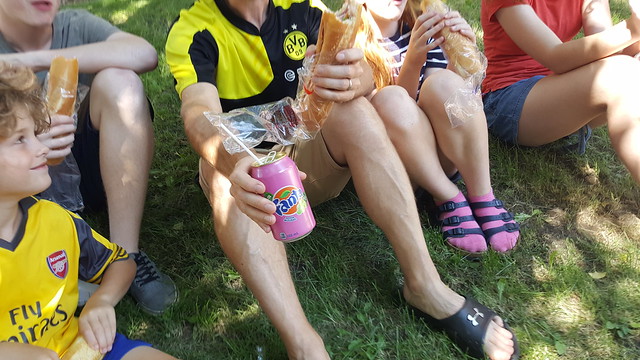
First lunch in Montreal: Vietnamese subs in Chinatown.
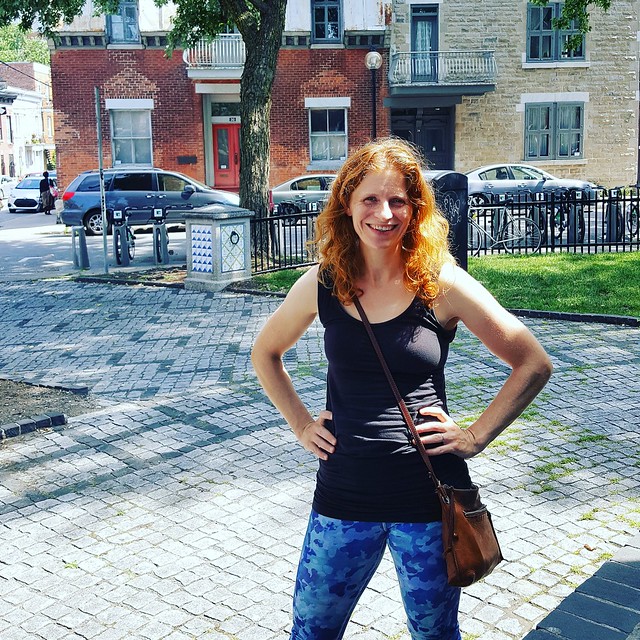
My pilgrimage to Leonard Cohen’s house in Montreal. Imagine “So Long, Marianne” playing on my phone to get the full atmosphere.
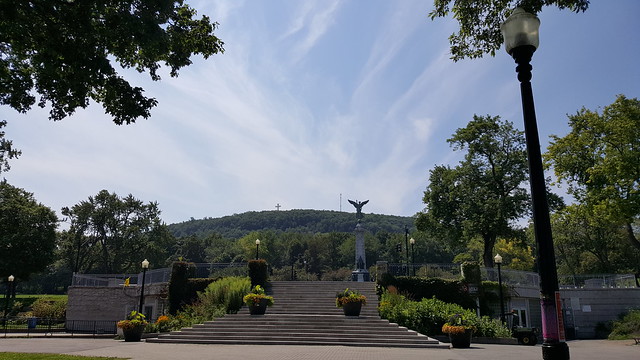
Mount Royal in Montreal. We climbed all the way to the top, despite several of us (me and CJ) suffering (dramatically) from fear of heights.
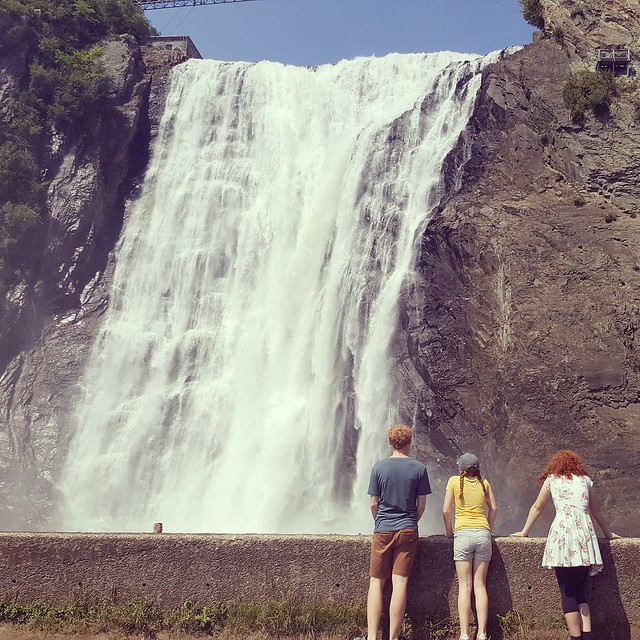
Montmorency Falls, outside Quebec City.
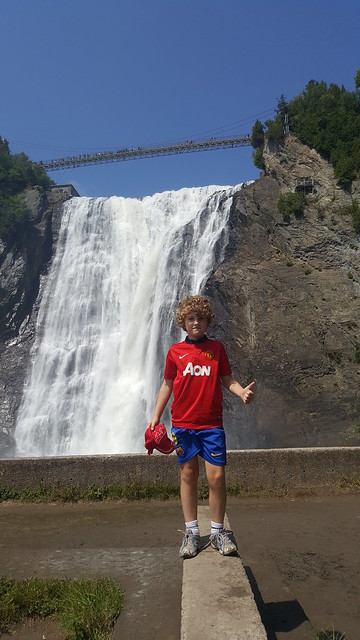
The two of us stayed on the lower end of the falls, while the others climbed to that bridge up there and waved at us.
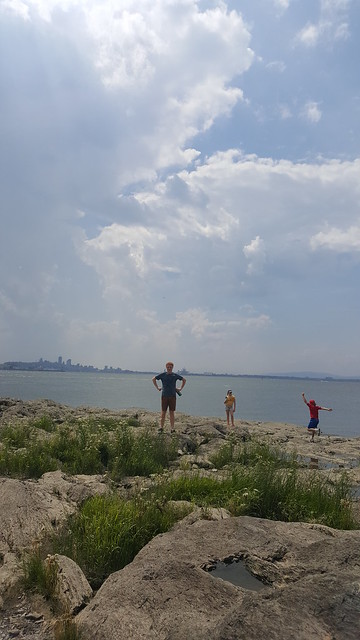
Picnic lunch on the Ile d’Orleans.
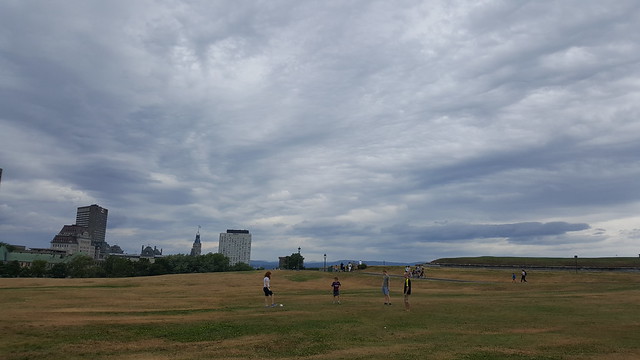
Soccer on the Plains of Abraham.
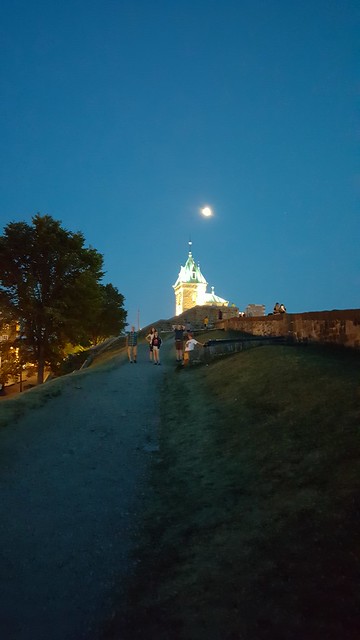
On the walls of the old city, Quebec. I couldn’t make it up to the top, which is why I’m so well-positioned to take this photo. So many steep hills in Quebec!
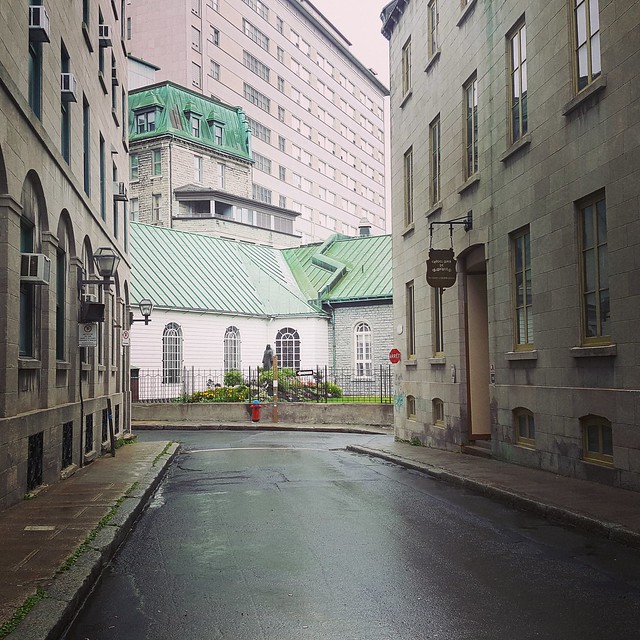
Augustine Monastery, which called me off the main drag and into an early morning yoga and meditation class on our last day in Quebec.
The only problem with being on holiday is not being on holiday anymore.
Today is also the birthday of our younger daughter, who is now twelve. A lot has happened in these past twelve years, so I won’t say it’s disappeared in a flash, but it has gone. The years have gone. She starts junior high next month: a new school, an earlier day, a new route to walk. I’m pleased that she wants me to continue being her soccer coach; somehow I’m less embarrassing as a coach than as a mother.
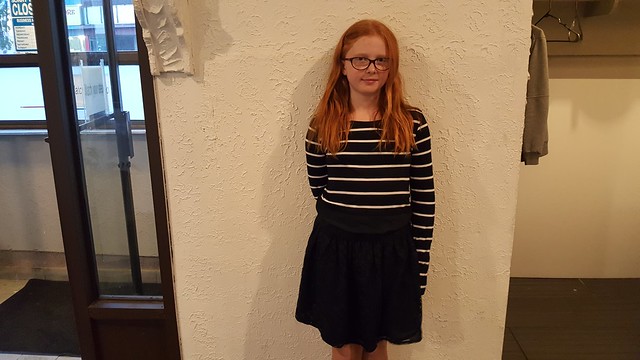
Birthday girl.
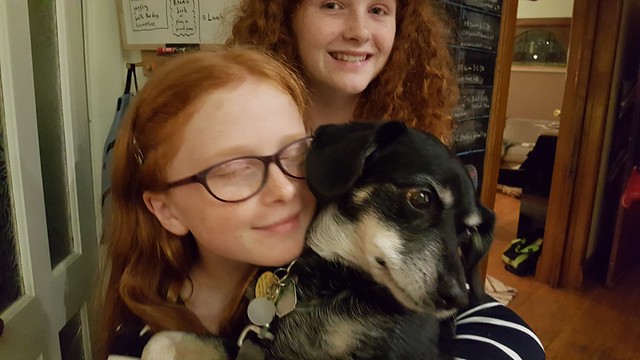
Birthday breakfast was pancakes with M & Ms (made by Kevin). Her siblings are making the cake. We’ve got soccer practice tonight, and we’ll have cake and gifts after that. Home again, home again….
xo, Carrie