
On gift-giving
canopy
I’m part of the Writers’ Union of Canada, and as such receive a trade-type magazine produced by the union called Write.
{confession: I’m not entirely sure why I’m part of the Writers’ Union, other than it seemed very exciting to join way back when my first book was published; I’ve stayed out of principle, despite the annual dues, because I want to be part of a writing community, even though I’ve yet to feel particularly at one with this community. Hm. Is this something I should be confessing publicly? Do others feel the same way?}
Long aside. My point is that yesterday I read an interesting article in the latest issue of Write. It appears not to be available online, so here is a mini-copy-and-paste of the parts that resonated with me. It’s written by Rosemary Sullivan (who was my professor in grad school), and titled: “The gift-giving culture: In defence of creative writing workshops.”
We writers were seduced for awhile into believing we could speak of culture as a product. We could speak of cultural industries, adopting the commodity model, and asserting that we contributed to the general monetary economy and should be rewarded. But books are not products that earn a market reward. They are works of art that are essential to our collective human experience, and society, for its mental and spiritual health, should sustain their creation in the sheer principle of self-interest.
{and here I shall skip backwards in her essay, because it makes sense to me}
We need to acknowledge that writers live in a different cultural paradigm: they live in a gift-giving as opposed to a commodity culture. … We are so deeply inside consumer culture that we cannot imagine a cultural paradigm other than that of private property. … But in a culture based on the gift (giving without assurance of return) … giving in itself creates a cycle of return. In a gift-giving culture, when you give, you create a moral debt that will be paid back when the circle of giving completes itself.
{this reminds me of Margaret Atwood’s Payback}
Well, what do you think? I’m drawn to the writing-as-gift-giving idea (at least for literary writing). If I bake a loaf of bread and sell it, I can work out a pricing scheme that takes into account labour and cost of materials, and what the market will bear, and I can hope to earn a fairly stable return for my investment. But if I write a book of fiction, there is no way to estimate in advance the cost of my labour (which is essentially time), or whether I will ultimately be producing something that anyone wants to purchase. As Rosemary Sullivan puts it:
There is no relationship, except perhaps that of luck, between the energy and thought put into a book, and the return the writer receives.
She goes on to argue that creative writing workshops and programs are a defence against superficiality, and provide writers with community, with networks of support. She says creative writing programs aren’t trying to teach people how to write, but how to be part of a gift-giving paradigm, as writers, readers, editors, publishers, etc.
I like the idea of being part of a larger collective conversation, through my writing. In a sense, that’s what this blog has become (for me). I’m still not sure I buy her argument about the larger purpose of creative writing programs — but then I’ve never been part of one. Maybe I would feel differently if I were. Anyone out there want to comment on this? I will be leading creative writing workshops for teens this fall, as part of my participation in the Eden Mills Writers Festival. What should I be trying to foster, there?
One more thing on the collective voice. In the past few months, I’ve been invited to contribute essays to four different proposed anthologies. This is hugely exciting; and it is certainly not monetary excitement I’m feeling. It’s excitement about being part of collaborative experiences, being asked to participate, and potentially adding my voice to the mix.
Which brings me around to a final thought on the gift-giving paradigm. Gift-giving is so life-affirming. To be asked to give is in itself a gift; especially when you are being asked to give of a talent, or to give exactly in the way you feel born to give. So when I’m asked to write something creative and literary and thoughtful, I’m thrilled. Really I am. Whoever is asking is recognizing that I (may) have something to offer, and I love giving it, whether or not I receive strictly monetary payment in return.
{note: this does not apply to the freelance writing/editing work that belongs to the commodity culture, and which I am truly grateful also exists}
:::
News: I was interviewed by poet and new mother, Erin Knight, for a piece just published on Open Book Ontario about being a writer and a mother. Take a look, here.
Creative discomfort
photographer
“Creative discomfort.” I know the feeling well, and now I know what it’s called! If you have 36 minutes to spend watching John Cleese talk about creativity, click here. (As a multi-tasker, I did physio exercises whilst listening, but even without the exercises I would consider it time well-spent.)
Here are a few points that really clicked with me.
Be open. Be silly, be judgement-free, play. There is also a time to be closed and to apply your ideas, to bring them to fruition and into coherent shape. But without time to play freely there is no creativity. He advocates a beginning and an end to play. It’s exactly what we all hated as kids: being told that it’s time to come inside and wash up for supper; time to clean up the toys. Playtime isn’t all the time. There also needs to be time to build your invention.
But creativity is not just about playtime, and structured time. It’s also about sitting with a problem that has yet to be solved. It’s about passing by the easy or obvious solutions, and sitting with the problem/subject and giving your mind time to dig into its unconscious and come up with something original. This is a deeply uncomfortable process. I do it instinctively and not without pain — for me and for everyone around me. When I’m working out a problem, I’m irritable, agitated, distracted. (It’s one of the reasons I exercise.) But I can’t help myself. I can’t accept the easy solution. I have to keep looking until I find something else. I’ve sometimes thought of it as a kind of obsessive personality flaw. After listening to this talk, however, I think it might be the single-most important quality in my personal creative toolbox.
A few more points. When we play freely, we don’t worry about making mistakes; we risk being silly and wrong and ridiculous, because there is no silly or wrong or ridiculous. I think of this in my own parenting. I wonder. Am I too quick to point out problems or flaws? Successful collaboration and communal play comes from building on each other’s ideas, not knocking them down. That doesn’t mean you have to blanket every idea with “Wonderful!” but that you help build on the ideas that come. “Could you elaborate on that? Could you push it futher? What if …?” Maybe it’s also like riffing. When you’re in the middle of a good conversation and everyone is carrying everyone else along, not worrying about taking detours, or getting off-topic.
One final point. Cleese is very much against solemnity. He’s not against seriousness — we can talk deeply about serious subjects while laughing, after all. What gets his goat (and also squashes creativity) is self-important solemnity that refuses humour, that sees it as subversive (well, it is!); the ego that refuses to laugh at itself, that is defensive, that shuts down the house for the sake of propriety.
And on that note … I’m off to ponder and wonder and sit with some pretty grumpy-making creative discomfort. But with a light heart, friends. With a light heart.
Say it simple, say it best
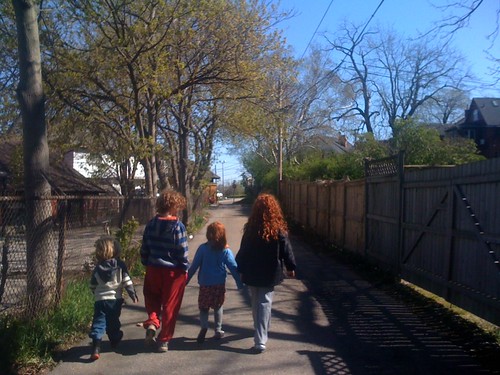
thanks to my mom for taking this photo of my kids walking to a diner for breakfast
This morning, our littlest piano player was becoming frustrated with her practicing. Slam, slam, slam the fingers on the keys, wrong note, BANG, wrong note, BANG, wrong note, BANG. “This song is too hard!” This was preceded by a ridiculous argument with her sister over the “funnies” in the paper (which no one finds funny, yet everyone insists on reading; which I find funny). And it was followed by a ridiculous argument with said sister over a sunhat — she wanted to wear her sister’s hat, which was apparently much superior to her own. “I only have one hat and she has two!” was the cry of misery.
Suddenly I realized — she was tired. It had been a late night, her first soccer practice of the season, bedtime pushed back by an hour, and she’d woken early.
Ah. It all made perfect sense.
I’m feeling a little bit the same way myself, frankly. Need more sleep.
A series of entertaining digressions
this photo is unrelated to this post’s content; but I digress
Last night, I was invited to read at The Bookshelf in Guelph, which is not far from where I live. It also happens to be the city where my husband and I bought our first house. (I always drive by and peek at it; yesterday, I thought that it looked like it had been sold again; it was a smallish house, a “starter” home, on a fairly busy street.) Our first two children were born in that house. And I spent many an early morning at The Bookshelf with my eldest. He was an early riser (and I was not). Mid-morning was a foggy slog, for me. It helped to put him in the stroller and walk somewhere. It helped, also, to have a destination. So we often walked to The Bookshelf, which was open early. We would sit in the children’s section and read. Our home library is stocked with many board books that came from The Bookshelf.
But I digress. It’s what I do.
I was invited to read with Andrew Hood, whom I’d never met. Originally from Guelph, he now lives in Halifax, and he’s launching his second collection of stories, The Cloaca, with a tour. Catch him tonight in Toronto at the Gladstone. I read first, and then sat back and enjoyed Andrew’s performance of his work. Let’s just say I laughed a lot. He has a talent for dark humour. We shared the stage for a Q&A.
Toward the end of the Q&A, a question came from a young man in the audience — a Nicaraguan doing graduate work at the university. I’ll admit that when he introduced himself I felt a twinge of fear; if I worried about anything during the writing of the book, it was whether I could accurately capture a country not my own. (Okay, I might have worried about a few other things too; but that was top of the list.) But what he wanted to say was that he felt there was another character in my book: the character of Nicaragua. And he wanted to know how I had gotten Nicaragua so right. At which point I started breathing again. I didn’t have a terribly deep answer for him, but I think he’s right, the place is a character too, and if I got it right it’s because I wrote about it the same way I write about all my characters: with great affection. Maybe too much. I really love my characters. I know they’re flawed, but I love them anyway — or, not even anyway — I love them because of their flaws. And so I love Nicaragua for its noise and its smells and its danger and its wild beauty. I mentioned how loud Nicaragua is, and he said that when he first moved to Canada, he thought Canadian cars must not have horns. That’s how quiet we are here, by comparison.
I’m going to digress again.
We subscribe to The Walrus, and yesterday the June edition arrived. In it is a really fine review of The Juliet Stories. I can’t link to it, because it doesn’t appear to be online, but here’s a taste: “Snyder’s new book is the rare successful execution [of a novel in stories], a stream of sensual imagery that grows more sophisticated with each page.” Isn’t that lovely? Just as lovely is the reviewer’s excellent summary of the book: “The Juliet Stories highlights the lessons we learn in youth and with age, and the conflict between the freedom we value and the security we desperately need.” Love that.
One more digression.
Sitting on my desk right now (atop a pile of possibly important papers) is a registration form for a senior recreational women’s soccer team. I’m thinking of joining! Agh! That would mean five out of six of us would be playing registered soccer this summer (CJ will join in on practices, since Kevin is coaching two of the kids’ teams). It would also put us at soccer fields six out of seven days a week, sometimes at multiple fields on the same day. Is this too crazy? The funny thing is, the kids are totally excited. They want to see me play. I’m still wavering, wondering whether it’s too much. Also wondering whether I’ll totally suck. I haven’t played soccer since the age of TEN. That’s a mere twenty-seven years ago.
Wait, I have a final digression. It’s short.
Just discovered this amazing new Canadian magazine called Eighteen Bridges. It’s got excellent writers, long-form journalism, quirky and interesting subject matter, and I’ll give you a link to an article that shows what I mean. Jessica Johnson (an old friend from my National Post days) writing about, ahem, waxing. Girls, you know what I’m talking about. Or maybe you don’t. I personally lack any experience with it, and it was comforting to read about another woman in the same position. Um. Okay, it’s impossible to write about this without sounding all wink-wink. Forget what I’m saying; read Jessica’s piece instead.
And on that note …
Join the running club
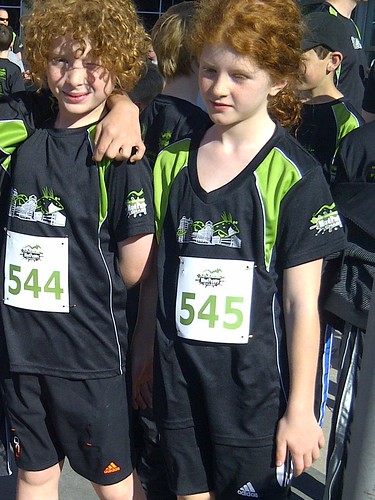
after the race
This weekend my big kids ran their first race. Signing up was of their own initiative — inspired by friends. Albus raised quite a lot of money, also of his own initiative, for the cause (Kidsability). They trained regularly with friends in the weeks leading up to the race, sometimes led by a parent, but also on their own. And on Sunday, they each ran their own very individual race, according to their unique personalities.
Albus stuck with a friend. He finished in good time, with faster splits than we’d been doing our training runs (5:43/km), 162nd of 540 runners. Here is a classic Albus-defining moment: As he approached the finish line, he found Kevin in the crowd and stopped to wave. By contrast, AppleApple was so focused in her sprint for the finish line that she had no idea anyone was yelling her name and cheering her on. She ran entirely on her own, and much faster than we knew she could (4:40/km), finishing 50th of 540 runners.
Both children loved the experience, and want to do it again. I love that they each did it their own way, and that each came away happy and proud. To thine own self be true!