
Swimming studies, early morning, girl in green
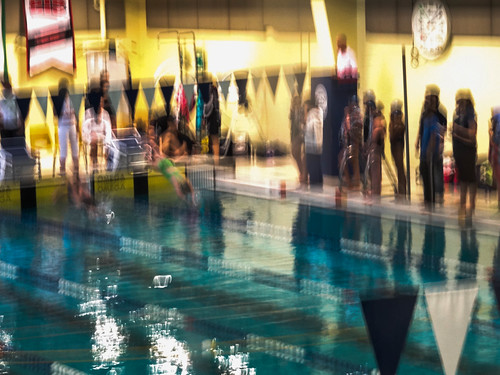
First race, 100 metre breast. Takes 9 seconds off her best time.
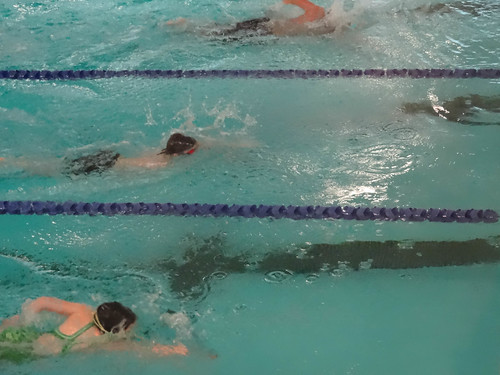
Second race. Girl in green approaches 25 m turn in the 100 m free.
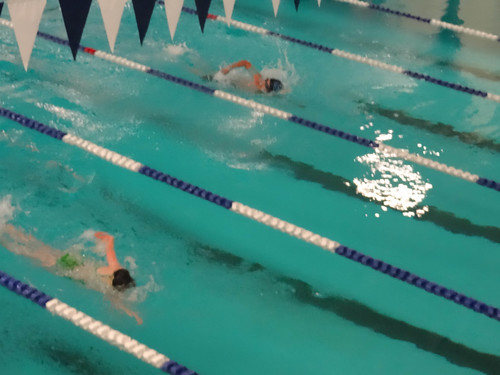
Girl in green opens lead at 75 m turn in the 100 m free.

Girl in green cruising to win her heat in the 100 m free. Takes 20 seconds off her best time. Mother too excited to hold camera steady.
“I just wish I could swim every night for two hours.” {which she did over the Christmas holidays during her club’s training camp}
How to turn supper into a competitive sport

Kevin and I have stumbled onto a way to make cooking fun again.
It all began the first week of January. Kids were still off school, but we wanted to get back to work. So we split our days. I took the morning kid-shift, he took the afternoons; but afternoons meant suppers too. I relinquished my iron hold over kitchen proceedings, and introduced him to The Joy of Cooking, and he liked it. A lot.
We did have Yorkshire puddings two nights in a row because the first recipe didn’t replicate his childhood memory of his mother’s version. Sadly, neither did the second recipe. After which, he moved on to a traditional shepherd’s pie. Getting in touch with his British Isle roots. (What if he attempts blood pudding??) I must add that he also solicited advice from me, which I appreciated. Because I was practically itching to give it.
I found that the brief break inspired me to cook with more enthusiasm, and, I’ll admit it, a faint stirring of competition. Nothing like a little challenge to get me inspired.
I’ve already been creamed by the competition, according to our four-year-old. Kevin prepared leftover noodles with cheese sauce on Saturday evening, and, to repeat a story I already told on Facebook, here’s how that went over:
CJ: Who made this supper?
Kevin: I did.
CJ: This supper is awesome! *holds out arms for hug*
Me: Are you serious? I’m going to cry.
Please note: I have never, not once, received a spontaneous hug for any meal I have set upon the table. A more common response would be:
“Why do you always make food that I hate?”
I have been preparing said meals for eleven-and-a-half years. That’s, like, 4000 meals.
But I digress.
We’ve decided to up the stakes.
Inspired by a friend who is going on sabbatical this summer, and who is chronicling her attempts to “eat down the freezer and cupboards,” Kevin and I have decided to prepare meals using all those edible odds and ends that dwell, untouched and neglected, in our own cupboards and freezers. (I suspect there’s some weird survivalist instinct in me that wants to save the stored food, in case of apocalyptic circumstances; in any case, we have a lot, and we could probably reduce our monthly grocery bill by making better use of it. Worth a try.)
* I started on Monday with a meal of quinoa (cupboard), spelt (cupboard), and brown rice (cupboard) salad with roasted red beets (leftover), and a corn (frozen) and potato (cold cellar) chowder (broth from freezer) with bacon (freezer). For bedtime snack, we opened a jar of pearsauce (cupboard) and served it with yogurt.
* Last night, Kevin made us a spinach (freezer) gorgonzola sauce with bacon (leftover), mushrooms (lingering), and shrimp (freezer), over pasta. He wisely prepared a separate cheese sauce for the children who didn’t want the fancy bits, making him, once again, most popular chef with the four-year-old set. (Pandering! I refuse to stoop to such tactics!)
* For tonight’s meal, I’m planning to prepare corn tortilla (freezer) quesedillas with refried red beans (freezer) and roasted red pepper salsa (freezer, fridge, cupboard), and a raw cabbage (cold cellar) salad.
The opposite of indomitable
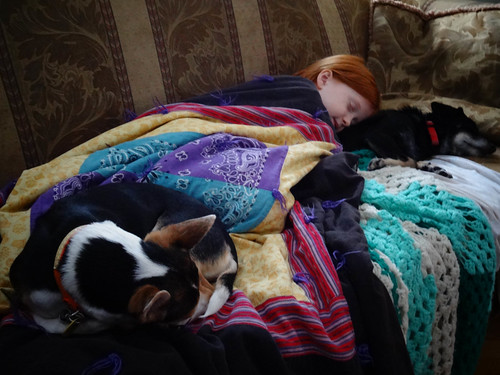
pretending to sleep
This Monday morning is not brought to you by an efficient or clear-headed start. It begins with a sore throat, an unwillingness to rise early, and a sense of being behind on each and every task of the day. Honestly, I could happily go back to bed right now, and it’s not even noon. I have only my own work to do, and must locate some inner will power and just do it. While washing the dishes last night, I thought, if it were only me, I would be leaving these dishes on the counter and collapsing on the couch in front of bad tv. So many of the things that I do every day, I do only because I have to. I have to lest the larger collective project of family fall apart. I can’t veg on the couch when there’s laundry, dishes, kids need baths and grooming, piano practice and homework wrangling, and the week ahead is waiting to be discussed with Kevin and scheduled out on the chalkboard.
So I just do it, though not with the enthusiasm or fervor of a slogan. Nope. I just do it. Trudge.
Maybe that’s why I get a lot done. I’ve got these dependents, expecting and needing structure. If it were just me, what would I be doing? Maybe every day would look a lot like this morning has: sleepy, dull-eyed, slow-moving, and oddly unconcerned. I would read the paper and drink coffee.
Or would I?
After all, I do have a big sense of adventure to satisfy, and, often, an inner whirlwind of energy. Today just doesn’t happen to be whirling with energy. I’m a bit sick. I’m tired. I spent a multi-faceted weekend in happy activity, bouncing from place to place. I ran 14km through the fog on Friday night; coffee date with my elder son on Saturday morning; baked bread; met with Tricia and our friend Steve to discuss filming for our Amazing Race audition video; library with elder daughter; dinner date with Kev; up at 6am Sunday morning to drive soccer girl to a game in Mississauga (through blinding rain and dark); home in time to grab a banana, change, and head out to film scenes for audition video in a nearby park (splashing through cold puddles and weeds, trying to get muddy, and look tough / photogenic / captivating / ourselves); home to change for a really fun soccer game; and, well, that just about catches us up to those supper dishes. It was kind of non-stop.
Until about 10pm last night, when I just stopped and haven’t really started up again in full indomitable Carrie mode. Feeling a touch domitable. (Domitable? Nope, just checked: not a word.)
I know how to be when I’m rolling and up and moving and full of enthusiasm. It’s when I’m tired and sick(ish) and worn out that I don’t know how to be — I don’t know what to do with myself, or how to rest. Know what I mean? (Stretch, Carrie, stretch.)
Problem solving
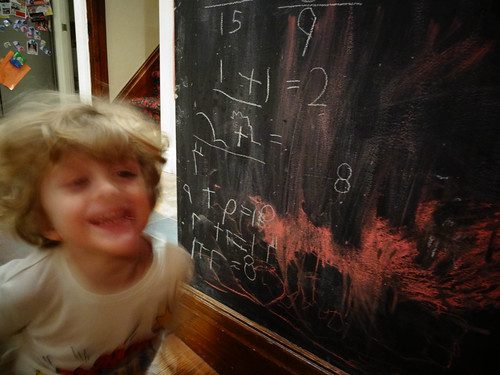
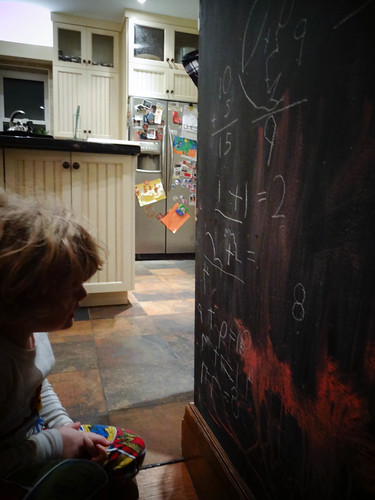
“I woke up early, so I just laid there and did math-es.”
“Oh? What math did you do?”
“I was doing the pluses.”
Artistic discipline and athletic discipline

“Artistic discipline and athletic discipline are kissing cousins, they require the same thing, an unspecial practice: tedious and pitch-black invisible, private as guts, but always sacred.”
– from “Practice” in Swimming Studies, by Leanne Shapton
I loved this book. I bought it for my new Kobo, which my two eldest got me for Christmas — their own idea, their own money, their own surprise. I hope to use it to buy more of the books that I might not quite make the leap for in the bookstore. But I’ve now learned that it might inspire me to buy certain books twice, because having read Swimming Studies as an ebook, I long for the actual physical artifact of this particular book, so that I can share it, and so that I can leaf through its pages.
I was sad to reach the end of Swimming Studies. It is a memoir written in a style that I found both affecting and aesthetically serene. Shapton shares a series of moments, linked by their connection to her own life, and to swimming. She resists the impulse to analyze (I admire this, being compulsively analytical myself). She draws scenes that are coloured with very specific detail, that open the possibility of a story the way clues do. It gave me the sensation of looking at old photographs, and wondering about the people captured there. It gave me the sensation of disturbing a private scene, almost, and not fully grasping the significance of everything going on.
I find myself wondering over certain small scenes, like one early on: Why did the women behind the counter at the coffee shop rebuff her mother’s friendliness, in the early dark of morning, and why did her mother keep trying to be friendly? Or even just resonating with a familiar sound I have never paid attention to: the clanging of a frozen rope against a flag pole.
I like that the book seemed to belong to no established genre, nor to care. It didn’t need to fit easily into a category. I did not find myself becoming impatient with some parts that I imagine others might find indulgent: the minute descriptions of pools she remembers swimming in, or her collection of swim suits. I kind of just loved the whole thing.
I can’t imagine growing up with an athletic discipline and routine underpinning my daily life. But I know all about artistic discipline. I find it fascinating to glimpse the mind and experience of someone who has lived both. And I wonder if I could find some lesson, some inspiration here, some ease with the small; the ordinary transformed by attention; the possibility for forward motion within a scene that looks set and still. If ever I were to write a book based on my blog, I think this is where I would begin.