What if I were to focus on accepting myself?

Whenever I float the idea of not blogging anymore (and it’s an idea that keeps bubbling up, with somewhat alarming frequency, actually), I know exactly what I would miss most: connections. A friend texted after my last post to say it had reminded her of a cartoon she’s kept for years: a woman stands alone, thinking, “I wonder if I would be happier if I put as much effort into accepting myself as I do into changing myself.”
That got me thinking.
What if I were to focus on accepting myself? What would that look like?
It would mean I wouldn’t shame myself for wanting to share my thoughts out loud. I would stop calling it a compulsion (a pretty judgemental word).
It would mean I might see my writing in simpler terms. I would accept what I’m able to create and do.
It would mean, maybe, too, that I wouldn’t be so frustrated during these rough patches (like right now) when I’m squeezed for writing time and my days are spent looking after sick kids, out of routine; because these days are gifts too, and my work is not only to write write write, but to live live live. To be alive is to be with others, to be interrupted, to fail, to be frustrated, emotional, achy, tired, weak, and surrounded by the fruits of your labours, which sometimes feel really heavy. If I accept myself, I accept that my days are broken. I accept that I have limits and limitations. I accept, too, that I’m on a path of my own choosing and virtually everything I do is in service to something or someone I care deeply about–how fortunate is that!
I have a question for myself: if I focus on accepting myself, would I discover that I am an ambitious woman, or a woman who is content with muddling along? Can I be both?
xo, Carrie
Snow day
When I’m meditating, which I’ve only just started doing regularly, for ten minutes a day, I tell myself: This is all you need to do right now. You don’t need to do anything else.
It is such a relief to the mind to have that bit of rest — focused rest, not sleep — when the mind is aware and present and yet not obliged to do anything but sit and observe.
I name what I’m feeling: worry, usually, or the desire to make a list and get organized, to remember all of the things that need doing. I name it and I say, you don’t need to do this right now.
It is such relief.
I really don’t know what life is about, honestly. I don’t know if there are big gestures that a person should be aiming themselves toward, in life. When I’m sitting still inside my mind, I think, no, life is not about big gestures. It is not about effort. It is about ease. It is about stillness. It is about being witness to.
But how, I think, could I accomplish anything without effort? I am such a believer in hard work. Yet I know, too, that much of what I’ve accomplished seems to come instead from grace. It isn’t that hard work hasn’t gotten me somewhere — hard work and discipline perhaps creating the necessary space for grace. But then I think, well, no, grace isn’t dependent on work or effort. We can all of us be graced by grace, that is the nature of grace. And then I wonder whether those who stand and wait, without an apparent plan, without the desire to change or be changed, aren’t actually on to something more profound than I am, with my striving and reaching and stretching.
Another question: What is this compulsion to share what I see and experience?
Could I not go there, to a place of stillness and grace, and return quietly? Apparently, this blog post would suggest that no, I cannot. But I’m thinking about it. Rather hard thinking, in truth.
All of the following probably fits into the category of wanting to change or be changed, but I don’t know how to address what I’m feeling in different terms: I would like to learn how to put aside the striving and access the ease of presence. I would like to learn how to clear more space for my mind to be still and focused. I would like to learn how to love the world more, to name what I see without judgement.
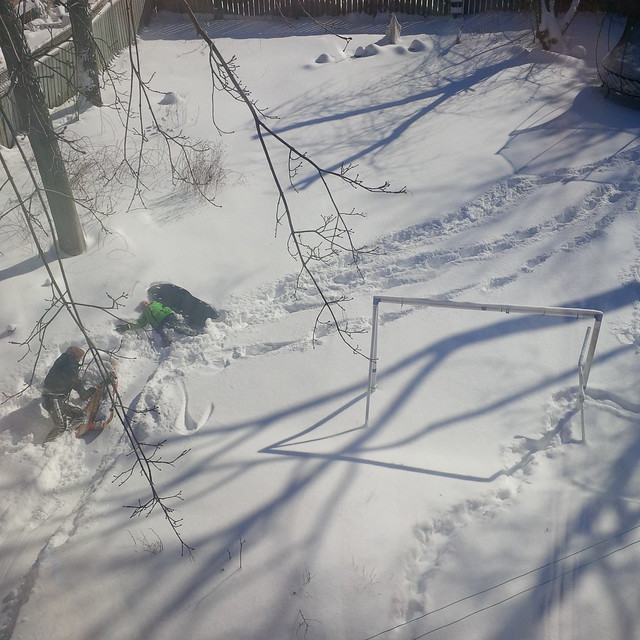
Happy snow day.
xo, Carrie
For attention to matter

“Attention without feeling, I began to learn, is only a report. An openness – an empathy – was necessary if the attention was to matter.” — Mary Oliver, Our World
Check mirror before exiting house
This morning, when the plumber arrived to hopefully fix our toilet before our annual scotch party this Saturday, I was on the couch by the fire with the dogs, enjoying the last minutes of my nap. I answered the door, trying to appear not to have been recently asleep. We exchanged pleasantries and I showed him the problem, then removed myself to chastise and crate the dogs, who had threatened to remove the plumber from his leg. Then I caught a glimpse of myself in the mirror. Now, I tell myself that the plumber has no idea what I ordinarily look like, so perhaps he wasn’t as frightened as I was by the sight of me.
My hair had dried funny and a sizeable clump was standing straight out over my left ear.
And I looked approximately a decade older than I actually am due to raccoon-like, circular, darkish, bruised-looking dents around my eyes. Goggle eyes!
Evidence of early morning swim. It lasts longer some mornings.
The good news is this: I got up to swim.
I’m managing to rise early every single week-day to exercise. More good news: I was able to run intervals at an indoor track yesterday. Very very slowly. When I tried out the running a couple of weeks ago, it’s possible I was going way too fast. Oops. That’s not like me at all. Ahem. But even a slow run is thrilling when it’s pain-free. Add in the daily walking at my treadmill desk, and I’m actually covering a lot of kilometres these days.
And I’m trying to meditate, just the tiniest bit. Ten minutes a day. It reminds me of swimming laps. I do a lot of counting and controlled breathing while swimming laps.
Today, AppleApple wondered why I don’t swim faster; this was not exactly a critique. Despite being a quite damning critic of the inefficient swimming styles she observes in the lanes all around us, she says my stroke actually looks like it’s being done correctly. But with such a proper-looking stroke, she thinks I should be going faster, and I agree. So perhaps there are unseen inefficiencies. Next time, on her suggestion, I’m going to try rotating my shoulders more — stretching forward on the glide like I’m making myself as long as I possibly can. (Why do I always imagine that I can improve, no matter what I’m trying to do? Is that a really irritating trait?)
The plumber has left. The dogs have calmed down.
It’s time for meditation, followed by walking and writing. Nobody will be here to see the goggle eyes or to judge the sticky-out chlorinated hair, not even me. I’ll be gone too; that’s what it feels like when I’m writing, like I’ve left the room, left this season and place and time. Away: inventing imaginary memories for imaginary people who seem so strangely real.
(Note to self: check mirror before picking up kids for piano lessons.)
xo, Carrie
Lists; struggles; forgiveness; free time
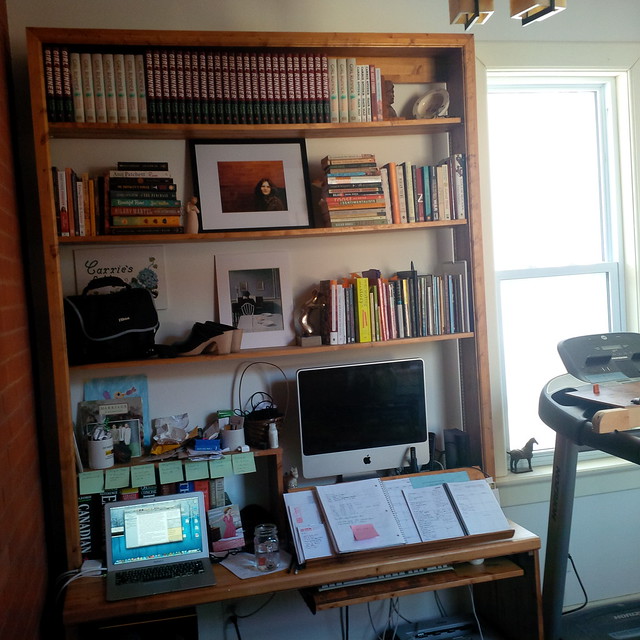
I cleaned my office!
List of things to do today, on this Sunday, a month after Christmas…
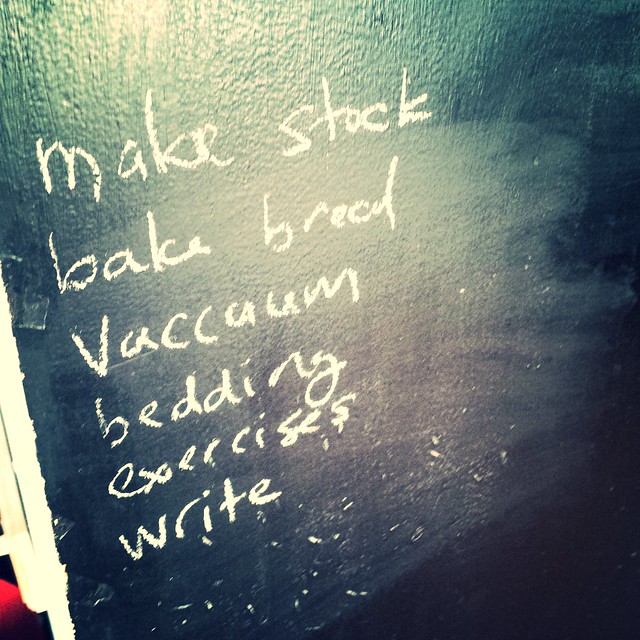
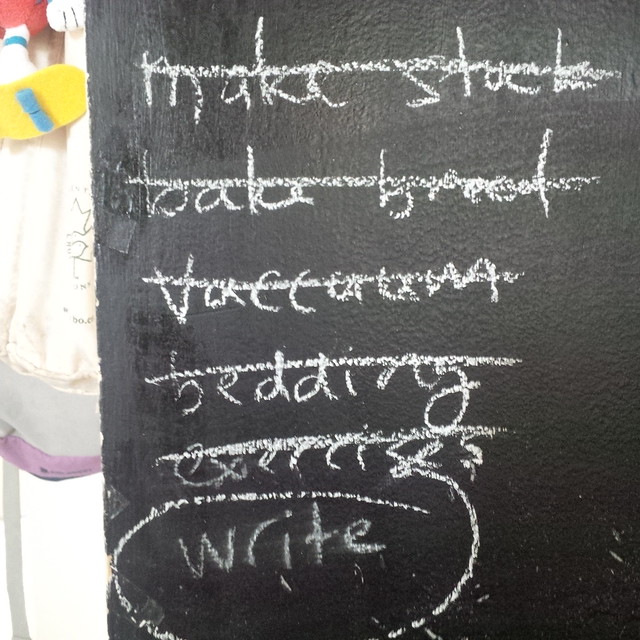
wash bedding; bake bread; make chicken stock; vacuum; exercises; write
Write comes last, but it’s where I’ve begun (well, a second load of bedding is whirling in the washer as I type, but laundry is like that, must be attacked in a steady march throughout the day).
What we’re struggling with, on the parenting front…
motivating a child who does what’s asked, but no more: and I wonder, are some born without a strong internal self-motivational engine and how best to foster/plant the seeds of creativity and initiative? Are we the dreaded helicopter parents if we schedule this child’s life on his/her behalf, or are we neglectful if we allow her/him to drift, seemingly content not to discover or pursue any interests arising from within?
Do we all have interests arising from within? What is interest? Is it creativity, curiosity, the desire for knowledge and challenge? Is it also, perhaps, the desire for more, a positive form of anxiety, a positive channeling of our dissatisfaction with what we already have?
What we want for our children is universal: we want them to be content, but also to be productive, kind, thoughtful, engaged individuals. It’s that last bit we want most of all: to be engaged. Engagement means (to me) that sweet spot where the interests within an individual connect to the world without.
What is working, on the parenting front…
this four-part system of apology. It goes roughly like this. 1. I’m sorry for [insert specific wrong-doing]. 2. It was wrong because [insert specific harm caused to the other person]. 3. Next time I will [insert possible amendment(s) to future behaviour]. 4. Will you forgive me? [to which the wronged person replies “I forgive you.”]
It feels a bit odd and formal when introduced for the first time, but I must say there’s a real appeal to it in practice, and makes saying sorry both more meaningful and more satisfactory to all parties involved.
Good ways to spend some “free” time on the weekend …
playing Bach on the piano; walking to the library with a cranky child; helping coach small boys on the soccer field; lingering, being silly with family over a supper of hamburgers and caesar salad; legendary power nap on the couch by the fire; beer and conversation with Kevin
xo, Carrie
PS I actually wrote this list on our chalkboard wall this morning. So it really will happen. If it’s on the wall, it must happen.