Friday, Nov 22, 2013 | Big Thoughts, Friends, Good News, Parenting, Teaching, Work |

It’s a pattern. Every Friday morning this fall, I sleep in (ie. not up at 5AM), yet can barely drag myself out of bed. I eat breakfast, start the laundry, see the children out the door, and struggle to be otherwise productive at anything. The cup of coffee doesn’t seem to help.
Thursday evenings I teach. Friday mornings I’m drained. I think it might be as simple as that. But frustrating, too, because there is so much about teaching that I’ve enjoyed this fall. It’s gone how I’d hoped it would go. I’m accomplishing what I’d hoped to accomplish. So how to explain my body’s reponse to the job?
I’m going to go out on a limb and self-diagnose as introvert.
A long day of writing leaves me pop-eyed and twitching. Manic, you might say. Or, energized. Three hours of teaching leaves me jelly-noodled, spine sunken like a comma. Bloodless, you might say. Glazed. Is this how other teachers feel?
This sounds like an extended complaint. I’m not meaning to complain, only to observe.
I don’t think teaching naturally drains everyone. I’m sure of it. Kevin comes home from teaching buzzing with good energy. I wish that were me. My students are terrific, interesting, thoughtful, hard-working, open-minded, and a pleasure to share ideas with.
So, yes. I do feel frustrated by myself. It’s not that I’m shy. It’s not hard for me to talk to people. But it may be that I’m introverted, and draw my energy from being alone. Any thoughts on this, from introverts or extroverts alike?
Two more things. Okay, could be more than two, but I’ll keep it to two in this section of the post. We’ll call this the newsy section.
1. I did an interview about style for BLUEPRINT, a student-run magazine at Wilfrid Laurier. I liked the questions, and I liked thinking of myself as actually having and even cultivating style. (Long-time friends, please don’t laugh.) You can read the interview here.
2. I’m hearing rumour that the latest QUILL & QUIRE magazine has a blurb about the success of Girl Runner at the Frankfurt Book Fair. Kevin’s promised to pick me up a copy on the way home. (Quill & Quire is Canada’s publishing industry magazine.) Couldn’t find a link.
Final section of Friday’s blog post. This will be the philosophical section wherein I write about an idea that is only half-formed, as bloggers are wont to do. The idea is about work.
Work is a word that I’m beginning to realize has enormous value in my mind. But I define it in very narrow terms. Work is writing. Period. Everything else gets filed under other categories, somehow. This happens unconsciously, and I’ve only just realized that I do it.
Here are some of my (unconciously formed) categories, which all go into the big filing cabinet of LIFE.
Parenting/pleasure. Family. Marriage. Hobbies. Recreation. Obligation. Chores. Cooking and baking. Reading. Friends. And, of course, Work.
Parenting/pleasure encompasses all the things I do for and with my kids. Of course these things have to be done, but they don’t feel like obligations. That’s why I add the word pleasure to the file.
Family is a broader category and includes my wider family systems.
Marriage. Obvious.
Hobbies. I think that’s exercise, for me. It seems to occupy the space that a hobby would. It’s quite time-consuming, and I’m devoted to it for no reason other than I love doing it. Photography fits in here. Blogging, too.
Recreation is anything done in the spirit of pure play.
Obligation is job-jobs. Things I do to earn money. There’s a bit of cross-over here between other categories, and it includes promotional work for my writing life. It isn’t all a grind, and I don’t mind doing it, but nevertheless these are jobs that must be done rather than jobs I would choose to do. These jobs don’t seem to count in my mind as work, no matter the financial value attached to them.
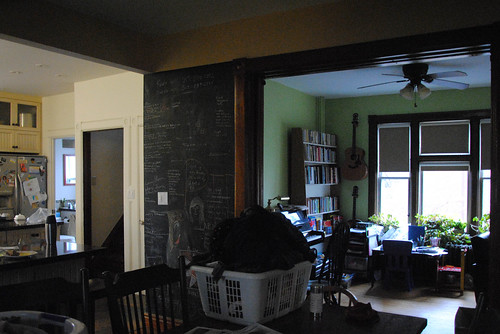
Chores. Also obvious. That overflowing laundry basket on the table behind me right now, for instance.
Cooking and baking. I enjoy doing this too much to call it a chore, and yet it isn’t a hobby either, seeing as feeding everyone is a daily necessity.
Reading. This gets a category all to itself. It comes close to work, in my mind, obviously in a good way.
Friends. Maintaining relationships, trying to keep them fed and nurtured, far and near, in-person and via social media.
And finally, work. As I type out this half-formed idea, I realize that work is a constant, even if I’m not at my desk. I’m feeding my working life, and my writing, by being in the world, by parenting, by playing, by running and reading, by all of it. So work is both a precious and guarded particular part of my life (writing), and work is all of it, all the time, always.
End of idea.
Thursday, Nov 21, 2013 | Fun, Kids, Parenting, Siblings |
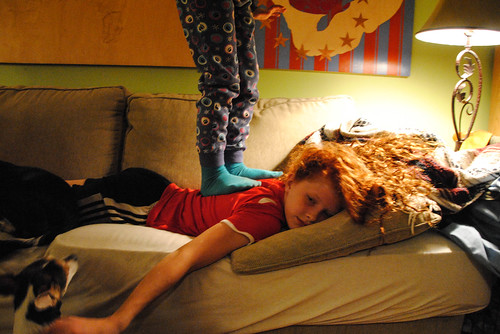
Need a back rub? Consider this simple and inexpensive way to ease sore muscles. It’s all in the toes, apparently.
Your siblings will fight for a turn. You might even get some extra help from the dogs, whether you want it or not.
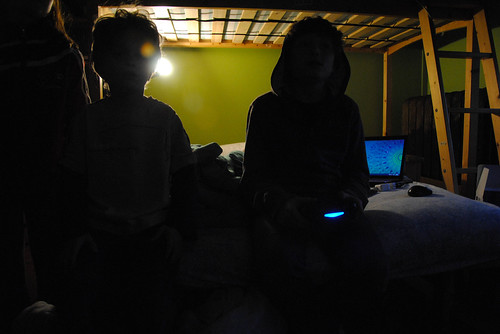
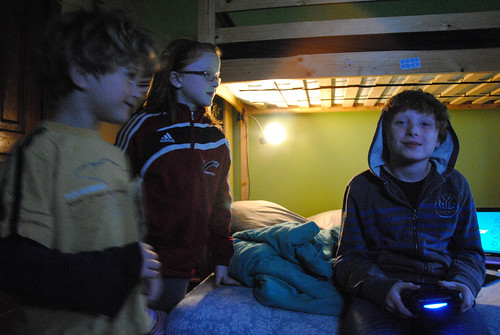
Want the latest in video gaming technology? Try researching it obsessively, reporting in minute detail to your parents (who don’t always appear to be paying attention), conversing for weeks about nothing else, and, if all else fails, purchasing it for yourself with your summer babysitting money.
Enjoy the fruits of your labours. (I know I do: evidence, above.)
Wednesday, Nov 20, 2013 | Blogging, Chores, Driving, Interviews, Kids, Soccer, Swimming, Writing |

Yesterday, while grabbing a book to bring along to a soccer field I mentally composed a perfect blog post. Maybe I’ll blog on my phone beside the soccer field, I thought. But the post vanished, and instead, beside the soccer field, I chatted with other parents (whom I see far more often than I do my closest friends) and watched, mesmerized, our daughters pass the ball with great skill and determination. The book stayed unopened in my hand.
The perfect imaginary blog post is not unlike the perfect imaginary book, I suspect, a subject Ann Patchett addresses in her very funny and quite serious essay on writing, “The Getaway Car,” in her new book of essays, THIS IS THE STORY OF A HAPPY MARRIAGE.
Logic dictates that writing should be a natural act, a function of a well-operating human body, along the lines of speaking and walking and breathing. We should be able to tap into the constant narrative flow our minds provide, the roaring river of words filling up our heads, and direct it into a neat stream of organized thought so that other people can read it … But it’s right about there, right about when we sit down to write that story, that things fall apart.
Two things in that passage. One, the obvious point that writing is not a natural act; and two, that we narrate our lives, and it’s the second I’ve been thinking about most.
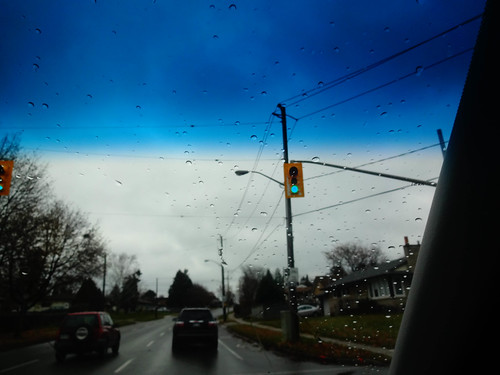
Yesterday, I imagined writing from inside the new car. I would tell you about the sudden shock of snow, the windshield wipers working, the warm hum from the vents. I might add in a snippet of caught conversation between me and a child. I might even admit to a burst of irritation at the stupidity of another driver. There would be the hush of tires turning. The flash of lights and the smear of their colour across the wet windshield in the early dark.
It’s fitting that I put my book advance toward a new vehicle, as the new vehicle has become my second home in a way that seems almost outrageous when I add up the hours. I’ve undone every green dream I ever had, whilst supporting my children in their extra-curricular interests. On Monday, between 5:05pm and 9:15pm, I spent a total of two and a half hours in our new vehicle, including an hour and a half venture, around town, that had me climbing out at home with a numb posterior. During that particular round, “Aggie” and I visited a far-flung indoor soccer field, a gymnastics club on the opposite side of town, and a pool, before returning home. And it snowed the whole time. The best part was when the eldest voluntarily joined me for the final trip of the evening. “What should we talk about?” he asked cheerily, and, as we’d already covered the intricacies of the PS4 gaming system he’s hoping for, we moved on to music, and soccer, and the mall, and fantasizing about food we’d like to eat.
That’s the one good thing about all this time in the car. It’s time with the kids, and we talk, a lot.
But later, home again, kids in bed, I said to Kevin, “When I’m all done driving these kids around, I’m going to be old. That’s what’s going to happen. I’ll be done driving them, and I’ll be old.”
photos in this post taken by child in passenger seat
Meanwhile — and this may save me — I’ll be “narrativizing” my life.
Yesterday afternoon, I listened to a Writers and Company podcast: Aleksandar Hemon interviewed by Eleanor Wachtel. Hemon uses his own experiences in his fiction, without qualms or apology: “The way I write fiction most often is that I imagine a different outcome of a situation.” Hemon observes something unfolding and ending, a snippet, a glimpse, or a straightforward hike from A to B, and he wonders: what if X had happened instead? A character might appear to be based on himself, yet he seems to harbour no worries about being mistaken for a character. In short, the line between fiction and non-fiction does not seem to trouble him. He’s writing stories, not history, whether they are “true stories” (non-fiction) or fiction. “We go toward the things we do not know in literature. To go in the opposite direction is to write only about the easy things.” (I’m paraphrasing; I took notes while listening, as non-fiction versus fiction has become a bit of an obsession while I try to teach it to my students, and while I reflect on what writing/publishing The Juliet Stories has both given me and cost me.)
I feel myself urgently wanting to use what I’ve got at hand, and to spin it into something different; “to arrive at something,” as Hemon puts it. There is life. There is the rendering of life into story. I’m missing quite a few pieces in my life, right now. Apparently I can’t squeeze everything in to satisfaction, not while driving for hours a day. What gets lost? Wouldn’t I love to host more suppers? Yes. My social life is pinched. I’m tired far too early in the evening. The laundry overwhelms. But there’s something about writing that can set life into balance, for me. I arrive at something there that I can’t here.
Monday, Nov 18, 2013 | Birthdays, Holidays, Weekend |
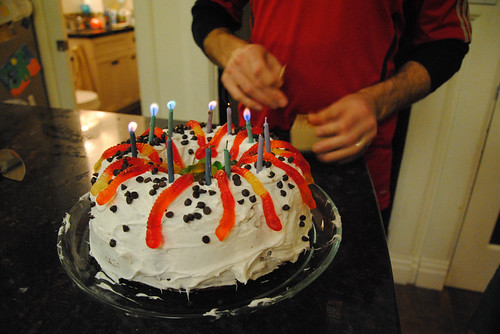
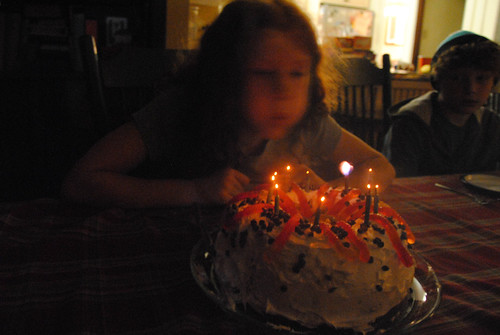
gummi worm volcano cake
We had a big windstorm overnight, and a power surge that blew out part of the hydro wire running to our house in rather spectacular fashion with firecracker pops and flashing blue light, which made it hard for everyone to sleep last night. Luckily, the line is being held up by the tree in our front yard, so it’s not downed, and is still providing electricity. Don’t worry, we’re doing all the things we’ve been told to do, it isn’t a danger to anyone, currently (so to speak), and all will be repaired soon.
But it was a disturbed night. And it’s AppleApple’s birthday. Maybe we should let the kids stay home from school today, came the pre-dawn thought.
Really?! Yes, really. The joy was unanimous. Some are still in pajamas and it’s nearly 4pm.
I also intended to catch up on things left undone, but have only been partially successful in that.
Still, it seems we all needed this catch up day. It ends at 5 o’clock when the evening activities kick in, but it’s been sweet.

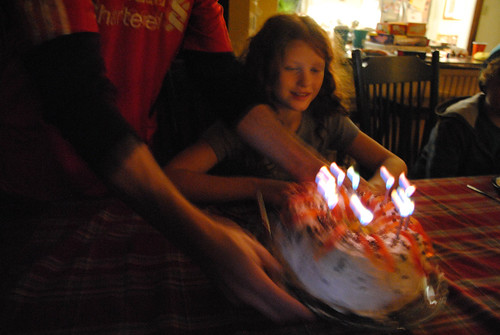
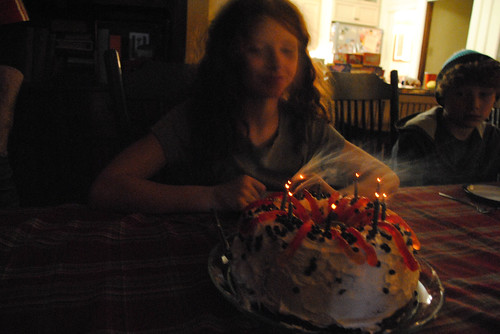
On the weekend, we celebrated AppleApple’s birthday, a small party with long-time friends that allowed her to relax, play, and hang out, which seems to happen not frequently enough. It was a “baking and board games” theme. The girls baked the cake and fashioned a gummi worm volcano in the middle.
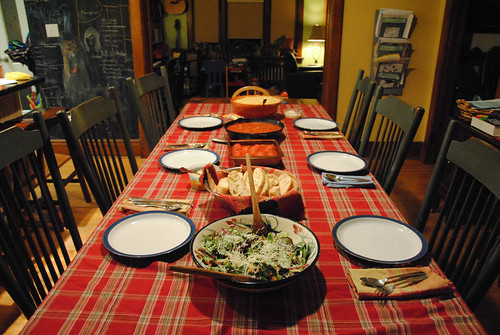
We had spaghetti with meatballs and caesar salad, and I thought, looking at the table, that I’m a lot like my dad in my over-estimation of food amounts: ain’t nobody going hungry at my table!
still ten
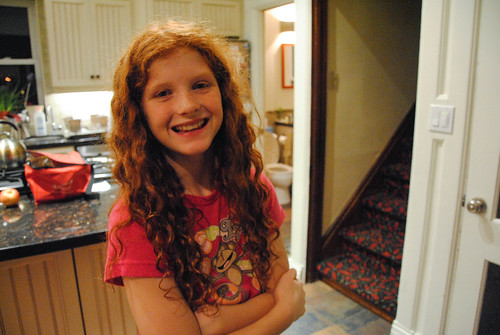
Here’s the birthday girl last night, when she was still 10. She had a loose tooth, which she pulled right before bed. “Don’t forget about the tooth fairy,” she said, and when, about half an hour later, I climbed up to her bunk with a toonie to exchange for the tooth, she whispered, “Mom, I’m still awake!” “Do you want the tooth fairy to come tonight?” I asked, being on my way to bed. “Mom, I’m actually asleep.”
definitely eleven
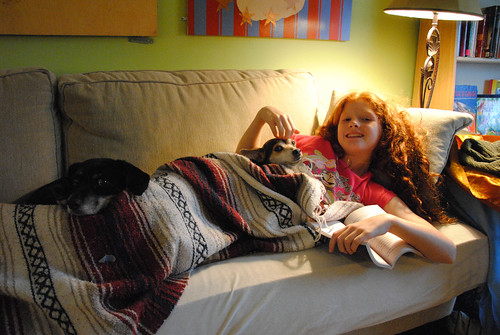
And here she is today, officially 11, blissed out with dogs and book. Yeah, she’s wearing the same pajamas she was wearing last night. I think that means she’s having a happy birthday.
Friday, Nov 15, 2013 | Kevin, Teaching, Work, Writing |
Lunch date with Kevin. We took the food back to his office because sometimes we like to do take-out. We don’t always eat at home. It’s not that we don’t have enough to eat home, just that sometimes we like to get take-out. I’m sorry. I can’t help myself. All I can do is move forward.
This was going to be a serious post about serious things, and what could be more serious than poetry? A friend in my poetry book club made copies for the group of an article in Harper’s Magazine, by Mark Edmundson, from July of this year called “Poetry Slam: Or, The decline of American verse.” Whilst waiting in my quiet office for students to come and talk to me, I read through it, underlying bits here and there and scribbling arguments in the margins. What spoke to me directly was his suggestion that it took three qualities to write “superb lyric poetry,” (and in my mind I couldn’t help but substitute “literature” for “lyric poetry”).
First, the writer must have something of a gift: she must be able to make music, command metaphors, compress senes, write melodiously when the situation demands and gratingly when need be. … [Second,] she must also have something to say. There must be some region of her experience that has transfixed her and that she feels compelled to put into words and illuminate. … [Third,] the poet still must add ambition. She must be willing to write for her readers. She must be willing to articulate the possibility that what is true for her is true for all.
He goes on to say that ambition might just as rightly be called courage. I like that view of ambition, frankly. Moreover, I like that view of what’s required to write well, and plan to offer it up to my students before the term ends (two more classes, my God, it’s not enough!). I think most of us who are drawn to writing come with the first talent: a facility for language. It’s why we’re drawn to writing. It may also be what stops many of us from moving on much further, and why agents and publishers tear their hair out trying to get young and talented writers to write about something, and not just beautifully or masterfully or lyrically. That’s why theme is so important. You have to have something to say. But I knew both of those things before reading this article; it’s his third point that is a new idea for me. And I like it, very much.
Ambition. Courage. Willingness to put one’s grand ideas on offer for public critique. The daring required to engage. No wonder a writer needs a hide tougher than a rhino’s. How does this willingness to stand out, to say something out loud, to take a stand, to care about something publicly, how does all of this fit with the necessity of being vulnerable? Because if you’re writing about something that compels you, something you care about, you can’t not be vulnerable. It’s what makes what you’re doing matter. We all know it, as readers.
One more thought from the article, on writers who teach.
Teaching poetry means talking about it in a highly self-conscious way. It means bringing the judging facility to the forefront. … But poems, especially vivid, uncanny poems — ones that bring stunningly unlike things together in stunningly just and illuminating ways — don’t come from anywhere close to the front part of the brain, the place where (let us say) judgment sits.
Now. I like to think that teaching creative writing this fall has forced me to distill and make useful much of the knowledge I’ve gained instinctively over my years of practice. I appreciate being forced to bring the judging facility to the forefront. But I’ve written next to nothing of creative content this fall, and though it wouldn’t be fair to blame this entirely on teaching, I do wonder if he’s got a point. By picking something apart, analyzing its pieces, well, the thing you’re dissecting is dead, isn’t it. It had better be, for the sake of all involved. When I’m writing, it’s like coping with a living thing that seems almost unrelated to the suggestions and guidelines I keep trying to share with my students. Sure, there are rules. There are excellent, tried-and-true ways of doing things. But I’m not thinking about them. I’m writing. I’ll save the analysis for later, for revision and editing.
For the record, I had the pork belly with the papaya salad, and Kevin had the fried chicken, and both were very very good. If you live in town, follow @westofseoul on Twitter for menu updates and to find out where the truck is parked from day to day.