
Move as a team
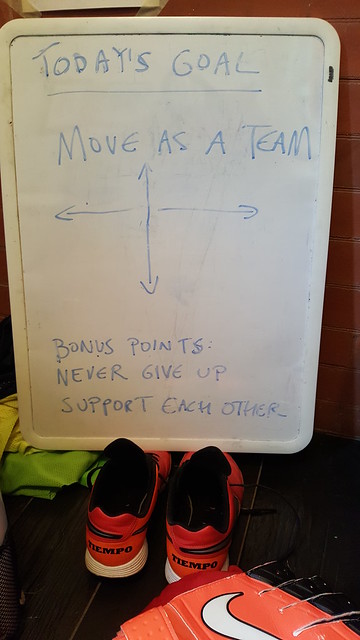
I want to tell you about why I love coaching soccer. But I’ll begin with why I find coaching so bloody hard.
My U13 Girls team spent the weekend at a tournament, our first competitive tournament ever. I’m pretty sure we came in last, though I haven’t checked the stats to confirm that. We mostly lost games.
I was pretty bummed out after yesterday’s games, both against teams I believed we could have beaten. Things looked messy on the field. The grass was long. Our passes died. We struggled. I felt like a coaching failure, to be frank. Maybe I’m not cut out to coach competitive soccer, I thought — I’m not willing to short-shift kids who are trying their best but may not be as skilled as other players, for example; I want to win as a team or lose as a team, not just play my 11 best and bench everyone else. Maybe, I thought, my priorities and instincts are all wrong for competitive play. But luckily Kevin (who was coaching our youngest’s team at the same tournament) stopped by for half a game, and he offered a different perspective on what he’d seen. Sure, the players looked shaggy, sure, we were losing, but the kids on the bench were having a hoot. Everyone was talking and laughing. And on the field, no one gave up, everyone tried their best right to the final whistle. We were a bit disconnected, that’s all.
I took his observation to heart. The players had supported each other well off the field, and their spirits had remained high. We had some good stuff to build on. Could we transfer that connection and communication onto the field? I boiled down my message and set today’s team goal: MOVE AS A TEAM.
What a difference! The progress we made from one day to the next was astonishing. The support and enthusiasm I’d seen on the bench translated onto the field. (It helped that the grass was shorter too).
But what makes me proudest is what I witnessed from my team during tough moments today. When a player was struggling between games, the whole team surrounded her to express how valuable she is to them (I did not cue them to do this — it was a spontaneous outpouring). (This player went on to have a strong game.) On the bench, I heard many kind and enthusiastic words spoken. A player who was upset about a call got a big calming hug from a teammate. We took some hard calls in our second game, but remained respectful to the end. What I witnessed throughout was a desire for mutual success that was completely contagious. Empathy in action.
So, we didn’t win. Not a single game.
But the players grew miles as a team, we scored some awesome goals, and we progressed and learned a lot in a compressed span of time. It’s exciting to imagine what these kids will be able to accomplish, together, during our summer season.
And that’s why I love coaching.
xo, Carrie
Anxiety is not a stranger
Anxiety is not a stranger in this house.
Lately, it’s been visiting me regularly. I suppose it could be grief. It could also be the loose, unfinished nature of the work I try to do. I’ve trained myself to be patient, to trust, to allow things to unfold in their time, not to push too hard, not to rush the process. But it’s taken training because I am actually someone who appreciates a firm decision. I like to make plans and execute them. In the fuzzy existence of being a writer, plans seem forever in flux, at the mercy of whim or economics or both. I like to take action, I like to make and to do. But there is only so much I can make or do or act upon in this fuzzy existence of being a writer. If that is where I exist. If that is what I am.
Anxiety is not a stranger.
I haven’t cartooned for two days. Soccer season is upon us, and most evenings are packed and late. I haven’t shifted my routine to cartoon at another time, or even to cartoon in another fashion — by speeding up the process, or limiting my expectations, drawing faster, messier, more piecemeal. I’d come to expect something of myself in my drawings, which had become less and less like cartoons. (That sentence is written deeply in the past tense, I realize.)
Anxiety preys on expectations.
I’ve been writing. Diligently. Every day. But the project is self-indulgent. It’s all about the writing itself, language, structure, stripped down sentences, ideas, and not at all about the plot. I’m torn: do I write to please myself, or do I write to please others? I think that by pleasing myself I will please almost no one else.
Anxiety is another word for doubt. Self-doubt.
It is rainy today. I haven’t sat outside on my stump. Sometimes, the meditation soothes me, especially listening to the birds and the wind in the trees. Being outdoors soothes me. Yesterday evening, we gathered to bury the ashes of my stepmother. The beauty of where we were came rushing up to meet us. A wide softly sloping ploughed field, a stand of thick green trees. As the brief ceremony beside the grave began, I saw a hawk holding over the field, riding the air currents in a soft sloping arc.
Later, we sang: I’ll fly away, oh glory, I’ll fly away. When I die, hallelujah by and by, I’ll fly away.
The comfort of the gospel songs felt like medicine, and made holy space, and we kept hearing a lone bird chirping in the trees overhead, as if it were joining our song.
Anxiety reminds me of all the smart, brave, kind things I should have done and did not do. Anxiety reminds me of all the wrong, stupid, foolish things I have done. Anxiety plants inertia.
Sometimes, it seems I am so closed, even to myself, that only writing will dig up what hurts. But I don’t know what hurts, if anything. I don’t know why a sensation of nervous energy froths beneath my ribs, no matter how I rise early to exercise it into submission. I wonder, what have I learned from sitting down to write this post? Perspective is a long game. Introspection comes up short.
xo, Carrie
The enchanted life
I’ve been wandering through a book kindly sent to me by my Canadian publisher, Anansi, called The Enchanted Life: Unlocking the Magic of the Everyday, by Sharon Blackie. One of her suggestions is to find a place to return to, daily if possible, outside somewhere. A place where you can sit and simply be, and observe the natural world around you.
At first, I fantasized about biking or walking to a nearby park to sit beside the little creek that runs through it. But after several days of not biking or walking to the park to do this, I recognized that, as is often the case, fantasy and reality are two divergent paths. I do love my fantastical life, as lived in my imagination, but down here in reality, setting into action even small life changes requires a different toolbox.
Let me back-track.
I’ve just finished a three-day workshop on instructional skills (teaching skills), which was intensive, immersive, challenging, and rewarding. My takeaway could apply to life as surely as it applies to lesson-planning: to meet your objective, you need to identify it clearly, and create a process that leads you toward it.
So if my objective or goal is to sit outside in nature, and specifically, to find a place that I can return to daily if possible, what process would lead me toward that goal?
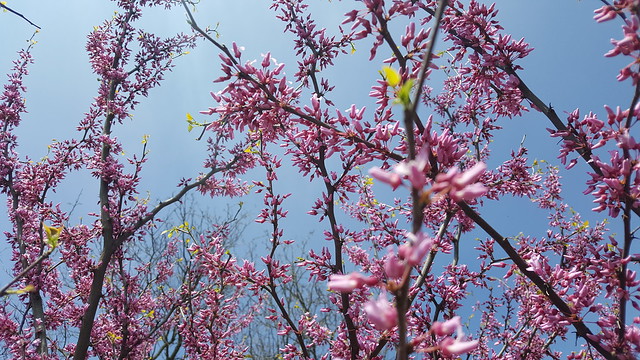
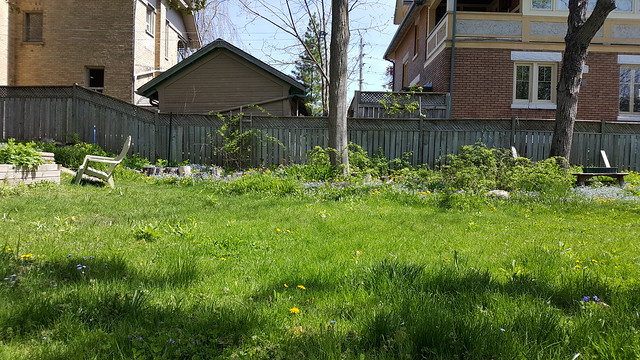
The answer turned out to be quite simple and straightforward, in this example. Best of all, it emerged naturally. After several days of not biking or walking to the park, one morning last week, I went to the back yard and sat down on a stump. Something must have called to me. I’d just walked my youngest up to meet his friends before school and instead of going into the house as usual, I went into the yard. The dog was with me, the air was sweet and temperate, and the buds were at their very newest, just barely emerging in a soft fuzz of yellow and green overhead. I took off my sandals and sat with bare feet in the grass. I closed my eyes. I listened to the birds and the traffic, and the jingle of the dog’s collar.
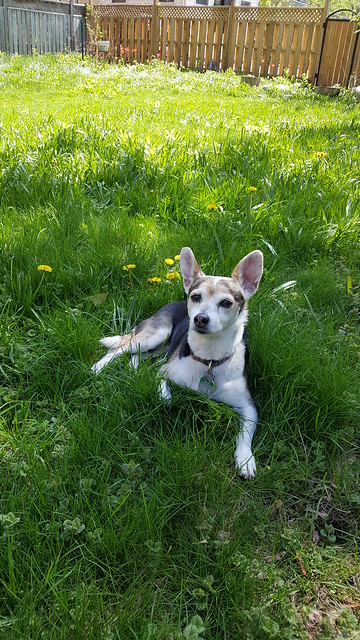
Aha. I’d found my spot, my place outside in nature to which I could return almost daily.
So I’ve been returning, not quite daily, but often enough to see already small changes in the grass and weeds and flowers. Today, I opened my eyes after a ten-minute meditation and thought, This is my work, too.
It might not look like work. And it might not register as work, because it is so full of pleasure. But I know that in order to write, to create, and yes, to teach, I must be contemplative. I must reflect. I must be quiet and listen and observe and watch, and be. In this quiet place — quiet on the inside, I mean — such wonderful fantastical ideas play across my mind. So much of my work happens in the imagination. So it is inevitable that some of these ideas will capture my interest enough to be named as possibilities to pursue here in the real world.
The process by which these possibilities are achieved seems to me both practical and mysterious. We are ever-changing, and our needs and interests are ever-shifting. The process by which we move toward goals, and the goals themselves, also change and shift, as they must; often unconsciously. I like when I can recognize what’s happening and celebrate it. I like when I can recognize what I want to have happen, and can tweak my daily routine to see it come about.
Exercise is one area where it’s been easy for me to set goals and achieve them. These goals have changed and continue to change, affected by injury, age, and intention. I am aware of both the changing nature of my goals, and of the changing processes required to meet them. Therefore, I feel ease and flexibility in my approach. Parenting is the same for me, somehow; ever-changing, but replete with clear objectives: to support and to love. The work might be hard, but the meaning of the work is clear.
Naming a goal is perhaps the most difficult step. Narrowing it down. Understanding it, understanding why you want this particular change, or outcome. Committing to it. Why do I want to sit quietly in nature as often as possible? Immediately, answers float to the surface. Because it calms me, because it connects me to something bigger than myself, because it clears my mind. It helps me to see the bigger picture. It feeds my spirit.
What if I were to name a different goal: to publish another novel. I’ll confess that my motives feel less clear in this example, even though the goal appears straightforward. Certainly, I understand the process. But the underlying objective, the greater why of it all, eludes and troubles me; no doubt it’s different now than it was when I first published. And so I wonder … Is it to further my professional career, both as a writer and a teacher? Is it to share knowledge in a creative way? To entertain an audience? Is it to earn a living? Is it to publicly express ideas important to me that can’t be otherwise expressed? Is it to garner attention and feed my ego? (How I fear this last intention, how I fear it might be a secret intention I hide even from myself.)
It seems to me that writing a novel expresses a different intention than publishing a novel. I’m at ease with the former; I’m uncomfortable with the latter.
Yet I want to name it as a goal. I want to publish another novel.
Because …
I want to learn from the process, again, how to go forth into the world carrying an idea, and how to share it openly, generously, without fear or shame. I want, also, to polish an idea until it becomes a publishable book, full of breathing characters that live beyond me.
Somehow, my body understands that sitting quietly on a stump is part of the process that will lead me there.
xo, Carrie
A pebble dropped on the path
Yesterday, at piano lessons, I wrote out some plans in an attempt to frame my goals in terms that were clear and measurable.
The template I followed was to name my identity or ROLE (or the identity or role that I wanted to claim), name GOALS for myself within that role, and name STRATEGIES or practical tasks I could do to achieve that goal, or some parts of that goal. The final piece of the puzzle was to BUILD ACCOUNTABILITY into my goals—in other words, involve others.
And I recognized that accountability is where the concept, and shape, of writing communities takes on real life and value.
This exercise helped me understand that my starting place should be with a role and goals; that’s the only way I’ll be able to understand what a writing community, and accountability, means to me, or what kinds of community feed and sustain the goals I’m setting for myself.
Here’s how the exercise looked on the page, roughly speaking.
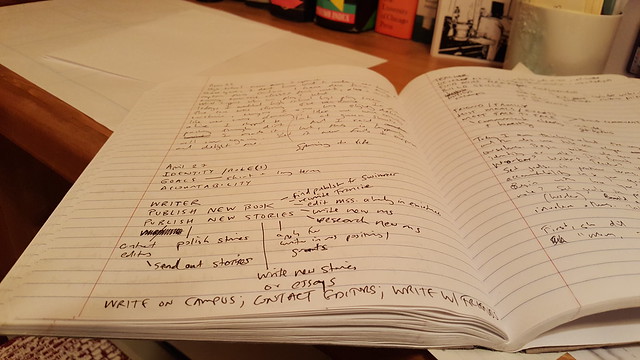
For role, I started with WRITER.
I named two goals: PUBLISH NEW BOOK + PUBLISH SHORT STORIES/ESSAYS IN (LITERARY) MAGAZINES
Then I named strategies for approaching each.
PUBLISH NEW BOOK: Find publisher for The Swimmer (new novel manuscript); rewrite/edit Francie (novel manuscript in progress); research toward new manuscript; write new manuscript (novel; as yet undefined)
PUBLISH SHORT STORIES/ESSAYS: Contact editors; send out stories; polish stories; maintain a spreadsheet to track submissions; write new stories and essays; apply for grants or writer-in-residence positions
I noticed that there were two distinct categories within each larger goal: 1. strategies for getting published and 2. strategies for writing new work
Ergo, a third goal: WRITE NEW WORK.
And, my strategies for the goal.
WRITE NEW WORK: write on campus (i.e. free from distraction); contact editors (pitch story ideas); write with friends.
What surprised and pleased me about this analysis is the level of accountability (aka writing communities) already built into existing strategies. (Maybe you would find the same?!) For example, built into “find a publisher” is accountability: my agent is involved in this process. I’m not tackling it alone. However, I’ve got little/no accountability built into rewrite/edit my work-in-progress. This is of my own doing: I’m extremely private and superstitious about work in progress. The closest I’ve come to building accountability into this stage is to write/rewrite in parallel with a friend; Kevin is also my first reader on all manuscripts, but he’s not an editor, and besides, our marriage depends on him NOT offering editorial advice on my rough drafts. So here is a gap where I can ask: do I need more accountability at this stage in the process? And my honest answer is: I don’t know. I’ve handled this stage on my own FOREVER, and with measurable success.
But I’m open to considering a change.
I would be even more open, in fact, to seeking earlier editorial feedback on the short stories and essays I’ve been writing. This could be a wise step to add before submitting to magazines. Food for thought.
To return to the goal of writing new work, I wonder, at present, what does “writing with friends” look like? What’s the picture it makes in my mind? Perhaps it means what I’m already doing: Parallel writing at a friend’s kitchen table. Perhaps it means another workshop with Lynda Barry (though not this summer, sadly). I also think it means writing along with my students in class. However, given my current daily commitments, I don’t think it means organizing or leading writing workshops or a larger writing group … but perhaps it will mean that someday.
If you feel inspired or intrigued, I hope you’ll give this exercise this a whirl! Name your role, your goals, your strategies, and the ways in which you plan to build in accountability. How will you measure success?
I will measure success in BIG tangible goals, but also in TINY steps along the way: every time I write something new, including this post, I’ve met a goal. I’ve dropped a pebble on the path. Do cartoons count? YES! Private journal rants? YES! Letters to the editor? PROBABLY, HEY WHY NOT!
Yesterday, I also named and analyzed two other roles: TEACHER and FRIEND/FAMILY MEMBER. I won’t go into detail here. But we all have more than one role, so it’s worth considering how these roles overlap and interplay, and limit or feed each other.
Naming your ROLE will change how you frame your approach. How you see yourself is key, it’s critical, it’s the MOST IMPORTANT PART of this whole exercise. It’s also worth remembering that this isn’t a one-time assessment, but needs to be examined and altered as we continue to grow and change, as new roles are thrust on us, often out of our control, or new circumstances bring loss. Personally, I loved doing this exercise. Maybe you will find it clarifying too?
xo, Carrie
What would a writing community look like?
What would a writing community look like?
Okay, here’s the thing: I don’t know. But I have a few ideas. Could you please add yours?
A small workshop group that meets regularly to read and critique each other’s writing. In the classroom, I create small groups who read each other’s rough drafts, prepare comments, and present their editorial feedback in person, face to face. Because each student has submitted work for scrutiny, they recognize each other’s vulnerability in their own. Often students will tell me that they were paralyzed with anxiety before their first workshop, while afterward they feel energized, surprised to discover that they actually enjoyed the experience.
A writing partner. I meet with a friend on occasion to write at her kitchen table, while she does the same. When we’re finished, we read each other what we’ve written (or show each other, if it involves cartoons, which it might). I like working while someone else is working too — working in parallel. But best of all, I like the immediacy of sharing what I’ve just made, which is too fresh and new to be anything but marvellous. And because what we’ve made is so fresh and new and marvellous, there is no critique involved. We just enjoy, and let the thing be what it is. I really like that.
An online group or FB page. When I was running the template for my creativity course, I made a FB page so that participants could share the work they were doing. But not everyone used it. I’ve noticed this with other online FB groups to which I belong … not everyone feels comfortable posting in a semi-public forum to semi-strangers.
A fellow traveller. Occasionally, I meet to talk shop with a local writing friend. We’ve never shared our works-in-progress with each other; instead, we give each other the support and encouragement of fellow travellers on an often bumpy road. There’s a lot we don’t need to explain to each other, and that’s a relief. Over the years, I’ve also reached out to more experienced writers to ask for advice, and have received kind and generous responses.
A blog, like this one. You’re out there. I love hearing from you, because I confess the conversation can feel one-sided at times. Maybe that’s why I forget that my blog has offered me terrific literary connections over the years — almost a decade’s worth of connections, in fact.
Literary magazines. I drop in to The New Quarterly’s office on campus to say hello from time to time. I also find that just reading other writers’ work gives me a sense of connection. Sometimes I just have to respond, often on my blog, though occasionally I’ve written a letter to a writer I don’t know to express appreciation.
Other creative writing teachers. I have not accessed this community at all. There are only a couple of professors who teach creative writing at UW and I’ve utterly failed to reach out to them.
Something I notice as I gather up these ideas. My ideal community is give-and-take. It is non-hierarchical; everyone involved is a participant whose voice has equal value. It feels really good — like friendship does. It’s a conversation. It’s about sharing.
And that’s it, off the top of my head.
Please share your thoughts and ideas with me. Are you a writer seeking community? Maybe you’ve established community already? Maybe you’re not a writer, but you can pinpoint what connections have fed your work and life? What does community mean to you, in practice, not just in theory?
xo, Carrie