
Lifelines in a time of social distancing
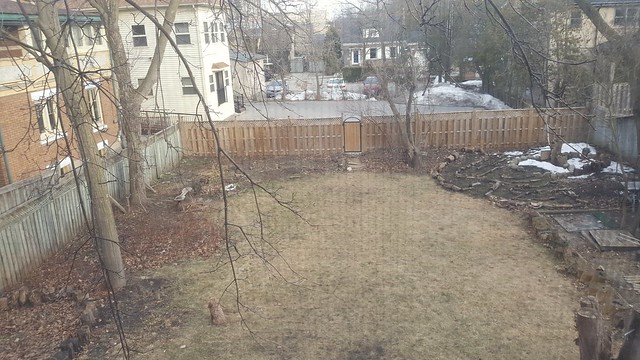
spot the dog
While in this time of strangeness, isolation, social distancing, and hunkering down waiting, waiting, I’m trying to sort out how to get through each day intact, as whole as possible. I’ve been informed by my children that I must must must limit my intake of coronavirus news; and they’re right; and I’m trying.
But I’ve felt distracted, full of questions about what’s right to do, what’s wrong to do, and whether the decisions I’m making are harming or helping our collective cause, and the individual lives in our immediate family. Last week was a whirl of decision-making, including cancelling The X Page’s remaining workshop sessions and the performance, while making plans for publishing the stories. There was a constantly changing flow of information from public health officials and various levels of government. We found out on Thursday that schools would be closed at least till early April; all soccer cancelled too; just last night, it was recommended that all bars and restaurants in Ontario close or move to take-out or delivery only.
And I’m pretty sure the phrase “social distancing” entered my vocabulary less than a week ago, but now we all know it, and we’re trying to practice it, and to understand why, and to explain it to those people in our lives who don’t see what the point is, exactly.
It’s been a bit too much, while also being not nearly enough. Fears: diffuse; particular; unseen.
And now the late-night talk shows have gone off the air, just when I most need their mixture of news, satire, reassurance and comedy!
So here’s what I’m doing to stay afloat, mentally. I’m not saying it’s all working for me, just that these are the lifelines I’m grabbing hold of today, and did yesterday, and in all likelihood will again tomorrow.
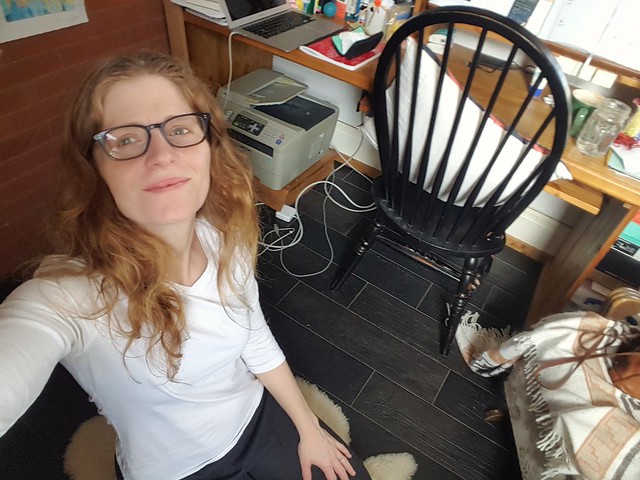
Meditation. I have a kneeling bench that my dad made for me a few years ago, which is comfortable to sit on yet prevents me from falling asleep. (An habitual problem.) I recommend The New York Times’s guide to meditation, if you’re just getting started. There are also lots of apps to try out (I like Headspace; it’s not free, but you might be able to access a free trial to see if you like it).
Over on Instagram, Elizabeth Gilbert posted an easy-to-do meditation you can bring into any moment of your day, taking notice of a descending list of things all around you. This is my scribbled version, below, and it’s helped me at least once today when I was waiting to wash my hands, as there was a line-up for the bathroom, and I was feeling irrationally irritated about the waiting:

Podcasts. Below are a few. If you have a favourite, could you please leave your suggestions in the comments? I need more!
The Daily from The New York Times, a podcast that lasts just about long enough for a quick morning run (and, yes, it has been a lot about the coronavirus lately, but the info is solid and trustworthy, not inflammatory).
On Being, a podcast that I sometimes have patience for and sometimes not (it’s dense with spirituality).
Poetry Unbound, a podcast in which a poem is read, discussed, then read again. Episodes are about 11 minutes, the perfect amount of time to sit in quiet mediation.
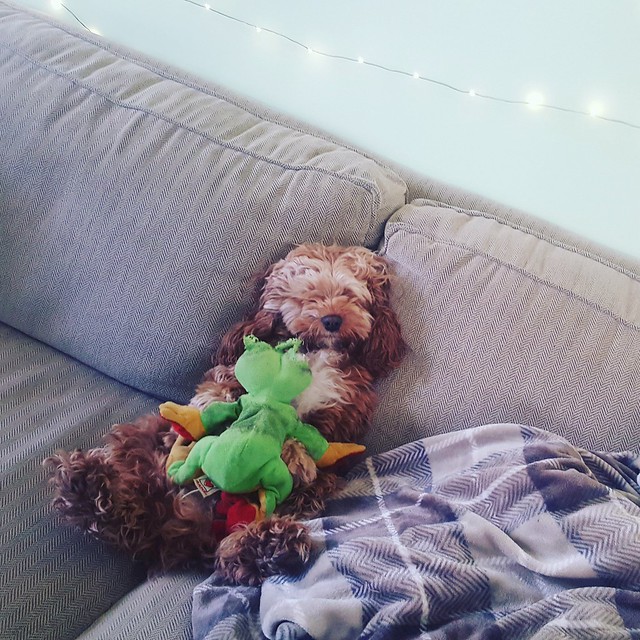
Dog walks with Kevin and Rose have also been a balm. However, I cancelled a walk with a friend this morning, perhaps an over-reaction? I just don’t know. Does anyone?
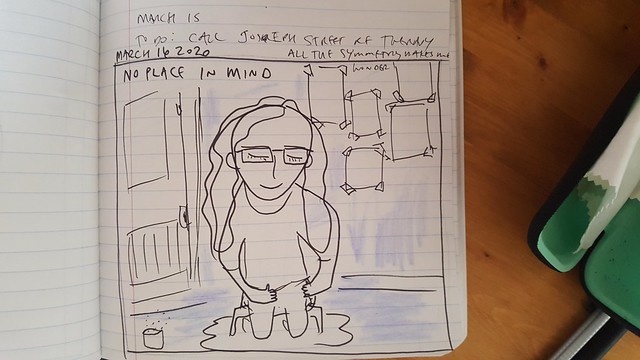
Finally, here’s one last lifeline, which I’m hoping to share with my writing friends: daily drawing/writing in my notebook. I haven’t done this yet today, but it’s on my to-do list. (That’s yesterday’s cartoon, above.)
Follow this recipe for 10 minutes of bliss: Put on a song at random from my Lynda Barry playlist on Spotify (which has 64 followers at present!); draw a self-portrait to that song; then write for 3 minutes, answering the question: What’s on Your Mind? Or Why Did This Song Choose You Today?
xo, Carrie
To sit with someone I love and just be

I’ve been thinking about how hard it is to let others be. How often when I express anger or frustration it’s about a situation over which I have no control. And my anger and frustration is not about the situation, exactly, but about my lack of control.
Knowing that, recognizing it, makes it easier to let go.
You are not responsible for fixing everything.
Saying these words to myself brings a feeling of great calm. I allow myself to let go of even those I love most, of expectations, of desire, of the need to protect, to keep safe, to confirm, to hold, to beg for proof of. I let it be. Whatever it is. I don’t necessarily want to let it be, but I let it be anyway.
In this way, I am able to look directly at what is before me and see it clearly. We find ourselves, often, every day at least, in situations over which we have no control. This is challenging to accept. Challenging to understand. What makes it even more challenging, maybe, is that we live in a culture that prizes control, that sells us a version of reality in which whoever wants it most wins, that tells us that we can improve exponentially if we try and that if we don’t, we aren’t trying hard enough. That a winner wins and a loser loses and those are the only two options. That we just have to set our minds to it. Decide to do it. You can do anything, you just need to work harder, yell louder, demand more, bend the rules if you must, take what you deserve!
No.
No, and no, and no.

Clarity of vision recognizes all that is not ours to claim, to own, to change, to bully into being. And that’s pretty much everything. Anything I bring forth is a gift. It belongs to grace, not to me.
The way that I see it is this: with acceptance comes clarity. When I accept that I inhabit this earthly body and mind for a fraction of time, when I understand how small I am, how easy, then, it is to accept and love not only myself, my tiny precious singular brief flawed radiant self, but also to love and accept all that swims beyond me, beyond my control.
To be aware that I am, in concert and with all others who are, too, who will be, and who were.
Does this mean I will just lie back and gaze at the stars and let life wash over me? Actually, that sounds lovely. Maybe I’ll achieve that level of inner calm and peace someday. Right now, it means that I’m still wrestling with the urge to strive for better and more. But also that I’m finding it ever and ever easier to embrace and celebrate the joy of process. Of being. Of simply being, here, now.

If my calling is to sit with someone I love more than life itself and simply be, if that’s what I’m called to do, that is the highest calling I can imagine.
I also love making things. I love expressing what I’m discovering by making things.
When I write stories, I sit with my characters. I listen to what they’re telling me, I record what I discover. It’s the most joyful work. I feel nothing but wonder that I get to do this work, because it’s wonder I feel as I do it.

I’ve received good news in the past week, news that offers support and external encouragement to keep doing this work. This news fills me with wonder. I cherish it, thank it and welcome it, even while I know that it isn’t of me, it isn’t me. In the presence or absence of news, I continue to do as I’m called to do. I sit with those I love more than life itself and simply be. Thank you, thank you, benevolence and grace.
xo, Carrie
Best; worst

Celebration; grief. This is me, right now.
How to hold two extreme emotional states within one mind and body, all at once? I can’t do it. Instead, I seem to have landed somewhere in the middle, in flatness that speaks of protection, flatness that is an antidote to fear, but also to joy.
I can’t reveal more, and recognize that it may seem disingenuous or deceptive to hint at drama without offering details. I apologize. I don’t mean to be locked down, or to seem vague or untruthful; but also, this is too much of me not to speak of it at all. The depth of grief involves a personal situation, close to my heart, and I’m unlikely ever to reveal details outside my very closest circle. The height that deserves celebration involves my professional life; and this, I think, will be revealed more widely in due course, just not yet.

To say that I am distracted would be an understatement.
To say that I am challenged is accurate, but not strong enough.
To say I’m hanging in here, staying focused on what matters, jettisoning temporarily all that can be let go, surviving, feeding myself, breathing, reaching out to ask for help as needed, is true, all true.
I look forward to sharing my good news, in good time.
xo, Carrie
How a dream is made manifest: no map needed

photo by Sam Trieu
We are at the halfway mark of season two of The X Page Workshop.
And I’m reflecting on how things, especially ineffable things, are made manifest.
Four years ago in April, I travelled to France to participate in an interdisciplinary arts festival, where I collaborated on a performance project with Kelly Riviere, a translator and actress, who has since become a playwright. We loved working together. For me, it awakened a hunger for more creative collaboration; but when I returned to Canada, I couldn’t figure out immediately how to connect my solitary writing work with the work of other artists in other disciplines.
I believe that The X Page workshop is an answer to the hunger I first recognized while working with Kelly in France. My hunger wasn’t exactly a desire to do theatre. Or to write plays. Or to perform. I think what I really wanted was to be a part of something bigger than myself. I wanted to know how other artists and creators work, and I wanted to work in collaboration with them.

photo by Sam Trieu
In essence, I believe the existence of The X Page is an example of how something as ineffable as a wish or a dream, or even an emotion, can be made manifest, can become something that takes form, that exists, that is in the world. There’s no map for doing this. In truth, there’s not even a destination. When I think of the disparate threads of my own experience that inform this project, it’s almost comical. You couldn’t replicate this as a plan! But it’s not about making a plan, and that’s what I’m recognizing and, honestly, what I’m most in awe of. How we make the things we make without knowing what we’re making. I LOVE that.
As the workshop took incipient form, I remember my sense of purpose as I pulled friends, acquaintances, and people I’d only just met into the project, seeking advice, partnership, sponsorship, support, reaching out, calling people (and I hate talking on the phone!), emailing, meeting in person, fundraising, grant-writing, making decisions, making mistakes, learning from my mistakes. My energy was almost obsessive in nature. I didn’t know if the idea would work, I didn’t know what we would make in the end, and I didn’t know if the project would be sustainable. I just knew we had to do it.
And here we are, in season two.

photo by Sam Trieu
My point is that we are all, at all times, in the midst of doing things that will make manifest other things.
To this point, I’ve noticed a tendency to self-sabotage, to downplay success and magnify failure. I do this privately, and I do it publicly.
Truth: I don’t like this quality in myself.
Also truth: My absolute greatest fear is being blinded by pride and ego, and becoming a giant asshole.
And it’s become clear to me that self-sabotage in no way prevents that fear from coming true. Nope. Instead, it hampers my ability to bring into being other projects, as or more ambitious than this one. And that is not a manifestation I’m interested in nurturing.
My goal this year is to notice a) what is being made manifest and b) how I respond to what is being made manifest. Specifically: What I’m bringing into the world. The things I dislike, as well the things I love. And I don’t think that self-sabotage is the way to bring the things I care about into the world. Self-critique, accepting mistakes, taking responsibility, forgiving myself, learning, changing, observing, seeking counsel, and recognizing what’s not mine to bear — all of those are excellent qualities that I hope to claim for myself; and none involve self-sabotage.

I’ve brought some things into the world that I love so much!
My children, but also my relationships with my children, which are ever-shifting, growing, changing.
My collaborative connections with people I admire, but also the work that goes into developing, maintaining, and cherishing these relationships.
My friendships, but also the nurturing and care both given and received within these relationships.
And, of course, my writing, but also my relationship to my writing, the way I’m learning to value it, prioritize it, make space for it, and celebrate the moments that I decide are worth celebrating.
- A new story in Room magazine.
- A successful grant application for a work-in-progress. (With thanks to ECW Press for their recommendation.)
Onward.
xo, Carrie
#writinglife #confessions
I often set myself a project that spans the full year. This year, I’m considering chronicling my daily writing life, but I haven’t figured out how best to frame it. Should I keep it short, as in a daily tweet? Today’s would read something like …
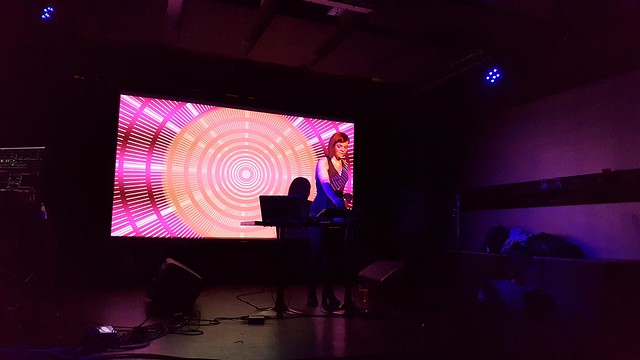
Tired, late night @ Edna King’s show in Guelph. Writing group cancelled this AM; I miss them, we haven’t met in a month. Fell asleep on couch reading Song of Achilles. Drew self-portrait, wrote What’s on Your Mind + blog post. Next, continue revising new novel. #writinglife
But in all honesty, one day is going to look a lot like the next, and a tweet has limited space for the animating details.

The long-form version of today’s chronicle goes something like this …
Today, I’ve been staggering around like a zombie after getting 4 hours of sleep last night; not conducive to clear-headed composition. I went to my sister’s show last night, an intense experience (EDM) that sent me into a form of dance/trance, which I spent thinking about my character, Bess, from the new novel I’m writing, set in the 16th century. My eyes were closed much of the time, and I kept gazing into my mind’s eye for Bess, trying to see what she was seeing: the image of darkness and enclosure, the image of an open night sky.
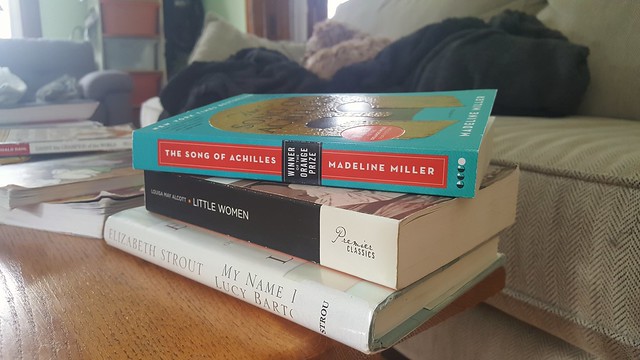
I’m reading Song of Achilles, historical fiction, and this morning, I fell asleep within ten minutes of picking up the book.
I was disappointed that my writing group meeting was cancelled again, as we’ve struggled to find time to meet this year. Our aspiration is to meet every other week, but we’ve only gotten together once in 2020 due to illness, travel, and other meetings and complications. I look forward to those mornings so much. It’s one of the only spaces where I have neither need nor compulsion to explain anything about #writinglife. We’re all in the industry, struggling, staying hopeful, doing the work, and encouraging and believing in each other. I’m missing that medicine.
While walking the dog, I thought about this blog post. I thought: what if I were honest, publicly, about this path I’m on? I’m giving myself a year; one year, in which to research and write with full commitment. January was blissful. I spent many hours of many days simply sitting and writing. It was blissful and it was filled with anxiety. I also sent out six grant applications at the beginning of last month, and four were rejected earlier this week. Truth! Ugh! Painful! Shameful! Humiliating!
But, on the other hand, also in January, I learned that my short story, “16-Century Girl,” published last winter by The New Quarterly, had been submitted for a National Magazine Award.
And, I filled another notebook! I’m working on two separate and very different fiction projects. One is historical fiction, and I’m close to completing a first draft (“close to completing” could mean 6 weeks or 6 months, or even longer). The other project is very new, and I’ve only been working on it for a few months; too new to discuss, though it does have a name: I’m calling it Two Women. I work on Two Women by hand, composing with pen and paper, and I’ve filled three notebooks so far. I’m working on Bess in Scrivener, and I’m composing it as if amassing a great heap of loose scraps, writing forward until I reach the end.
This week, I reached an end, of sorts, for Bess, and started back at the beginning, preparing for a slow, careful, thorough revision by setting up the Scrivener file beside a Word doc with the same text, and going through line by line, scene by scene, deleting, rewriting, composing new scenes. Don’t ask me why I’m taking this route. I’m writing this novel completely on gut instinct and dream-like visualization. The manuscript is short but dense. I’m curious to see whether it wants to be fleshed out further, or whether its structure and tone demands that it remain short and dense.

Also while walking the dog, I had a thought about the auto-fiction short story collection I’ve mostly completed; could each story be punctuated by one of my 4-panel cartoons, as a way of creating a breath between the stories, which are heavy and kind of demanding, and I don’t think anyone would want to sit down and read them all at once? Something needs to ease the transition between stories; maybe the meditative cartoons I’ve been drawing would fit there?
So that’s today, as of 2:03PM. As soon as I press publish on this blog post (if I do indeed decide to publish it), I’m setting up Bess in the side-by-side format, to work through whatever scene comes next. I have to pick up kids at 2:45, but I can return home and keep working on Bess till it’s time to make supper.

The other writing I’ve done today was in my notebook. As is my habit, I answered the question: What’s On Your Mind? as a means of dumping out surface anxieties before getting to work. I also drew a self-portrait — dancing last night — to Lizzo’s “Juice”.
Lastly, I will report that I continue to wait, with seemingly perpetual hope, patience, and possibly delusional optimism, to hear from my agent about two completed manuscripts (one for children, one for adults). Would you like to wait with me? We could be here awhile. But in the meantime, while I wait, I’ll be writing and dreaming and writing and dreaming, in full-on bliss, stealth-attacked by anxieties, and holding dear to prayers and visions. Truth.
#writinglife
xo, Carrie